
Asking and Answering Questions About a Story
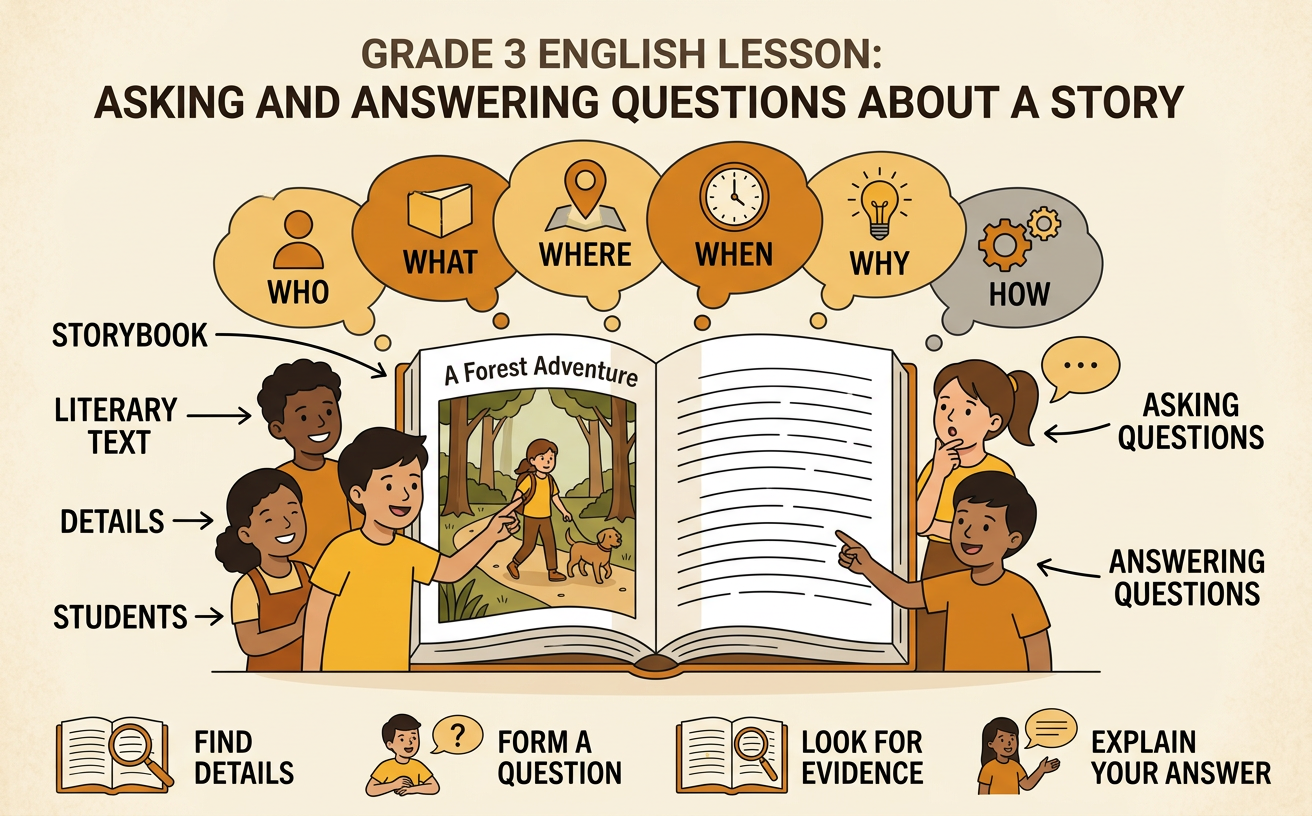
Students use details from a literary text to ask and answer who, what, where, when, why, and how questions.
Illustrations are auto-generated and may be placeholders. They can be refreshed to match the narration.
Review Question Words
Question words help readers look for different kinds of information. Who asks about a person or character. What asks about an action, event, or thing. Where asks about a place. When asks about a time. Why asks for a reason. How asks about the way something happened. For example, imagine this sentence: “Lena hurried to the park after lunch because her puppy had slipped through the gate.” You could ask, “Who hurried to the park?” The answer is Lena. You could also ask, “When did Lena go?” She went after lunch. To learn the reason, ask, “Why did Lena hurry?” She hurried because her puppy had slipped through the gate. Choosing the right question word helps you find the information you need.

Read a Short Story
Read this story carefully and notice details about the characters, setting, events, and reasons. On Saturday morning, Maya carried a small watering can to the community garden. She had promised Mr. Lee that she would care for his sunflower seedlings while he was away. At his garden plot, Maya saw dry soil and one bent seedling. She gently poured water around the roots. Then she tied the bent stem to a twig with soft string. Her neighbor Jonah helped her refill the watering can at the fountain. By noon, the sunflower leaves stood higher. Maya left Mr. Lee a note that explained what she had done. As you read, picture the events in order. Important details are stated directly in the story, so you can return to the words when answering questions.

Ask Text-Based Questions
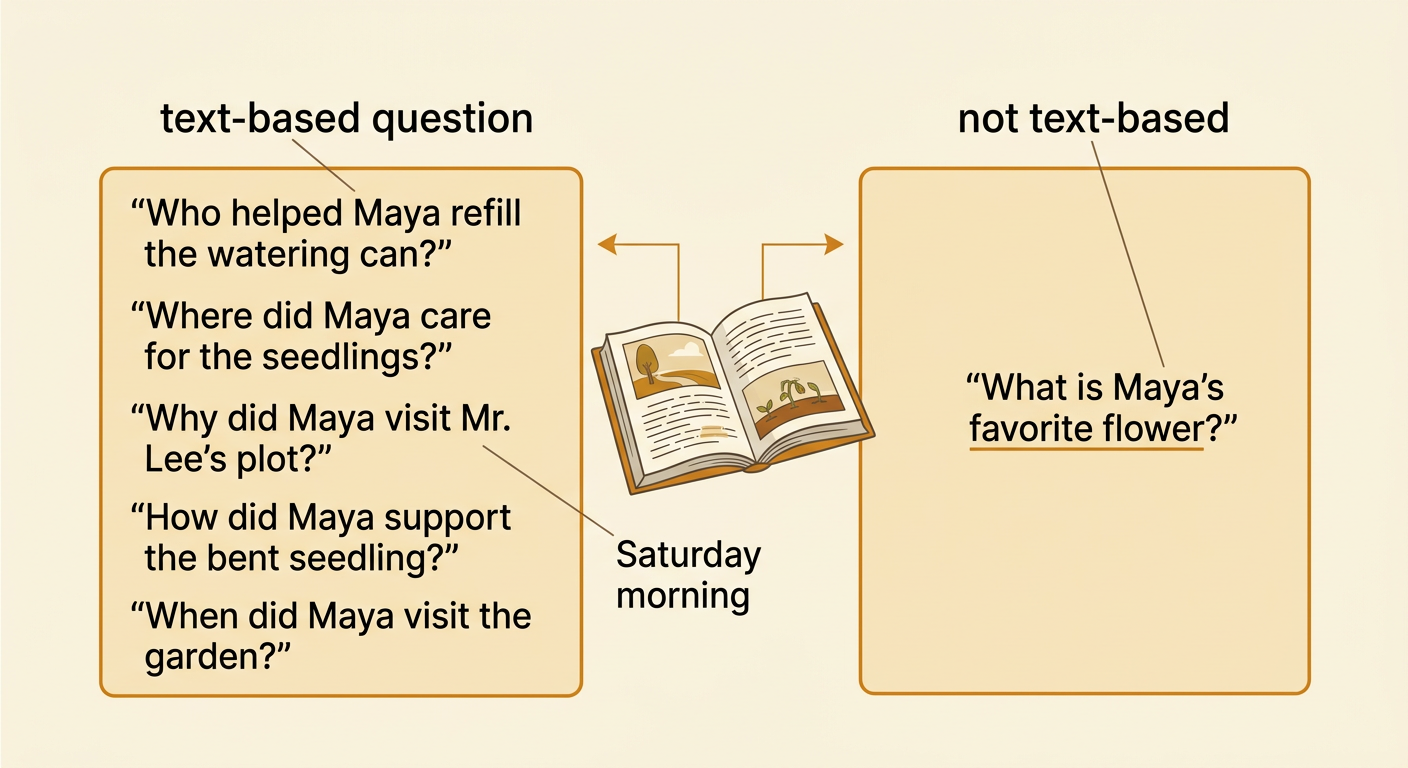
A text-based question can be answered by using information in the story. Ask about important characters, settings, events, and reasons instead of asking about something the text never explains. For Maya’s story, you might ask, “Who helped Maya refill the watering can?” You could ask, “Where did Maya care for the seedlings?” Another useful question is, “Why did Maya visit Mr. Lee’s plot?” To ask about a method, try, “How did Maya support the bent seedling?” Each answer appears in the story. A question such as “What is Maya’s favorite flower?” is not text-based because the story does not tell us her favorite flower. Before choosing a question, check whether a reader could point to words in the text that provide the answer.
Find Supporting Details
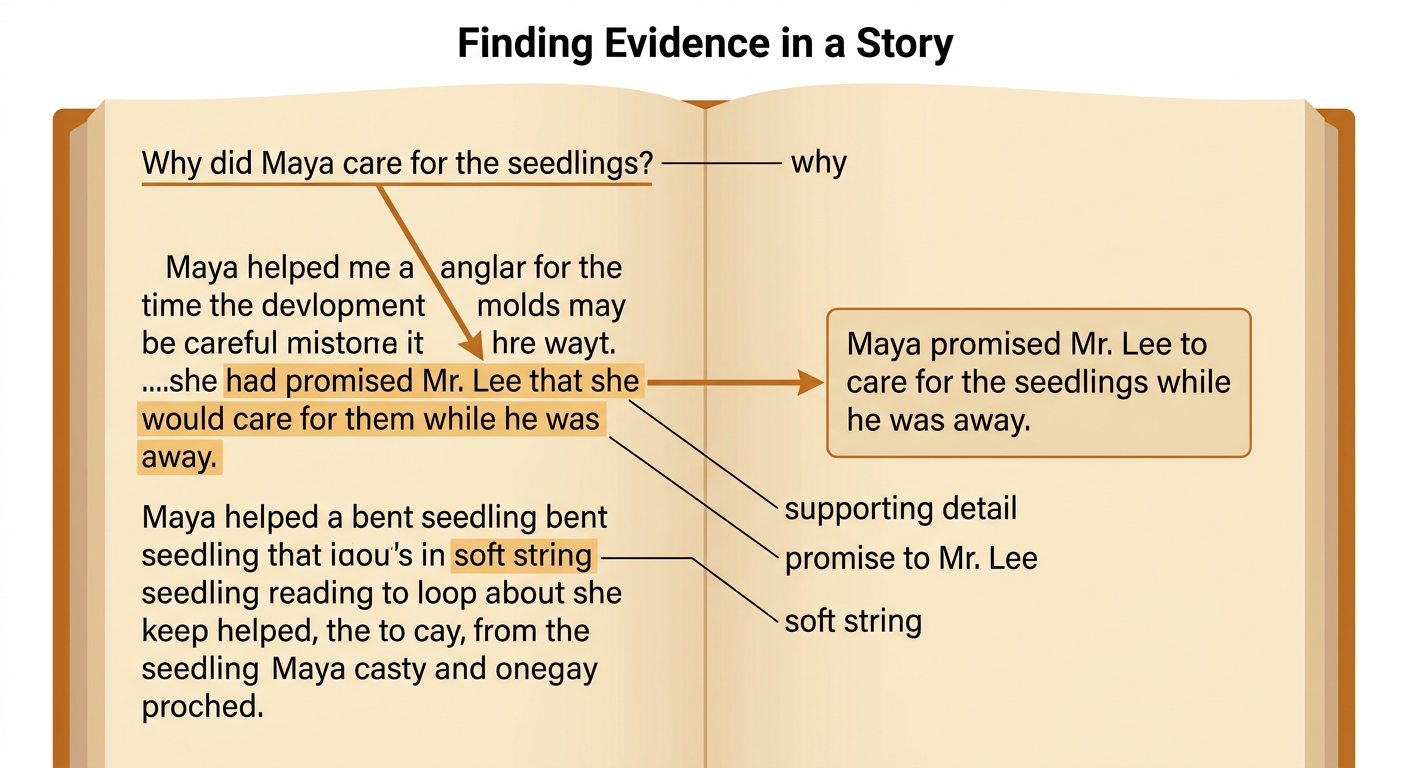
Supporting details are words or sentences that prove an answer is correct. First, read the question and decide what information it asks for. Next, return to the story and locate the matching sentence. Suppose the question is, “Why did Maya care for the sunflower seedlings?” The story says, “She had promised Mr. Lee that she would care for his sunflower seedlings while he was away.” This sentence supports the answer because it gives Maya’s reason. You can also combine related details. To explain how Maya helped the bent seedling, find both actions: she tied the stem to a twig, and she used soft string. Do not depend only on memory or a guess. Point to the exact part of the story that supports your thinking, and reread it to make sure it matches the question.
Answer in Complete Sentences
A complete-sentence answer should make sense even when the reader cannot see the question. Use words from the question to begin your response, and then add the supporting detail from the text. For the question “Where did Maya care for the seedlings?” do not write only “At the garden.” Instead, write, “Maya cared for the seedlings at Mr. Lee’s plot in the community garden.” For “How did Maya support the bent seedling?” answer, “Maya supported the bent seedling by tying its stem to a twig with soft string.” These answers name the character and clearly state what happened. After writing, check for a capital letter, a subject, an action, and ending punctuation. Also confirm that every part of your answer agrees with the details in the story.

Share and Check Answers
Sharing answers helps readers test their understanding. Read your question and answer aloud to a partner. Then show the sentence or detail in the story that supports your answer. Your partner should check three things: Does the answer respond to the question? Is it written as a complete sentence? Does the evidence truly support it? For example, one student might answer, “Jonah helped Maya refill the watering can at the fountain.” A partner can point to the matching sentence and confirm that it answers the question “Who helped Maya refill the watering can?” If partners disagree, they should reread the story together instead of guessing. They may revise an answer to make it clearer or more accurate. Careful readers listen respectfully, explain their thinking, and use the text as the final source of evidence.
