
Atomic Structure and Periodic Trends
Students connect electron configurations and valence electrons to recurring trends in atomic radius, ionization energy, electronegativity, and chemical behavior.
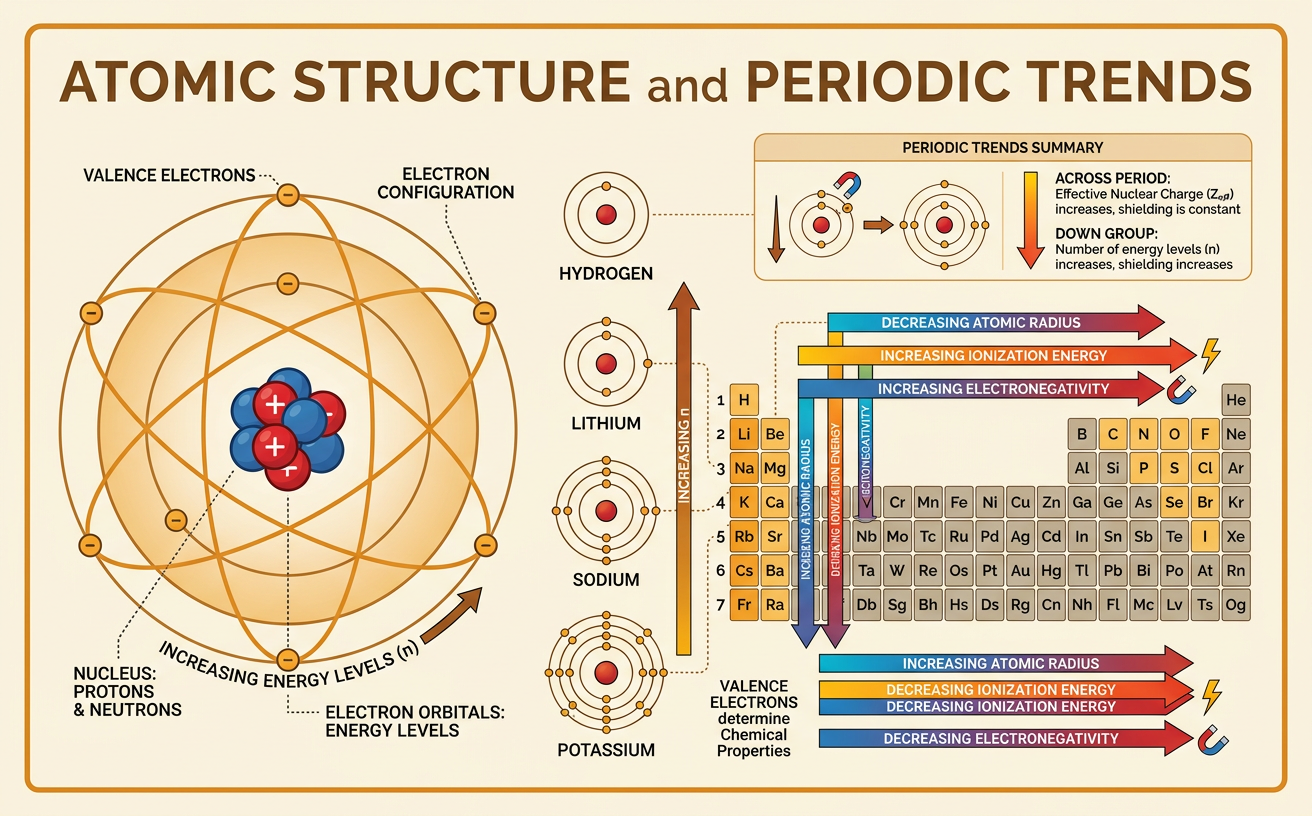
Illustrations are auto-generated and may be placeholders. They can be refreshed to match the narration.
Subatomic Particles
Atoms contain protons, neutrons, and electrons. Protons have a positive charge, neutrons have no charge, and electrons have a negative charge. Nearly all atomic mass is concentrated in the nucleus, which contains protons and neutrons. Electrons occupy regions of space called orbitals around the nucleus. An element’s atomic number equals its number of protons and determines its identity. In a neutral atom, the numbers of protons and electrons are equal. Ions form when atoms gain or lose electrons, while isotopes form when atoms of the same element have different numbers of neutrons. For example, a neutral sodium-23 atom has 11 protons, 12 neutrons, and 11 electrons. A sodium ion, Na+, still has 11 protons but has lost one electron, leaving 10 electrons and a net positive charge.
Electron Energy Levels
Electrons occupy quantized energy levels, meaning only certain energies are allowed. Within each principal energy level are sublevels labeled s, p, d, and f, and each sublevel contains orbitals. Every orbital can hold a maximum of two electrons with opposite spins. Electrons generally fill lower-energy orbitals before higher-energy orbitals, following the Aufbau principle, while also following the Pauli exclusion principle and Hund’s rule. Electron configurations describe this arrangement. Chlorine, with atomic number 17, has the ground-state configuration 1s² 2s² 2p⁶ 3s² 3p⁵. Its electrons occupy three principal energy levels, and its highest occupied level is n = 3. Because electron energy and distance from the nucleus generally increase across occupied principal levels, chlorine’s outer electrons are more shielded from the nucleus than its inner electrons.
Valence Electrons
Valence electrons are the electrons in an atom’s outermost occupied energy level and are most directly involved in bonding and chemical reactions. For main-group elements, the periodic table group reveals the number of valence electrons: Group 1 atoms have one, Group 2 atoms have two, and Groups 13 through 18 have three through eight, with helium as an exception because it has two. Atoms often gain, lose, or share electrons to reach a more stable outer-level arrangement. Sodium has the configuration [Ne]3s¹, so it commonly loses one valence electron and forms Na+. Chlorine has [Ne]3s²3p⁵, so it commonly gains one electron and forms Cl−. The attraction between these oppositely charged ions produces ionic sodium chloride. Transition-metal valence patterns are less simple because both s and d electrons may participate in bonding.
Periodic Table Patterns
Periodic trends result from repeating valence-electron configurations, nuclear charge, and electron shielding. Across a period from left to right, atomic radius generally decreases because the nucleus gains protons while added electrons enter the same principal energy level, increasing effective nuclear charge. Over the same direction, first ionization energy and electronegativity generally increase because electrons are held more strongly. Down a group, atomic radius increases as additional occupied energy levels are added. Ionization energy and electronegativity generally decrease because valence electrons are farther from the nucleus and more shielded by inner electrons. For example, sodium and chlorine are both in Period 3, but chlorine has a smaller atomic radius, higher first ionization energy, and higher electronegativity than sodium. Noble gases usually lack assigned electronegativity values on common classroom scales because they rarely form bonds.
Predicting Element Properties
The periodic table can be used as a model to predict an element’s size, attraction for electrons, likely ion charge, and chemical behavior. First locate the element’s group and period. The group suggests its valence-electron pattern, while the period identifies its highest occupied principal energy level. Then apply periodic trends to compare it with nearby elements. Magnesium is in Group 2 and has the configuration [Ne]3s², so it commonly loses two electrons to form Mg²+. Oxygen is in Group 16 and has six valence electrons, so it commonly gains two electrons to form O²−. Charge balance predicts the ionic formula MgO. The trend model also predicts that magnesium has a larger atomic radius and lower electronegativity than oxygen. Similarly, calcium should be larger and have a lower first ionization energy than magnesium because calcium is below magnesium in Group 2.