
Atoms, Elements, and the Periodic Table
Students examine atomic structure, relate elements to their numbers of protons, and use periodic table patterns to predict basic properties.

Illustrations are auto-generated and may be placeholders. They can be refreshed to match the narration.
Inside the Atom
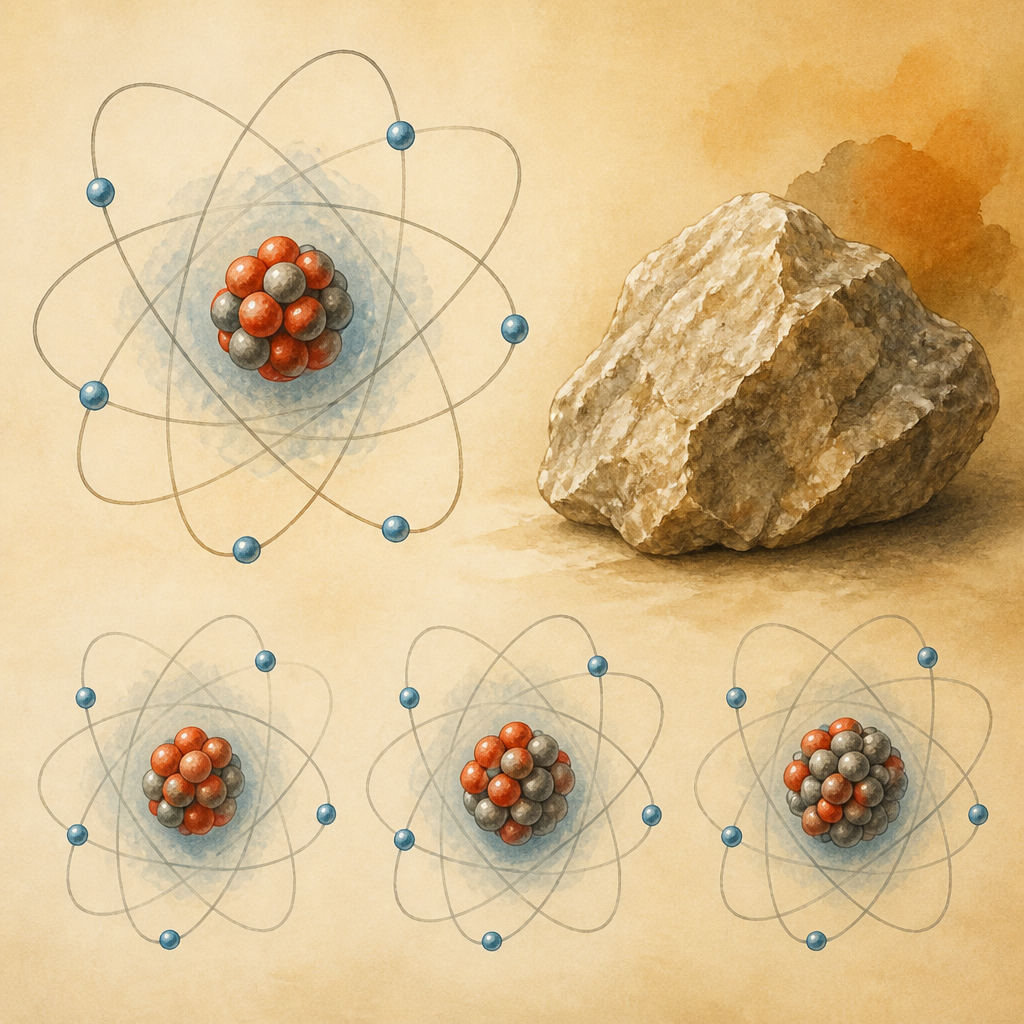
All ordinary matter is made of atoms. An atom contains a tiny, dense nucleus surrounded by electrons. The nucleus holds positively charged protons and neutral neutrons, while negatively charged electrons occupy the space around it. Most of an atom is empty space, but the nucleus contains almost all its mass. In a neutral atom, the number of protons equals the number of electrons, so the positive and negative charges balance. For example, a neutral carbon atom has six protons and six electrons. Models often make the nucleus and electrons look much larger than they really are so their arrangement can be seen. These models are useful representations, but they are not exact pictures of atoms.

Atomic Number, Mass, and Isotopes
Each element is identified by its atomic number, which equals the number of protons in one atom of that element. Every oxygen atom has eight protons, so oxygen's atomic number is 8. The mass number is the total number of protons and neutrons in a particular atom. An oxygen atom with eight protons and eight neutrons has a mass number of 16. Atoms of the same element can have different numbers of neutrons; these versions are called isotopes. The decimal atomic mass shown on the periodic table is a weighted average of the naturally occurring isotopes. Changing the number of neutrons changes an atom's mass, but changing the number of protons would create a different element.
Reading the Periodic Table
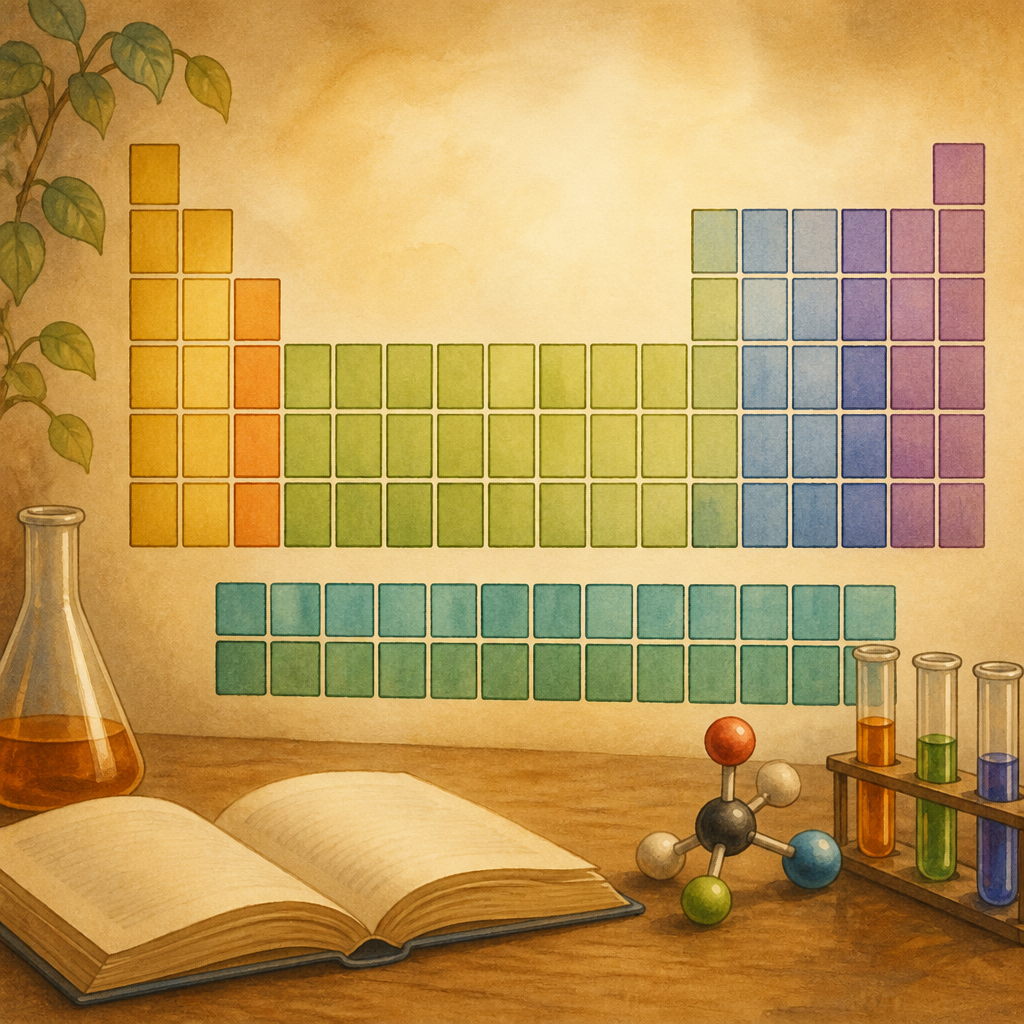
The periodic table organizes elements by increasing atomic number and repeating patterns in their properties. Each element box usually shows a chemical symbol, atomic number, name, and average atomic mass. Chemical symbols begin with a capital letter and may include a lowercase second letter. For example, Na represents sodium, while N represents nitrogen. Horizontal rows are called periods, and vertical columns are called groups or families. Elements in the same group often have similar chemical behavior because they have similar arrangements of outer electrons. The table is therefore more than a list. A student can use an element's location to infer whether it is likely to be a metal, nonmetal, or metalloid and how it may react.
Periodic Patterns and Element Families
Most metals appear on the left and center of the periodic table. They are commonly shiny, bendable, and good conductors of heat and electricity. Nonmetals appear mainly on the right and often conduct poorly. Metalloids lie near the zigzag boundary and have a mixture of properties. Important families include highly reactive alkali metals in Group 1, reactive halogens in Group 17, and mostly unreactive noble gases in Group 18. For example, sodium is an alkali metal that reacts strongly, while neon is a noble gas that rarely reacts. These are general patterns rather than rules for every condition, but they allow scientists to make useful predictions before testing an element.