
Atoms, Molecules, and the Building Blocks of Matter
Students develop a particle-level understanding of matter by distinguishing atoms, elements, molecules, and compounds and by using models to represent simple substances.
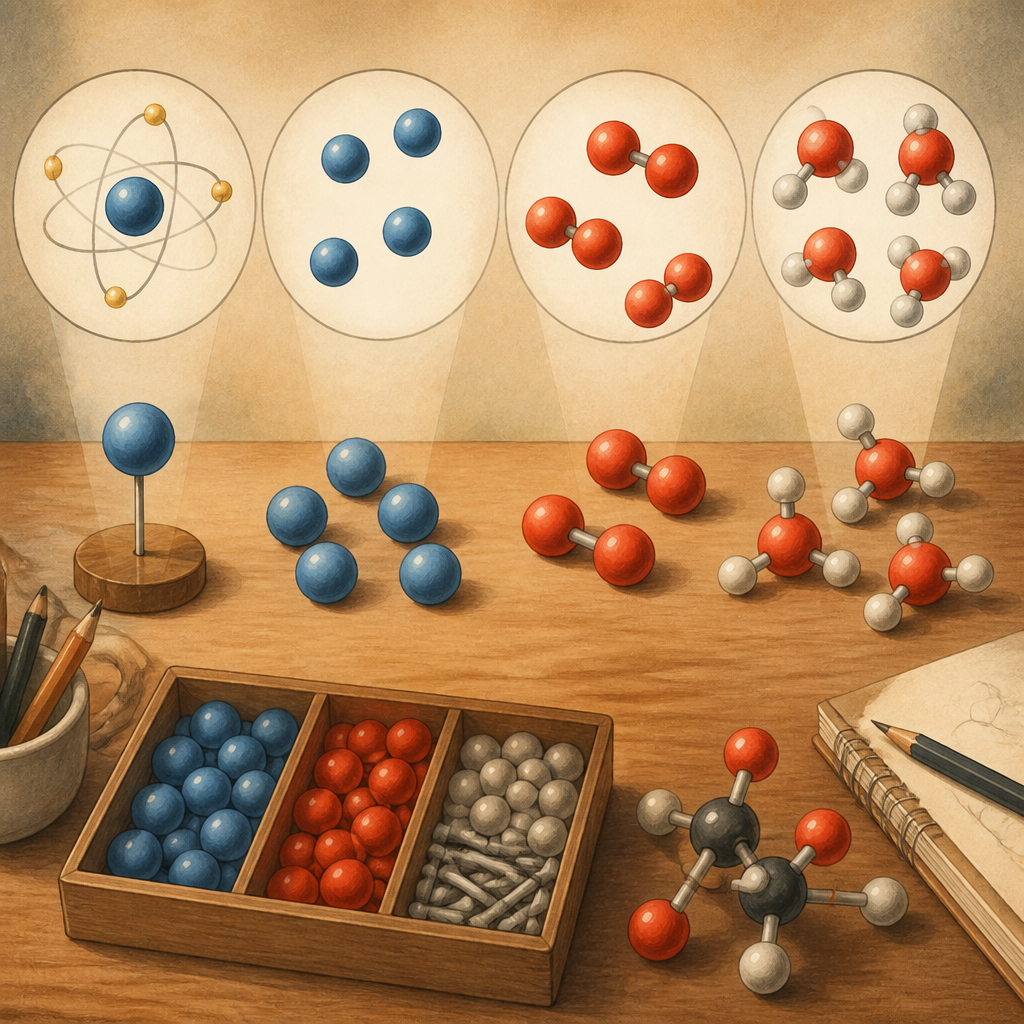
Illustrations are auto-generated and may be placeholders. They can be refreshed to match the narration.
Matter Is Made of Particles
Matter is anything that has mass and takes up space. All matter is made of extremely small particles called atoms. Atoms are too small to see with an ordinary microscope, so scientists use models to represent them. Each kind of atom has its own properties and belongs to a particular element. For example, a piece of copper wire contains an enormous number of copper atoms. Even though the wire can be bent or cut, its atoms remain copper atoms. Air, water, rocks, living things, and classroom desks are all made of atoms. Thinking about invisible particles helps explain why different materials have different properties, even when the particles themselves cannot be observed directly.
Elements and the Periodic Table
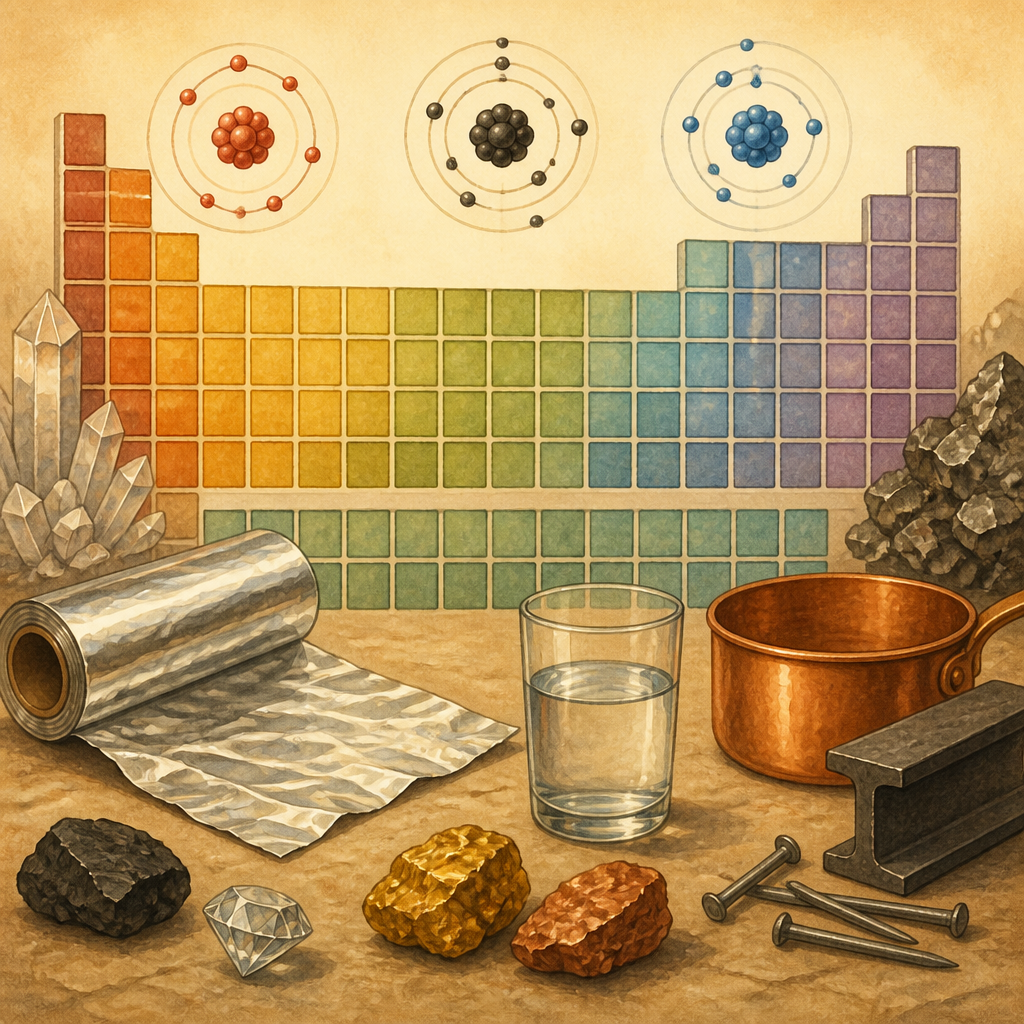
An element is a pure substance made of only one kind of atom. Scientists have identified more than 100 elements and organize them on the periodic table. Each element has a name, symbol, and atomic structure. Oxygen has the symbol O, carbon has the symbol C, and iron has the symbol Fe. Objects may contain one element or several elements combined together. For example, aluminum foil is mainly made of aluminum atoms, while a steel spoon contains iron mixed with carbon and other elements. The periodic table is like a reference chart that helps scientists compare elements. Elements in similar areas of the table often have related properties, but each element remains a unique type of matter.
Atoms Join to Form Molecules
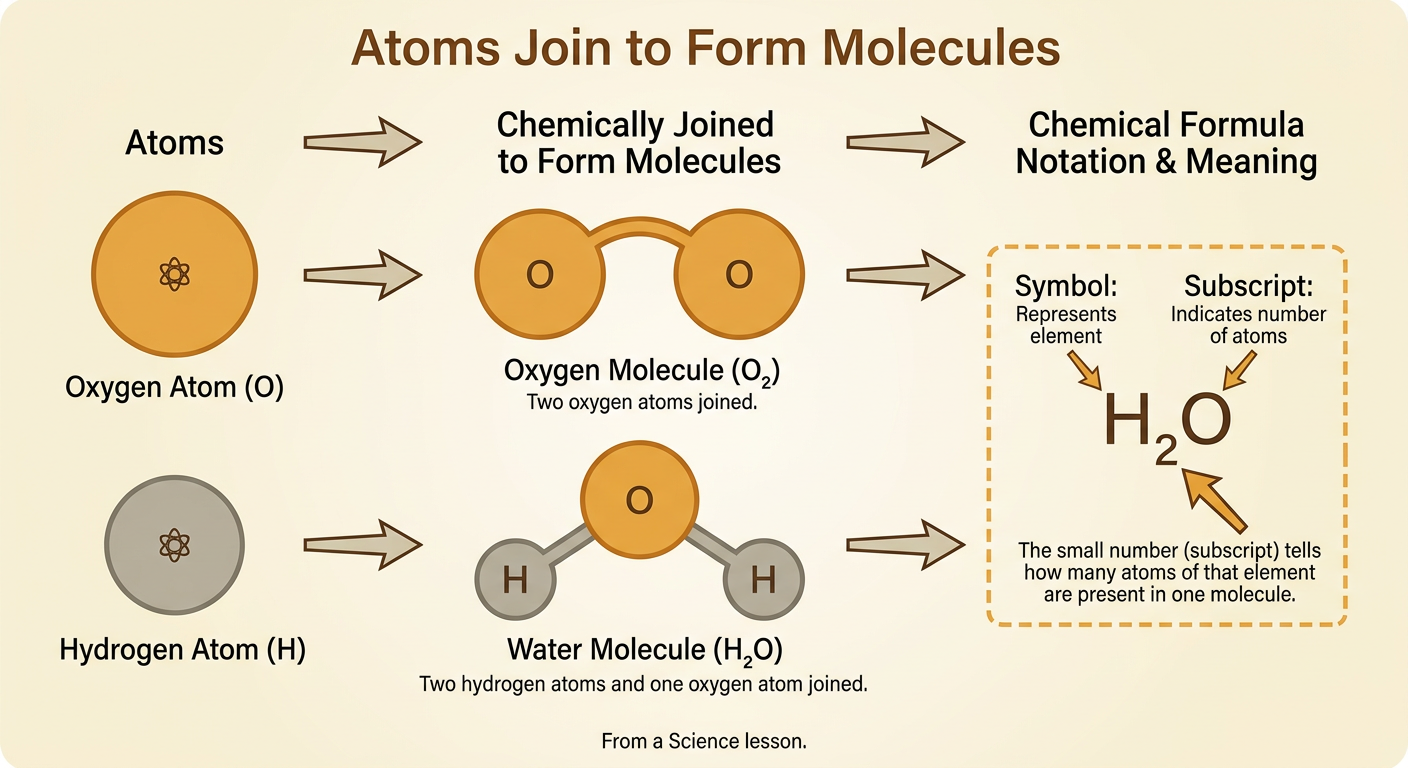
A molecule forms when two or more atoms are chemically joined. The atoms may belong to the same element or to different elements. Oxygen gas contains molecules made of two oxygen atoms, represented as O2. A water molecule contains two hydrogen atoms and one oxygen atom, represented as H2O. The small number written after a symbol tells how many atoms of that element are present. Molecules can have properties that are very different from the atoms that form them. Hydrogen and oxygen are gases at room temperature, but when their atoms are chemically joined in water molecules, they form liquid water. A molecule model shows the number, kinds, and arrangement of atoms without showing their actual size.
Compounds Have Fixed Compositions
A compound is a substance made from atoms of two or more different elements that are chemically joined in a fixed ratio. Water is always made from hydrogen and oxygen in a two-to-one ratio. Carbon dioxide always has one carbon atom for every two oxygen atoms. Because the atoms are joined chemically, separating a compound usually requires a chemical change. This is different from a mixture, whose parts are combined physically and may be separated more easily. Salt water, for example, is a mixture because the salt can be recovered by evaporating the water. Table salt itself is a compound made of sodium and chlorine. A compound has its own properties, which can differ greatly from the properties of its elements.

Using and Evaluating Particle Models
Scientists use drawings, colored spheres, computer images, and physical kits to model atoms and molecules. A useful model identifies each type of atom and shows how the atoms are connected. For example, a carbon dioxide model may use one black sphere for carbon and two red spheres for oxygen. Models make patterns easier to understand, but they also have limitations. The spheres are not the true sizes of atoms, and the spaces between particles may not be drawn accurately. Students can evaluate a model by asking what it explains and what it leaves out. Comparing models of water, oxygen, and carbon dioxide reveals that different substances contain different combinations of atoms, which helps explain their different behaviors and properties.
