
Balancing Chemical Equations and Conservation of Mass
Students interpret and balance chemical equations to demonstrate that atoms—and therefore total mass—are conserved during chemical reactions.

Illustrations are auto-generated and may be placeholders. They can be refreshed to match the narration.
Evidence of a Chemical Reaction
A chemical reaction occurs when atoms rearrange to form substances with new compositions and properties. Observable evidence may include a color change, formation of a gas, production of a solid precipitate, a temperature change, or emission of light. For example, when vinegar is mixed with baking soda, bubbles form because the reaction produces carbon dioxide gas. The bubbling is evidence that a new substance may have formed, but observations alone do not identify every substance or prove exactly how atoms rearranged. Scientists combine observations with measurements and chemical tests. Physical changes can look similar to chemical reactions: boiling water produces bubbles, but the water molecules remain H2O. Careful reasoning distinguishes a change of state from a change in chemical composition.

Reactants, Products, and Chemical Equations
A chemical equation represents a reaction with symbols and formulas. Reactants are the starting substances and appear on the left side of the arrow. Products are the substances formed and appear on the right. The arrow means “yields” or “produces.” In the equation H2 + O2 → H2O, hydrogen and oxygen are reactants, and water is the product. Formulas communicate the kinds and ratios of atoms within each substance: H2 contains two hydrogen atoms, O2 contains two oxygen atoms, and H2O contains two hydrogen atoms and one oxygen atom. This equation correctly identifies the substances, but it is not yet balanced because the number of oxygen atoms differs between the two sides. Words such as “hydrogen reacts with oxygen to produce water” can therefore be translated into a symbolic equation.

The Law of Conservation of Mass
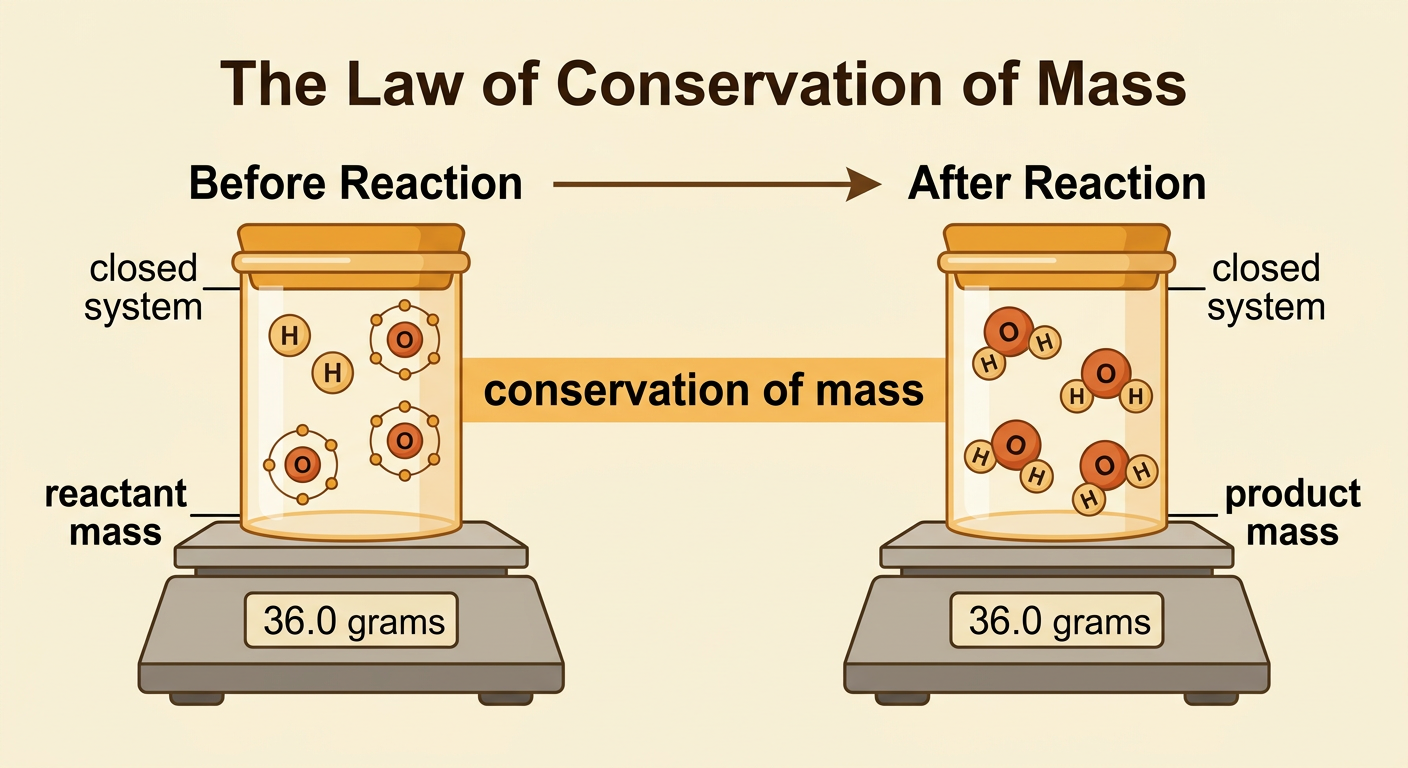
The law of conservation of mass states that matter is not created or destroyed during an ordinary chemical reaction. Atoms may separate, join, or form new arrangements, but every atom present before the reaction must still be present afterward. Because atoms are conserved, total mass is also conserved in a closed system. For example, if 4.0 grams of hydrogen react completely with 32.0 grams of oxygen in a sealed container, 36.0 grams of water form. The relationship can be written as 4.0 g + 32.0 g = 36.0 g. In an open container, measured mass may appear to decrease if a gas escapes, but the gas still has mass. Including the escaped gas restores the equality between the total mass of reactants and products.
Counting Atoms on Each Side
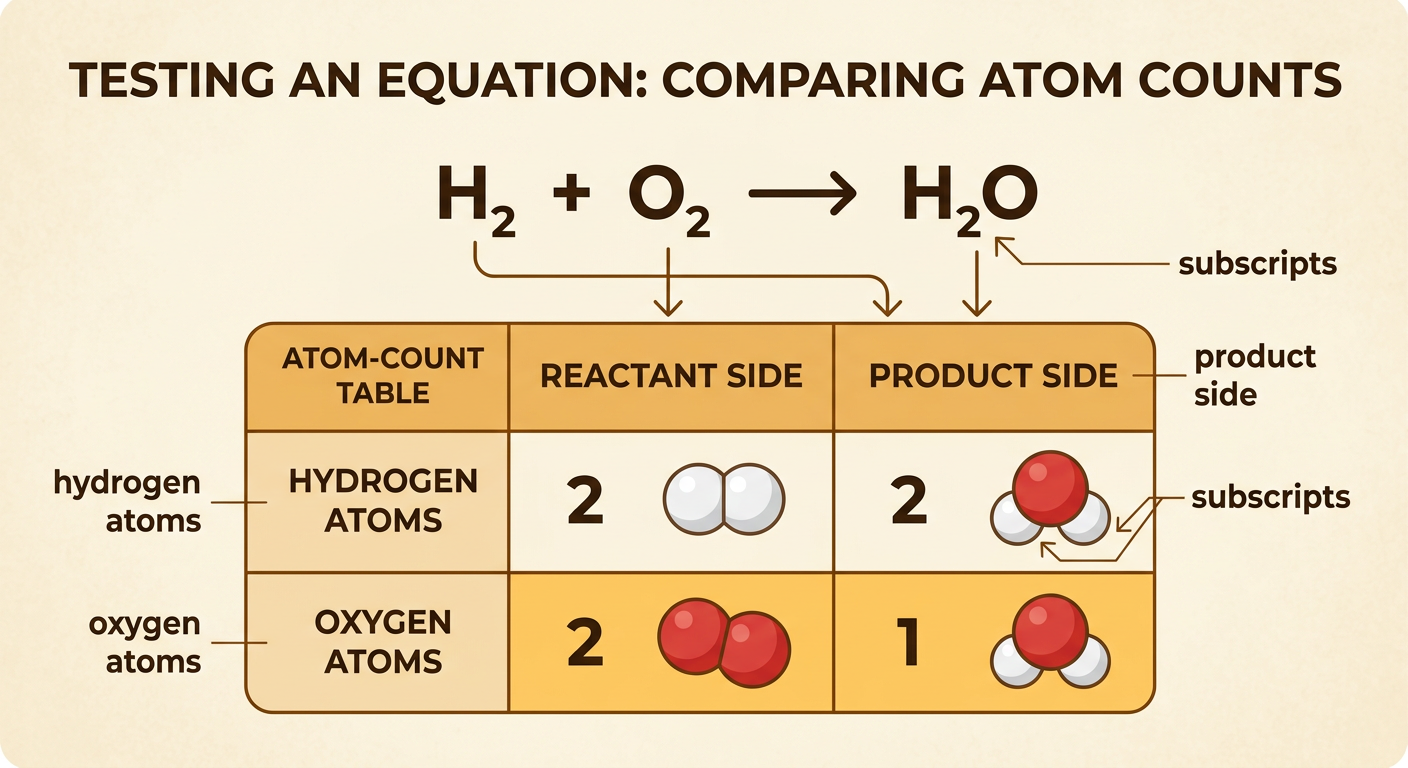
To test whether an equation is balanced, count the atoms of each element on both sides. Subscripts show how many atoms of an element occur in one formula unit or molecule. Consider H2 + O2 → H2O. On the reactant side, H2 contains two hydrogen atoms and O2 contains two oxygen atoms. On the product side, one H2O molecule contains two hydrogen atoms and one oxygen atom. Hydrogen is balanced because each side has two hydrogen atoms, but oxygen is not balanced because the left side has two and the right side has one. An atom-count table makes the mismatch easy to see. Count every element separately, and remember that a missing subscript means one. Do not change subscripts to balance the equation because doing so changes the identities of the substances.
Balancing with Coefficients
Balance an equation by placing whole-number coefficients before formulas. A coefficient multiplies every atom in that formula, while a subscript is part of the substance’s identity and must not be changed. Begin with H2 + O2 → H2O. Placing a 2 before H2O gives H2 + O2 → 2H2O. The products now contain four hydrogen atoms and two oxygen atoms. Oxygen is balanced, but hydrogen is not. Place a 2 before H2 to obtain 2H2 + O2 → 2H2O. Both sides now contain four hydrogen atoms and two oxygen atoms. The coefficients 2, 1, and 2 give the smallest whole-number ratio of molecules in the reaction. A coefficient of 1 is usually not written. Balancing changes the amounts of substances represented, not their chemical formulas.

Checking and Explaining a Balanced Equation
After balancing, verify the equation by recounting every element and confirming that the coefficients are in the smallest whole-number ratio. For 2H2 + O2 → 2H2O, the reactants contain four hydrogen atoms and two oxygen atoms. The products also contain four hydrogen atoms and two oxygen atoms, so the equation is balanced. A complete explanation should connect this numerical evidence to conservation of mass: the same kinds and numbers of atoms appear before and after the reaction, although they are grouped differently. Therefore, no atoms are created or destroyed, and total mass is conserved. The equation also communicates a quantitative relationship: two hydrogen molecules react with one oxygen molecule to form two water molecules. A strong scientific explanation states the claim, cites the atom counts as evidence, and uses conservation as the reasoning that links the evidence to the claim.
