
Battery Power: Chemical Energy in Action
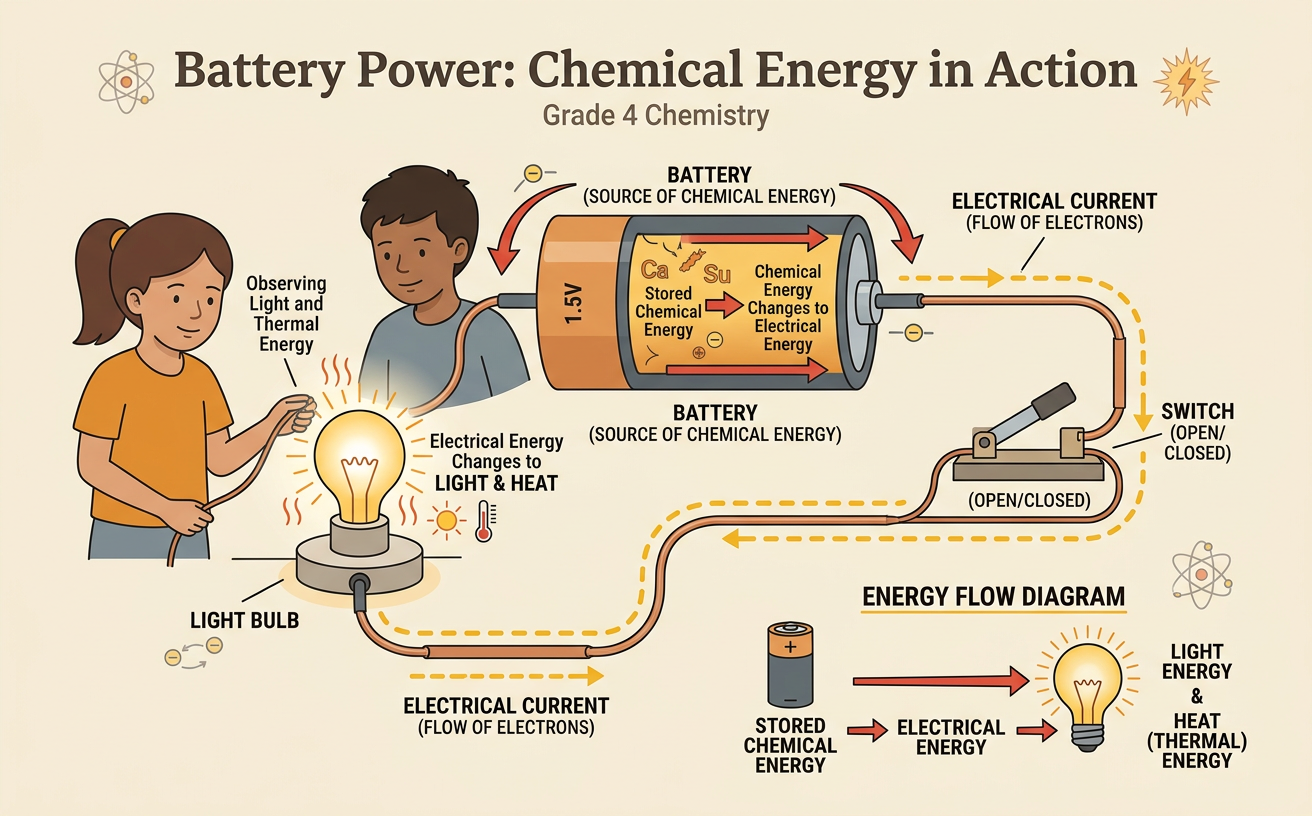
Students use a battery-powered circuit to observe how stored chemical energy changes into electrical, light, and thermal energy.
Illustrations are auto-generated and may be placeholders. They can be refreshed to match the narration.
Energy Stored in Chemicals
A battery stores chemical energy in the materials inside it. Chemical energy is energy held in substances and released when those substances react. A battery does not simply hold electricity like water in a bottle. When its positive and negative terminals are connected in a complete circuit, chemical reactions inside the battery help move electric charges through the wires. This creates an electric current that can power a device. For example, when you turn on a flashlight, chemical energy in the batteries changes into electrical energy. The electrical energy travels through the circuit to the bulb. If the circuit is opened, the current stops because there is no complete path. Never open or crush a battery, because the chemicals inside may be harmful.

Building a Simple Battery Circuit
A simple battery circuit needs a battery in a holder, insulated wires, and a small bulb in a bulb holder. First, connect one wire from the battery’s positive terminal to one contact on the bulb holder. Next, connect a second wire from the other bulb contact to the negative terminal. When every connection touches firmly, the parts form a closed loop and the bulb should light. If it does not light, test the device by checking for a loose wire, a burned-out bulb, or a weak battery. Change only one part at a time so you can tell which change helps. Never connect the two battery terminals directly with a wire. This short circuit can make the wire or battery dangerously hot.

Tracing Energy Changes
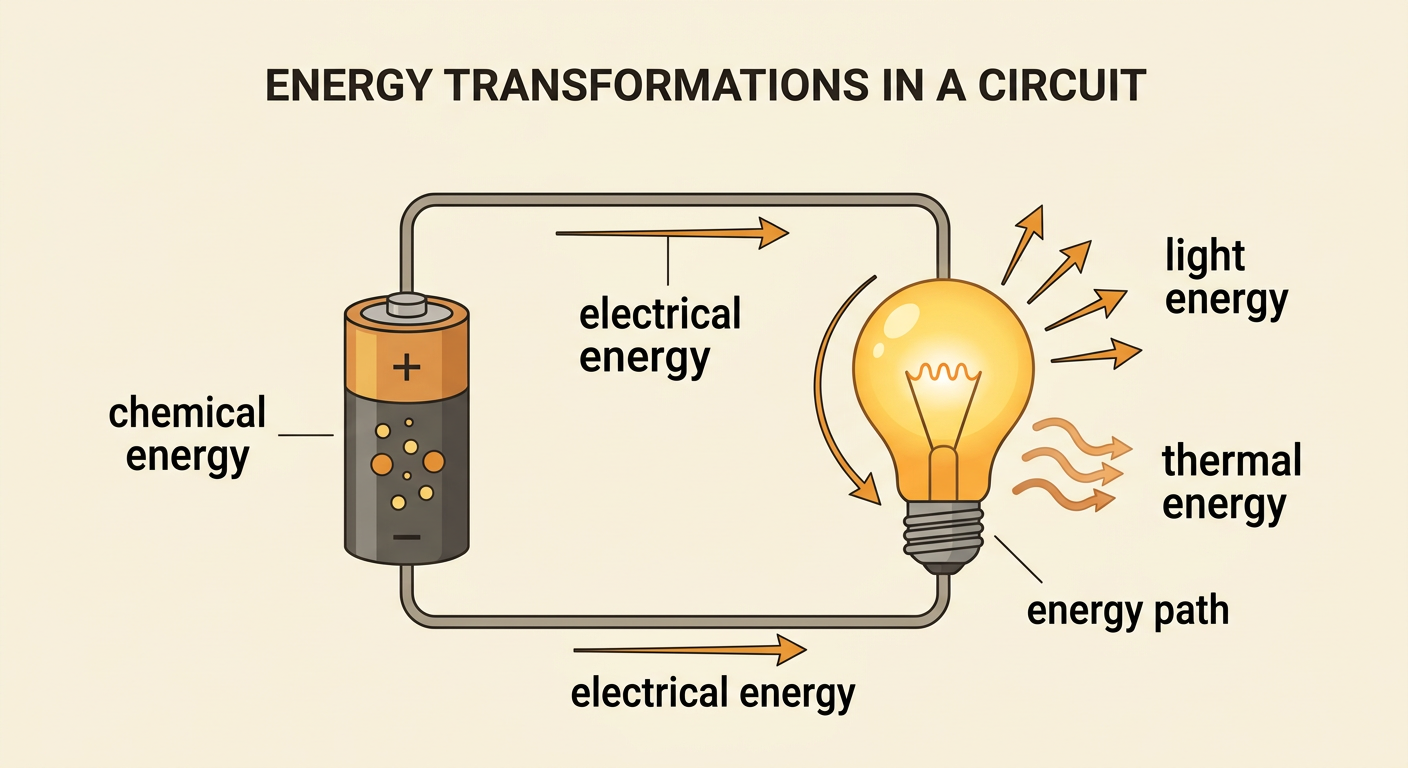
Energy changes form as it moves through a battery-powered circuit. The starting form is chemical energy stored in the battery. When the circuit is closed, chemical reactions provide electrical energy that is transferred through the wires. At the bulb, some electrical energy changes into light energy. Some also changes into thermal energy, which is heat. A small incandescent bulb may feel slightly warm after it has been on, but it should be disconnected before anyone checks it carefully. For example, a flashlight converts chemical energy into electrical energy, then into light and thermal energy. Energy is not created by the bulb. It is converted from one form to another. If the bulb stays dark, trace the energy path and look for a break in the circuit.
Recording and Comparing Test Times
Scientists record measurements so they can compare circuit tests fairly. Use a stopwatch to measure the interval from the moment the circuit is closed until it is opened. Record the time in seconds and note whether the bulb was bright, dim, or dark. Keep the same battery, bulb, and test procedure when comparing connections. Suppose Test A lasts 15 seconds and Test B lasts 25 seconds. Test B lasts 10 seconds longer because 25 minus 15 equals 10. Together, the tests last 40 seconds because 15 plus 25 equals 40. If two equal tests total 40 seconds, each test lasts 20 seconds because 40 divided by 2 equals 20. Follow the teacher’s time limit, disconnect the circuit after each test, and allow warm parts to cool.

How Batteries Changed Daily Life
Before batteries were widely used, people had few ways to carry a source of electrical energy from place to place. In 1800, Alessandro Volta built an early battery called the voltaic pile. Early batteries helped scientists study electricity and later helped power telegraph systems that sent messages over wires. However, many people still depended on candles or oil lamps for portable light. Today, smaller and more dependable batteries power flashlights, toys, clocks, smoke alarms, and many other devices. For example, a child in the 1800s might have used a candle to read after dark, while a child today can use a battery-powered flashlight. Batteries made portable electrical devices possible, but used batteries must be handled and recycled according to local safety rules.
