Broken Connections: Habitat Fragmentation and Biodiversity
Students analyze how roads and development fragment habitats, affect biodiversity, and inform the design of wildlife corridors and other conservation solutions.

Illustrations are auto-generated and may be placeholders. They can be refreshed to match the narration.
What Is Habitat Fragmentation?
Habitat fragmentation occurs when one large, continuous habitat is divided into smaller, separated patches. Roads, farms, neighborhoods, dams, and logging areas can create barriers between patches. The surrounding human-altered land is called the matrix. Fragmentation often reduces the total amount of habitat, increases the amount of habitat near an edge, and makes movement between patches harder. Edge conditions may include more light, wind, noise, pollution, predators, or invasive species than interior conditions. For example, a highway built through a forest may prevent salamanders from reaching breeding ponds and expose deer to vehicle collisions. Fragmentation is different from complete habitat loss because some habitat remains, but its arrangement and connections have changed. Both the size and location of the remaining patches influence which species can survive there.

Reading a Fragmented Landscape Map
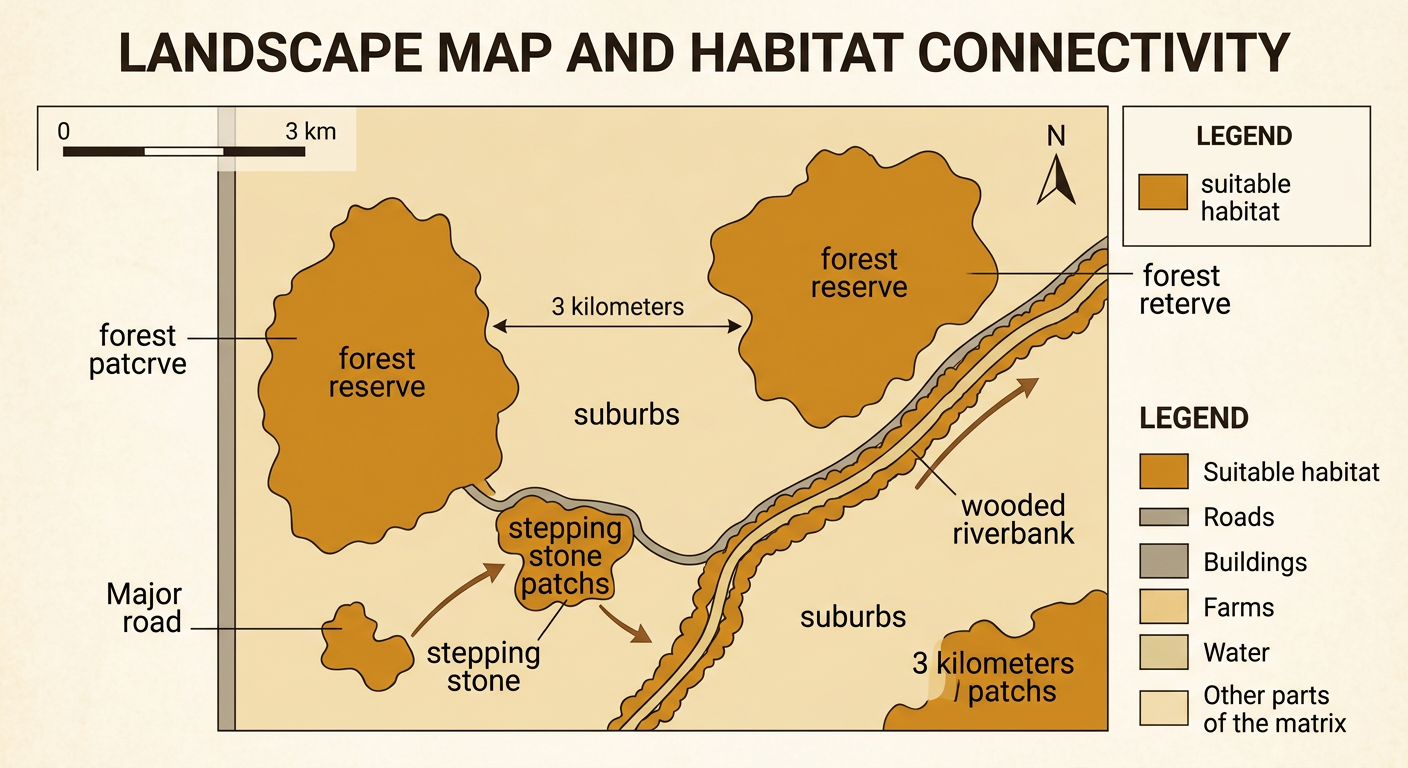
A landscape map can reveal habitat size, shape, separation, and possible movement routes. Begin with the title, scale, north arrow, and legend. Use the legend to distinguish suitable habitat from roads, buildings, farms, water, and other parts of the matrix. Large patches usually support more individuals and habitat types than small patches, while patches that are close together may be easier to reach. Narrow strips of suitable habitat can act as corridors, and small patches between larger areas can serve as stepping stones. For example, a map may show two forest reserves separated by three kilometers of suburbs. A wooded riverbank connecting the reserves could provide a route for birds, mammals, and insects. However, map appearance alone does not prove that species use the route; field observations, tracking data, or genetic evidence are also needed.
Effects on Populations and Biodiversity
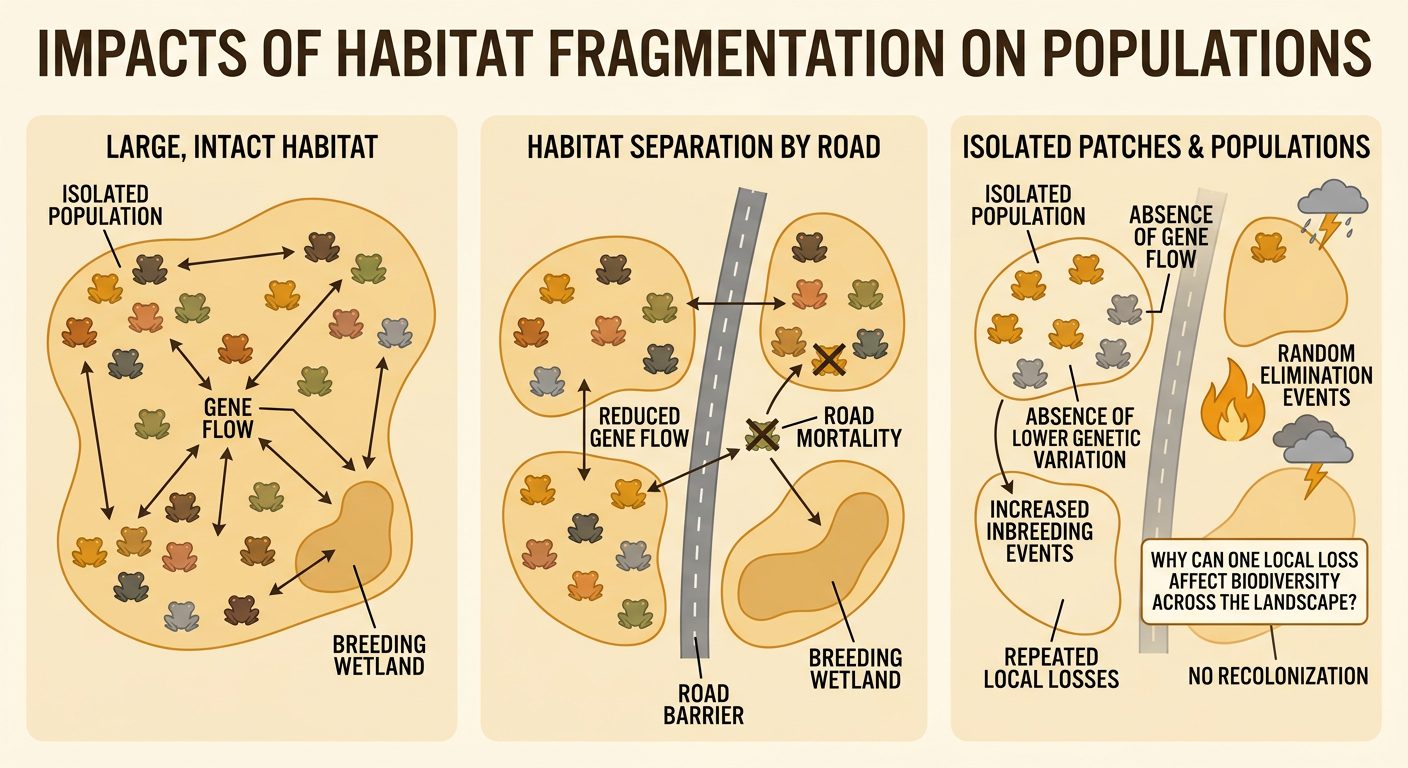
Fragmentation can affect population size, survival, reproduction, and genetic diversity. A small patch may contain too little food, shelter, or breeding space to support a stable population. If individuals cannot move between patches, populations become isolated and gene flow decreases. Inbreeding may become more likely, and a fire, disease outbreak, or severe storm can eliminate a small local population. Species that need large territories or avoid edges are often especially vulnerable. For example, frogs separated from wetlands by roads may be killed during seasonal migrations, reducing the number that reproduce. Over time, repeated local losses can lower biodiversity across the landscape. Effects are not identical for every species: some edge-dwelling animals or disturbance-tolerant plants may increase. Scientists therefore examine species traits, patch conditions, and movement data rather than assuming that all organisms respond in the same way.
Evaluating Evidence for Wildlife Corridors
Wildlife corridors are strips of habitat or crossing structures intended to connect separated populations. To evaluate a recommendation for a corridor, identify the claim, evidence, and reasoning. Strong evidence might include GPS tracking that shows animals using a crossing, camera records collected before and after construction, fewer wildlife-vehicle collisions, or genetic data showing increased gene flow. Researchers should also compare the corridor site with similar sites that did not receive a corridor. For example, if photographs show more pronghorn crossing near an overpass after it opens, that supports use of the structure. However, the claim that the overpass increases population survival requires additional evidence about collisions, reproduction, and population trends. Students should check sample size, study length, alternative explanations, and whether the studied species represents other species. Evidence supports a recommendation most strongly when several independent measurements produce consistent results.

Designing a Conservation Solution
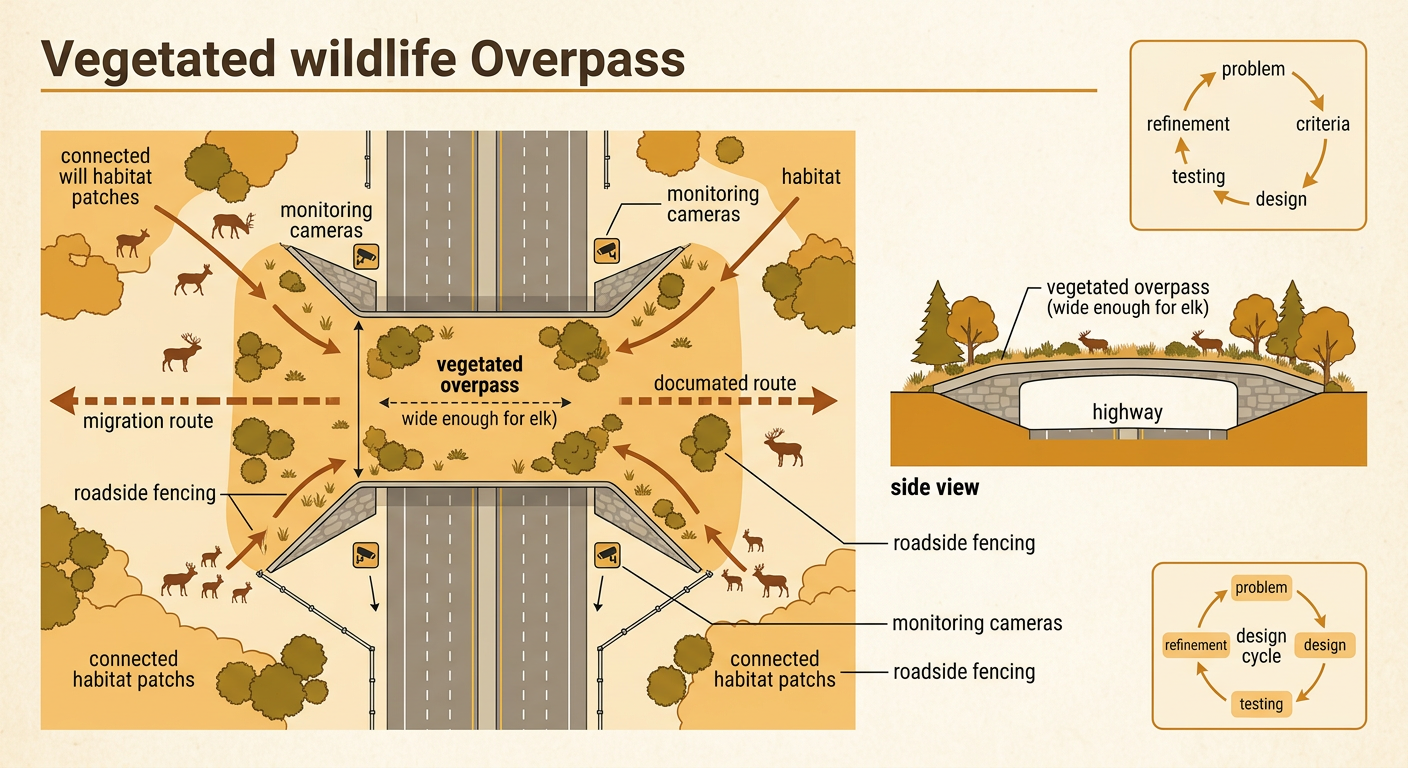
A conservation solution should reduce harm to biodiversity while considering cost, land use, safety, and community needs. First, define the problem and criteria for success, such as reconnecting breeding habitat or reducing collisions. Next, use maps and species data to compare options. Possible solutions include preserving a broad habitat corridor, building a vegetated overpass, installing culverts for amphibians, adding roadside fencing, restoring stepping-stone patches, or limiting development near sensitive areas. For example, a proposed highway crossing for elk should be placed along a documented migration route, wide enough for elk to use, and connected to fencing that guides animals toward it. The design should include monitoring through cameras, track surveys, collision counts, or genetic sampling. If animals avoid the crossing or collisions remain high, the solution can be refined by changing vegetation, fencing, lighting, noise barriers, or location.