
Bronze Age Trade: Connecting Resources and Civilizations
Students use maps and historical evidence to explain how the uneven distribution of copper, tin, and other resources encouraged trade and cultural exchange among Bronze Age societies.
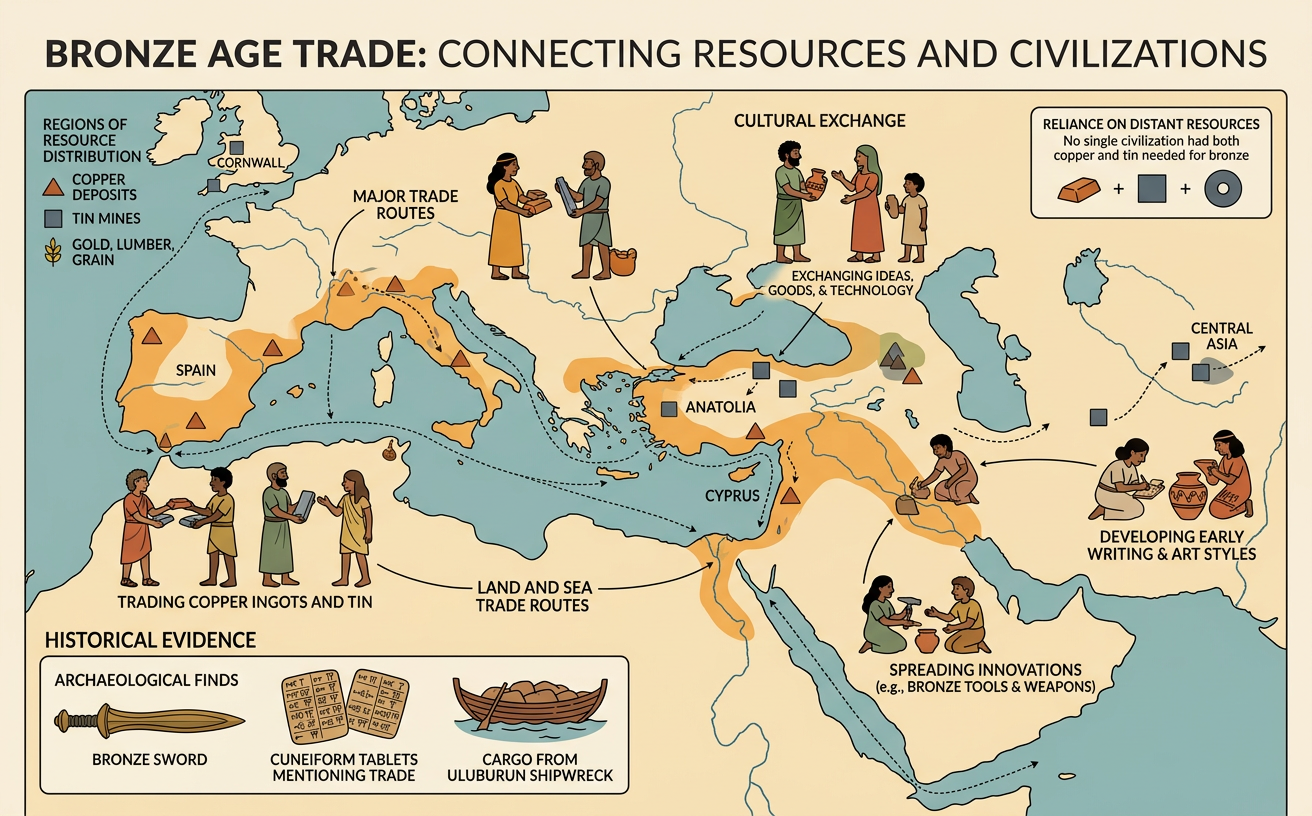
Illustrations are auto-generated and may be placeholders. They can be refreshed to match the narration.
What Made Bronze Valuable?
Bronze is an alloy, or mixture of metals, usually made by combining copper with a smaller amount of tin. Bronze was generally harder and held a sharper edge longer than pure copper. Craftspeople could melt it, pour it into molds, and shape it into tools, weapons, containers, and decorative objects. Damaged bronze items could also be melted and made into something new. These qualities made bronze valuable to farmers, soldiers, rulers, and artisans. For example, a bronze ax could cut wood more effectively and remain useful longer than many copper tools. However, most communities did not have nearby sources of both copper and tin. To produce bronze, they needed to obtain missing materials through trade. Demand for better tools and prestigious objects therefore helped connect distant mining regions, workshops, ports, and cities.

Mapping Copper and Tin Resources
Copper and tin deposits were unevenly distributed because geological processes formed metal ores in particular places rather than everywhere. A resource map helps historians compare the locations of deposits with settlements and possible trade connections. Important Bronze Age copper sources included Cyprus and parts of Anatolia, while tin came from more limited and sometimes distant sources, including Central Asia and regions farther west such as Cornwall. Scholars continue to investigate exactly which mines supplied particular societies at different times. For example, Cyprus had rich copper resources but needed tin from elsewhere to make bronze. A map showing copper on Cyprus and tin in distant regions reveals why transportation was necessary. The map does not prove that every marked place traded directly with every other place, but it helps researchers form questions about routes, distances, and the movement of raw materials.

Following Bronze Age Trade Routes
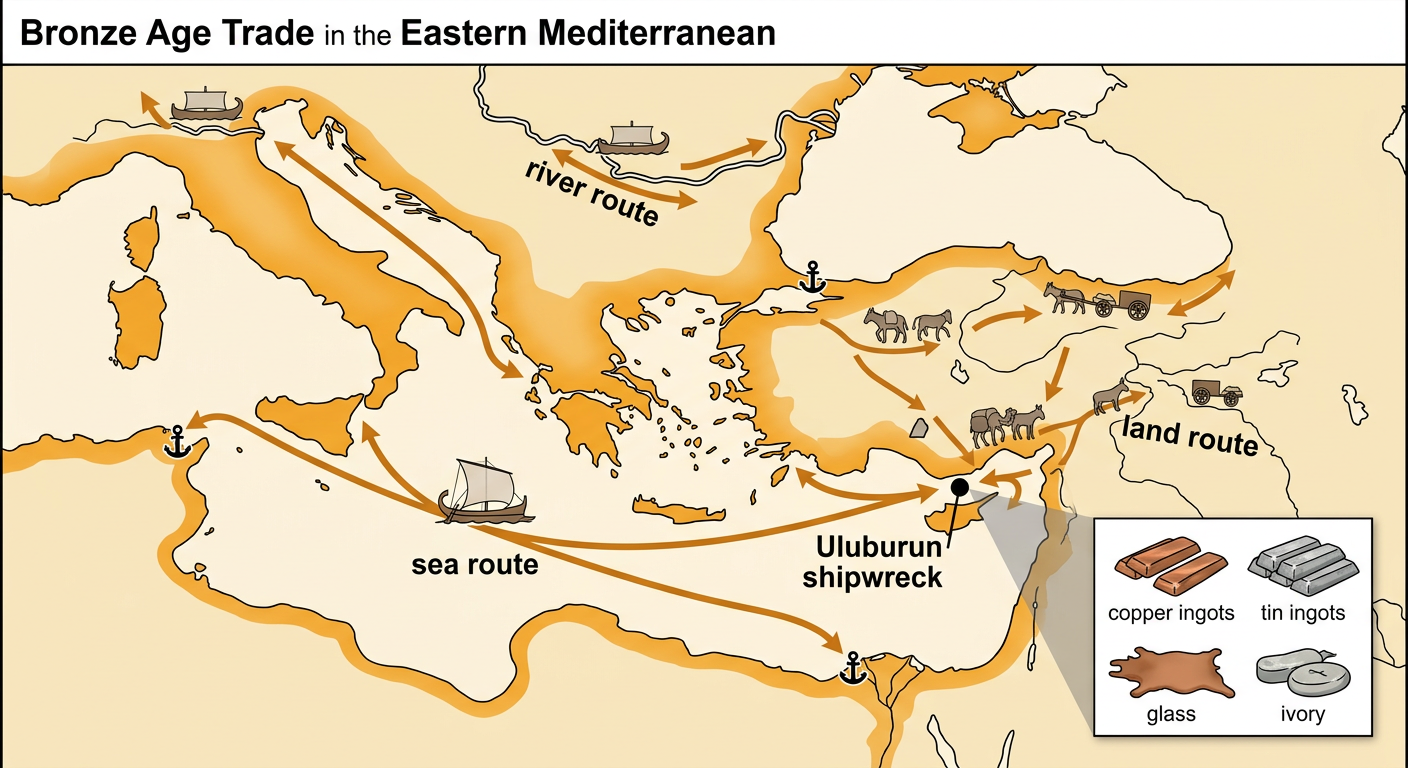
Bronze Age traders moved materials by sea, river, and land. Ships could carry heavy cargo along Mediterranean coastlines, while pack animals and carts transported goods across inland routes. Rivers connected farming settlements and cities, although travelers still faced mountains, deserts, storms, and attacks. Trade often worked through many exchanges: one merchant might carry metal to a port, and another might move it farther. The Uluburun shipwreck, dated to the late fourteenth century BCE and found off the coast of present-day Turkey, provides a concrete example. Its cargo included large quantities of copper ingots, tin ingots, glass, ivory, and luxury goods from several regions. The shipwreck shows that people transported valuable materials together over the sea. It also suggests that ports and coastal settlements served as important meeting points within networks connecting parts of the Mediterranean and Southwest Asia.
Goods, Ideas, and Technologies on the Move
Trade moved more than raw materials. Merchants and travelers also carried finished goods, artistic styles, technical knowledge, stories, languages, and religious practices. When craftspeople observed unfamiliar objects, they could copy a design or adapt it to local needs. Knowledge of metal casting, shipbuilding, measurement, and writing could spread through repeated contact among communities. For example, the cargo of the Uluburun ship included objects and materials associated with several regions, including copper, tin, glass, ivory, and pottery. Their presence on one vessel shows that different production areas were connected within a wider exchange network. A decorative pattern might appear in a new place because an object was traded, an artisan traveled, or local workers imitated imported goods. Cultural exchange did not make societies identical. Communities selected, changed, or rejected ideas while maintaining their own traditions.

Using Evidence to Explain Trade
A strong historical explanation begins with a claim and supports it with specific evidence. Primary sources are materials from the time being studied, such as ingots, tools, shipwreck cargo, tablets, or pottery. Secondary sources are later interpretations created by historians, archaeologists, and other researchers. Suppose the claim is that uneven metal resources encouraged long-distance trade. A student could cite a resource map showing copper on Cyprus and tin in distant regions, then cite the copper and tin ingots found in the Uluburun shipwreck. The reasoning should connect the evidence to the claim: bronze required both metals, few places had easy access to both, and transportation networks brought them together. Good explanations also recognize limits. A map suggests possible connections, while a shipwreck proves that particular goods were being transported. Using multiple sources creates a more convincing account than relying on one clue.
