Bubble Evidence: Did a New Substance Form?
Students mix baking soda and vinegar, observe gas production and temperature change, and use evidence to decide whether a chemical reaction formed new substances.
Illustrations are auto-generated and may be placeholders. They can be refreshed to match the narration.
Question: What Happens When Substances Mix?
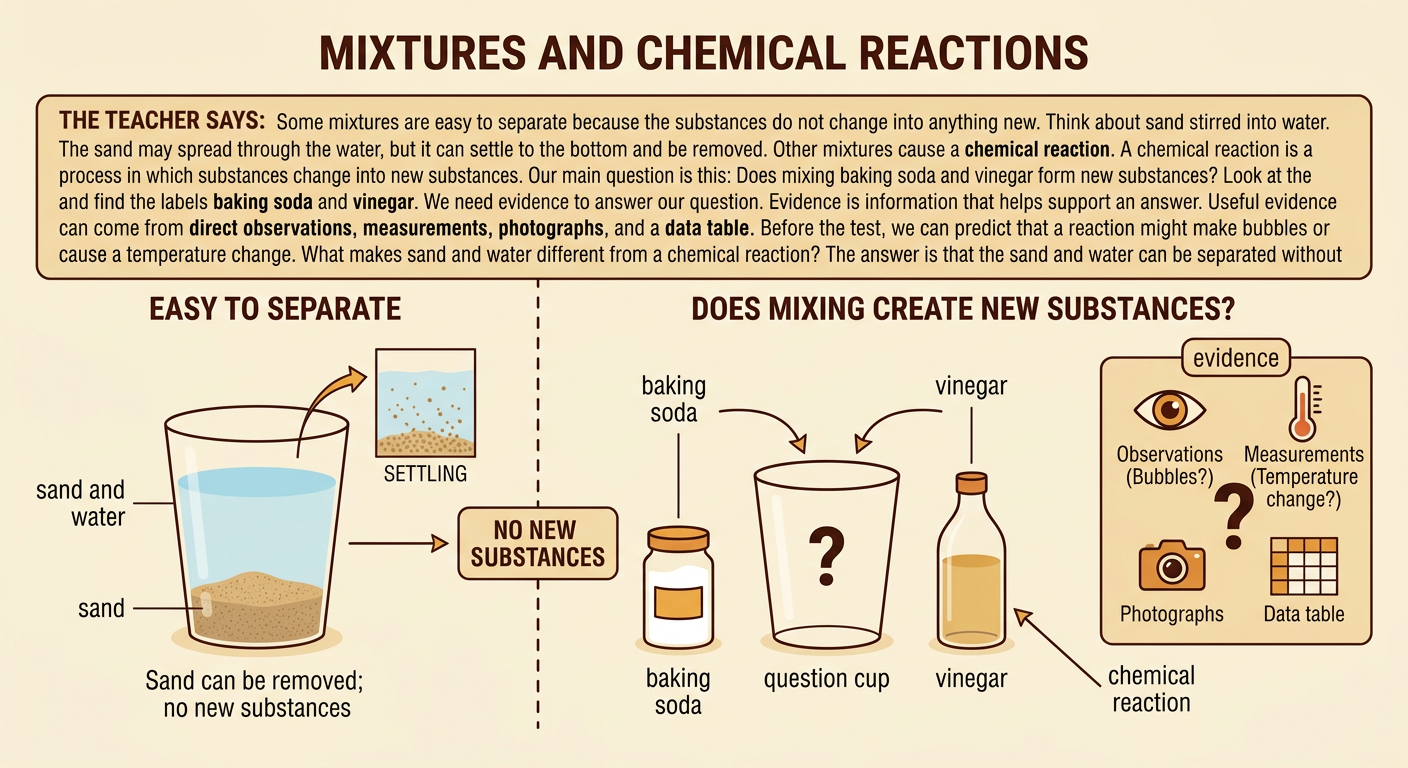
Sometimes substances can be mixed and then separated without changing what they are. Other times, mixing causes a chemical reaction that forms new substances. Our compelling question is: Does mixing baking soda and vinegar form new substances? To answer it, we need useful sources of evidence. Direct observations, measurements, photographs, and a data table from the investigation are helpful sources. For example, stirring sand into water does not produce bubbles or another clear sign of a new substance; the sand can settle and be separated. Baking soda and vinegar may act differently. Before investigating, predict what you might see or measure if a reaction happens. Do not taste any materials. Wear safety goggles and follow the teacher’s directions throughout the investigation.
Record the Starting Substances
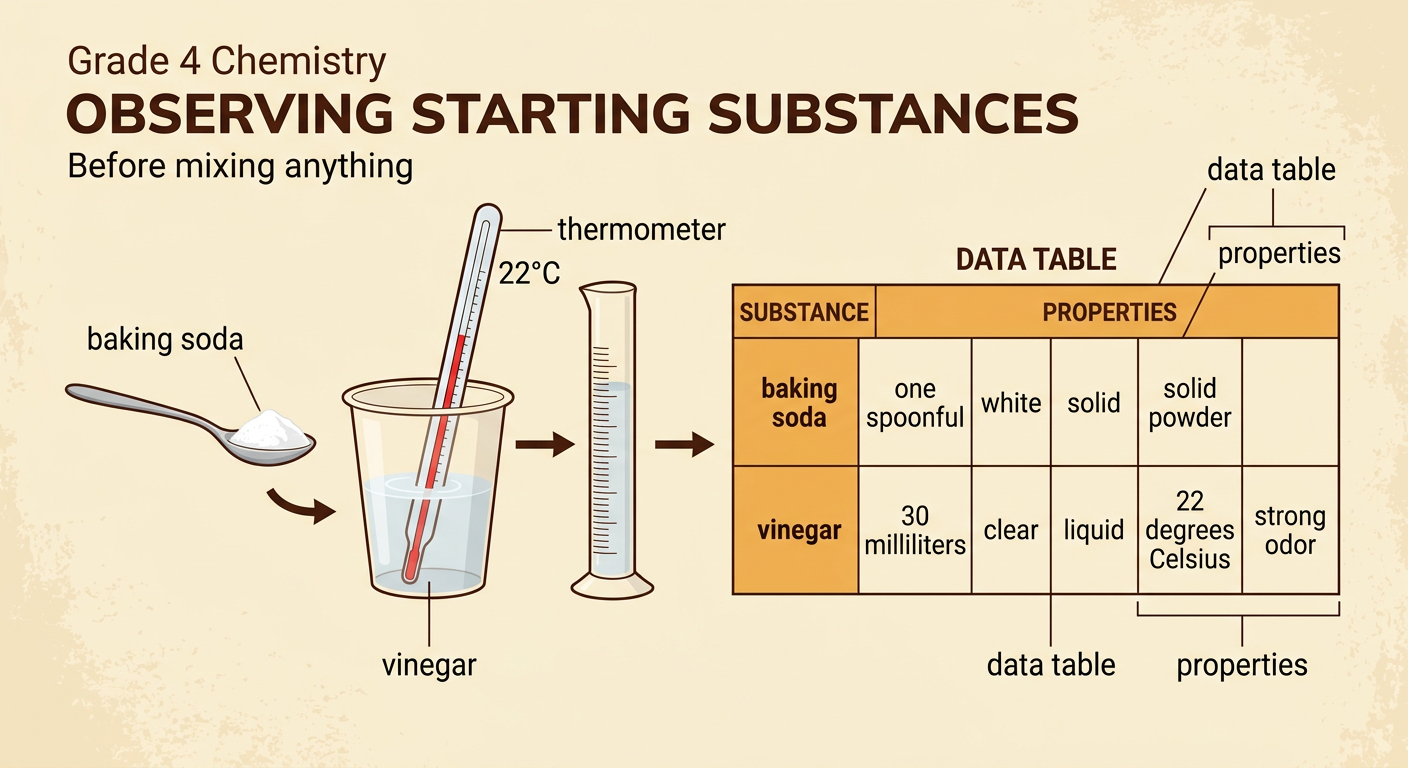
Before mixing, carefully observe and record the properties of each starting substance. Properties are features that can be seen or measured. Baking soda is a white, powdery solid. Vinegar is a clear liquid with a strong odor, but smell it only by gently waving air toward your nose if your teacher directs you. Place the vinegar in a clear cup and measure its starting temperature with a thermometer. Record the amount, state of matter, color, texture, and temperature in a data table. For example, you might record “baking soda: 1 spoonful, white solid powder” and “vinegar: 30 milliliters, clear liquid, 22°C.” These notes create a fair starting record. Later, compare them with observations made after mixing.
Mix Baking Soda and Vinegar
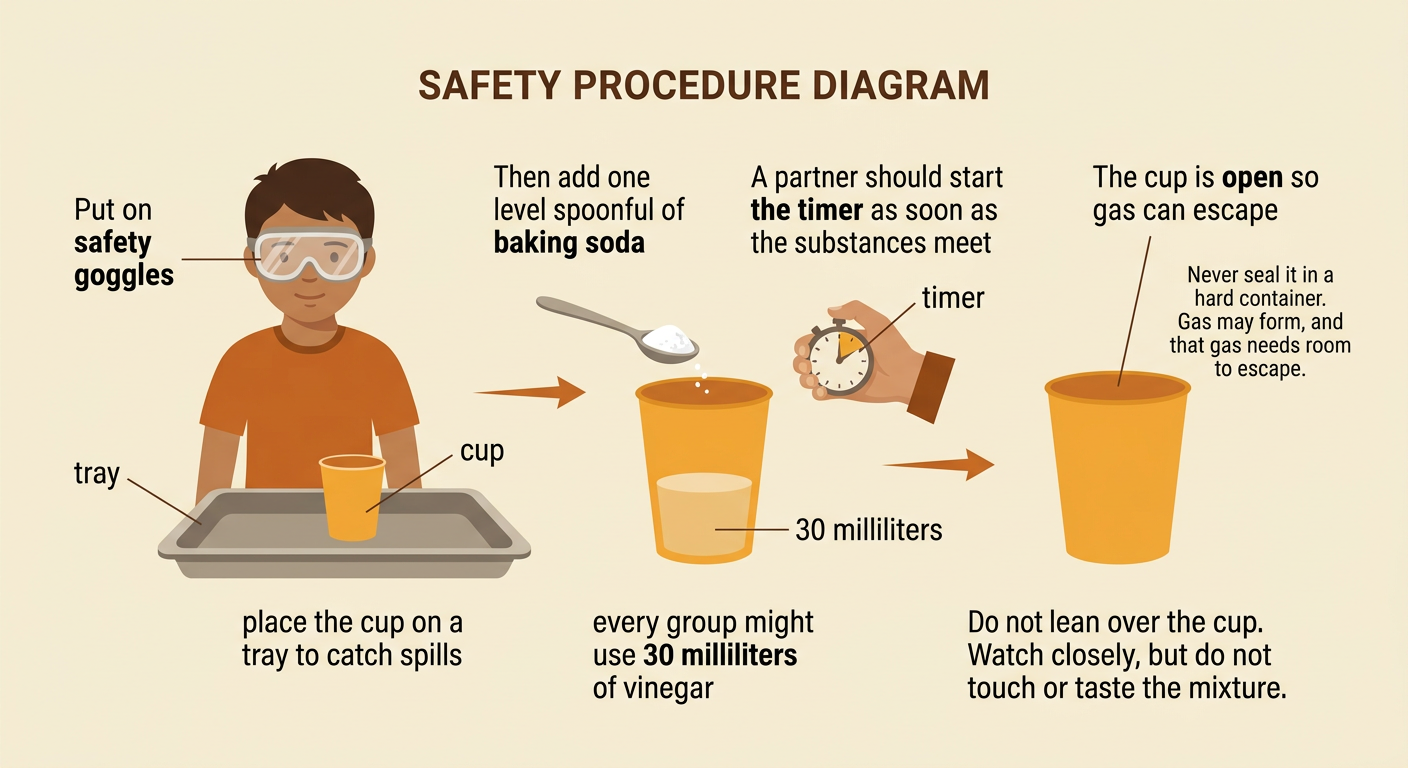
Put on safety goggles and place the cup on a tray to catch spills. Measure the teacher-approved amount of vinegar and pour it into the cup. Record its temperature. Next, add one spoonful of baking soda without leaning over the cup. Watch closely while a partner starts a timer. Do not touch, taste, or seal the mixture in a hard container because the gas needs room to escape. Keep the amounts the same if different groups repeat the test. For example, every group might mix 30 milliliters of vinegar with one level spoonful of baking soda. Using the same procedure makes results easier to compare. Write what happens immediately, after 30 seconds, and after one minute. A photograph or labeled drawing can also serve as an investigation source.
Observe Bubbles and Temperature Change
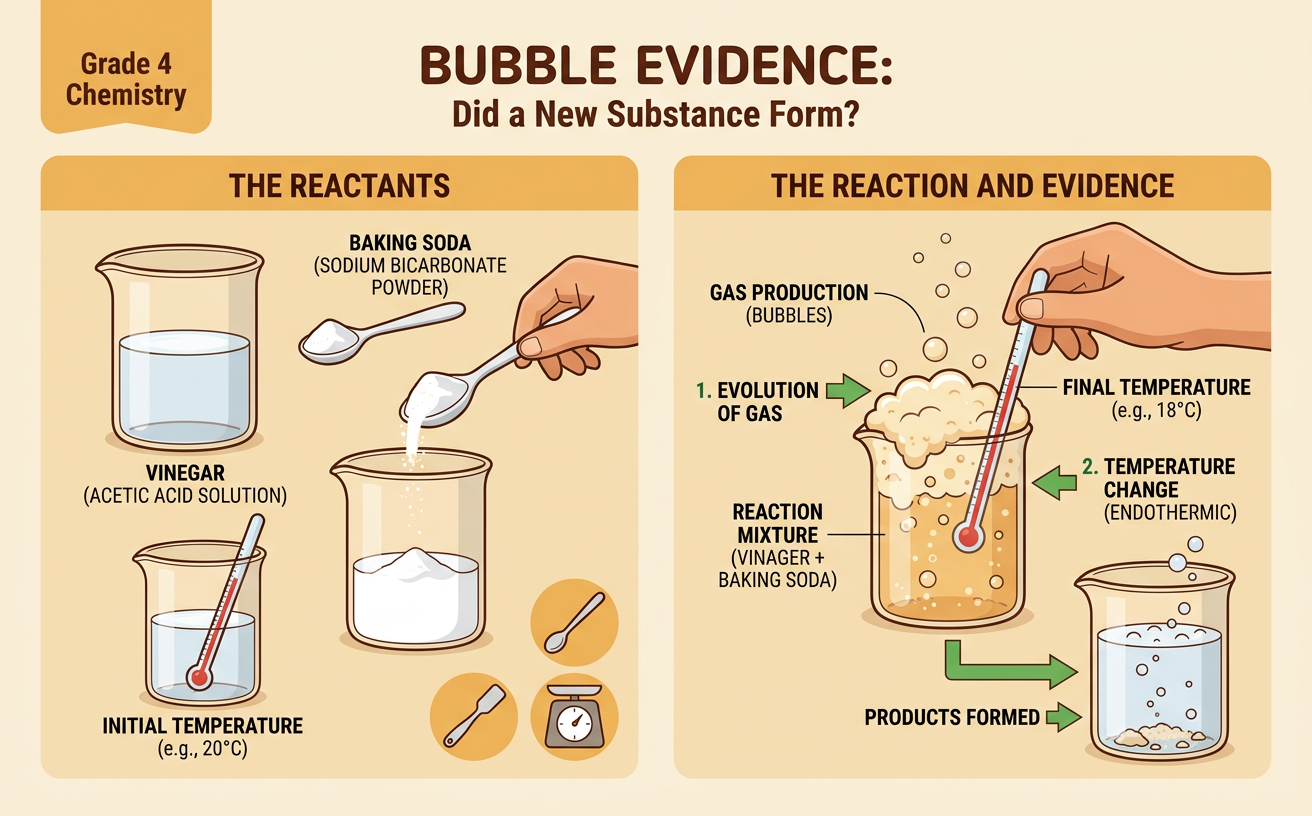
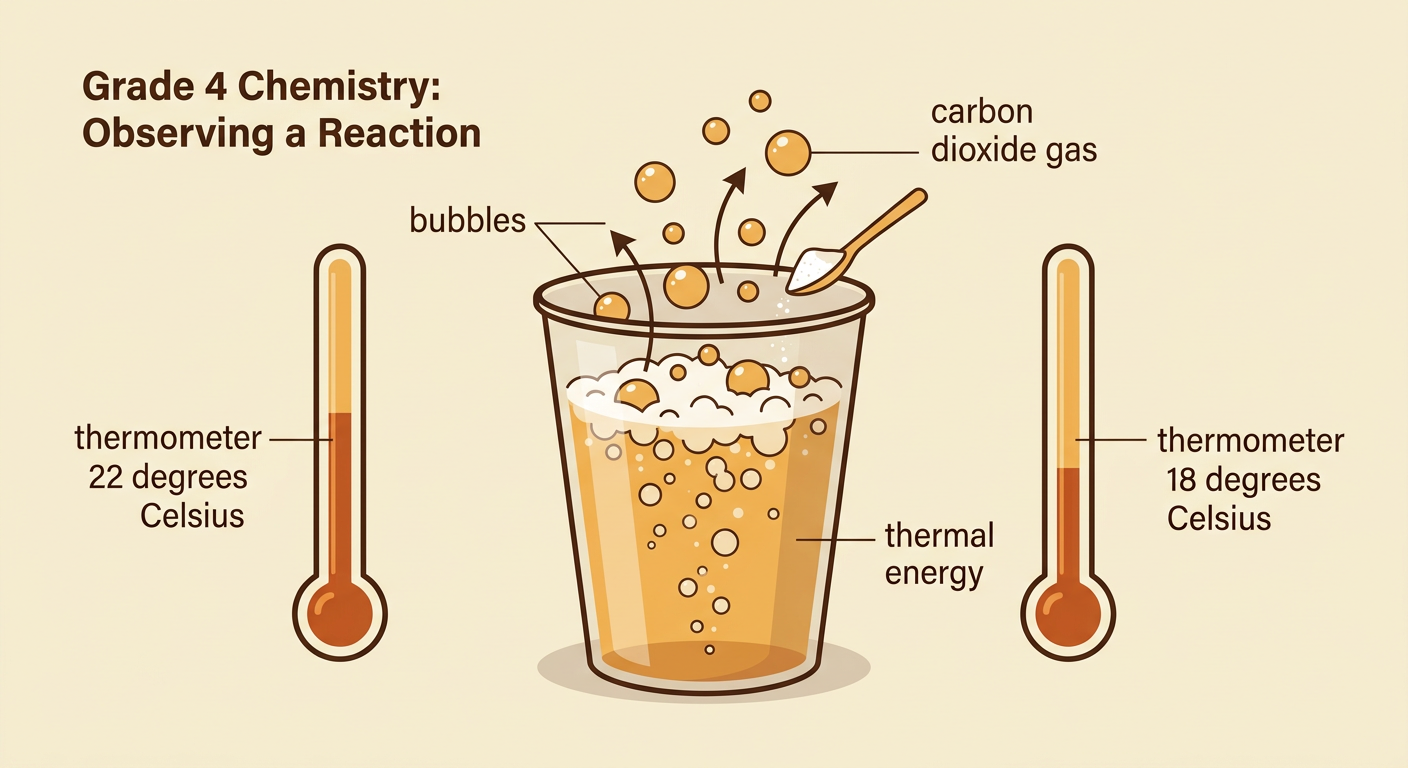
When baking soda enters the vinegar, the mixture begins to fizz and foam. Many bubbles rise and pop at the surface. These bubbles contain carbon dioxide gas, a substance that was not present as visible gas in either starting material. Carefully measure the mixture’s temperature again without touching the bottom or sides of the cup with the thermometer. The temperature commonly drops because the overall process takes in thermal energy from the mixture and nearby surroundings. For example, a starting temperature of 22°C might fall to 18°C. Record the actual result, even if it differs from the example. Also note how long bubbling lasts and what remains when it stops. Bubbles and a temperature change are observations, while thermometer readings and time are measurements. Together, they provide stronger evidence than one observation alone.
Use Evidence to Explain the Reaction
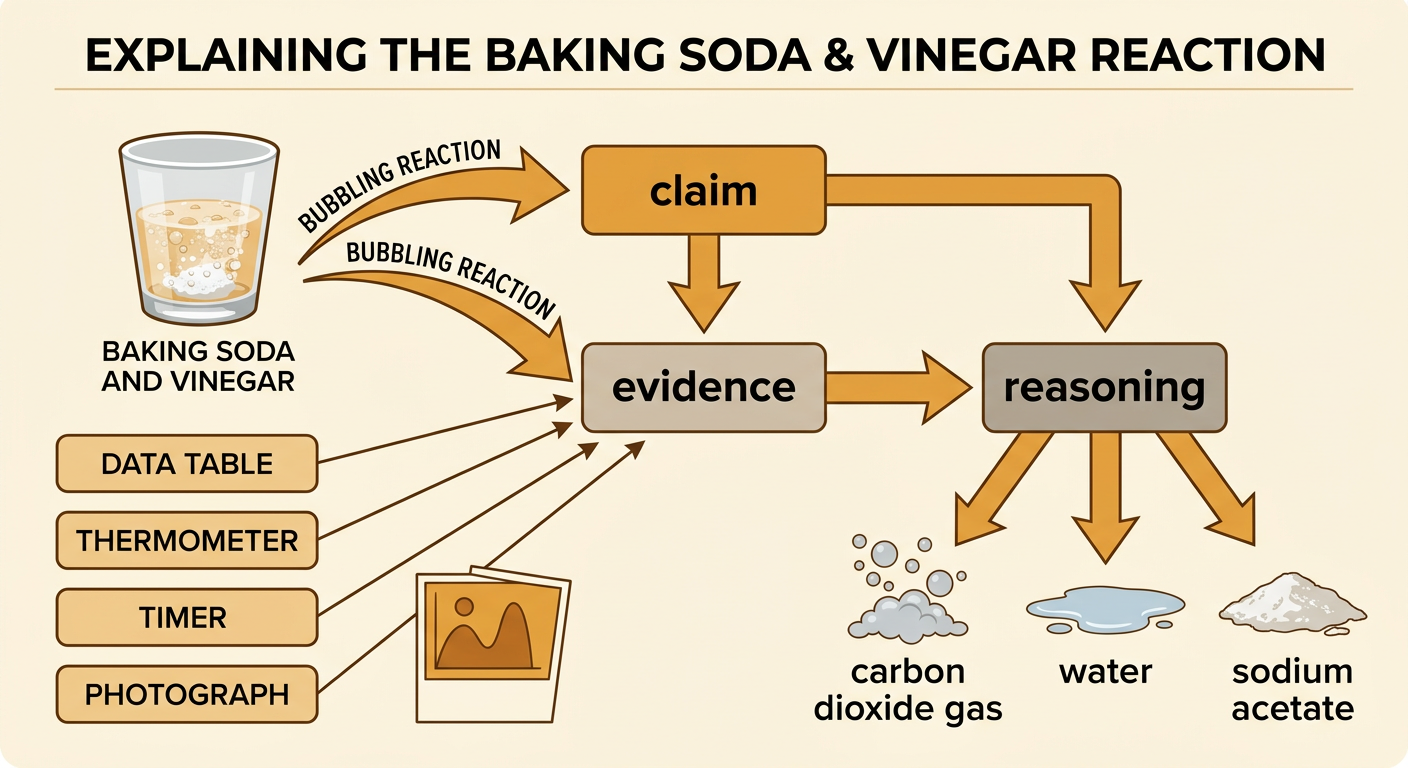
Use a claim, evidence, and reasoning structure to explain your conclusion. A clear claim is: Mixing baking soda and vinegar caused a chemical reaction that formed new substances. Evidence may include carbon dioxide bubbles, a temperature decrease, and changes in the starting materials. In your reasoning, explain that the gas has different properties from the original white solid and clear liquid. Scientists know that this reaction produces carbon dioxide gas, water, and a dissolved substance called sodium acetate. For example: “The mixture bubbled for 45 seconds, and its temperature changed from 22°C to 18°C. These observations and measurements support my claim because gas production and energy change show that atoms were rearranged into new substances.” Compare your data table, notes, drawing, and photographs. Identify which sources best answer the investigation question.