Build a Battery: Chemical Energy to Electrical Energy
Students build and test a simple fruit battery to investigate how chemical energy can be converted into electrical energy.
Illustrations are auto-generated and may be placeholders. They can be refreshed to match the narration.
Energy Stored in Chemicals
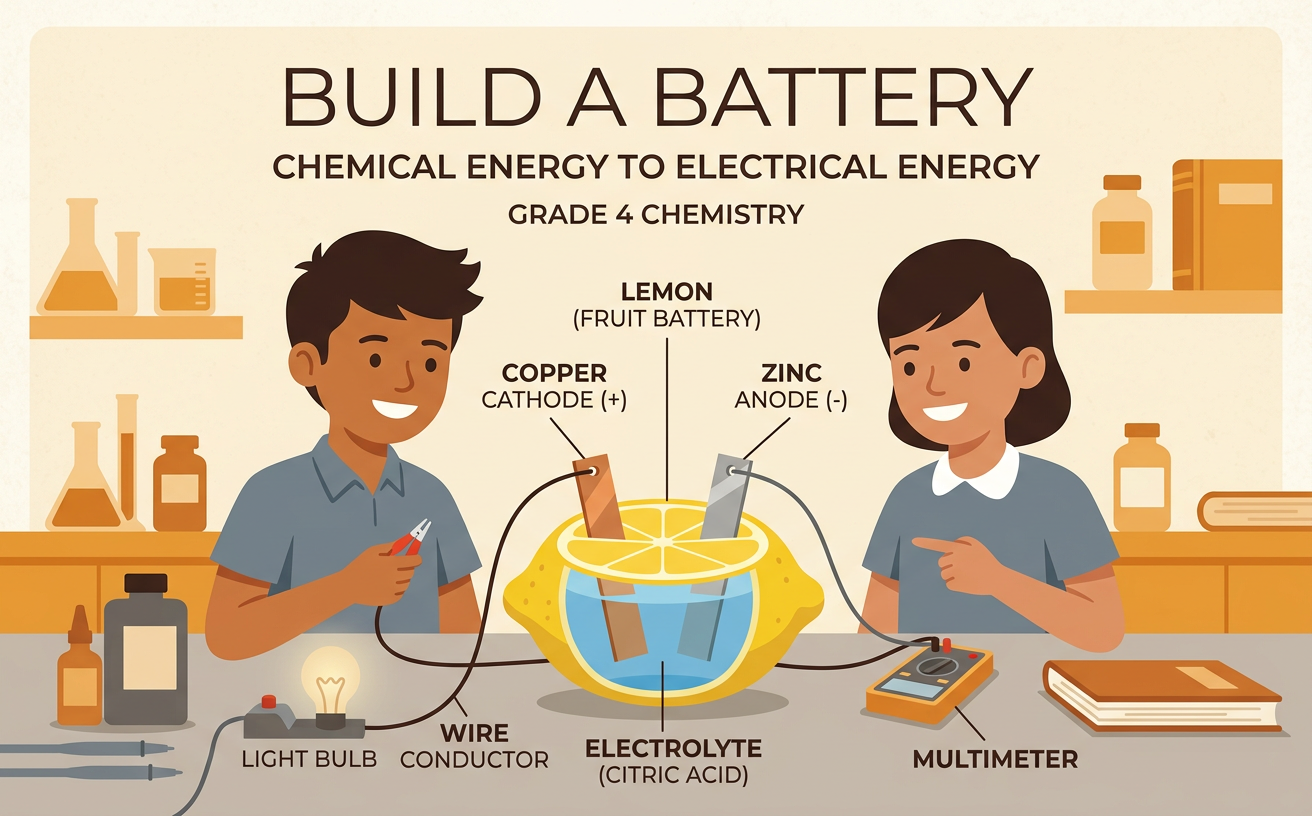
Chemical energy is energy stored in substances. In a fruit battery, chemical reactions occur when two different metals touch the fruit juice. The juice contains water and dissolved substances that allow charged particles to move. Zinc is more likely than copper to take part in a reaction that releases electrons. When the metals are connected by a wire, electrons move through the wire from the zinc metal toward the copper metal. This moving electric charge is an electric current. The battery therefore changes some chemical energy into electrical energy. For example, a lemon with a zinc-coated nail and a copper strip can produce a small voltage. It does not create enough energy to power large devices, but it can be measured safely with a classroom voltmeter.

Explore the Battery Materials
A fruit battery needs an electrolyte, two different metals, and a path for electric charge to move. The moist, acidic juice inside a lemon, lime, orange, or potato can act as the electrolyte. A zinc-coated nail and a copper strip or clean copper coin can serve as the two electrodes. Wires connect the electrodes to a voltmeter. The metals must not touch inside the fruit, or the current may take a short path that bypasses the meter. Before building, predict which fruit might produce the greatest voltage. Compare materials fairly by changing only one feature at a time. For example, use the same copper and zinc pieces with both a lemon and an orange. Wear safety goggles, do not eat tested fruit, and wash your hands after handling the materials.

Build a Fruit Battery
Gently roll a lemon on the table to loosen the juice without breaking the peel. With adult supervision, insert one zinc-coated nail and one copper strip into the lemon about an inch apart. Do not let the metals touch. Attach one clip wire to the zinc and another to the copper. Connect the free ends to a digital voltmeter. If the display shows a minus sign, switch the meter connections; the size of the voltage is still useful evidence. Record the voltage after the reading becomes steady. Test the design again to check whether the result is similar. To refine the battery, try cleaning the metals, moving them deeper into the fruit, or using a fresh fruit. Change only one part at a time so you can tell which change affected the voltage.

Measure and Graph Voltage
Voltage is a measurement of the electrical push provided by a battery. Use the same voltmeter setting for every test, and record each result in volts. Suppose three lemon trials measure 3/4 volt, 1/2 volt, and 3/4 volt. A line plot can display these measurements. Draw a number line labeled in 1/4-volt units, then place an X above the value for each trial. The example has one X above 1/2 and two Xs above 3/4. You can compare the number and position of the Xs for different designs. A plot with Xs farther to the right shows greater voltage measurements. Repeated trials also reveal whether a design gives steady results. Record the fruit type, electrode materials, design change, and voltage so another group can understand and repeat your investigation.

Connect Batteries to Natural Resources
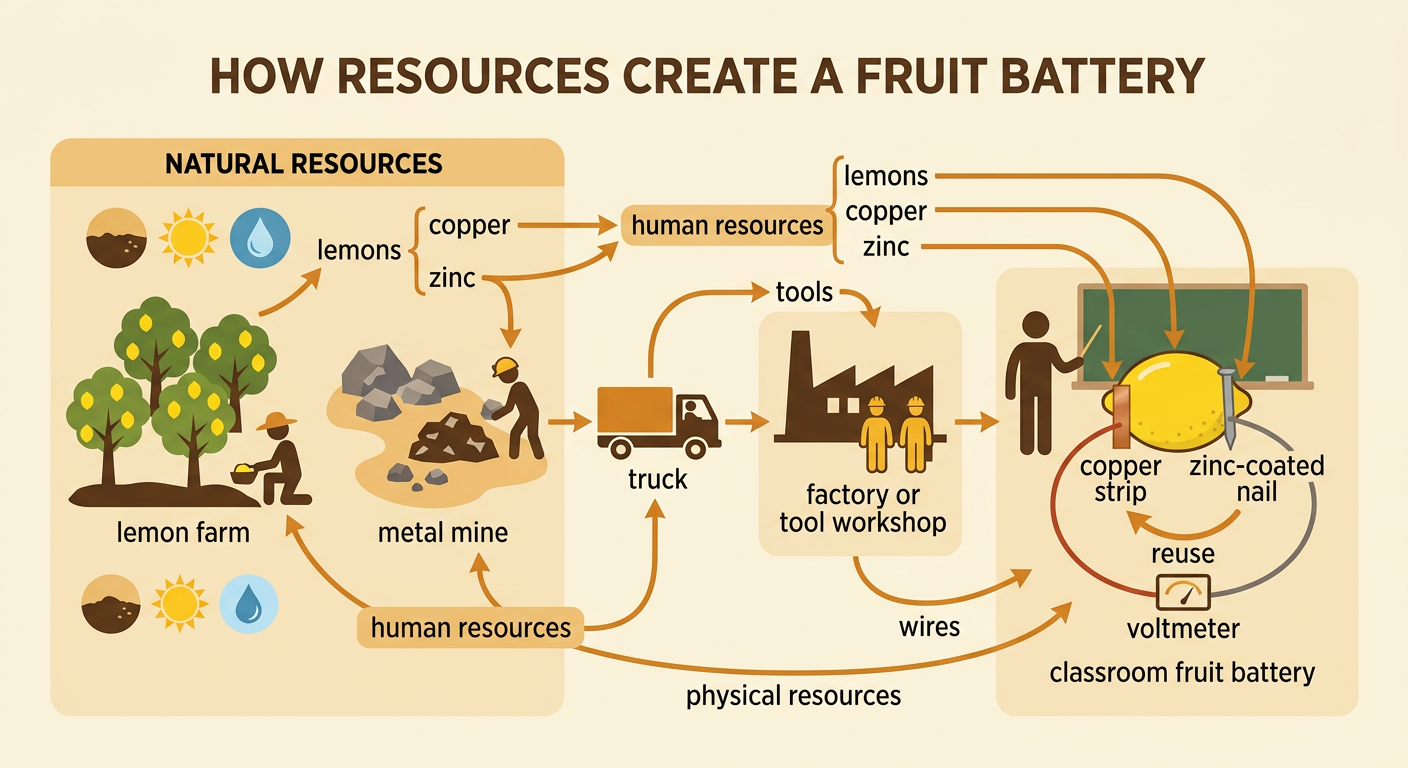
A fruit battery depends on several kinds of resources. Lemons are natural resources grown in soil with sunlight and water. Copper and zinc are natural resources obtained from rocks through mining and processing. People who farm fruit, mine ore, make wire, build meters, transport materials, and teach investigations are human resources because they contribute work and skills. Tools, trucks, factories, and voltmeters are physical resources made by people and used to produce goods or services. These resources have costs and environmental effects. For example, mining metals uses land and energy, while transporting lemons uses fuel. Using small pieces of metal again in future experiments can reduce waste. A fruit battery cannot replace an everyday commercial battery, but studying it helps engineers learn how material choices affect energy devices and how resources can be used responsibly.