Build a Digital Timeline Database
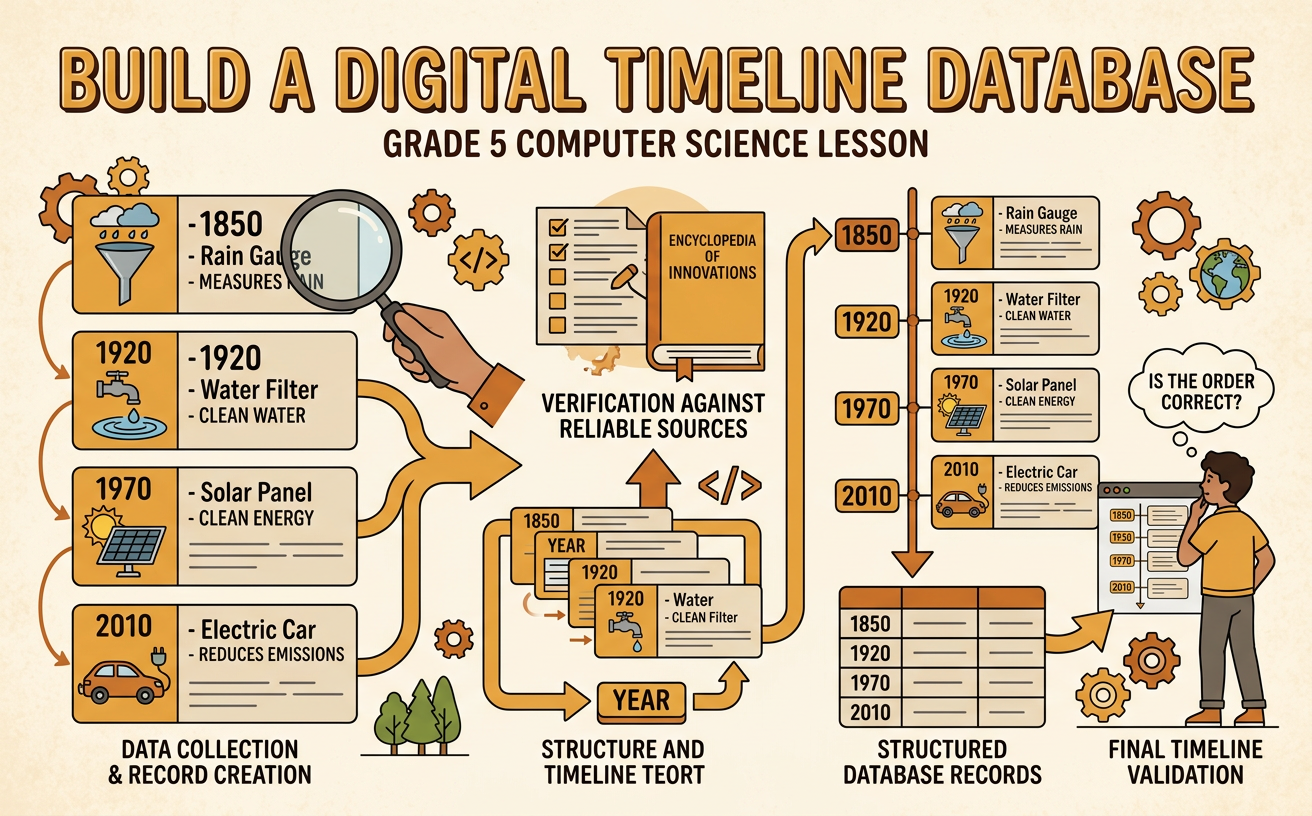
Students create structured records about environmental innovations, sort them by year, and verify that the resulting digital timeline is accurate.
Illustrations are auto-generated and may be placeholders. They can be refreshed to match the narration.
Identify Records and Fields
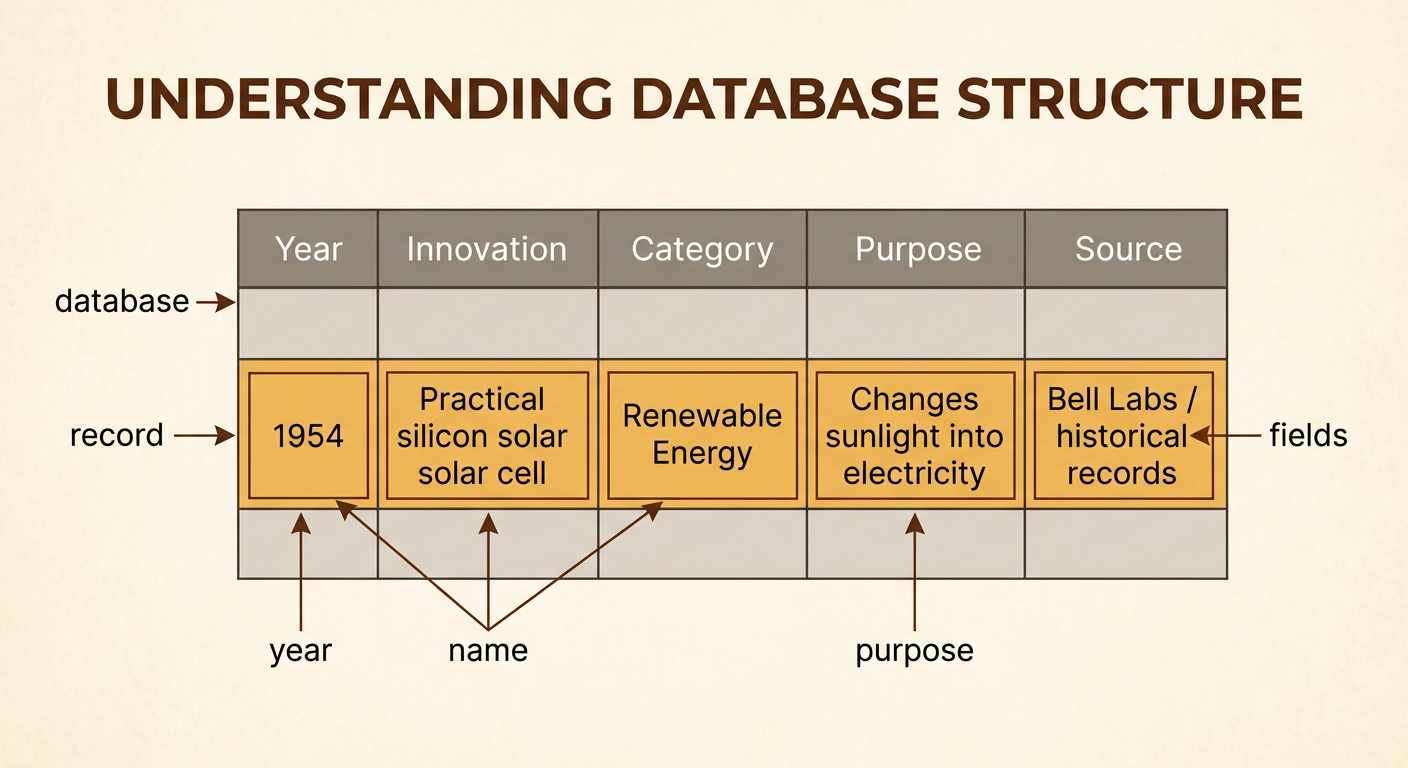
A database stores information in an organized way. Each record contains facts about one environmental innovation or development. Each field holds one type of fact, such as year, name, location, category, purpose, and source. Keeping the same fields in every record makes the information easier to search, sort, and compare. For example, one record could describe the practical silicon solar cell demonstrated by Bell Laboratories in 1954. Its year field would contain “1954,” its name field would contain “Practical silicon solar cell,” and its purpose field could explain that it changes sunlight into electricity. The source field would identify where the information was found. Think of a record as one row in a table and a field as one labeled box within that row.
Gather Environmental Innovation Facts
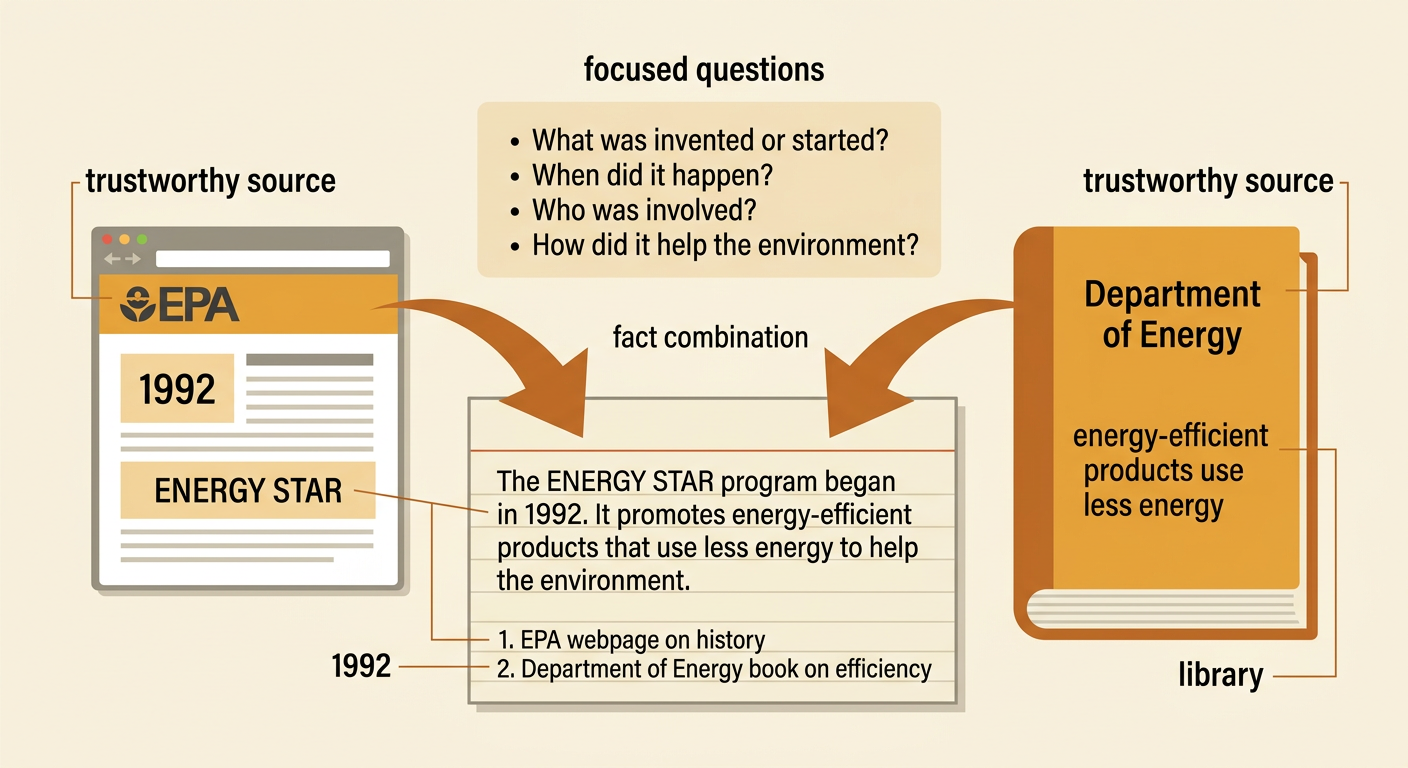
Use more than one trustworthy print or digital source to gather facts. Government agencies, museums, universities, books, and established science organizations are usually stronger sources than an unsigned webpage. First, ask focused questions: What was invented or started? When did it happen? Who was involved? How did it help protect resources or the environment? For example, an Environmental Protection Agency source can confirm that ENERGY STAR began in 1992. A Department of Energy source can help explain how energy-efficient products use less energy. Combine these details into one clear record, but do not copy whole sentences. Write the facts in your own words and save the title, organization, and link or book information for each source. If two sources disagree, look for a third reliable source before entering the fact.
Enter Consistent Data
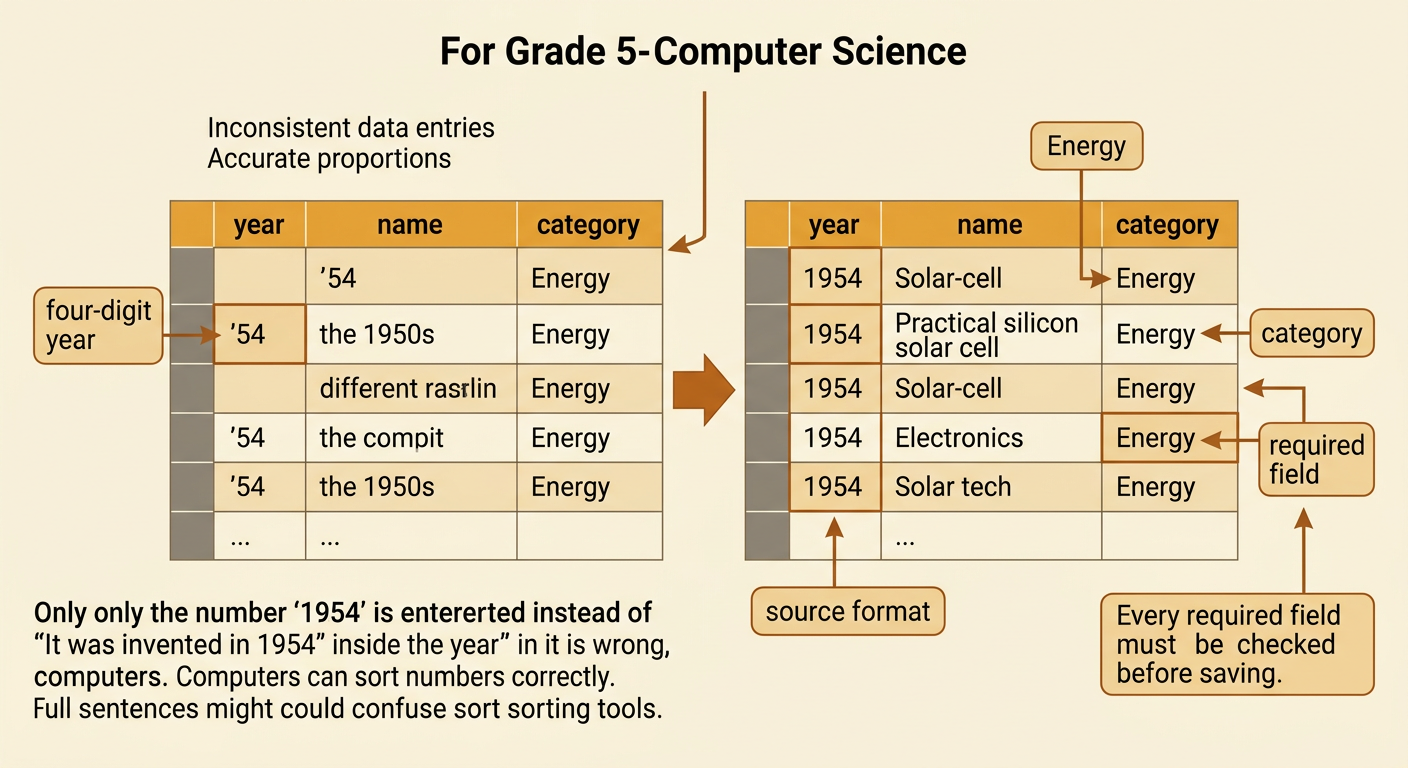
Consistent data follows the same rules in every record. Enter years as four digits, such as “1954,” rather than mixing “1954,” “’54,” and “the 1950s.” Choose standard category names, such as Energy, Water, Air, Waste, or Transportation. Use one record for each innovation, capitalize names the same way, and keep descriptions short and factual. For example, a solar-cell record might use “1954” in the year field, “Practical silicon solar cell” in the name field, and “Energy” in the category field. Do not place a sentence such as “It was invented in 1954” inside the year field because a computer may not sort that entry correctly. Before saving, check that no required field is empty and that every source is recorded in the same format.
Sort Records by Year
Sorting rearranges records according to a chosen field. To build a timeline, sort the year field in ascending order, which means from the earliest year to the latest year. A correctly sorted example might place the practical silicon solar cell in 1954, the first Earth Day in 1970, and the start of ENERGY STAR in 1992. Treat the year as a number so that 1992 does not accidentally appear before 1954. If two records have the same year, use a second field, such as month, day, or innovation name, to decide their order. Same-year records can also reveal developments that happened at about the same time. For example, the first Earth Day and the beginning of Environmental Protection Agency operations both occurred in 1970, showing a period of growing environmental action in the United States.

Verify and Explain the Timeline
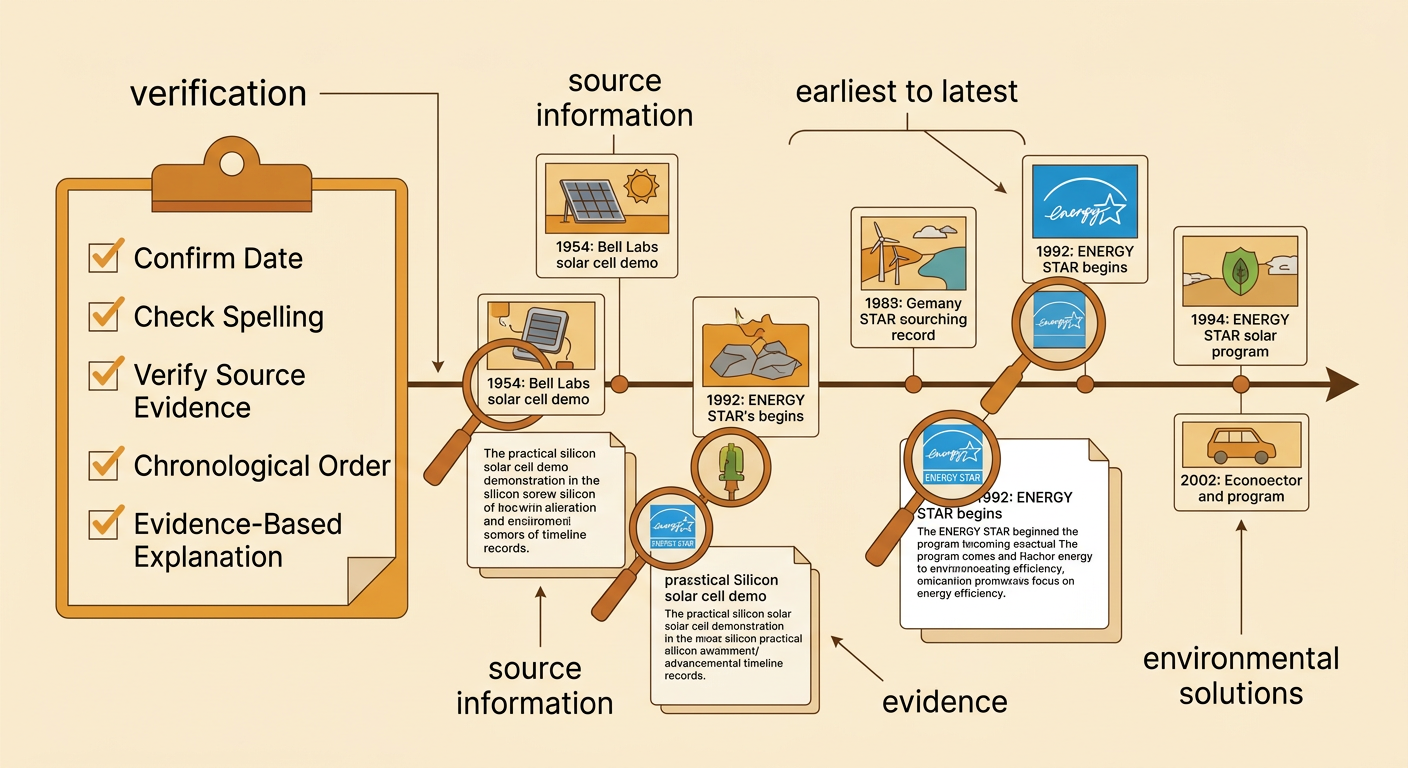
Verification means checking that the finished timeline is accurate, complete, and understandable. Read each record and compare it with its sources. Confirm the date, spelling, category, and explanation of environmental importance. Then scan the full timeline to make sure the years move from earliest to latest and no record is missing or repeated. Ask a classmate to test one record by following its source information. For example, the classmate might confirm that Bell Laboratories demonstrated a practical silicon solar cell in 1954 and that ENERGY STAR began in 1992. Finally, explain what the sequence shows. You might say that solar technology provided a way to produce electricity from sunlight, while later efficiency programs helped communities and consumers reduce energy use. A strong explanation uses evidence from records and describes how environmental solutions developed, connected, or appeared during the same period.