
Build an Animal Habitat Decision Tree
Students use yes-or-no questions and conditional logic to create a digital decision tree that classifies animals by their traits and habitats.
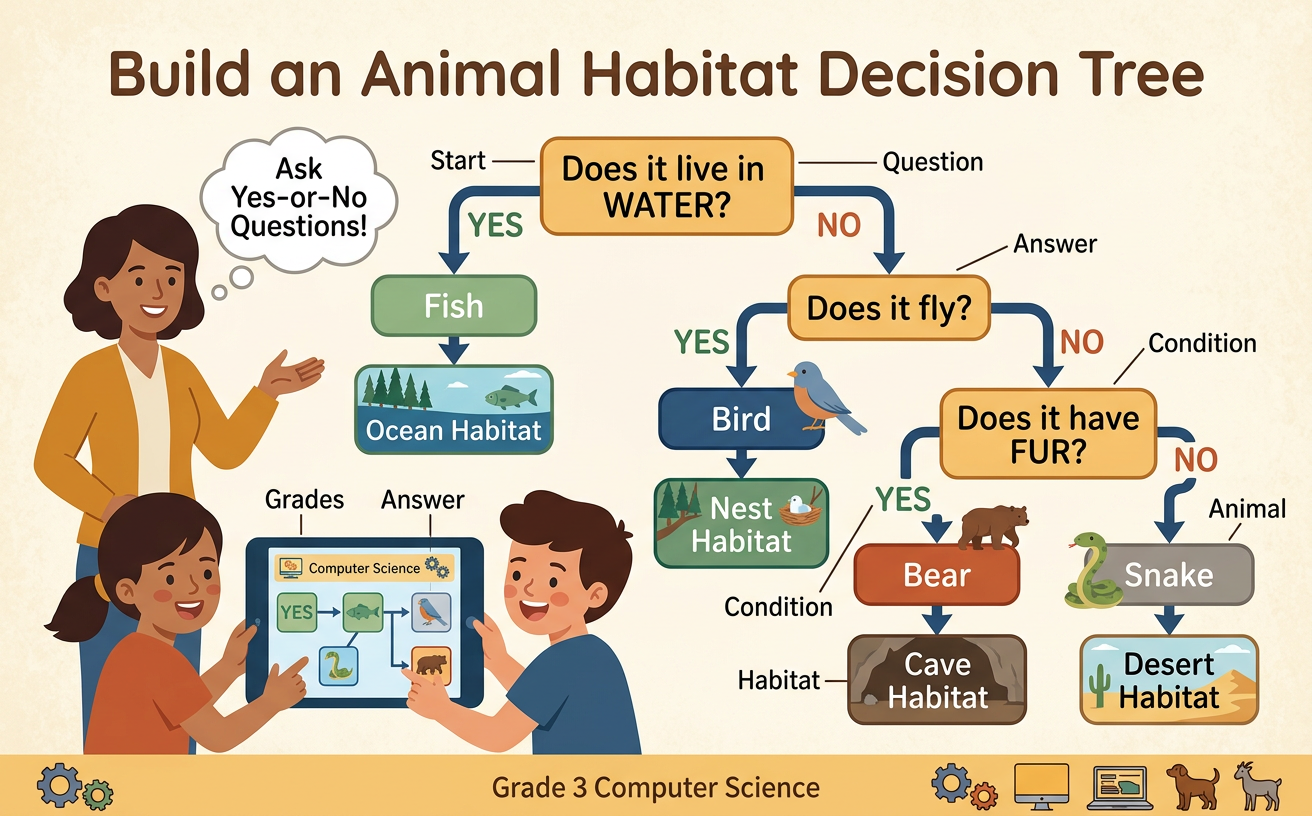
Illustrations are auto-generated and may be placeholders. They can be refreshed to match the narration.
Explore Animal and Habitat Data
Begin by collecting facts about animals and the places where they live. A habitat provides food, water, shelter, space, and suitable weather. Make a data table with one row for each animal. Include traits that can help you classify it, such as feathers, fur, fins, number of legs, and ability to swim. Also record habitat characteristics, such as temperature, water, rainfall, and plants. For example, a trout has fins and gills and lives in cool freshwater with enough oxygen. A camel has fur, four legs, and body features that help it survive in a hot, dry desert. Use reliable books, articles, or teacher-provided sources. Record facts rather than guesses. Your organized data will become evidence for choosing useful questions in a decision tree.

Learn How Decision Trees Work
A decision tree is a tool that sorts information by following a path of questions. It begins at a starting question called the root. Each question has branches for possible answers. In this lesson, every question will have a Yes branch and a No branch. The path ends at a result called a leaf. Imagine sorting a trout, frog, rabbit, and eagle. Start with “Does it have feathers?” A Yes answer leads to eagle. A No answer leads to another question: “Does it have fins?” Yes leads to trout. If not, ask whether it has moist, smooth skin. Yes leads to frog, while No leads to rabbit. Each answer narrows the choices. A good decision tree uses observable facts and gives one clear result at the end of each path.

Write Yes-or-No Conditions
A condition is a statement that can be checked as true or false. Turn each condition into a clear yes-or-no question. Choose traits that are easy to observe or confirm with data. “Does the animal have feathers?” is useful because the answer is either Yes or No. “Is the animal interesting?” is not useful because people may disagree. Write conditions that separate the remaining animals into groups. You can also use habitat facts, such as “Does it live mostly in water?” For example, this question separates a dolphin and trout from a rabbit and lizard. Next, “Does it breathe with gills as an adult?” separates the trout from the dolphin. Avoid questions with two ideas, such as “Does it have fins and live in cold water?” Ask about one fact at a time so every branch is clear.

Build the Digital Decision Tree
Use a slide tool, drawing program, or block-based coding app to build your tree. Place the first question at the top. Add two connected branches labeled Yes and No. Put another question or a final animal result at the end of each branch. In a coding app, conditional logic may appear as “if,” “then,” and “else.” For example: if the animal has feathers, then show “eagle”; else ask whether it has fins. Continue until every animal in your data set has a result. Keep branch lines from crossing when possible, and use the same wording from your data table. You may add small animal or habitat pictures, but the questions and labels must remain easy to read. Save your work often and give the file a clear name, such as “Animal Habitat Decision Tree.”

Test, Debug, and Explain
Test your decision tree by choosing one animal and answering each question with facts from your data table. Trace the path and check whether it reaches the correct result. Repeat the test for every animal. Debugging means finding and fixing problems. If a frog reaches “trout,” inspect each question and branch. Perhaps “Does it live in water?” was too broad because both animals can be found in or near water. Replace it with a more precise condition, such as “Does the adult breathe with gills?” Ask a classmate to test an animal without your help. Record any wrong result, explain the cause, and describe your change. Finally, write a short explanation using evidence. You might explain that trout survive well in cool freshwater because their gills take oxygen from water, while they cannot survive in a dry desert habitat.
