Build Teen Numbers
Students compose and decompose numbers 11 through 19 as one group of ten and some additional ones.
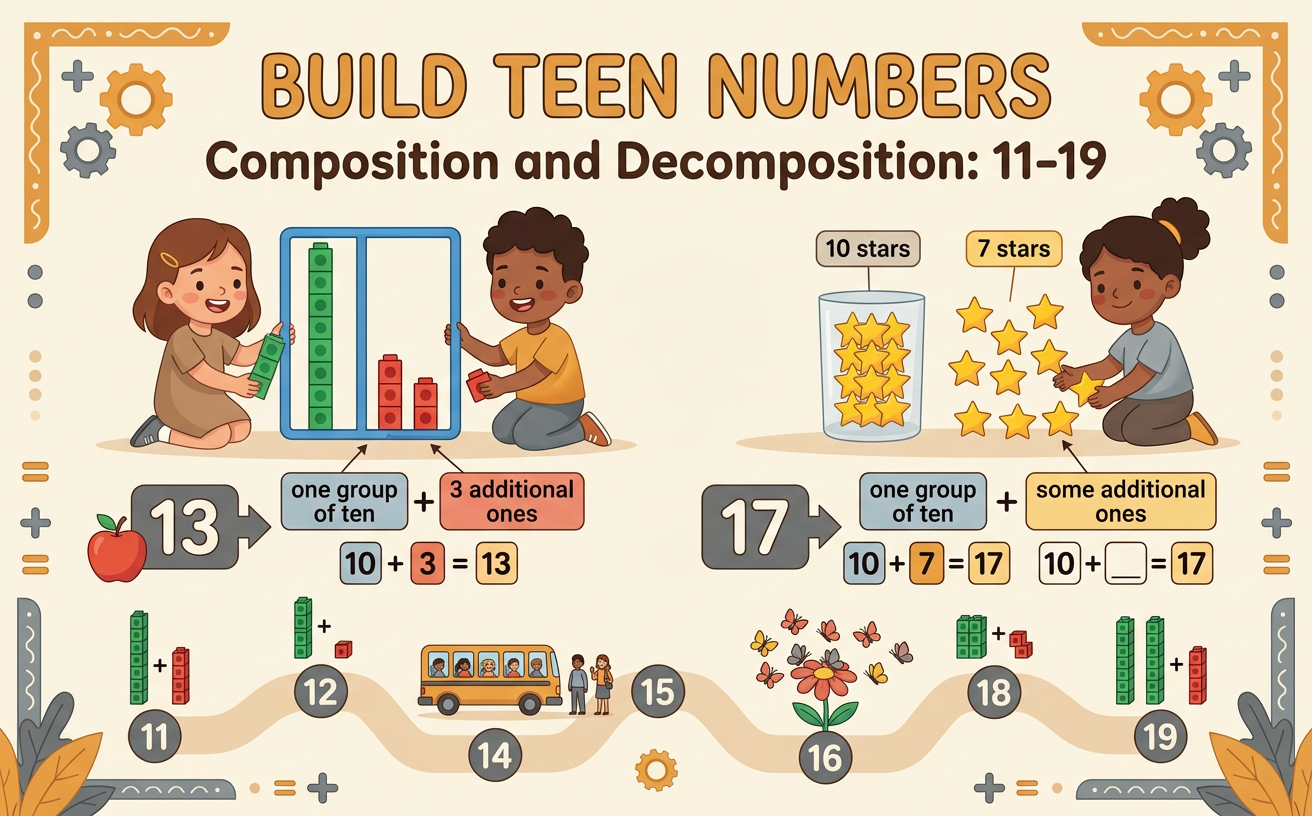
Illustrations are auto-generated and may be placeholders. They can be refreshed to match the narration.
Review Groups of Ten
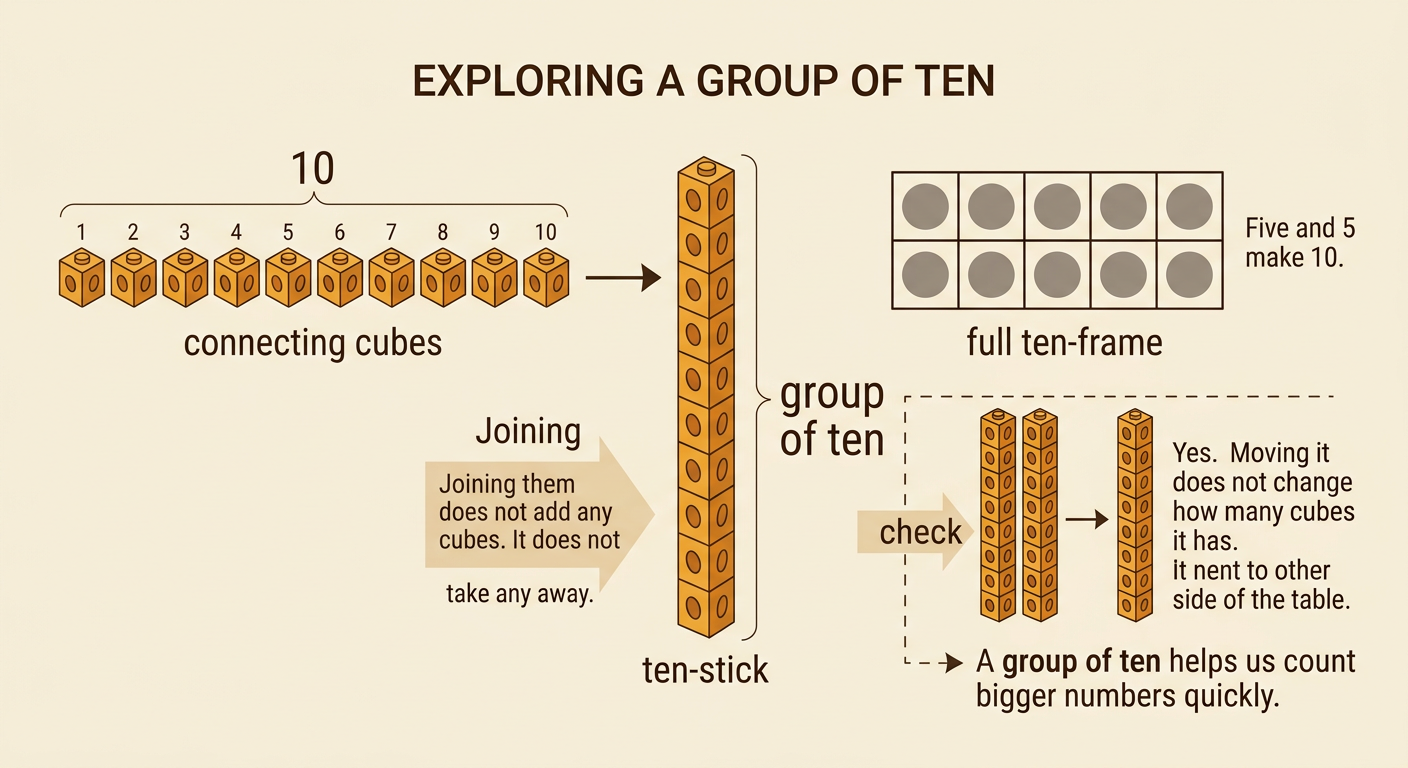
A group of ten has exactly 10 objects. Count 10 connecting cubes: 1, 2, 3, 4, 5, 6, 7, 8, 9, 10. Snap the cubes together to make one long stick. The stick is still 10 cubes, even though the cubes are joined. We can call it one group of ten. A full ten-frame also shows one group of ten because all 10 spaces are filled. Look at a full ten-frame and count the dots by rows. There are 5 dots in the top row and 5 dots in the bottom row. Since 5 and 5 make 10, the frame shows 10 ones. Making a group of ten helps us count larger numbers quickly.
Build a Teen Number
Teen numbers are numbers from 11 through 19. Each teen number is made of one group of ten and some more ones. Let us build 14. First, make a stick using 10 connecting cubes. Then place 4 single cubes beside the stick. Count from 10 as you touch the single cubes: 11, 12, 13, 14. The ten-stick and 4 single cubes make 14 cubes altogether. The ten-stick does not change into a different amount. It is still 10. The 4 extra cubes are ones. We can say, “Fourteen is one ten and four ones.” Try moving the cubes closer together or farther apart. The total stays 14 because no cubes were added or taken away.
Separate Tens and Ones
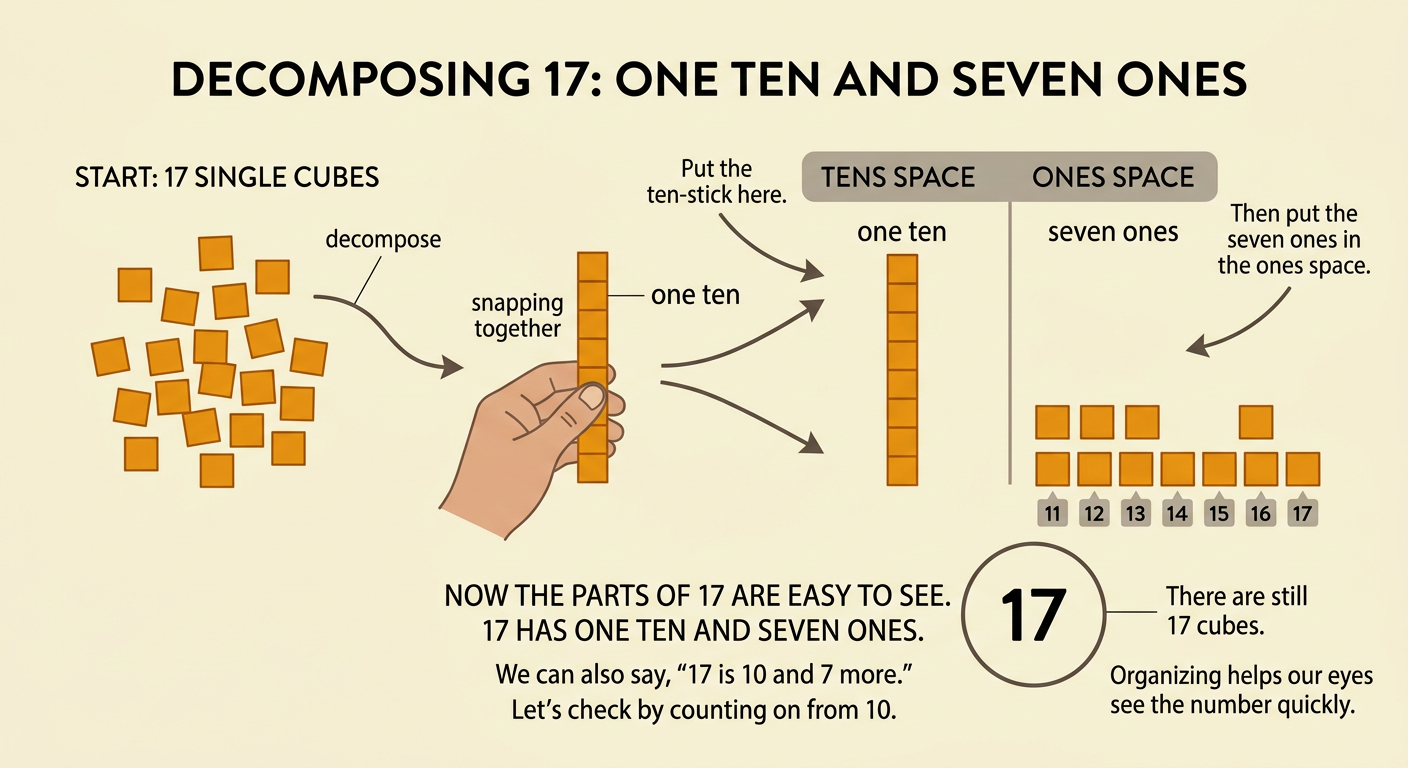
We can take apart, or decompose, a teen number into one ten and some ones. Suppose we have 17 cubes. Count out 17 single cubes. Choose 10 cubes and snap them together to make one ten-stick. There are 7 single cubes left. Put the ten-stick in the tens space and the 7 single cubes in the ones space. Now the parts are easy to see. The number 17 has 1 ten and 7 ones. We can also say that 17 is 10 and 7 more. Check the total by counting on from 10: 11, 12, 13, 14, 15, 16, 17. Separating the number into tens and ones does not change how many cubes there are.
Draw the Number
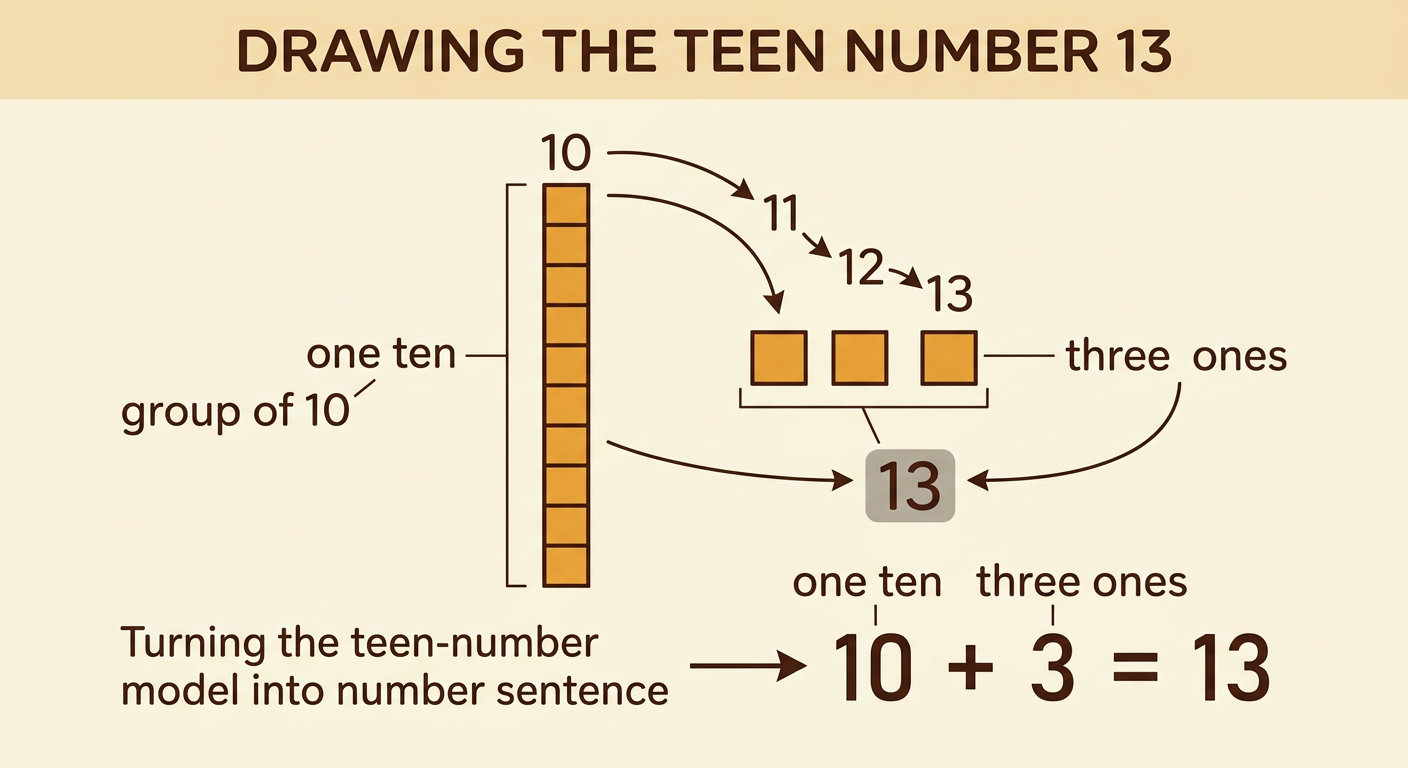
A drawing can show a teen number when cubes are not available. Let us draw 13. Draw one long rectangle to stand for a group of 10. Add 10 small dividing lines or boxes so it is clear that the long shape represents 10 cubes. Next, draw 3 small squares beside it. Each small square stands for one cube. Count the drawing: start with 10, then count the squares as 11, 12, 13. The picture shows 1 ten and 3 ones. You can also use a full ten-frame and 3 dots in a second ten-frame. Both drawings represent the same number. Be sure your picture shows exactly 10 in the group and exactly 3 extra ones.
Record and Share
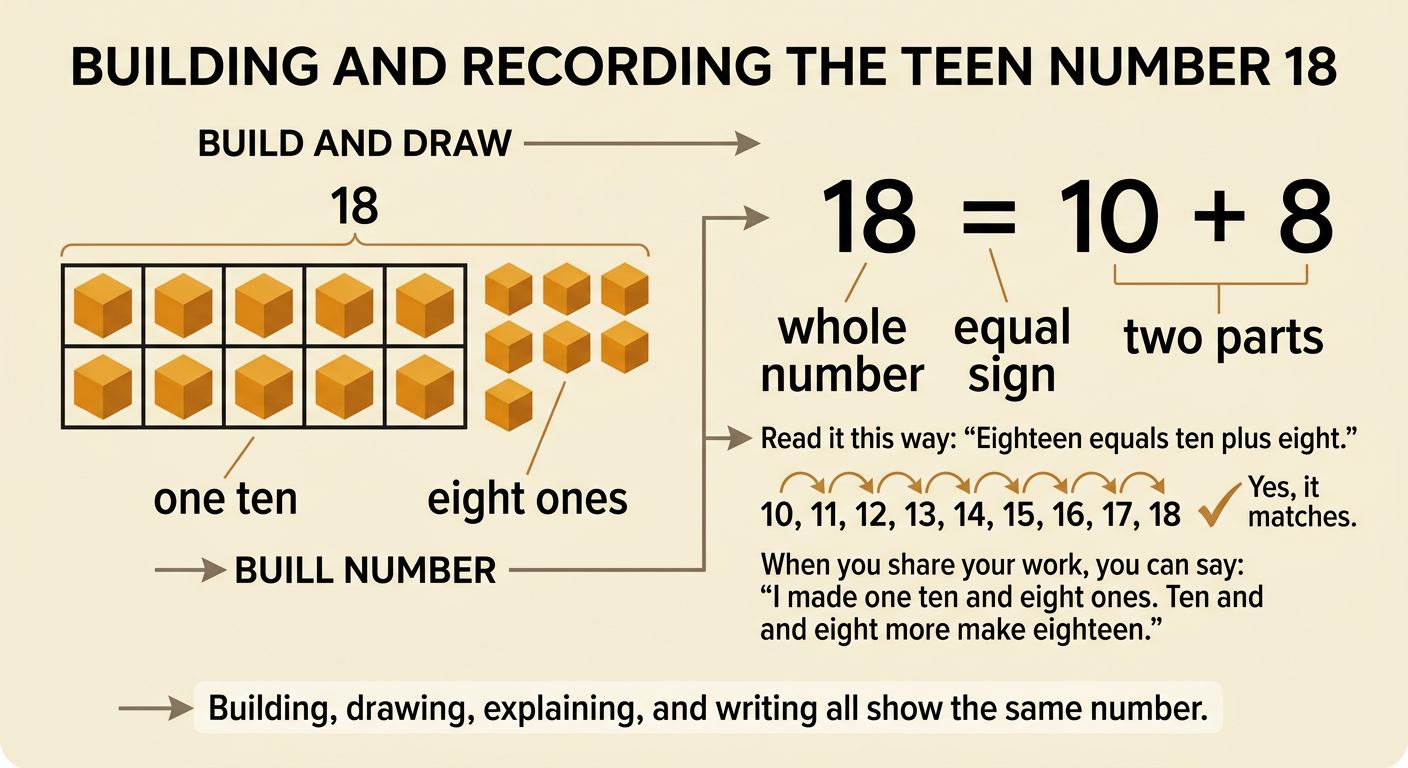
After building or drawing a teen number, record the parts with an equation. If you built 18, you have one group of 10 and 8 more ones. Write 18 = 10 + 8. Read it aloud: “Eighteen equals ten plus eight.” The equal sign means that both sides show the same amount. On the left is the whole number, 18. On the right are its two parts, 10 and 8. Share your work by showing your objects or drawing and explaining how you know. You might say, “I made one ten and eight ones. Ten and eight more make eighteen.” Check by counting the 8 ones after 10: 11, 12, 13, 14, 15, 16, 17, 18.