
Building and Solving Quadratic Equations
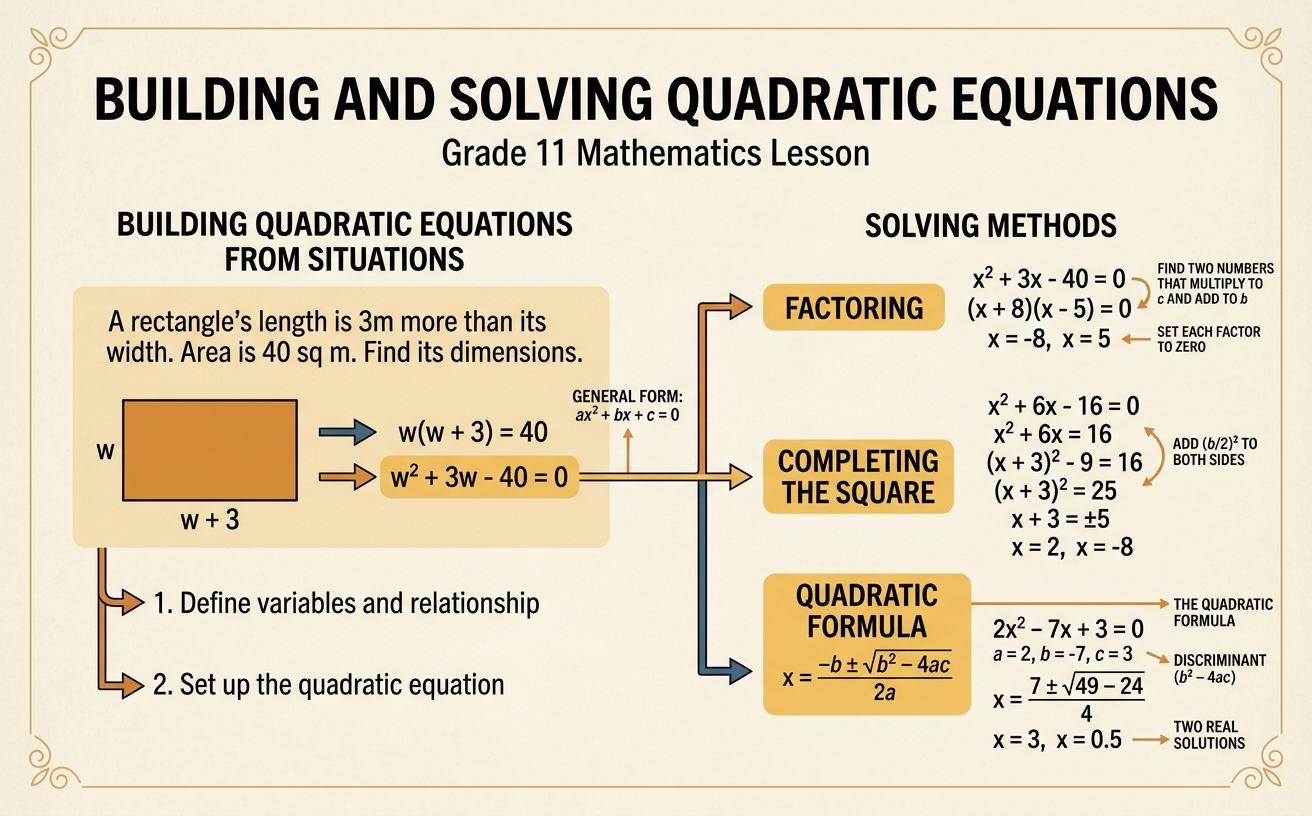
Students create quadratic equations from situations and solve them by factoring, completing the square, and applying the quadratic formula.
Illustrations are auto-generated and may be placeholders. They can be refreshed to match the narration.
Standard and Factored Forms
A quadratic equation can be written in standard form as ax² + bx + c = 0, where a is not zero. Standard form clearly displays the coefficients a, b, and c. Factored form is written as a(x − r₁)(x − r₂) = 0, where r₁ and r₂ are solutions, or roots. For example, suppose a rectangular garden has width x feet, length x + 3 feet, and area 40 square feet. The situation produces x(x + 3) = 40. Expanding and moving all terms to one side gives x² + 3x − 40 = 0. Factoring gives (x + 8)(x − 5) = 0. Thus, the algebraic roots are −8 and 5. The forms are equivalent, but each highlights different information about the equation.
Factoring Quadratics
Factoring solves a quadratic by rewriting it as a product and using the zero-product property. First place the equation in standard form with zero on one side. For x² + 5x − 24 = 0, find two numbers whose product is −24 and whose sum is 5. The numbers are 8 and −3, so the trinomial factors as (x + 8)(x − 3) = 0. The zero-product property states that if a product equals zero, at least one factor must equal zero. Set x + 8 = 0 or x − 3 = 0. This gives x = −8 or x = 3. Factoring is especially efficient when the coefficients are integers and the factors can be identified quickly. Always multiply the factors to confirm that they reproduce the original quadratic.
Completing the Square
Completing the square rewrites a quadratic expression as a squared binomial. Consider x² + 6x − 7 = 0. Move the constant term to obtain x² + 6x = 7. Take half of the x-coefficient, 6 ÷ 2 = 3, and square it to get 9. Add 9 to both sides: x² + 6x + 9 = 16. The left side is now the perfect square (x + 3)², so (x + 3)² = 16. Take the square root of both sides, remembering both signs: x + 3 = ±4. Therefore, x = 1 or x = −7. Adding the same value to both sides preserves equality. This method works even when a quadratic does not factor conveniently and also helps convert an equation into vertex form.
Quadratic Formula
The quadratic formula solves any equation in standard form ax² + bx + c = 0: x = (−b ± √(b² − 4ac))/(2a). For 2x² + 3x − 2 = 0, identify a = 2, b = 3, and c = −2. Substitute carefully: x = (−3 ± √(3² − 4(2)(−2)))/(2(2)). The expression under the radical becomes 9 + 16 = 25, so x = (−3 ± 5)/4. Using the plus sign gives x = 1/2, and using the minus sign gives x = −2. The quantity b² − 4ac is the discriminant. A positive discriminant gives two distinct real solutions, zero gives one repeated real solution, and a negative discriminant gives two nonreal complex solutions.
Checking and Interpreting Solutions
Solutions should be checked in the original equation and interpreted in the context of the situation. Return to the garden equation x(x + 3) = 40, whose algebraic solutions are x = 5 and x = −8. Substituting 5 gives 5(5 + 3) = 5 · 8 = 40, so it checks. Substituting −8 gives (−8)(−8 + 3) = (−8)(−5) = 40, so it also satisfies the equation algebraically. However, x represents the garden’s width, and a physical length cannot be negative. Therefore, −8 is not reasonable in this context, while the garden dimensions are 5 feet by 8 feet. Checking catches arithmetic errors, and interpretation separates algebraically valid roots from answers that meet a situation’s restrictions, such as positive time, distance, or length.