Building Equivalent Fractions
Students use visual fraction models and multiplication to generate and explain equivalent fractions.
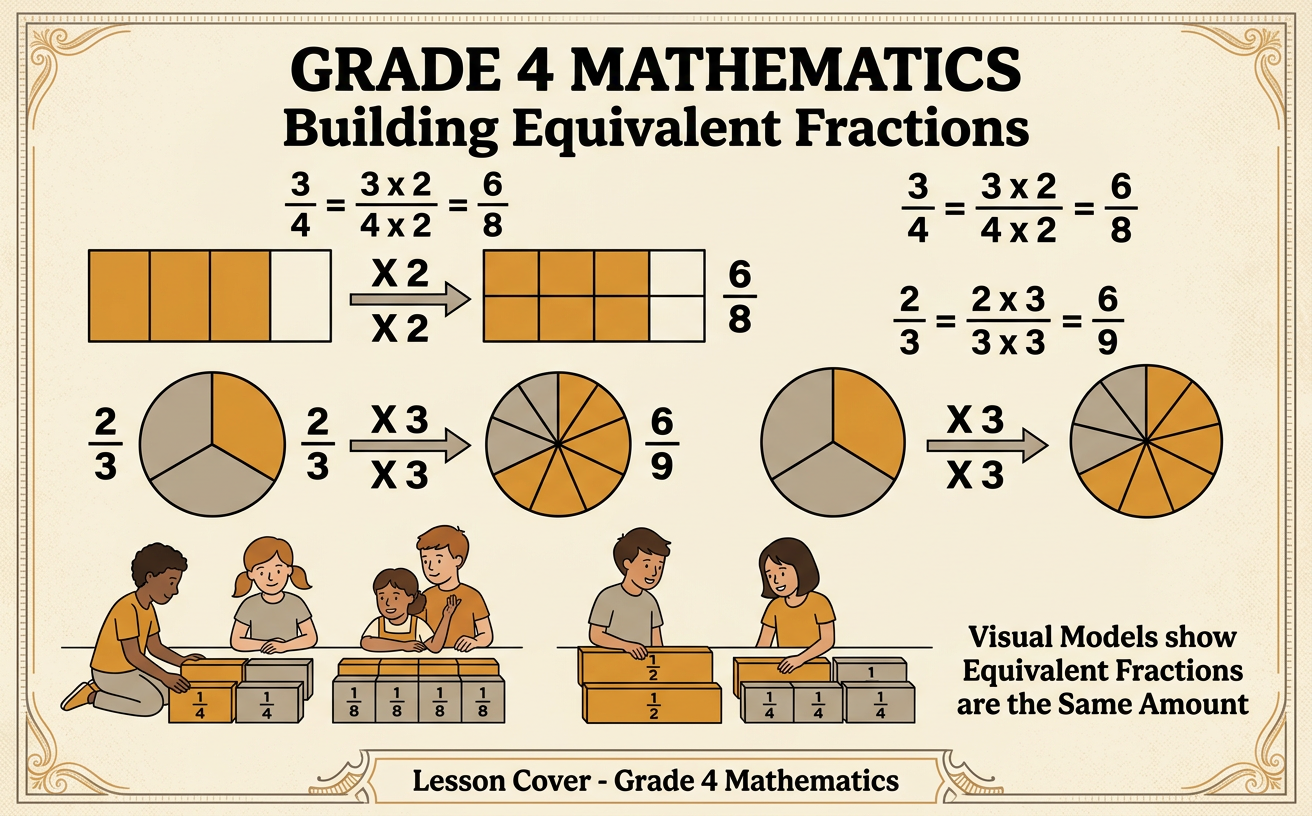
Illustrations are auto-generated and may be placeholders. They can be refreshed to match the narration.
Review Fraction Parts
A fraction describes equal parts of one whole. The bottom number, called the denominator, tells how many equal parts make the whole. The top number, called the numerator, tells how many of those parts are being counted. In the fraction 3/4, the denominator 4 means the whole is divided into four equal parts. The numerator 3 means three of those parts are counted. Imagine one rectangular granola bar divided into four equal pieces. If three pieces are shaded, the shaded amount is 3/4 of the bar. Equal-sized parts are important. If the four pieces are not the same size, they do not correctly model fourths. The numerator and denominator work together to name one exact amount.

Compare Visual Fraction Models
Equivalent fractions name the same amount even though they use different numbers. Compare two equal-sized fraction bars. Divide the first bar into two equal parts and shade one part to show 1/2. Divide the second bar into four equal parts and shade two parts to show 2/4. The shaded lengths are exactly the same. In the second model, each half was divided into two smaller equal pieces. The number of all parts changed from 2 to 4, and the number of shaded parts changed from 1 to 2. However, the total shaded amount did not change. Therefore, 1/2 and 2/4 are equivalent fractions. Visual models make this relationship easy to see because their wholes are the same size and aligned.

Generate Equivalent Fractions
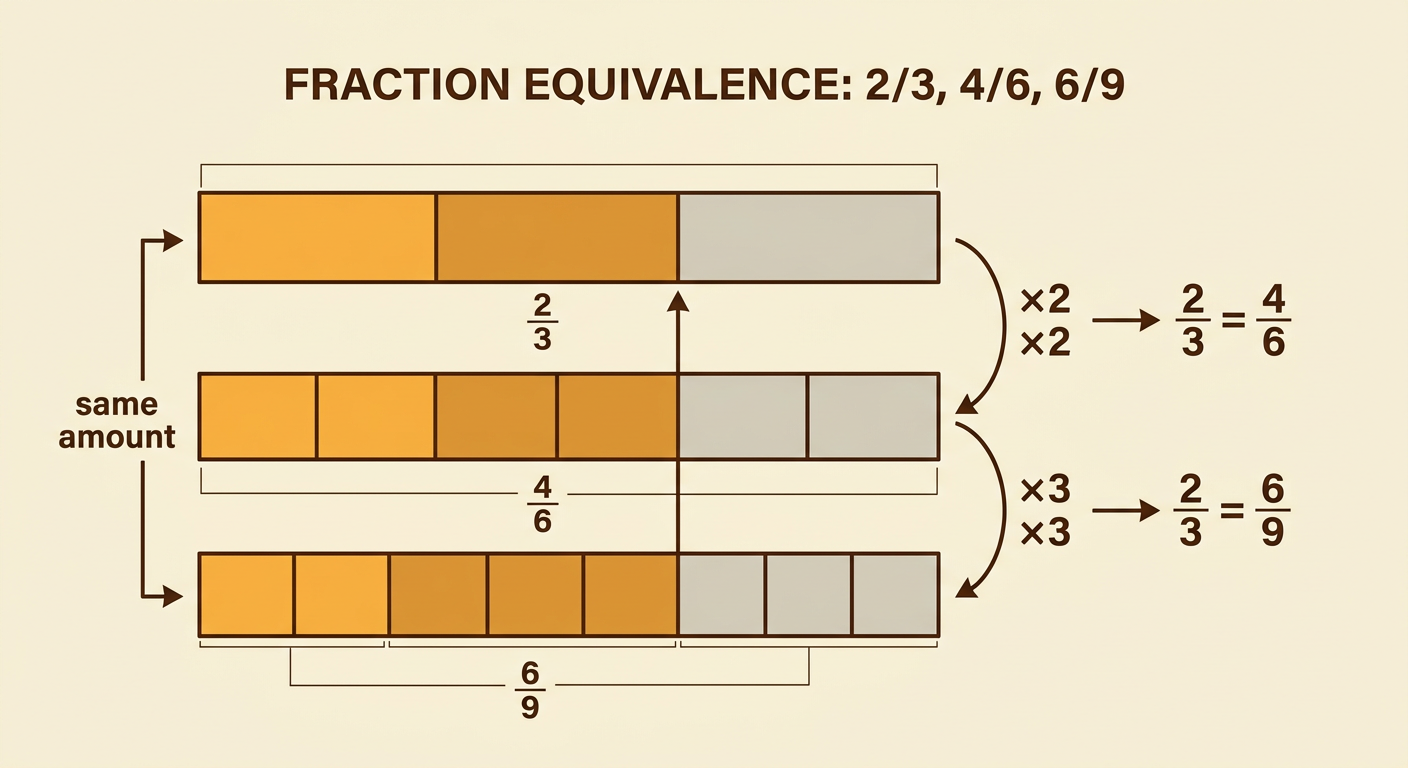
You can generate an equivalent fraction by multiplying the numerator and denominator by the same whole number. Start with 2/3. Multiply both numbers by 2: (2 × 2)/(2 × 3) = 4/6. This means 2/3 = 4/6. A fraction model explains why. Begin with a bar divided into three equal parts and shade two. Then divide every third into two smaller equal pieces. The whole now contains six equal pieces, and four of them are shaded. The amount of the bar that is shaded has not changed. You can make another equivalent fraction by multiplying by 3: (3 × 2)/(3 × 3) = 6/9. Thus, 2/3, 4/6, and 6/9 all name the same amount.
Explain the Multiplication Pattern
When you multiply the numerator and denominator by the same number, you change how the whole is partitioned, not how much of the whole is named. Consider 3/5. Multiplying both numbers by 2 gives (2 × 3)/(2 × 5) = 6/10. Each of the original five equal parts is split into two smaller equal parts, so the denominator doubles from 5 to 10. Each of the three selected parts also becomes two pieces, so the numerator doubles from 3 to 6. There are more pieces, but every piece is smaller. The selected amount remains the same. Multiplying by 2/2 is also like multiplying by one because 2/2 equals one. Therefore, the value of the fraction does not change: 3/5 = 6/10.

Complete an Exit Check
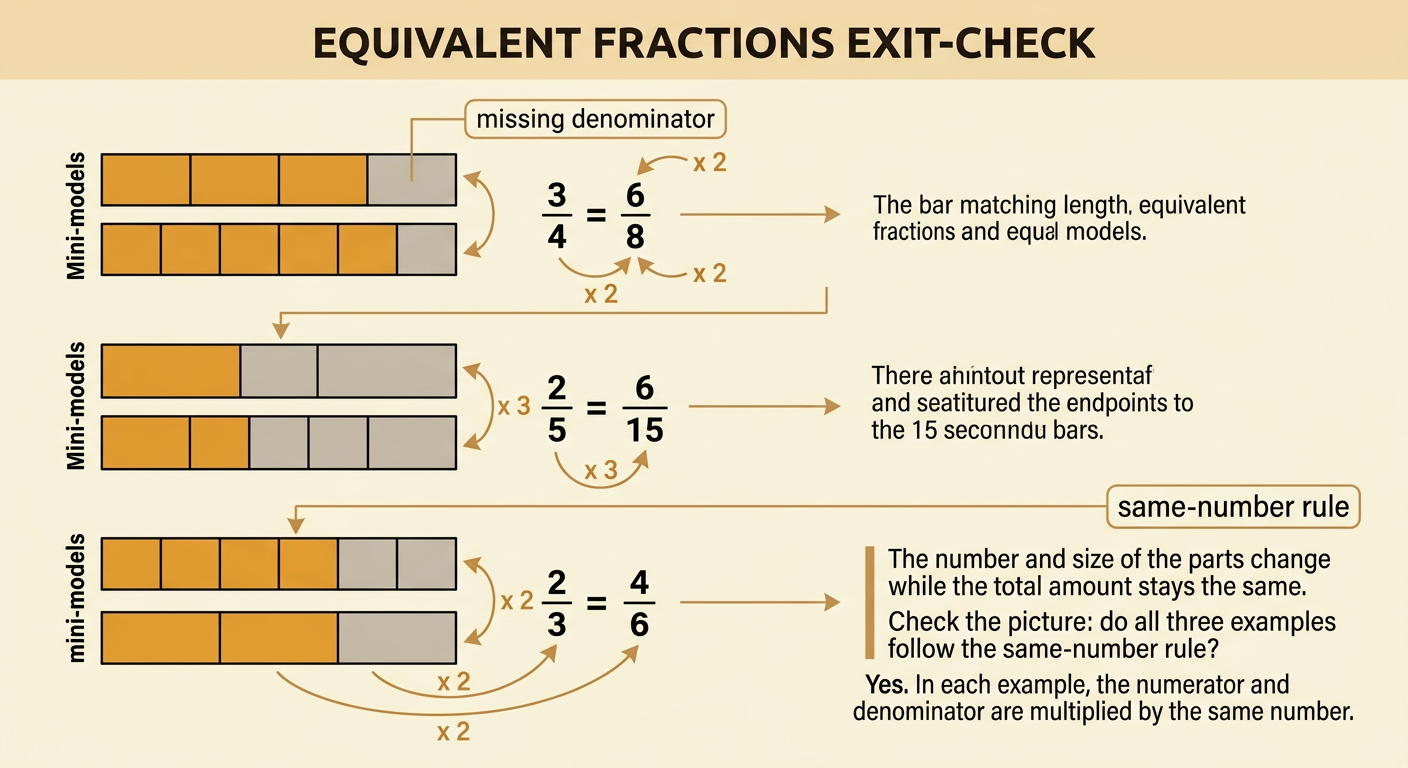
Use what you learned to complete this check. First, fill in the missing number: 3/4 = 6/__. Since 3 was multiplied by 2 to make 6, multiply 4 by 2 also. The missing denominator is 8, so 3/4 = 6/8. Next, decide whether 2/5 and 6/15 are equivalent. Multiplying both parts of 2/5 by 3 gives 6/15, so they are equivalent. Finally, explain why 4/6 = 2/3. A model can show both fractions with the same shaded amount, or you can notice that 2/3 multiplied by 2/2 equals 4/6. In every explanation, state that the number and size of the parts change while the total amount stays the same.