
Building Equivalent Linear Expressions
Students identify parts of linear expressions and use properties of operations to simplify, expand, and factor expressions with rational coefficients.

Illustrations are auto-generated and may be placeholders. They can be refreshed to match the narration.
Terms, Coefficients, and Constants
An algebraic expression contains numbers, variables, and operation symbols, but it does not include an equals sign. A term is a part separated by addition or subtraction. In 5x + 8 - 2x, the terms are 5x, 8, and -2x. A coefficient is the number multiplying a variable, so 5 and -2 are coefficients. A constant is a term without a variable, such as 8. Like terms have identical variable parts. The terms 5x and -2x are like terms, but 5x and 5y are not. Correctly identifying these parts helps us simplify expressions. For example, 7n + 3 + 2n contains two variable terms that can be combined and one constant term.

Using the Distributive Property
The distributive property allows a factor outside parentheses to multiply every term inside. For example, 4(x + 3) means four groups of x + 3. Multiplying 4 by both terms gives 4x + 12. The same rule applies when subtraction or negative numbers are involved. The expression -2(3y - 5) becomes -6y + 10 because -2 times 3y is -6y and -2 times -5 is positive 10. A common error is multiplying only the first term inside the parentheses. To check your work, count the terms inside the parentheses and make sure each received the outside factor. Distributing removes grouping symbols while preserving the expression's value.
Combining Like Terms
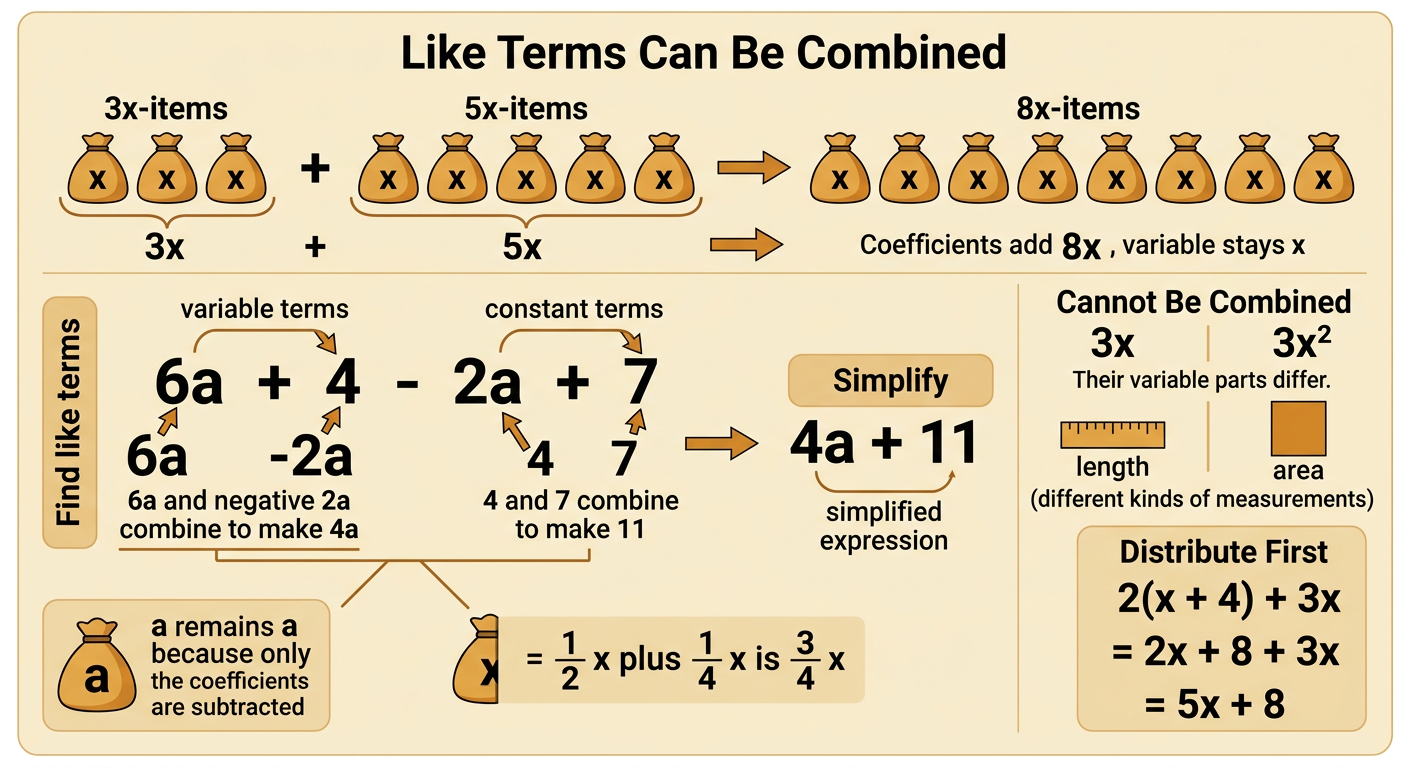
Like terms can be combined because they represent the same kind of quantity. Three x-items plus five x-items equals eight x-items, so 3x + 5x simplifies to 8x. Only the coefficients are added or subtracted; the variable stays the same. To simplify 6a + 4 - 2a + 7, first group like terms. Combine 6a - 2a to get 4a, and combine 4 + 7 to get 11. The simplified expression is 4a + 11. Terms such as 3x and 3x squared cannot be combined because their variable parts differ. When an expression has parentheses, distribute first and then combine like terms. For example, 2(x + 4) + 3x simplifies to 2x + 8 + 3x, or 5x + 8.
Factoring Linear Expressions
Factoring reverses the distributive property. Instead of multiplying a factor by terms in parentheses, we identify a common factor and place it outside parentheses. In 6x + 18, both terms have a factor of 6. Dividing each term by 6 gives x + 3, so 6x + 18 can be written as 6(x + 3). For 12y - 8, a common factor is 4, producing 4(3y - 2). The original and factored forms are equivalent because distributing the outside factor returns the original expression. Factoring can make the structure of an expression easier to see and can simplify later calculations. Always check a factored expression by distributing to confirm that every original term is produced with the correct sign.
Checking Whether Expressions Are Equivalent
Equivalent expressions have the same value for every permitted value of the variable. Properties of operations provide the strongest way to show equivalence. For example, 3(2x + 4) and 6x + 12 are equivalent by the distributive property. Substituting values can also help check your reasoning. If x = 5, the first expression is 3(10 + 4), or 42, and the second is 30 + 12, also 42. Testing one value supports a conclusion, but it does not prove that two expressions are always equivalent. To decide whether 4x + 2x and 6x squared are equivalent, simplify the first expression to 6x. Since 6x and 6x squared have different variable parts, they are not equivalent. Using algebraic properties explains why equivalence holds or fails.