
Building the Pyramids: Engineering, Labor, and Evidence
Students use archaeological evidence, engineering constraints, and ratio reasoning to evaluate explanations of how ancient Egyptians organized labor and constructed pyramids.

Illustrations are auto-generated and may be placeholders. They can be refreshed to match the narration.
Purpose of the Pyramids
Ancient Egyptian pyramids were royal tombs and powerful religious monuments. Egyptians believed that a king’s spirit could continue into the afterlife, so they placed the king’s burial chamber within a protected monument. Pyramid complexes also included temples, courtyards, causeways, and smaller tombs where ceremonies honored the dead ruler. Their great size displayed the king’s authority and the government’s ability to organize people and resources. For example, the Great Pyramid at Giza was built for Pharaoh Khufu around 2600 BCE. Archaeologists connect it to Khufu through evidence such as ancient inscriptions and its place in his surrounding complex. However, many valuable burial objects disappeared through ancient robbery. Historians must therefore combine evidence from the structure, nearby buildings, inscriptions, and later records instead of relying on a complete tomb.

Evidence from Ancient Egypt
Archaeologists use several kinds of evidence to investigate pyramid construction. Near Giza, they found a settlement with bakeries, storage areas, animal bones, tools, and buildings that may have housed workers and administrators. These finds indicate that large crews received food and worked within an organized supply system. Marks inside the Great Pyramid name work groups, including one associated with Khufu. A papyrus journal written by an official named Merer records a crew transporting limestone by boat to Akhet-Khufu, the ancient name of the Great Pyramid. This primary source describes one part of the supply process, not every stage of construction. Later writings and modern experiments are secondary evidence that can offer ideas but may contain gaps or errors. For example, Merer’s journal supports water transport of stone, yet it does not explain the exact ramp design used to lift blocks.

Construction Criteria and Constraints
A successful construction plan had to meet criteria: blocks needed to reach the correct height, fit accurately, and be moved without unacceptable injury or delay. Builders also faced constraints, including gravity, friction, limited time, available labor, stone weight, and tools made mainly from wood, stone, and copper. Water transport could move heavy loads efficiently, while sledges could spread a block’s weight over the ground. Wetting sand may have reduced the force needed to pull a loaded sledge under some conditions. Ratio reasoning helps estimate resources. Suppose one team can move 12 blocks in 3 days. At the same rate, it moves 4 blocks per day, so moving 40 blocks would take 10 days. Real work rates would change with distance, slope, weather, repairs, and block size. Engineers must therefore treat a simple ratio as an estimate and test whether its assumptions are realistic.

Testing Ramp and Labor Theories
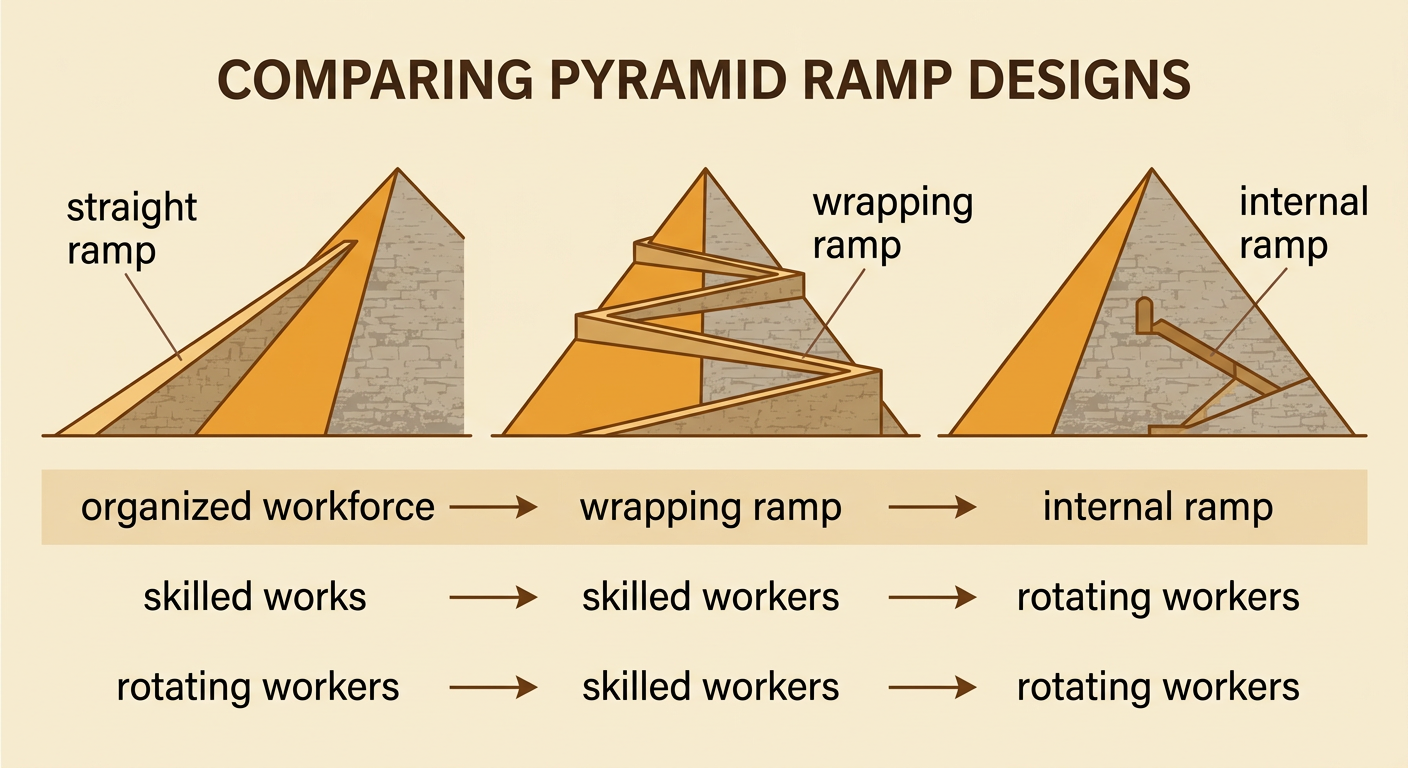
Historians and engineers compare several possible ramp designs. A straight ramp is simple and provides a direct path, but reaching great heights with a gentle slope would require a very long ramp and enormous amounts of material. A zigzag or wrapping ramp could use less space, but sharp turns might make heavy blocks difficult to control. An internal-ramp theory reduces the need for a massive outside ramp, yet much of its proposed route is difficult to confirm archaeologically. Investigators evaluate each idea against evidence, safety, turning space, slope, and material needs. Labor theories must also be tested. Archaeological remains of housing, food, medical care, administration, and named crews support an organized workforce that included skilled and rotating workers, rather than the old claim that the pyramids were built only by enslaved people. Still, evidence does not reveal the exact size or schedule of every crew.
Evidence-Based Conclusion
The strongest conclusion separates well-supported claims from uncertain details. Evidence supports the explanation that Egyptian officials organized crews, food supplies, stone transport, tools, and work areas on a large scale. Merer’s journal supports boat transport of limestone, while settlements, burials, and crew inscriptions support an organized labor force with skilled workers. Sledges and prepared routes are also consistent with images, artifacts, and engineering tests. However, the complete lifting system remains uncertain because no surviving source gives a full construction manual, and ramps were often removed or reused. A careful conclusion might state: Egyptians likely combined boats, sledges, ramps, levers, skilled crews, and careful administration, but the exact ramp arrangement is not proven. This claim cites several kinds of evidence and admits limitations. New discoveries could strengthen, revise, or challenge it, which is normal in historical and engineering investigation.
