
Building the Transcontinental Railroad
Students examine how workers overcame geographic challenges to build the transcontinental railroad and evaluate its effects on travel, trade, settlement, and Indigenous communities.
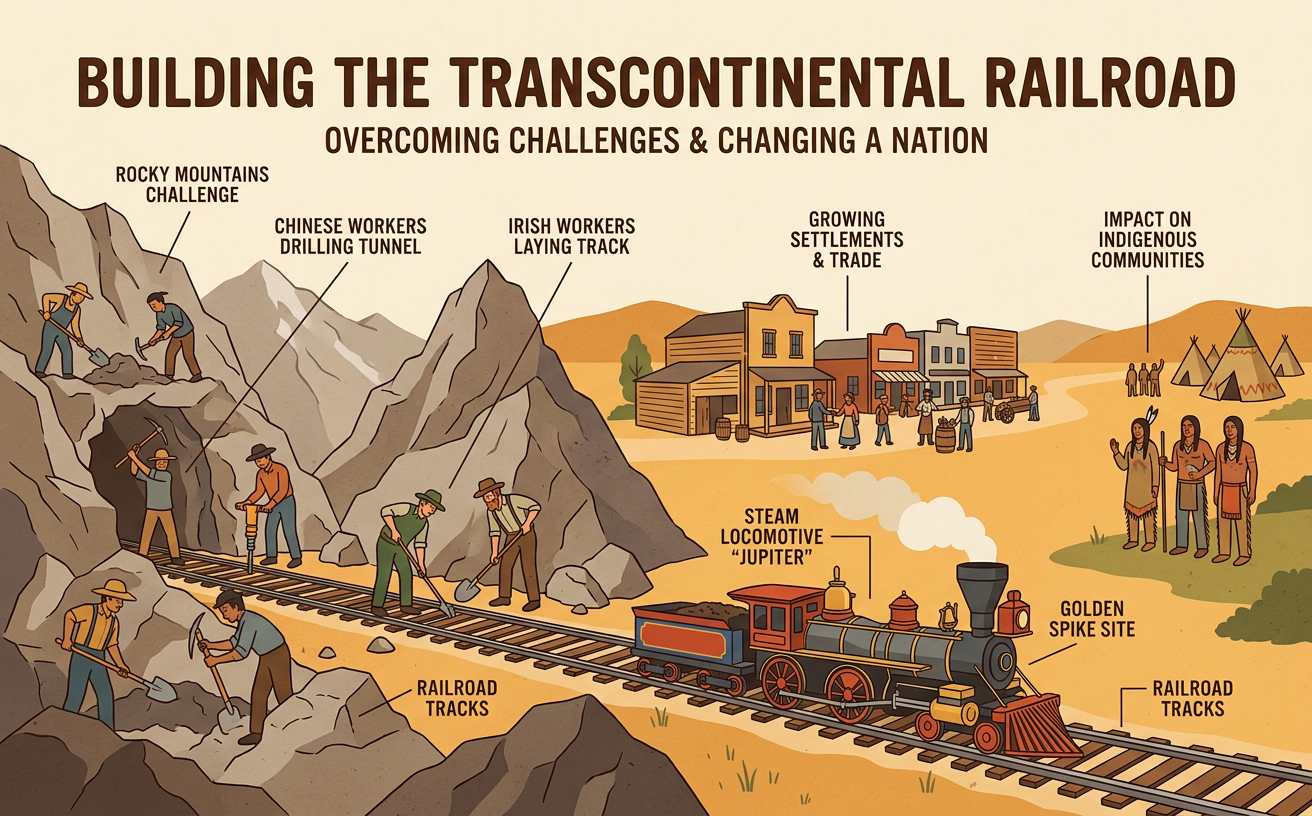
Illustrations are auto-generated and may be placeholders. They can be refreshed to match the narration.
Why a Nation-Spanning Railroad Was Needed
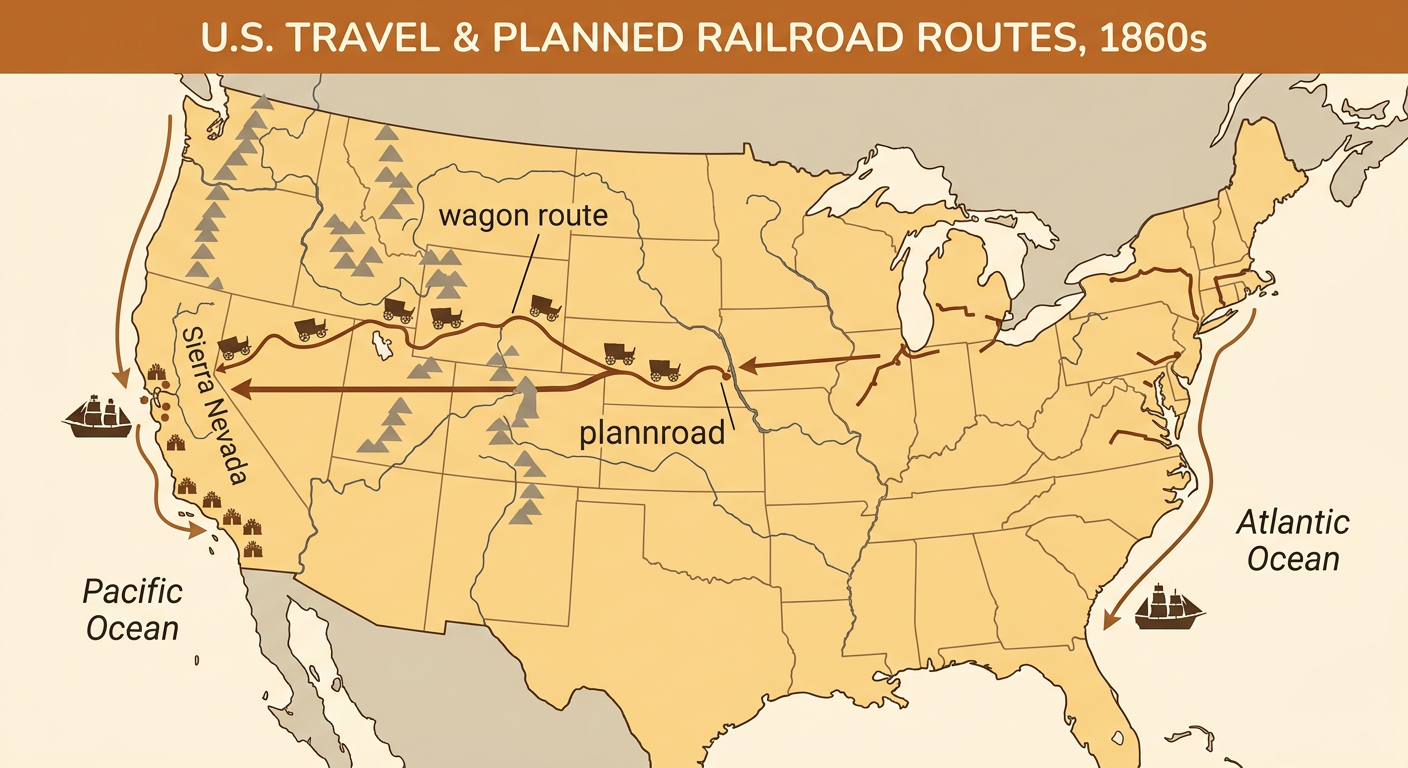
In the 1800s, the United States stretched from the Atlantic Ocean to the Pacific Ocean, but crossing the country was slow, expensive, and dangerous. Travelers went by wagon, stagecoach, ship, or short railroad lines that did not connect. A wagon journey could take several months. Businesses also needed a faster way to move mail, food, tools, and other goods. In 1862, Congress passed the Pacific Railway Act to support a railroad linking the eastern rail network with California. The government provided loans and land to railroad companies. The main goal was to move people and supplies across long distances more quickly. For example, if a wagon traveled 15 miles each day, covering 1,500 miles would take 100 days. A train could cover the same distance much faster.
Workers Who Built the Railroad
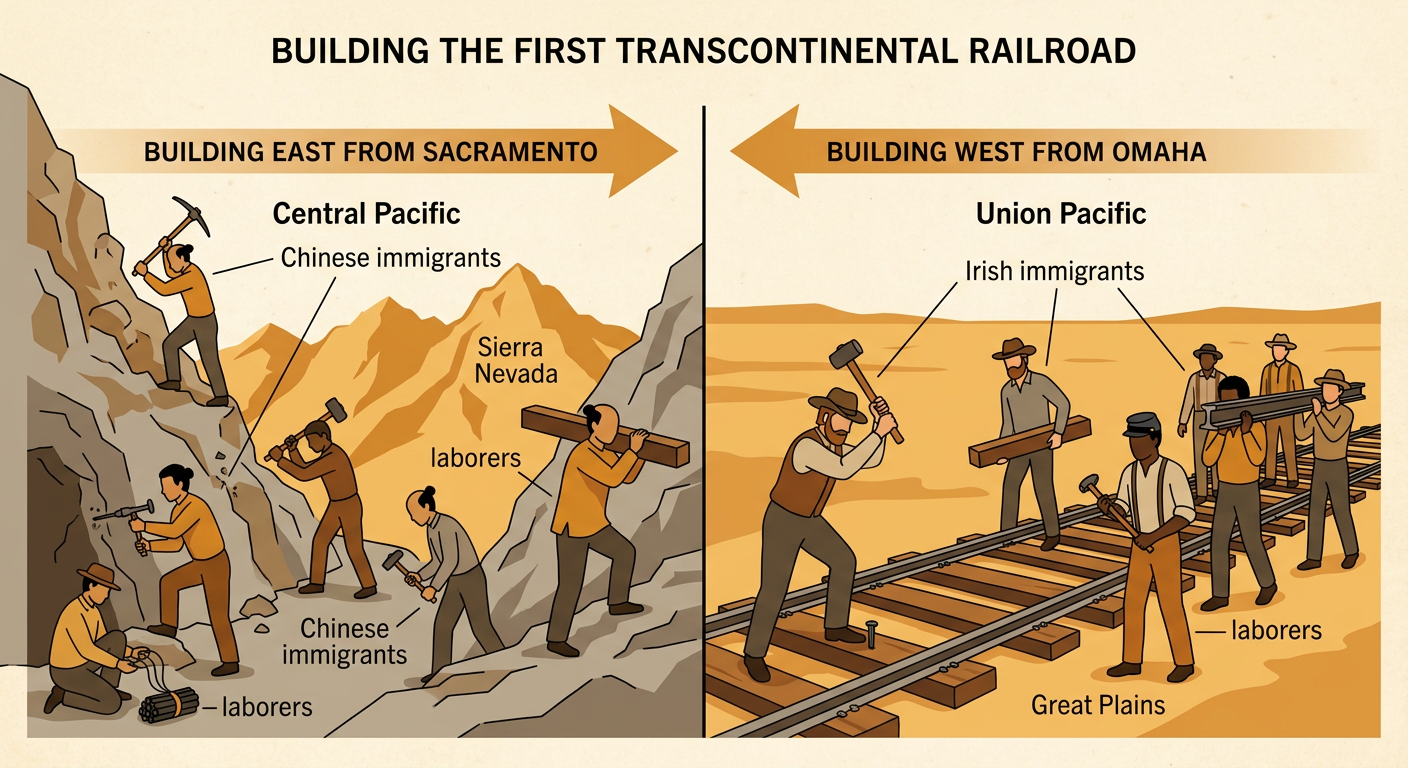
Two main companies built the first transcontinental railroad. The Union Pacific Railroad built westward from Omaha, Nebraska, while the Central Pacific Railroad built eastward from Sacramento, California. The workforce included immigrants, formerly enslaved people, Civil War veterans, and other laborers. Thousands of Chinese immigrants worked for the Central Pacific, especially in the Sierra Nevada. Many Irish immigrants worked for the Union Pacific. Workers laid track, built bridges, dug cuts, blasted tunnels, and carried heavy supplies. The labor was dangerous, and workers faced explosions, falling rocks, extreme weather, and accidents. Pay and treatment were not equal. For example, Chinese workers often received lower pay and had to provide their own food. In 1867, thousands of Chinese workers stopped working briefly to demand better pay and shorter hours.
Geographic and Engineering Challenges
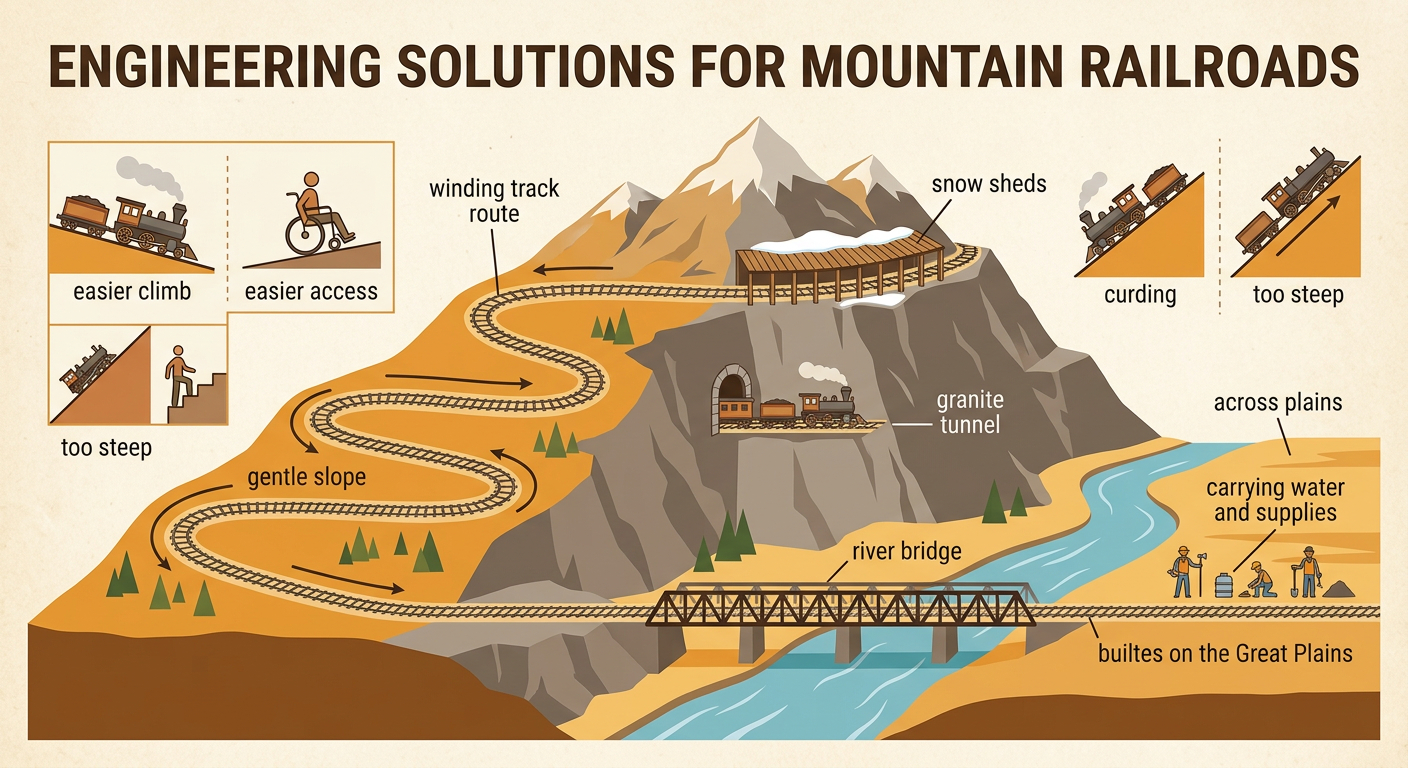
Railroad builders had to create a safe route across plains, rivers, deserts, and mountains. Their engineering problem was to build a track that trains could use without slopes that were too steep or curves that were too sharp. Important criteria included strength, safety, and a continuous route. Constraints included limited time, money, tools, workers, and building materials. In the Sierra Nevada, Central Pacific workers blasted tunnels through solid granite and built wooden snow sheds to protect tracks from deep snow and avalanches. On the Great Plains, Union Pacific crews built bridges over rivers and transported water and supplies across long, open distances. For example, a direct route over a steep mountain might be shorter, but engineers often selected a longer, winding route with a gentler slope so locomotives could climb it.
The Golden Spike at Promontory Summit
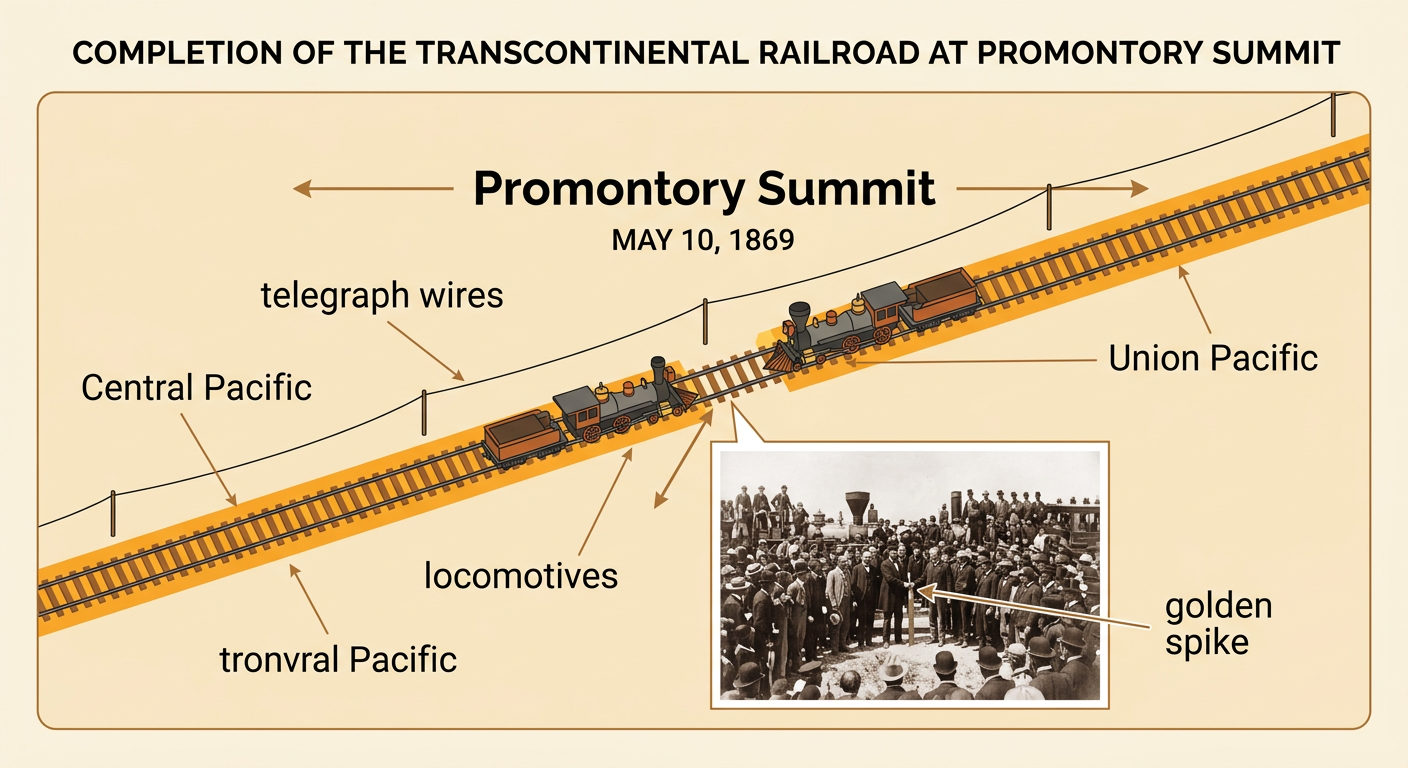
The Central Pacific and Union Pacific tracks met at Promontory Summit in Utah Territory on May 10, 1869. During a public ceremony, officials used a ceremonial golden spike to represent the joining of the rails. A telegraph connection allowed people in distant cities to receive the news almost immediately. The event marked the completion of the main railroad link between Omaha and Sacramento, which connected with other transportation routes reaching farther east and west. It did not mean that all railroad work ended; crews still repaired tracks, improved bridges, and built additional lines. The famous ceremony photograph shows locomotives, officials, and workers gathered around the track, but most Chinese workers were not included in the picture. This omission reminds historians to compare photographs with written records when deciding whose role has been remembered.
Effects on Trade, Travel, and Settlement
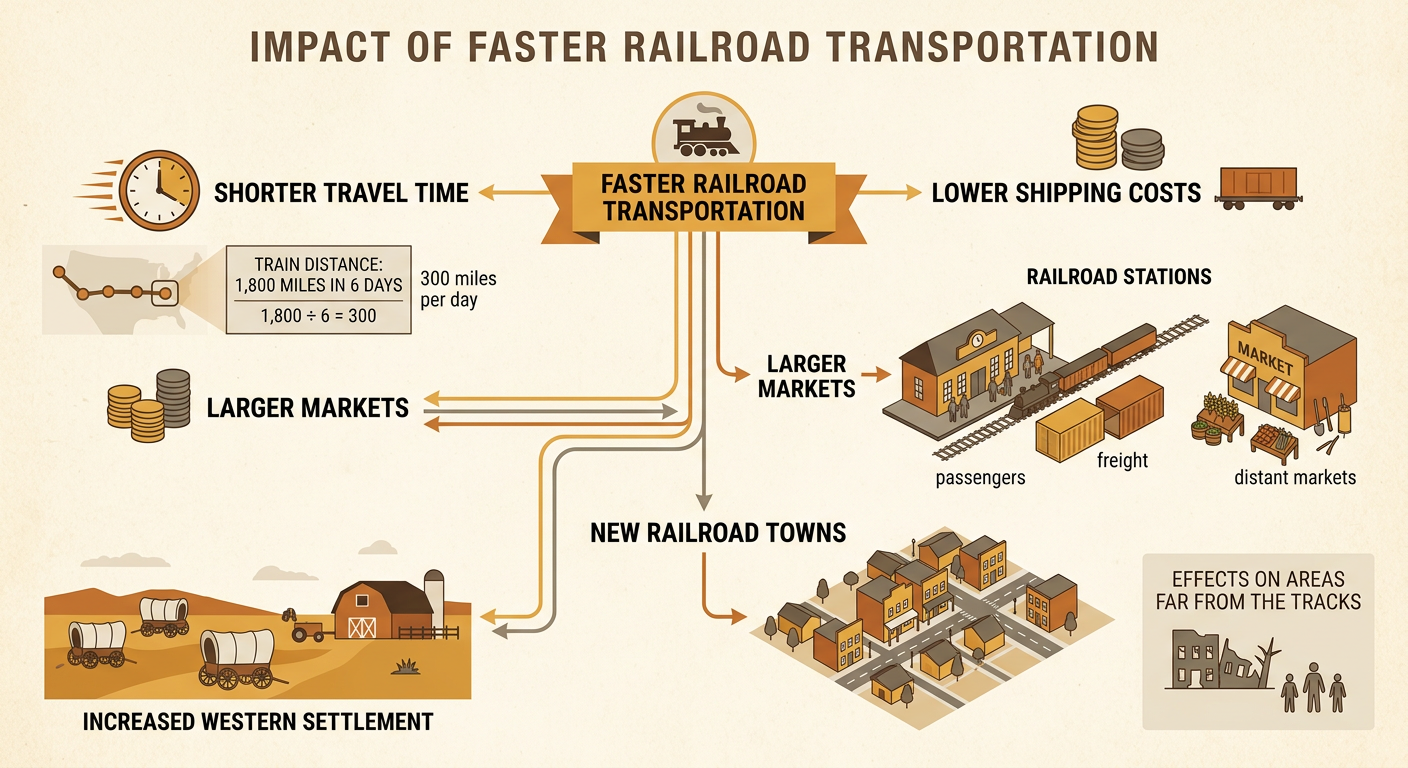
The transcontinental railroad greatly reduced the time and cost of moving people, mail, and goods. A cross-country journey that once took months could be completed in about a week. Farmers and manufacturers used trains to send crops, cattle, tools, and other products to distant markets. Towns grew near stations where trains stopped for passengers, water, fuel, and freight. Railroad companies also advertised western land, encouraging more settlers to move west. These changes expanded trade, but towns located far from the tracks sometimes lost business. Distance and time help show the railroad’s effect. For example, if a train traveled 1,800 miles in six days, it averaged 300 miles per day because 1,800 divided by 6 equals 300. Faster transportation connected markets, supported migration, and changed where communities developed.
Consequences for Indigenous Communities
The railroad crossed lands where Indigenous nations had lived, hunted, traveled, and governed for generations. Its construction and the settlement that followed often violated treaties or ignored Indigenous land rights. Trains brought more settlers, soldiers, miners, and commercial hunters into the West. Railroad access helped hunters kill enormous numbers of bison, which many Plains nations depended on for food, clothing, shelter, tools, and cultural practices. Tracks, towns, and farms also divided habitats and traditional travel routes. For example, as rail lines spread across the Great Plains, Lakota, Cheyenne, and other communities faced growing pressure on their lands and bison herds. Some Indigenous people traded with railroad communities or worked near the lines, while many resisted invasion and removal. The railroad created economic opportunities for the United States, but those benefits came with severe losses for many Indigenous nations.