
Built for the Environment: What Is an Adaptation?
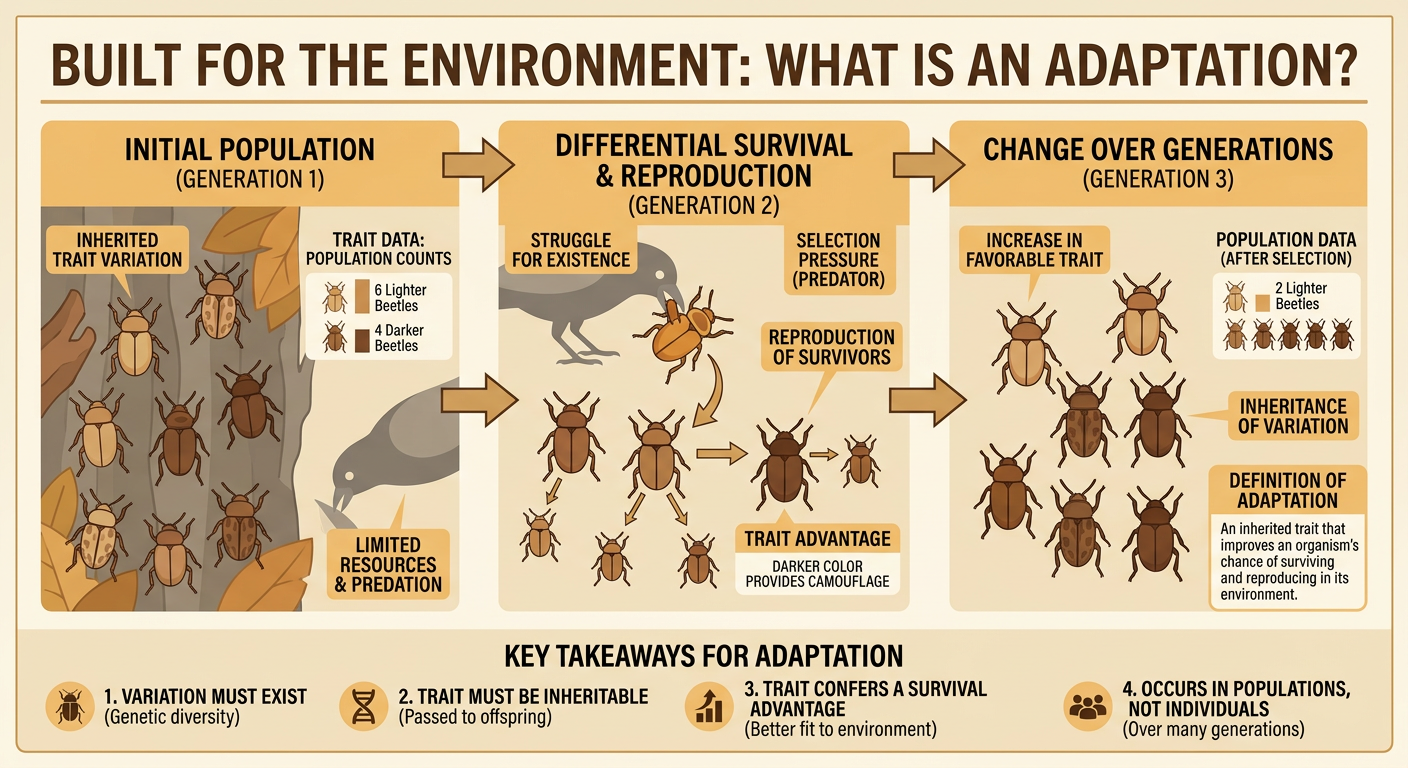
Students use trait and population data to explain how inherited variations that improve survival and reproduction can become adaptations over generations.
Illustrations are auto-generated and may be placeholders. They can be refreshed to match the narration.
Adaptation or Everyday Change?
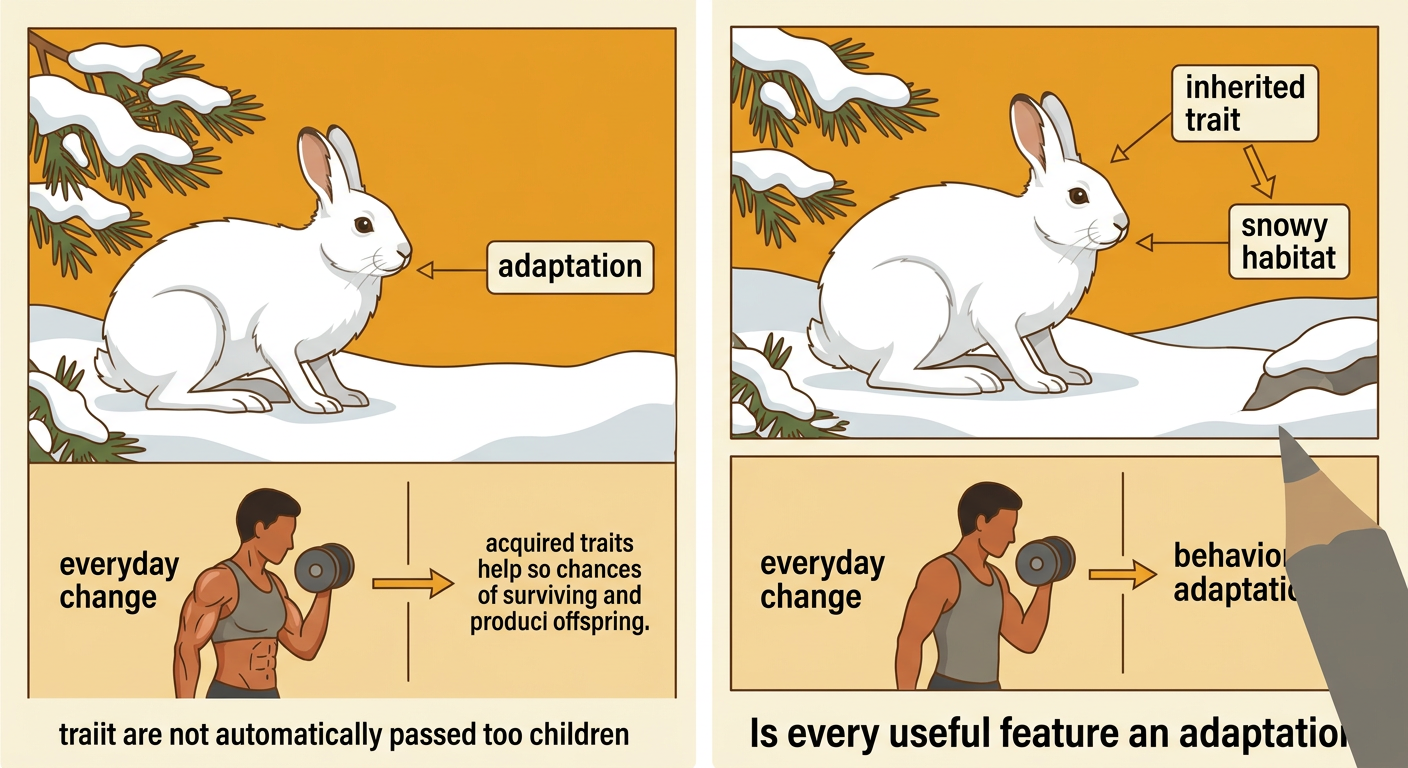
An adaptation is an inherited trait that increases an organism’s probability of surviving and reproducing in a particular environment. Adaptations develop in populations over many generations; individual organisms do not develop inherited adaptations because they need them. For example, a snowshoe hare’s inherited white winter coat can make it less visible to predators in a snowy habitat. In contrast, building stronger muscles through exercise is an everyday change acquired during one lifetime. It is not encoded as a genetic variation that offspring automatically inherit. Behavior can also be an adaptation if inherited differences influence it and it improves reproductive success. To identify an adaptation, ask three questions: Does the trait vary among individuals? Is the variation inherited? Does it improve survival or reproduction under specific environmental conditions? A useful trait in one environment may provide no advantage in another.
Inherited Variation Within Populations
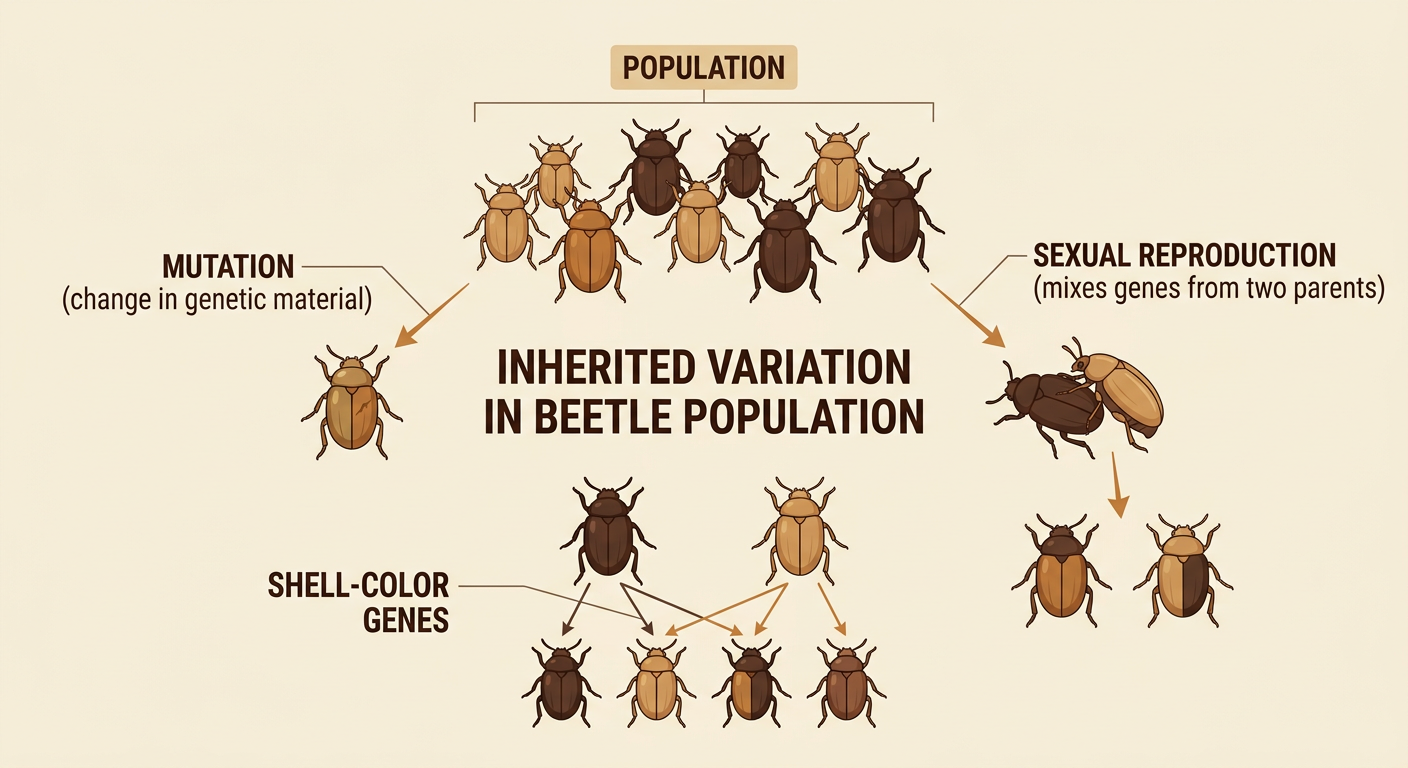
Individuals in a population are not genetically identical. Mutations and the mixing of genes during sexual reproduction produce inherited variation in traits such as color, size, or resistance to disease. Consider a population of beetles in which some have light-brown shells and others have dark-brown shells. Offspring tend to inherit shell-color genes from their parents, although new combinations can occur. The variation exists before the environment favors one form. Organisms do not choose or intentionally create the trait they need. Some differences, such as a scar or a missing leg caused by an accident, are not inherited genetic variations. Scientists study a large group rather than one unusual individual because evolution involves changes in the distribution of inherited traits across a population. Variation supplies the different traits on which natural selection can act.
Environmental Conditions and Trait Advantages
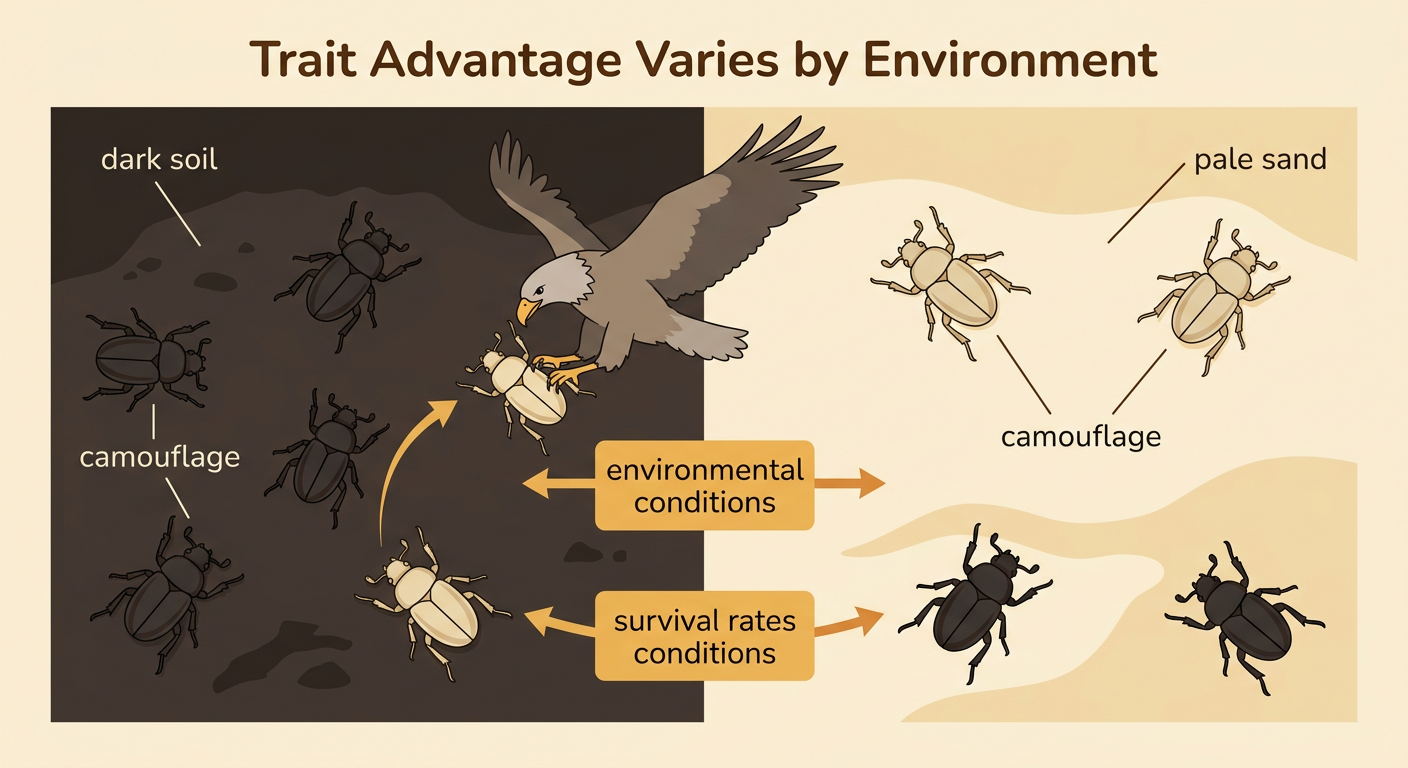
Whether a trait is advantageous depends on the environment. Imagine light- and dark-brown beetles living on dark soil after a wildfire. Birds hunt by sight, so dark beetles are harder to detect against the soil. Dark color does not guarantee survival, but it increases the probability that a beetle will escape predation. On pale sand, the same dark color could make a beetle easier to see, while light color could become advantageous. Other environmental conditions include temperature, water availability, food type, disease, and competition. A trait counts as an advantage only when evidence connects it to greater survival or reproductive success under particular conditions. Scientists might compare bird attacks on beetle models of different colors or record survival rates in different habitats. The environment does not cause beetles to change color on purpose; it affects which existing inherited variations are more successful.
Survival and Reproduction Over Generations
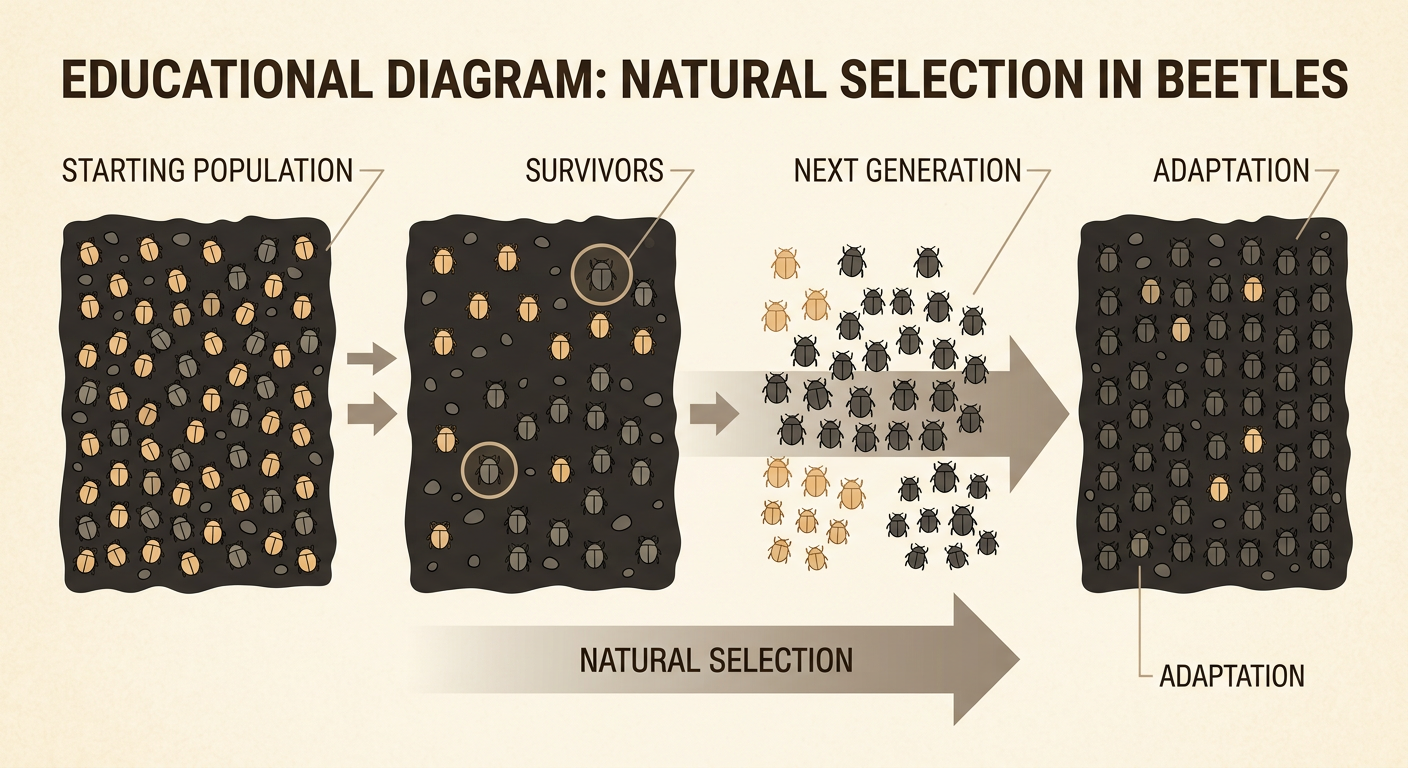
Natural selection occurs when individuals with an advantageous inherited trait survive and reproduce more often than others. Return to the beetles on dark soil. Suppose a starting population contains 50 light beetles and 50 dark beetles. After bird predation, 20 light beetles and 40 dark beetles survive. If the survivors reproduce and shell color is inherited, dark beetles contribute more offspring to the next generation. Over repeated generations, the proportion of dark beetles may rise. Individuals have not transformed from light to dark; instead, individuals with different inherited colors have left different numbers of offspring. Chance still matters, and not every dark beetle survives. Natural selection describes a difference in probability, not a guaranteed result. When an inherited variation repeatedly improves survival and reproduction in an environment and becomes common over generations, it can be described as an adaptation of that population.
Using Data to Explain an Adaptation
A strong explanation combines a claim, numerical evidence, and scientific reasoning. Claim: dark shell color is becoming an adaptation in the beetle population on dark soil. Evidence: dark beetles had 40 survivors out of 50, an 80% survival rate, while light beetles had 20 survivors out of 50, a 40% rate. A later survey found that dark beetles increased from 50% to 70% of the population after several generations. Reasoning: dark shells improved camouflage, so dark beetles were more likely to survive, reproduce, and pass the trait to offspring. Evidence has limits. A small model experiment may not represent every predator, and an observational survey can show a pattern without proving its cause. Using both sources strengthens the argument, but scientists should also seek larger samples, inheritance evidence, and repeated results. Specific data make the explanation testable rather than based on opinion.