Built to Survive: Traits and Habitats
Students compare organism traits and use evidence to explain why some organisms are better able to survive in particular habitats.

Illustrations are auto-generated and may be placeholders. They can be refreshed to match the narration.
Notice Different Survival Traits
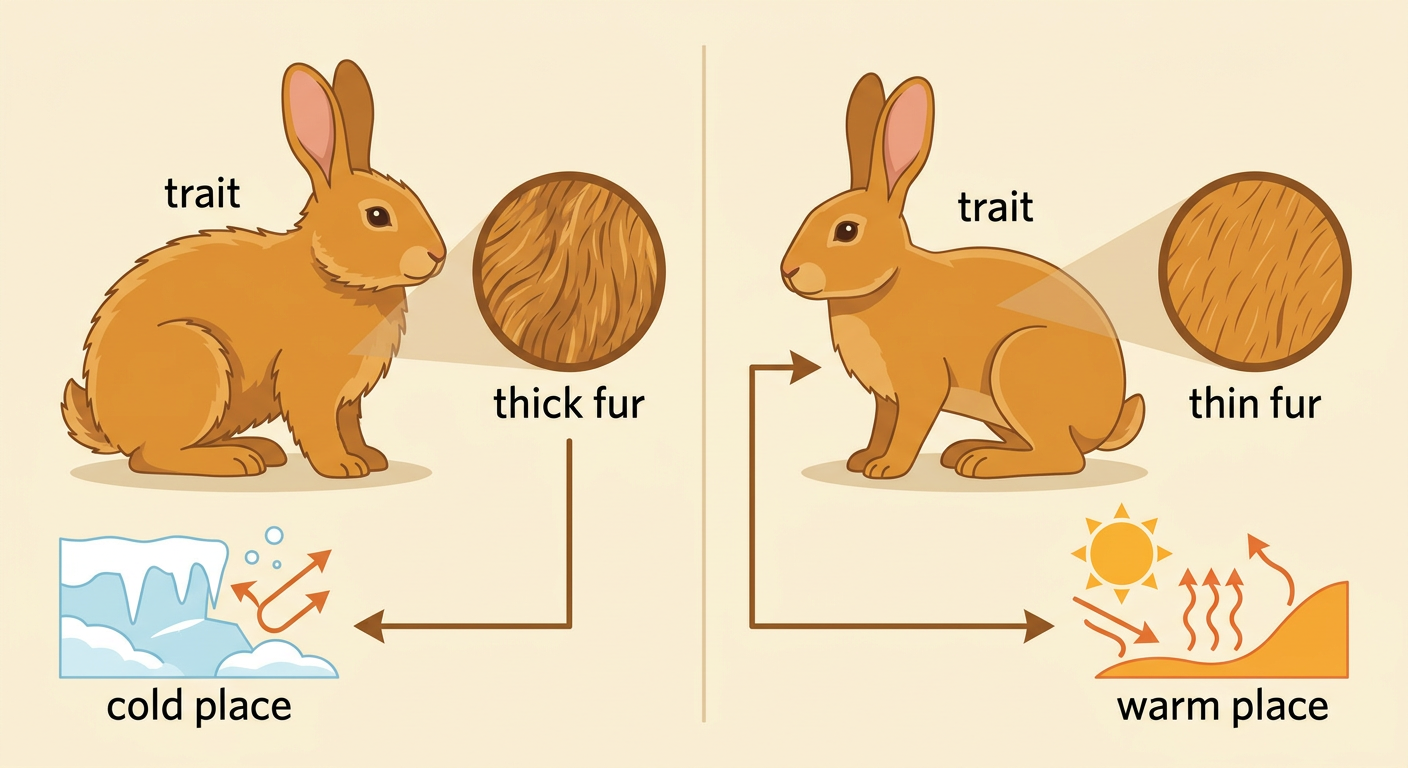
A trait is a feature of a living thing, such as body covering, color, shape, or behavior. Organisms of the same kind can have different traits. For example, some rabbits have thicker fur than other rabbits. Thick fur can help a rabbit stay warm in a cold place, while thin fur may release heat more easily in a warm place. Look closely at pictures or observations of organisms. Ask questions such as, “How are their feet different?” or “Which body covering might help here?” A trait does not guarantee survival. It may simply make an organism more likely to meet its needs, avoid danger, or handle the conditions in a particular habitat. Record what you notice before deciding which trait is helpful.
Explore Habitat Conditions
A habitat is the place where an organism lives and gets what it needs. Habitats have living parts, such as plants and animals, and nonliving parts, such as water, sunlight, soil, temperature, and wind. These conditions are not the same everywhere. A desert is often dry and may be hot during the day, while an Arctic tundra is cold and windy for much of the year. A pond contains standing water and wet soil near its edges. Use a map to locate each habitat and notice patterns such as distance from the equator, nearby water, or high mountains. Then ask, “What challenges would an organism face here?” Understanding the habitat helps you decide which traits may support survival there.

Match Organisms to Habitats
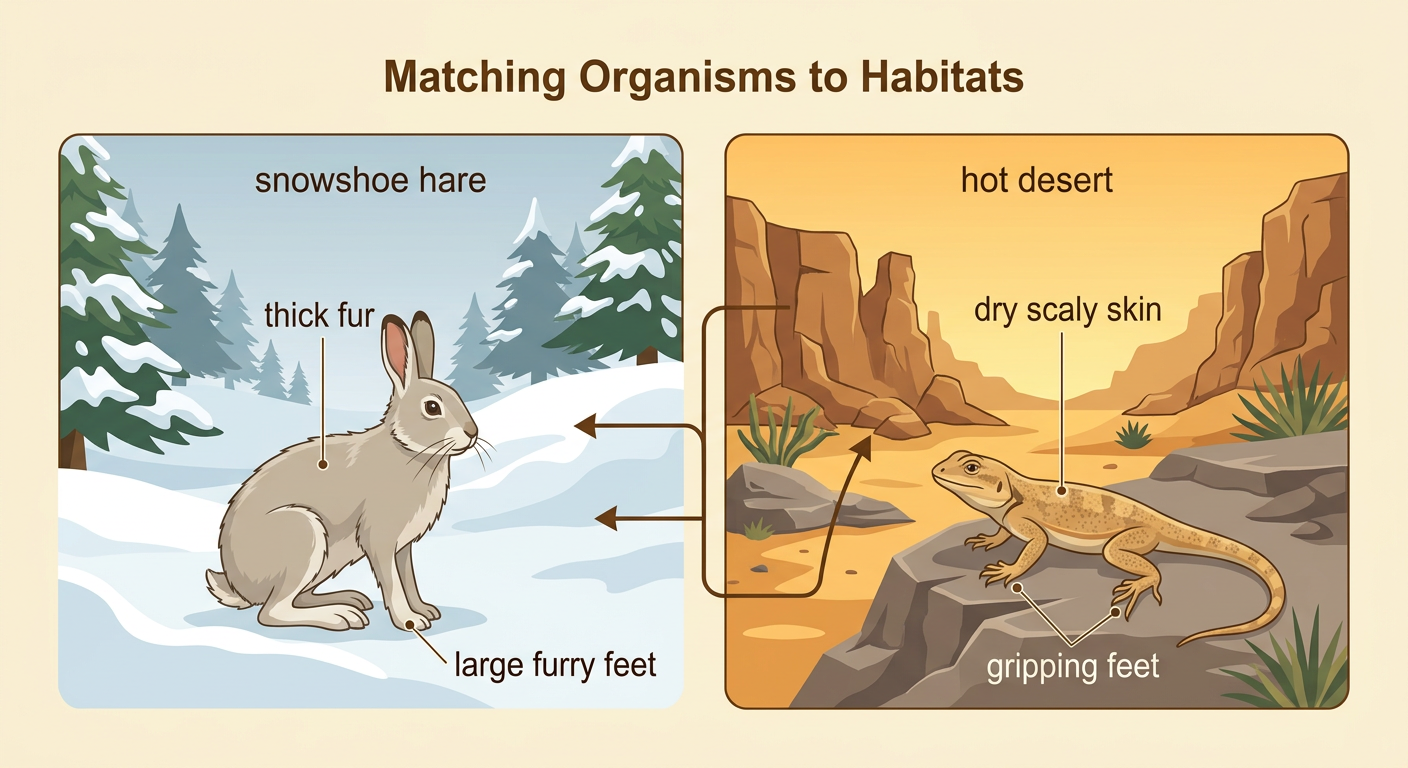
To match an organism to a habitat, compare its traits with the habitat’s conditions. Consider a snowshoe hare with thick fur and large, furry feet. Thick fur helps reduce heat loss in cold weather. Wide feet spread the hare’s weight across soft snow, helping it move without sinking as deeply. These traits make the hare better suited to a snowy northern forest than to a hot, rocky desert. Next, consider a lizard whose dry, scaly skin limits water loss and whose feet grip rocky ground. Those traits may be useful in a dry habitat. Make each match using a clear reason. Avoid saying an organism “wanted” or “needed” to develop a trait. Organisms already vary, and some trait differences work better under certain conditions.
Gather Evidence from Text and Maps
Evidence is information that supports an idea. You can gather evidence from an informational text, a map, a photograph, or recorded observations. First, ask a focused question, such as, “Why might a cactus survive better than a leafy garden plant in a desert?” Read the text closely and note facts: a cactus stores water in its stem, and its waxy surface slows water loss. Then study a habitat map showing that deserts receive little rainfall. Put these facts together. The plant traits match the dry conditions shown on the map. When answering a question, point to the source of each fact. You might write, “The text states that the cactus stores water, and the map shows that its desert habitat is very dry.”

Make a Survival Claim
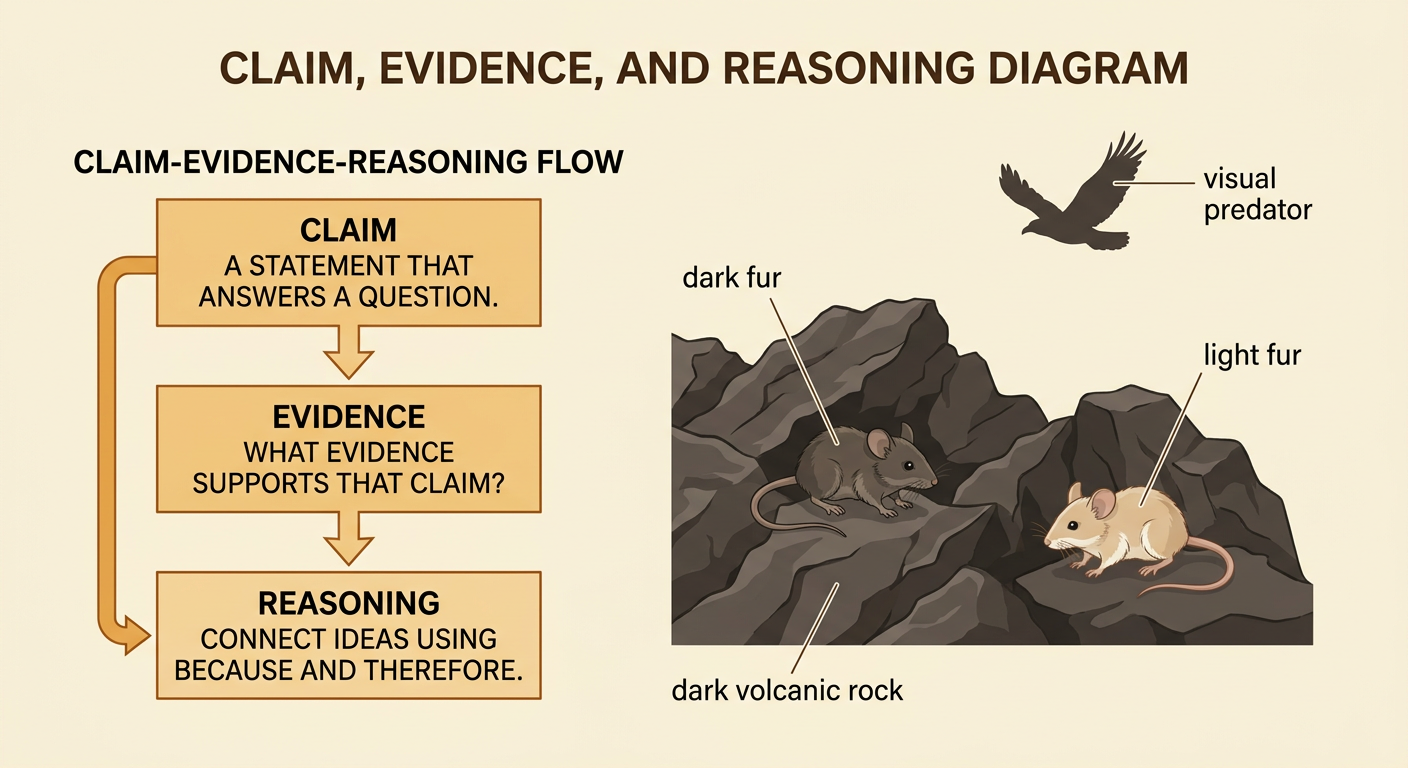
A claim is a statement that answers a question. To make a survival claim, choose the organism that is likely to survive better in a particular habitat and explain why. Imagine two mice living on dark volcanic rock. One mouse has dark fur, and the other has light fur. You might claim, “The dark-furred mouse is more likely to avoid visual predators on the dark rock.” Support the claim with evidence: the dark fur is harder to see against the dark background, while the light fur stands out. Then add reasoning that connects the evidence to survival: a mouse that is less visible may be less likely to be caught by a predator. Use words such as because, for example, and therefore to make the connection clear.
Share Evidence-Based Explanations
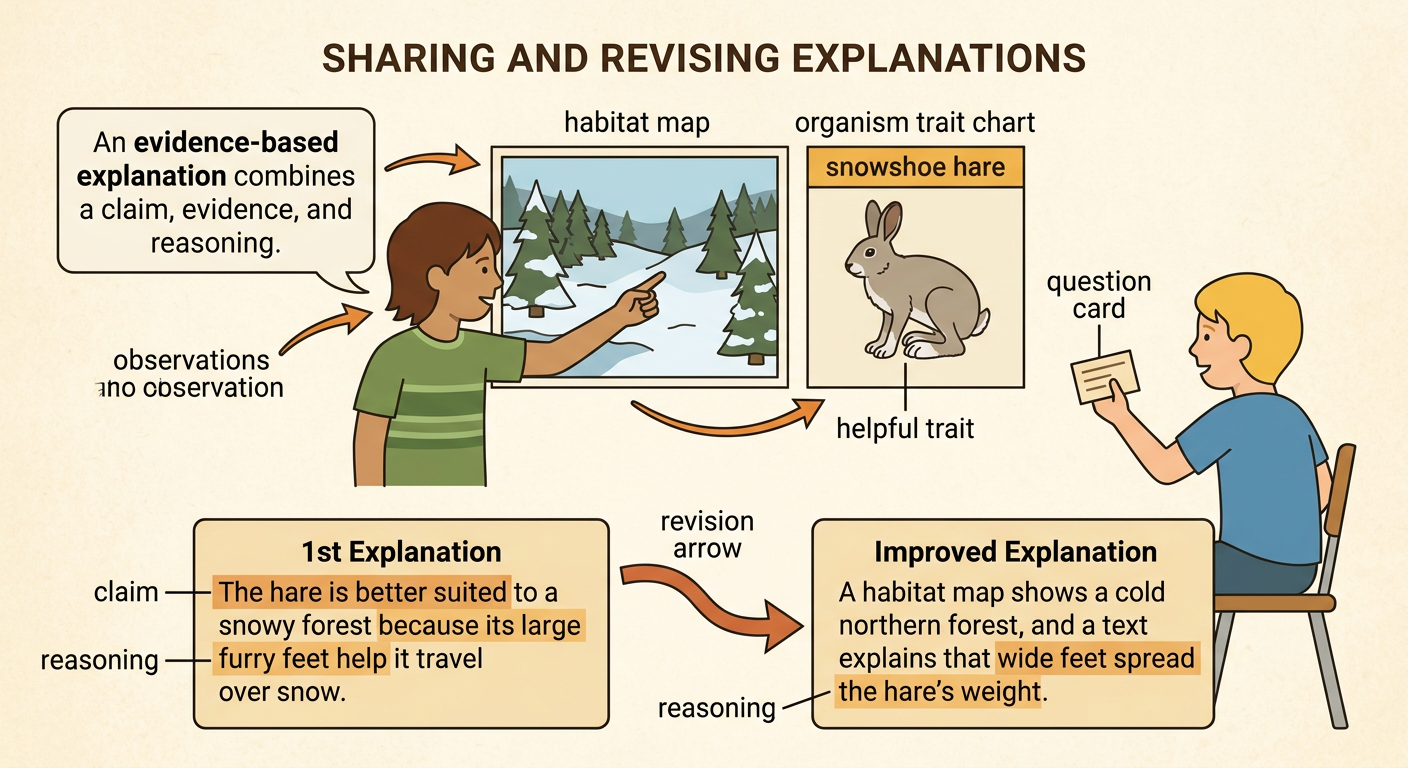
Scientists share explanations so others can examine their ideas and evidence. Present your survival claim in a clear voice or a short written paragraph. Name the habitat, identify the helpful trait, cite evidence, and explain how the trait may improve survival. For example: “I think the snowshoe hare is better suited to a snowy forest because its large, furry feet help it travel over snow. The habitat map shows cold northern forests, and the text explains that the hare’s wide feet spread out its weight.” Listen to classmates and ask respectful questions, such as, “Which map detail supports your claim?” Revise your explanation if new evidence is stronger or if your reasoning is unclear. A good explanation does not need everyone to agree; it needs relevant evidence and a logical connection.