
Can Others Get the Same Result? Repetition and Replication
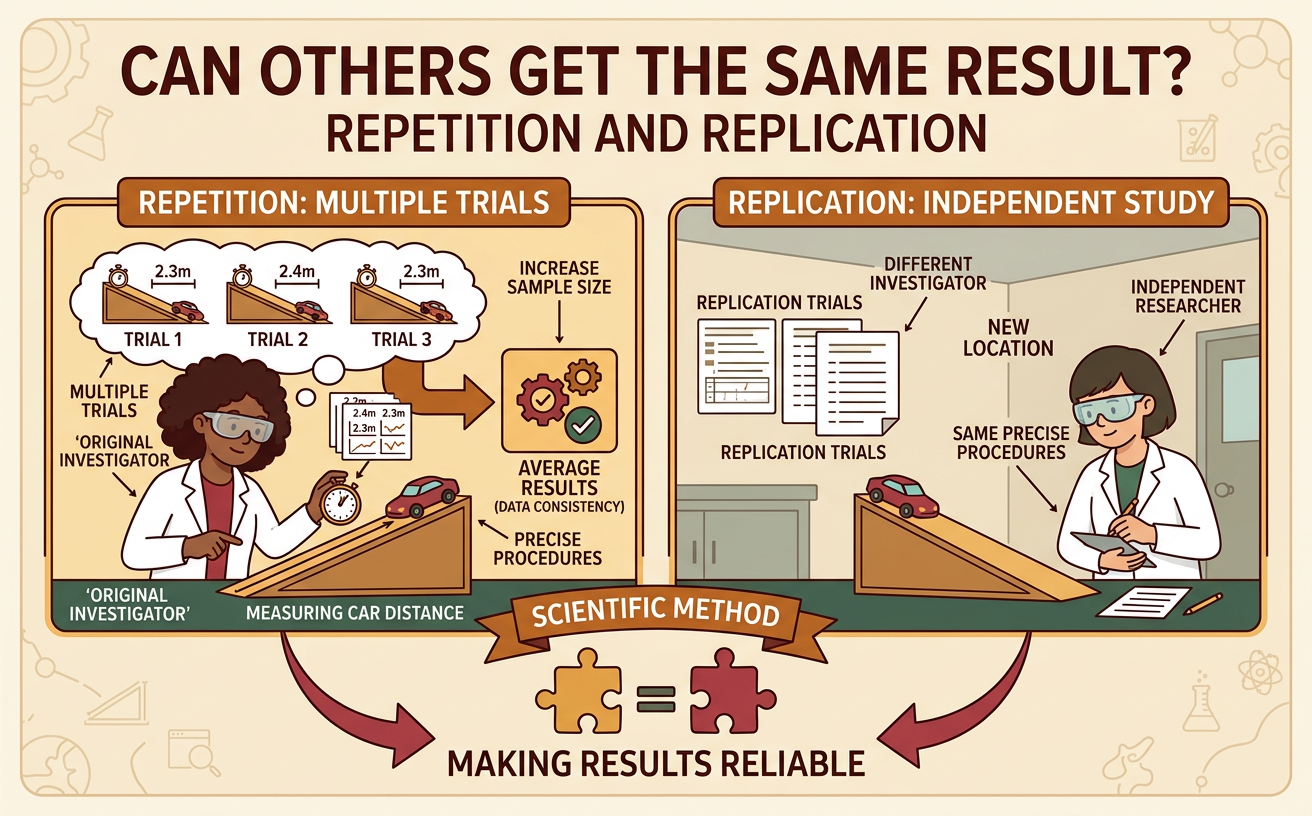
Students examine how repeated trials, adequate sample sizes, precise procedures, and independent replication make results from a scientific method more reliable.
Illustrations are auto-generated and may be placeholders. They can be refreshed to match the narration.
A Result Is Not Yet a Pattern
One observation can be useful, but it is not enough to establish a reliable pattern. Measurements can change because of natural variation, small measuring errors, or conditions the investigator did not control. Imagine dropping a paper helicopter from a height of 2 meters. On the first drop, it takes 2.4 seconds to reach the floor. That result does not show that every drop will take 2.4 seconds. A slight air current, a different release angle, or an error starting the timer could affect the result. Scientists look for patterns across several observations before making a claim. If many carefully controlled drops produce similar times, the evidence is stronger. A scientific claim should describe what the collected evidence supports without suggesting that one result proves the claim.
Repeated Trials and Sample Size
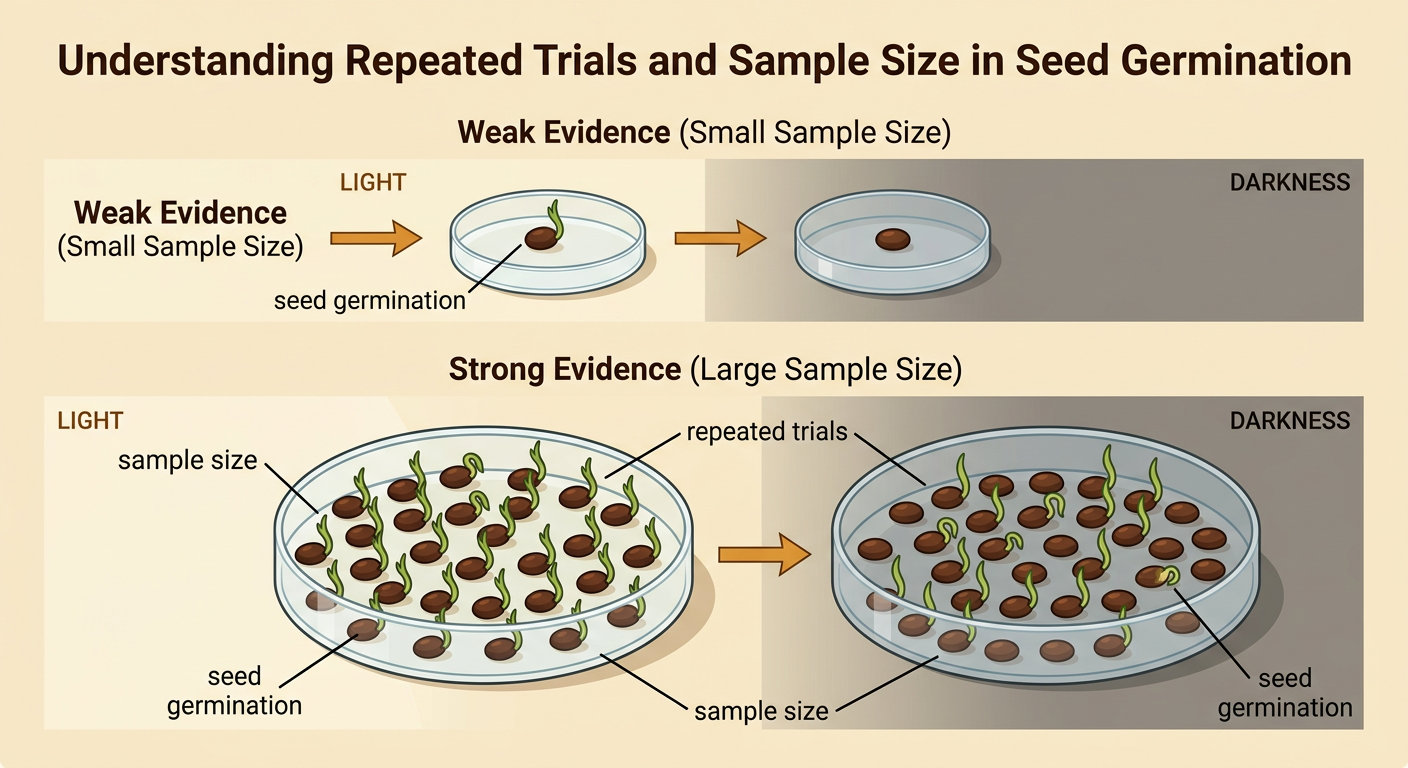
Repeated trials are multiple tests completed under the same planned conditions. They help investigators see whether a result occurs consistently and identify unusual measurements. Sample size is the number of objects, organisms, or observations included in an investigation. Suppose students test whether light affects seed germination. Testing one seed under each light condition would be weak because one seed might be damaged. Testing 30 similar seeds in light and 30 in darkness provides more evidence about the usual response. Students should record how many seeds germinate in each group and calculate a fraction, percentage, or average when appropriate. A larger sample does not fix a poorly controlled investigation, but an adequate sample reduces the influence of unusual individual cases. Repeated trials and sufficient data make comparisons more dependable.
Writing a Repeatable Procedure
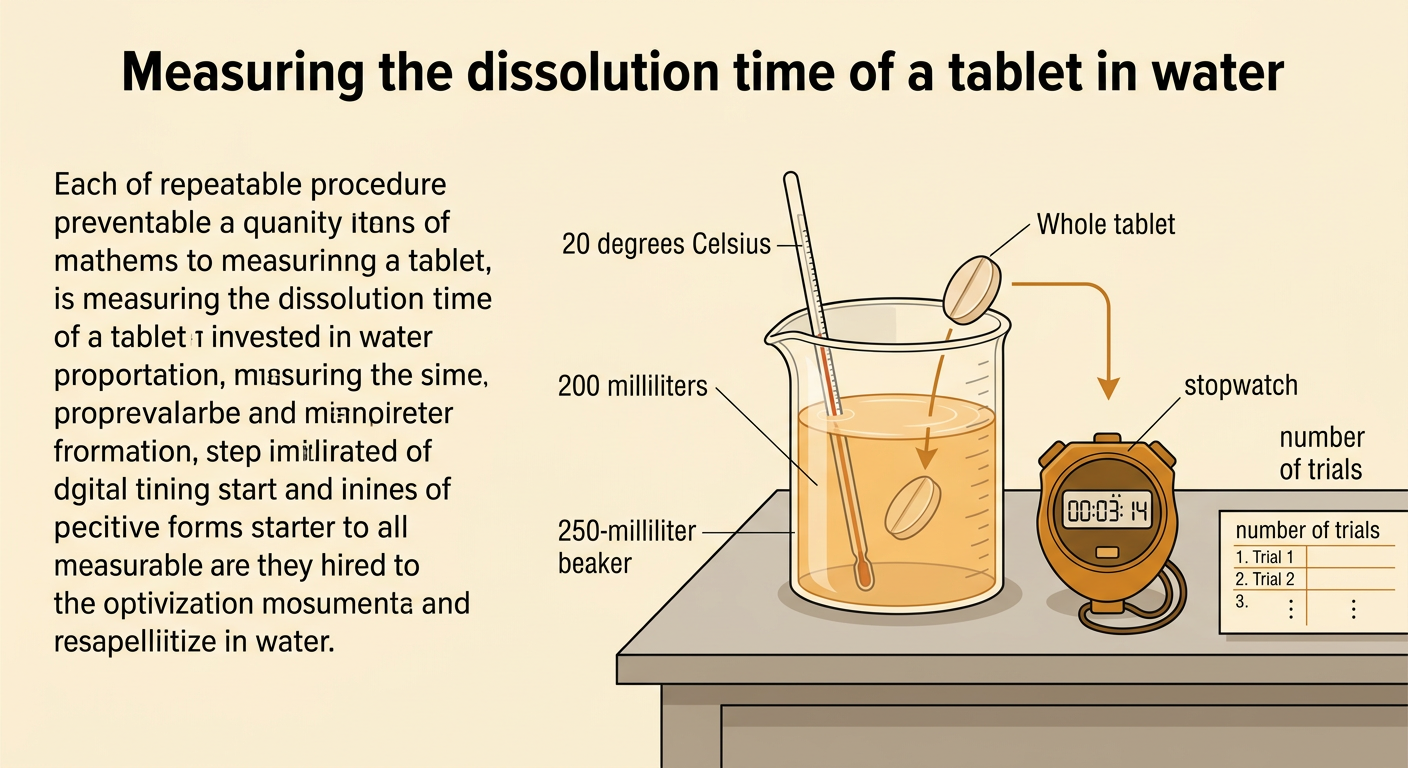
A repeatable procedure gives enough precise information for someone to perform the same investigation in the same way. It should list materials, numbered steps, quantities, measurement units, timing, and the conditions that must stay constant. For example, “Put a tablet in water and watch it dissolve” is too vague. A stronger procedure says to pour 200 milliliters of water at 20 degrees Celsius into a 250-milliliter beaker, add one whole tablet, start the stopwatch immediately, and stop timing when no solid is visible. It should also state the number of trials and whether the water is stirred. Investigators must follow the steps precisely and record any change they make. Clear procedures help separate real differences in results from differences caused by how people performed the test.
Replication by Independent Groups
Repetition and replication are related but different. Repetition occurs when the same investigators conduct more trials. Replication occurs when an independent group follows the reported method and conducts the investigation again with new samples and usually different equipment. Suppose one class finds that Brand A paper towels absorb more water than Brand B. Another class can replicate the investigation by cutting equal-sized sheets, placing each sheet in water for the same amount of time, and measuring the absorbed water. If both classes obtain similar patterns, the claim gains support from more than one source. If the patterns differ, neither class should hide the difference. The groups should compare procedures, samples, and measurements. Independent replication helps reveal unnoticed bias, unclear instructions, equipment problems, or results that occurred only by chance.
Comparing Results and Revising the Method
After repetition or replication, scientists compare results instead of asking only whether every number is identical. They examine averages, ranges, graph shapes, and possible sources of variation. Imagine two groups measuring how quickly 100 milliliters of hot water cools. One group records slightly higher temperatures than the other. Their graphs show the same downward trend, but the difference may come from using uncovered cups in one group and covered cups in the other. The investigators can revise the method to specify identical cups, no lids, the thermometer position, the starting temperature, and measurements every minute. They then test the revised method. A strong argument states a claim, cites evidence from both groups, and explains how the evidence supports the claim. Revising a method is not failure; it is a way to make later evidence more consistent and trustworthy.