Can the Change Be Reversed?
Students use observations to decide whether changes caused by heating or cooling, such as melting ice or cooking an egg, can be reversed.

Illustrations are auto-generated and may be placeholders. They can be refreshed to match the narration.
Heating and Cooling Matter
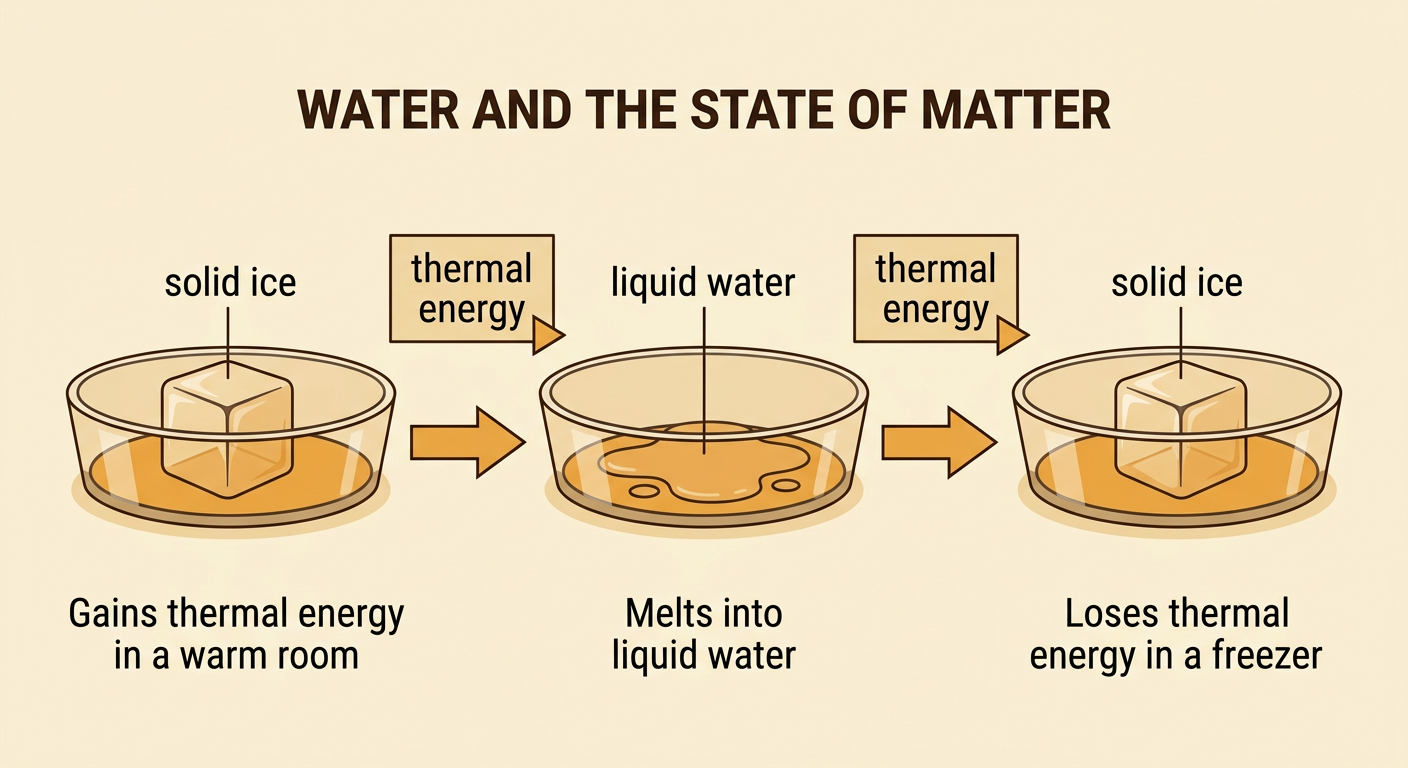
Matter is anything that takes up space, such as water, butter, metal, or air. Heating adds thermal energy to matter, while cooling removes thermal energy. These actions can change how matter looks, feels, or behaves. For example, an ice cube is solid water. In a warm room, it gains thermal energy and melts into liquid water. If the water is placed in a freezer, it loses thermal energy and becomes solid ice again. The substance is still water during both changes. Careful observations help us describe a change. We can record temperature, shape, texture, color, or state of matter before and after heating or cooling.
Observe Example Changes
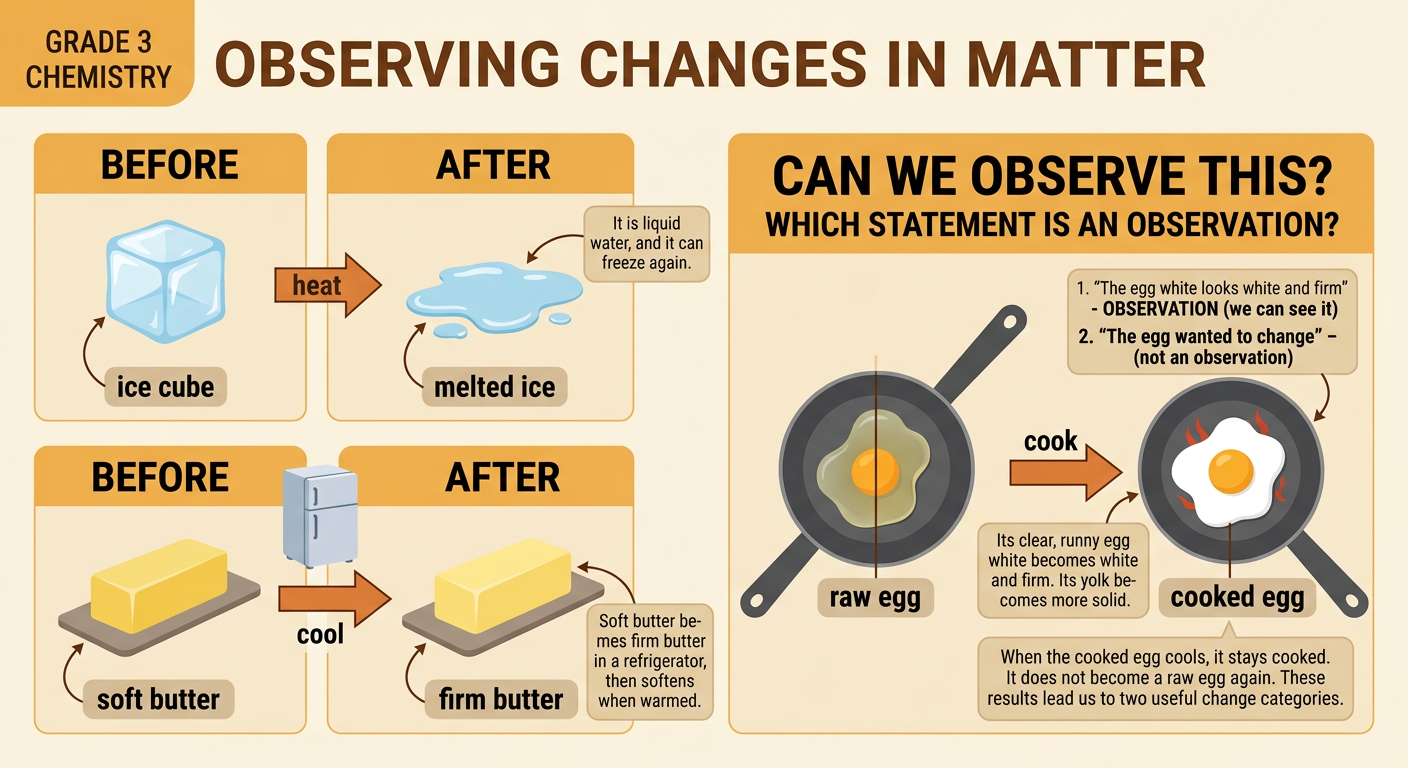
Scientists observe matter before and after it is heated or cooled. Consider three examples. First, an ice cube melts into liquid water when warmed. Second, soft butter becomes firm when cooled in a refrigerator and softens again when warmed. Third, a raw egg changes when it is cooked in a hot pan. The clear, runny egg white becomes white and firm, and the yolk becomes more solid. Record only what you can observe instead of guessing. You might write, “The egg white changed from clear and runny to white and firm.” Then test whether cooling returns each material to its earlier form. Melted water can freeze, and butter can firm up. A cooked egg does not become raw when cooled.
Reversible or Irreversible?
A reversible change can be undone so that the material returns to its earlier form. Melting and freezing water are reversible changes. Melted ice can be cooled until it becomes solid ice again. Softening and firming butter can also be reversed by changing the temperature. An irreversible change cannot be undone by simply heating or cooling the material. Cooking an egg is irreversible because cooling the cooked egg does not make it raw again. Baking cake batter is another example. After the batter is heated and becomes cake, cooling cannot turn it back into batter. To classify a change, compare the material before and after, try the opposite temperature change when it is safe, and use the results as evidence.

Graph the Evidence
A graph helps a class organize and compare observation data. Suppose student groups test 12 changes. They find that 8 changes are reversible and 4 are irreversible. Make a scaled bar graph with the categories “Reversible” and “Irreversible” along the bottom. Mark the side scale 0, 2, 4, 6, 8, 10, and 12. Because each interval represents 2 changes, the reversible bar reaches 8 and the irreversible bar reaches 4. The graph shows that the class observed twice as many reversible changes as irreversible changes. Always include a title, category labels, a numbered scale, and equal-width bars. Check that each bar matches the recorded data. A graph displays evidence clearly, but the observations explain why each example belongs in its category.

Make an Evidence-Based Claim
An evidence-based claim states an idea and supports it with observations. Begin with a clear claim, such as, “Some changes caused by heating or cooling can be reversed, but others cannot.” Next, give specific evidence. Ice melted into liquid water when heated and became solid again when cooled, so that change was reversible. A raw egg became firm when heated, but it stayed cooked after cooling, so that change was irreversible. Then explain how the evidence supports the claim. The water returned to its earlier state, while the egg did not return to its raw form. When writing your argument, include your opinion or claim, connected reasons, accurate evidence, and a concluding sentence. Words such as because, for example, and therefore can connect your ideas.

Cooling and Food-Waste Choices
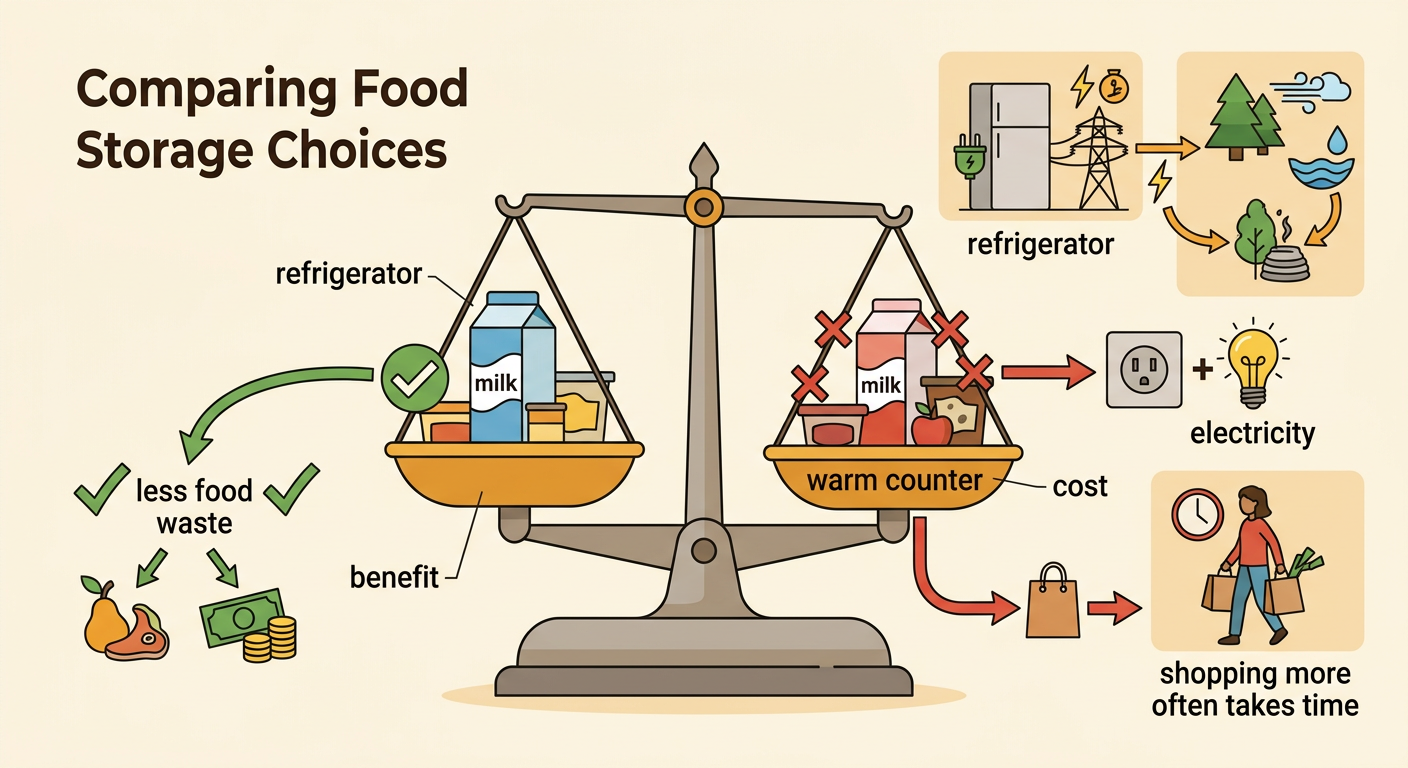
Cooling food can slow the growth of many microbes and help food stay safe and fresh longer. For example, putting milk in a refrigerator can keep it usable longer than leaving it on a warm counter. This choice has benefits and costs. A benefit is that less milk may spoil, so families can waste less food and money. A cost is that refrigerators use electricity, which families must pay for and which may affect the environment depending on how the electricity is produced. Another choice is to buy only the amount of food that will be eaten soon. This can reduce waste without needing extra refrigerator space, but shopping more often may take time. People compare benefits and costs before choosing. Safe food-storage rules should always be followed, and perishable food should not be left out too long.