
Can the Change Be Undone?
Students use observations of melting, freezing, and cooking to explain that some changes caused by heating or cooling are reversible while others are not.
Illustrations are auto-generated and may be placeholders. They can be refreshed to match the narration.
Notice Changes from Heat and Cold
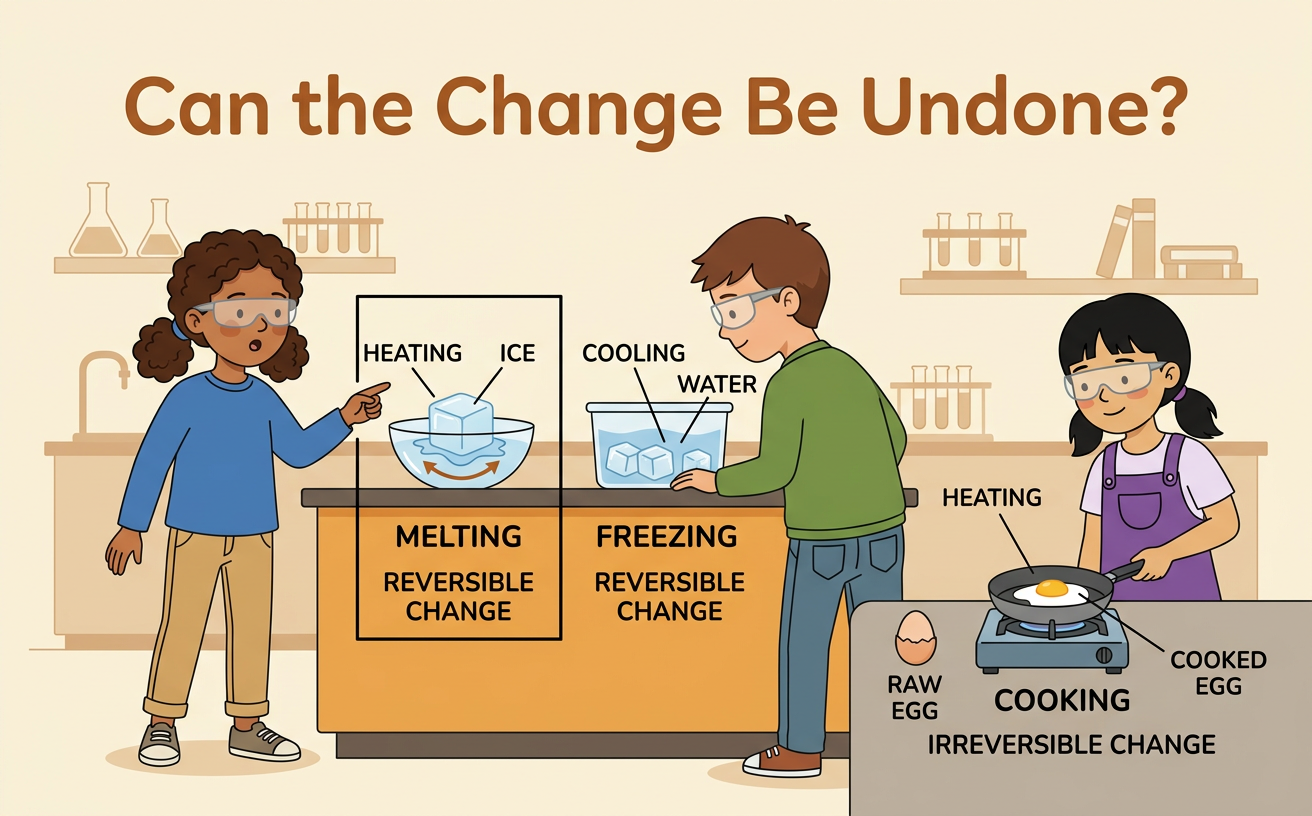
Heating and cooling can change how a material looks, feels, or behaves. Heat can make a solid melt, and cold can make a liquid freeze. For example, an ice cube left in a warm room becomes liquid water. If the water is placed in a freezer, it can become solid ice again. This change can be undone. Other changes cannot be undone so easily. Bread becomes toast when it is heated in a toaster. Cooling the toast does not turn it back into soft bread. Scientists observe color, shape, texture, and whether something is solid or liquid. These observations provide evidence about what changed and whether the change can be reversed.

Explore Melting and Freezing
Place an ice cube in a clear cup and observe it every few minutes. At first, the ice is hard, solid, and shaped like a cube. As it takes in heat from the warmer air, it melts into liquid water. Record what you see with words or pictures. Next, an adult can place the covered cup in a freezer. Cooling removes heat from the water, so the water freezes and becomes solid again. The new ice may not have the same cube shape because it takes the shape of the cup. Even though its shape is different, it is still frozen water. Melting and freezing are opposite changes, so this change can be undone.

Compare Melting with Cooking
Melting and cooking both use heat, but they do not always cause the same kind of change. When chocolate is gently warmed, it melts into a liquid. When it cools, it becomes solid chocolate again, although its shape may be different. Cooking an egg is different. A raw egg is runny and partly clear. Heat changes it into a firm, white cooked egg. Cooling the cooked egg does not make it raw again. The melted chocolate provides evidence of a reversible change because heating and cooling can move it between solid and liquid forms. The cooked egg provides evidence of a change that cannot be reversed. Students should only observe hot materials when a responsible adult handles them.

Sort and Graph the Changes
Scientists can sort observations to find a pattern. Make two categories: changes that can be undone and changes that cannot be undone. Suppose six picture cards show water freezing, ice melting, chocolate hardening, an egg cooking, bread toasting, and cake baking. Place the first three cards in the can-be-undone group and the last three in the cannot-be-undone group. Then draw a picture graph or bar graph. Label each category and show three changes in each bar. A picture graph could use one square for each change. The equal bar heights show that this set has the same number in both categories. The graph organizes the evidence, but each card must be sorted by what actually happens when the material is heated or cooled.

Explain Which Changes Can Be Undone
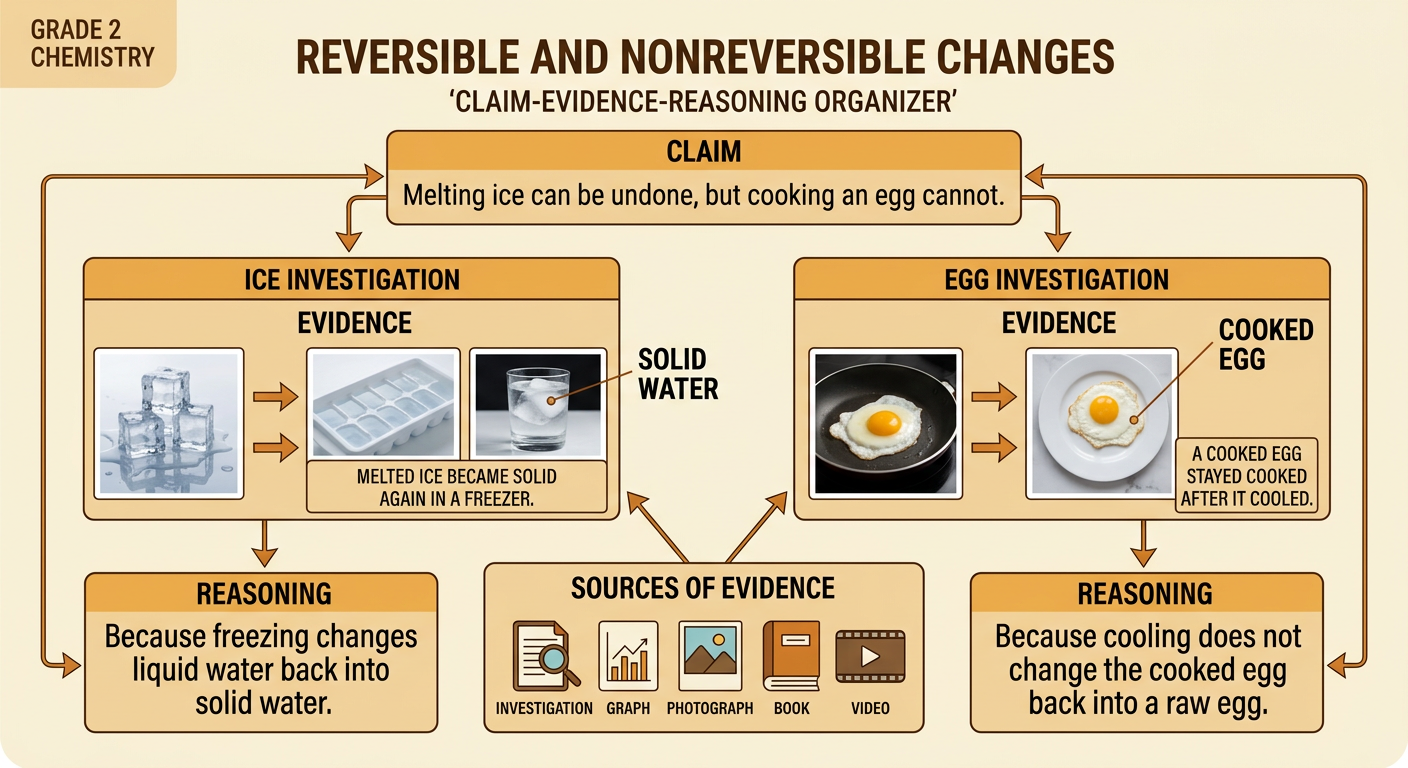
An argument in science includes a claim and evidence. A claim answers the question. Evidence is something you observed or learned from a reliable source. You might claim, “Melting ice can be undone, but cooking an egg cannot.” Your evidence could be that melted ice became solid again in a freezer, while a cooked egg stayed cooked after it cooled. Then explain your reasoning: freezing reverses melting because liquid water becomes solid water again. Cooling does not reverse cooking because cooking changes the egg in a lasting way. Use details from an investigation, class graph, photograph, book, or video. A strong explanation names the change, tells what happened next, and clearly connects the evidence to the claim.
Connect to Food Preparation and Storage
People make choices about heating and cooling food. Heating can cook food, improve its taste, and make some foods safer to eat. However, cooking takes time and energy, and burned food may be wasted. Cooling food in a refrigerator can help it stay fresh longer by slowing the growth of many microbes. A freezer can keep some foods for even longer. Refrigerators and freezers also use electricity and cost money to operate. Cooling does not make spoiled food fresh again. Imagine choosing what to do with leftover soup. Putting it in the refrigerator soon after the meal helps store it safely for later, while leaving it out can increase waste. A good decision considers benefits, costs, safety directions, and how much food is needed.
