
Can We Change It Back?
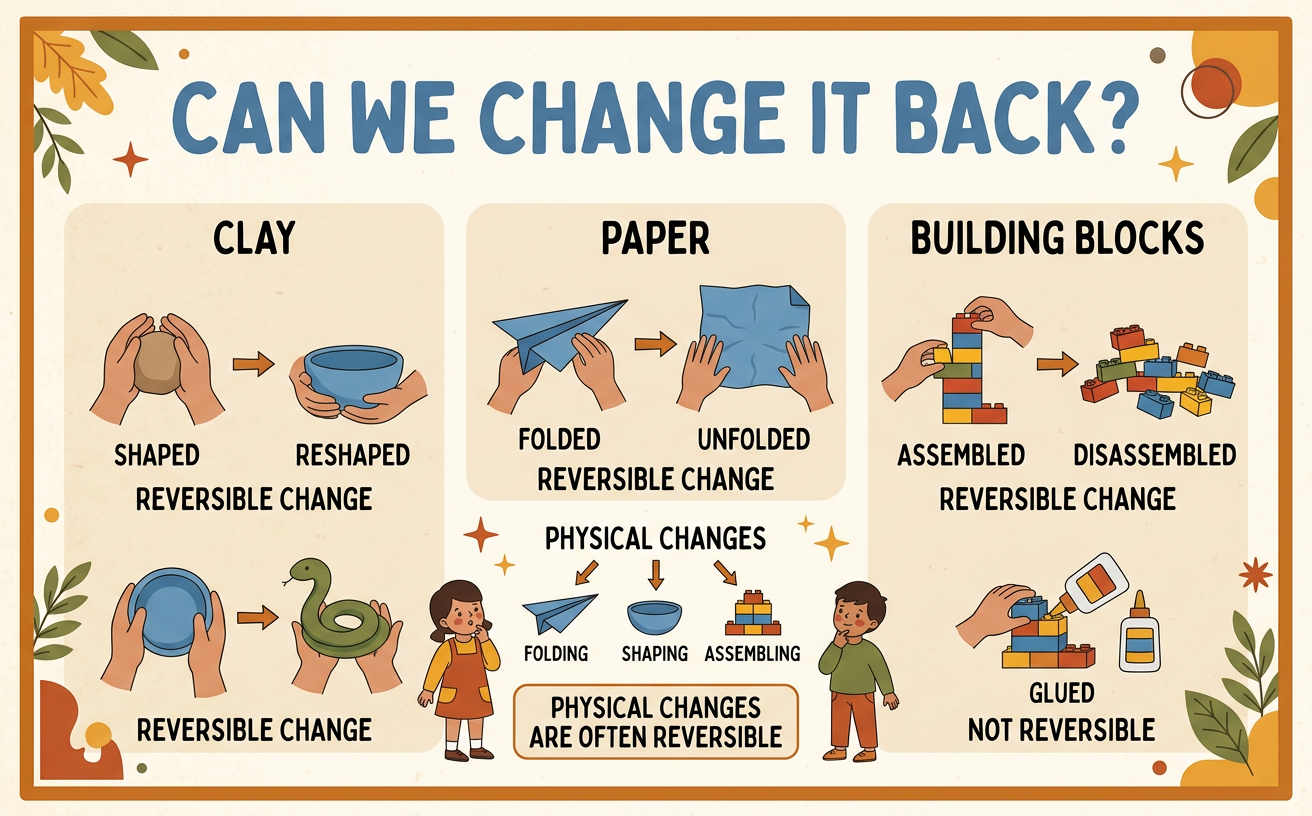
Students observe changes to clay, paper, and building blocks and determine which changes can and cannot be reversed.
Illustrations are auto-generated and may be placeholders. They can be refreshed to match the narration.
Notice the Materials
Look closely at a ball of clay, a sheet of paper, and a small tower made from building blocks. Use your eyes and hands to notice each object’s shape, color, texture, and parts. The clay is soft and can be pressed. The paper is thin and flat. The tower is made of separate blocks joined together. Describe each object before changing it so you can remember its starting form. You can draw or write what you observe. For example, draw the block tower and count how many blocks it has. These first observations will become evidence later. Evidence is information that helps us answer a question. Our question is: After we change each object, can we change it back to the way it was?

Predict What Will Happen
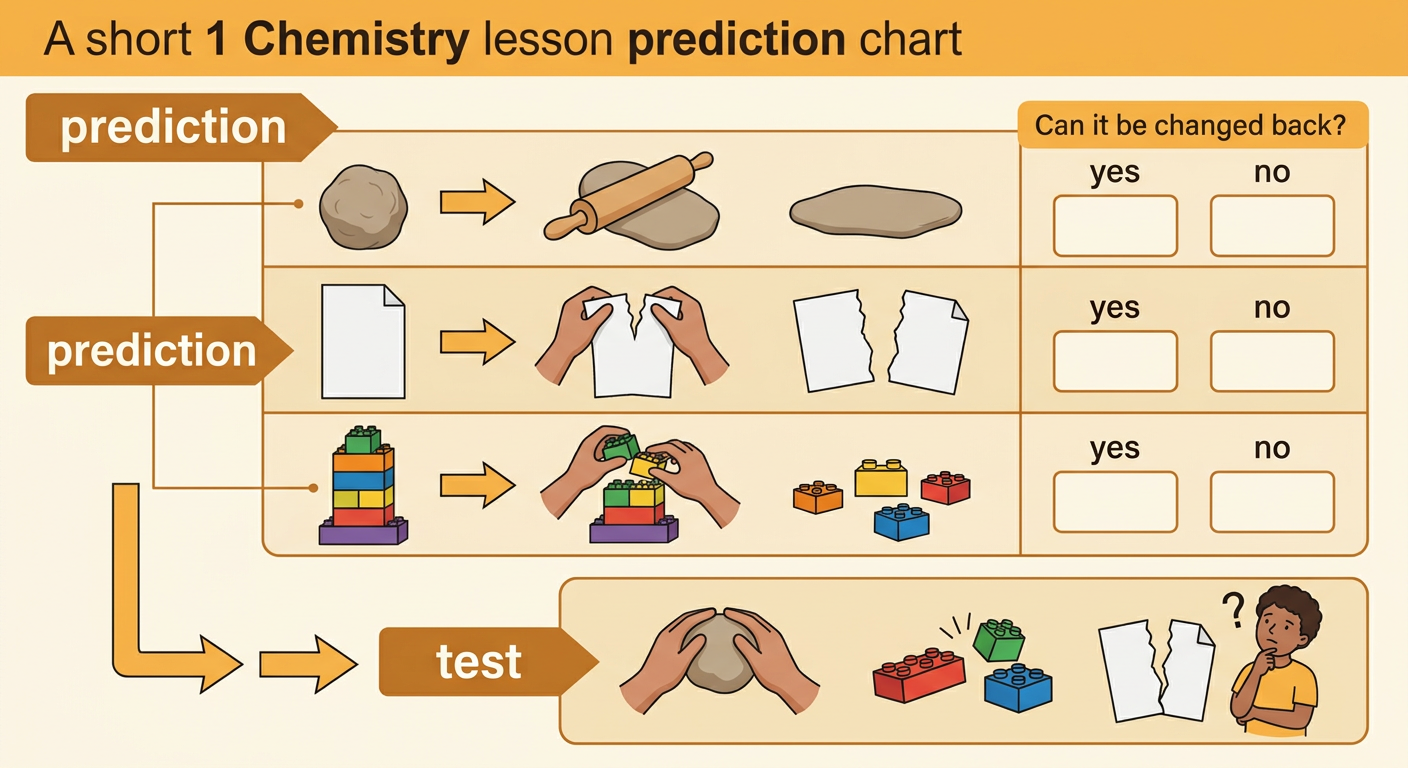
A prediction tells what you think will happen before you test an idea. Think about how each object might change. You could flatten the clay, tear the paper into two pieces, and take apart the block tower. Then predict whether each object can return to its starting form. Use what you know about the materials. Clay can be pressed and shaped many times, so you might predict that flattened clay can become a ball again. Blocks can be separated and reconnected, so you might predict that the tower can be rebuilt. A torn sheet of paper may be difficult to return to one whole sheet. Record each prediction as yes or no. It is fine if a prediction is incorrect because the test will provide evidence.
Change Each Object
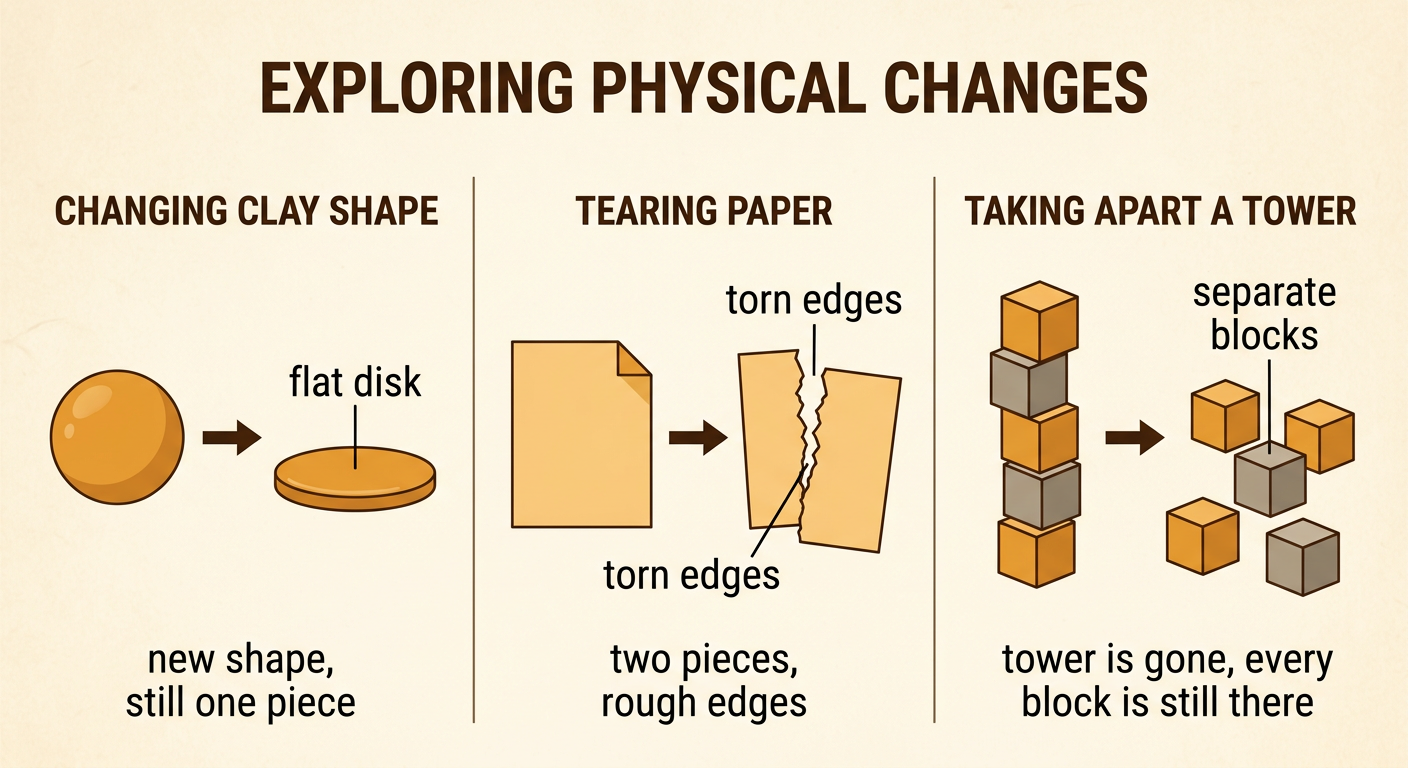
Now make one clear change to each object. Press the clay ball into a flat disk. Tear the paper into two pieces, following a line marked by your teacher. Take the building-block tower apart. Work carefully and change only one thing at a time. After each change, stop and observe. How is the object different from its starting form? The clay has a new shape, but it is still one piece of clay. The paper is now two pieces with rough torn edges. The tower is gone, but all of its blocks are still present. Draw or describe each changed object. For example, you might say, “The tower changed from one tall structure into six separate blocks.” These observations give you evidence about what happened during each change.
Try to Change It Back
Use the changed materials to test whether each object can return to its starting form. Roll the flat clay between your hands until it becomes a ball again. Reconnect the blocks by looking at your first drawing and rebuilding the same tower. Place the torn paper pieces together and inspect the tear. The pieces may fit beside each other, but the paper is not one unbroken sheet again. Tape can join the pieces, but it adds a new material and does not remove the tear. A change is reversible when the material can be returned to its earlier form. A change is not reversible when the original form cannot be fully restored. In this test, reshaping the clay and rebuilding the blocks are reversible. Tearing the paper is not reversible.

Sort and Record the Results
Organize the test results into two groups: can be changed back and cannot be changed back. Put clay and building blocks in the first group. Put torn paper in the second group. Then make a picture graph or tally chart. In this test, two objects could be changed back, and one object could not. Compare the groups by asking which has more and how many more. The reversible group has two objects, so it has one more object than the group with one object. Your class may also test folded paper or a different block design. Record those results separately because a folded sheet can usually be unfolded, while a torn sheet cannot be made whole again. Clear categories and counts make the evidence easy to understand and compare.

Share an Evidence-Based Claim
Make a claim that answers the question, and support it with observations. You might say, “Some changes can be reversed, but others cannot.” Then give evidence: “The flattened clay became a ball again, and the separate blocks became the same tower. The torn paper still had a tear, so it did not become one unbroken sheet.” Explain how the evidence supports your claim. You can also use the results to make decisions about materials. Reusing clay and blocks saves materials and lets people make new things. Keeping paper for drawing scraps can also be useful. Throwing damaged paper away may clear space, but it creates waste and means new paper may be needed. Recycling paper can reduce waste when recycling is available. Listen to classmates, compare their evidence, and revise your claim if new observations support a better answer.
