
Can We Engineer a Better Hand Warmer?
Students compare heat-releasing chemical processes and use temperature, safety, cost, and performance data to design and evaluate a model hand warmer.
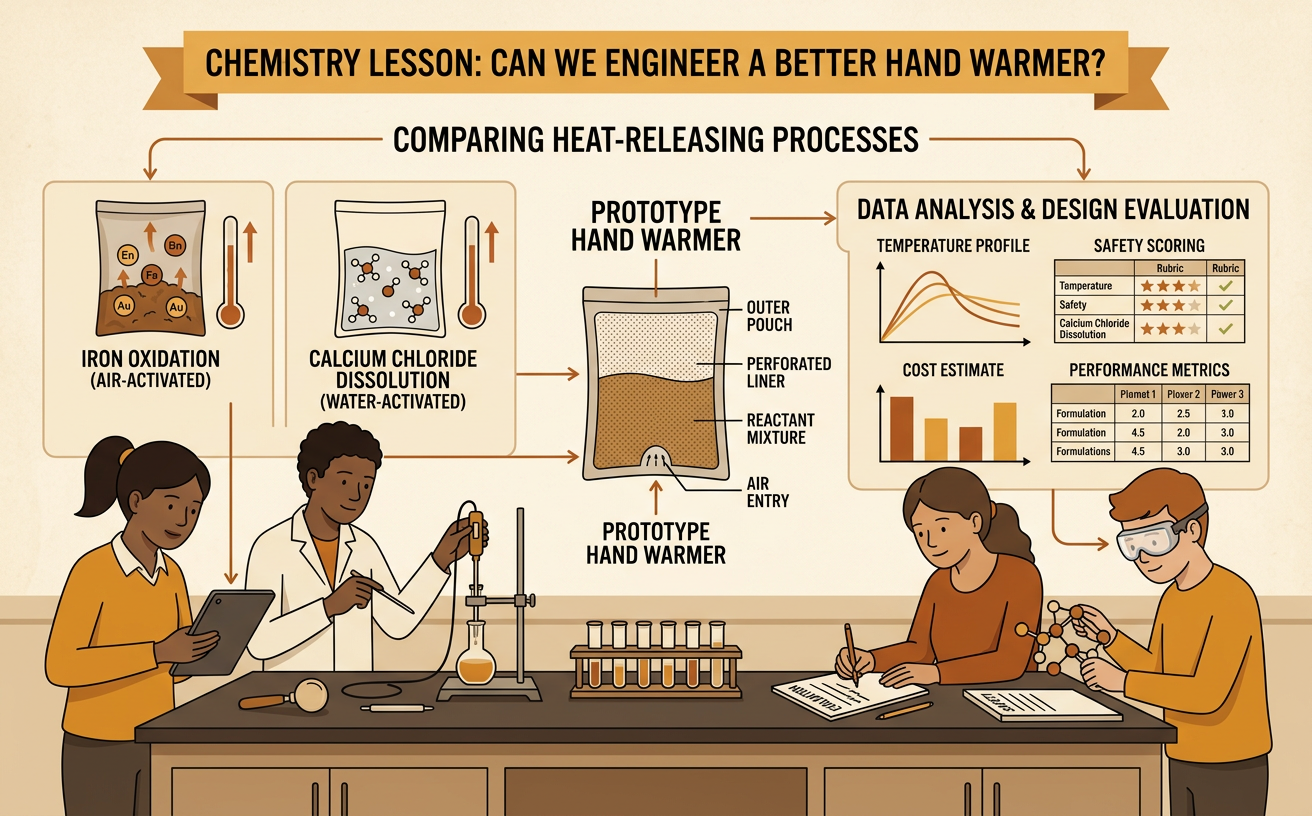
Illustrations are auto-generated and may be placeholders. They can be refreshed to match the narration.
Heat-Releasing Chemical Processes
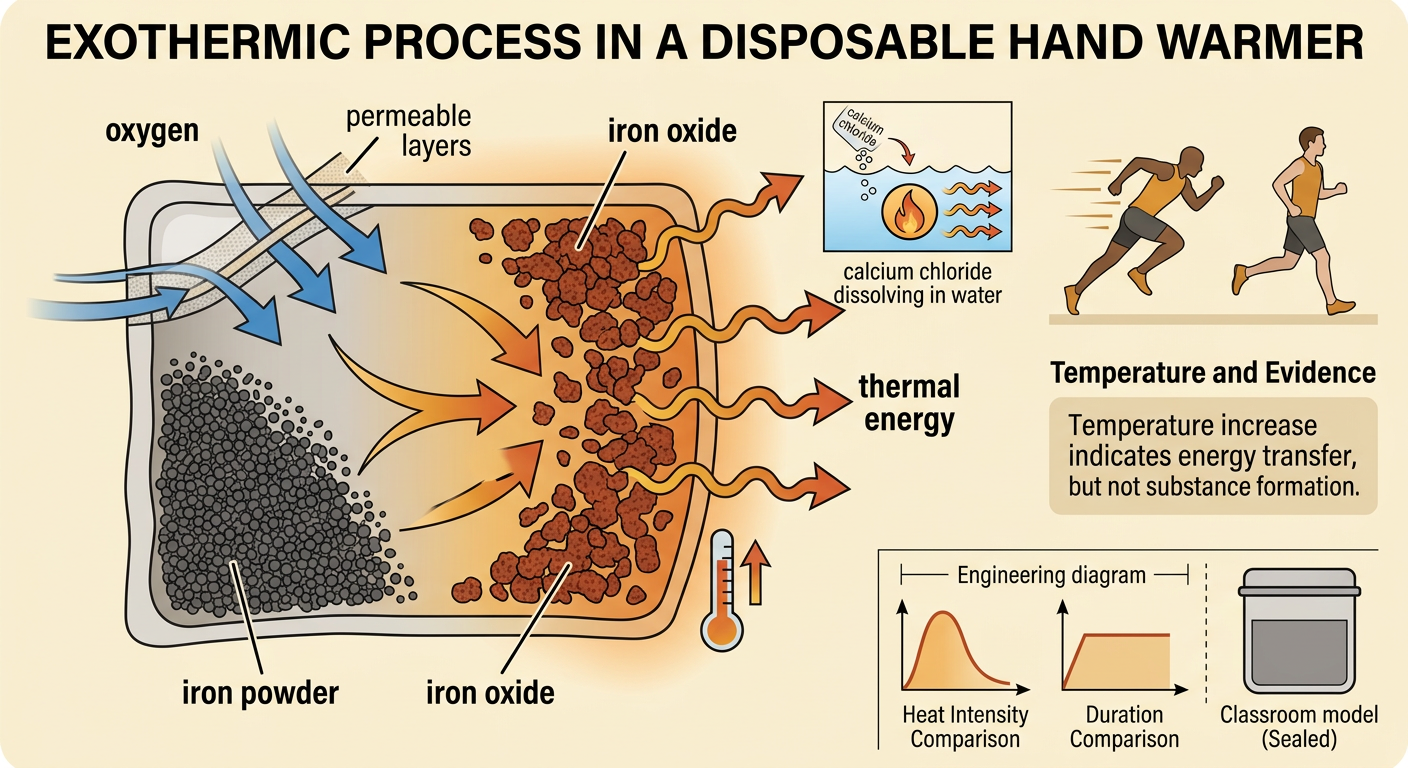
Some chemical processes release thermal energy into their surroundings. These processes are called exothermic. As energy moves from the reacting materials to nearby matter, the temperature of the surroundings rises. For example, disposable hand warmers often contain iron powder. When oxygen from the air reacts with the iron, iron oxide forms and thermal energy is released slowly. Another heat-releasing process occurs when calcium chloride dissolves in water. The temperature increase is evidence of energy transfer, but it does not prove by itself which substances formed. Different processes release energy at different rates and for different lengths of time. Engineers study these differences before selecting a process for a hand warmer. Any classroom model must remain sealed, use teacher-approved materials, and be tested with a thermometer rather than placed directly on skin.
Hand-Warmer Design Criteria
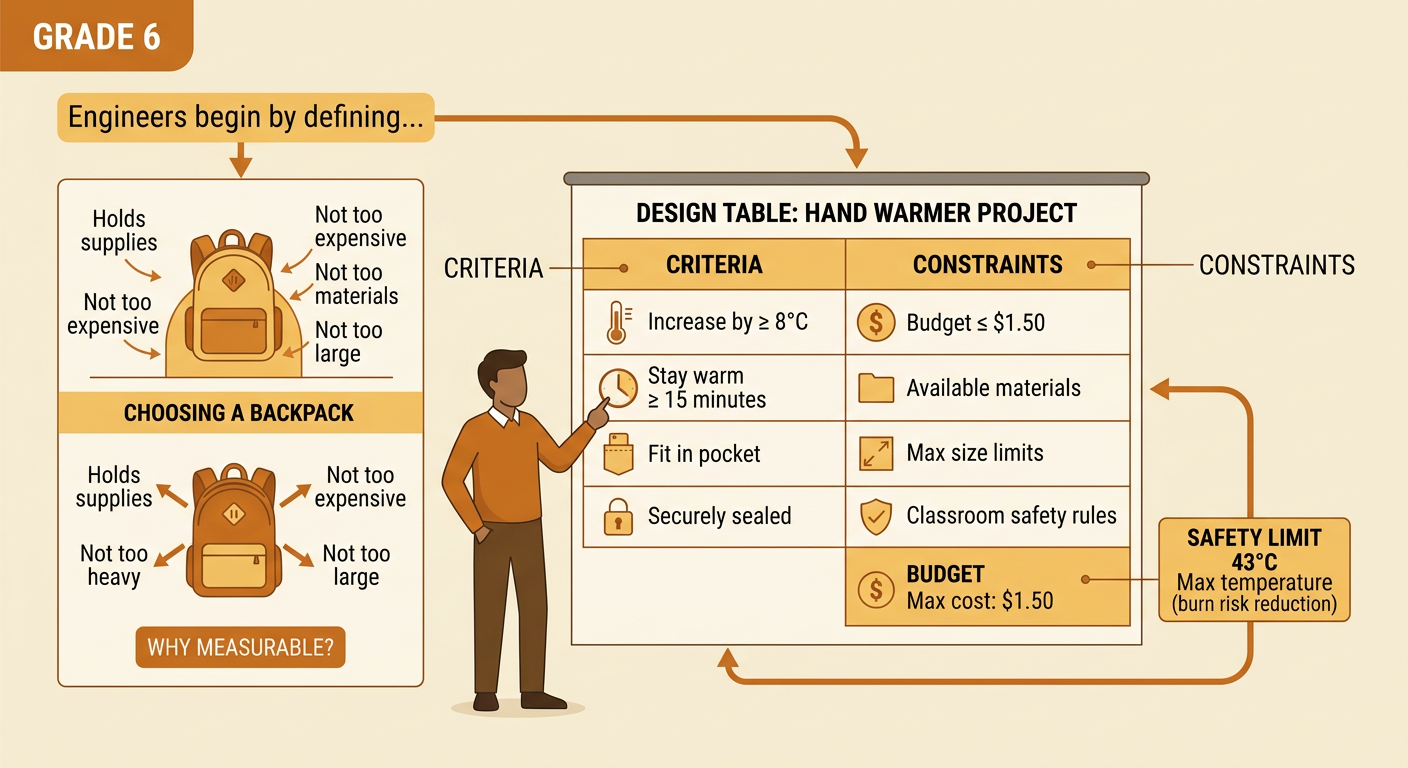
Design criteria describe what a successful hand warmer should do, while constraints limit how it can be made. Useful criteria might include reaching a comfortable temperature, staying warm for a certain time, fitting in a pocket, and keeping chemicals securely sealed. Constraints might include a limited budget, available materials, a maximum size, and classroom safety rules. For example, a design team might require its model to increase by at least 8 degrees Celsius, remain above its starting temperature for 15 minutes, and cost no more than $1.50. The team could also set a safety limit of 43 degrees Celsius to reduce the risk of burns. Criteria should be measurable so that designs can be evaluated fairly. Engineers often use a table to rank each criterion and decide which requirements are essential and which are preferred.
Testing Temperature Change
A fair test follows the same multistep procedure for every design. First, put on safety goggles and inspect each sealed model for leaks. Next, measure and record the starting temperature. Activate the model as directed by the teacher, start a timer, and measure its temperature at regular intervals, such as every minute for 15 minutes. Place the thermometer in the same position each time without opening the container. Record observations in a data table, including any swelling, leaking, or unusual changes. One factor, such as the type of chemical process, should be changed while other conditions stay the same. For example, two models can be tested in the same room using identical outer pouches and equal testing times. Repeating each test helps reveal whether the results are consistent. A model should never be held against skin during testing because its temperature may become unsafe.
Graphing and Comparing Results
A line graph makes temperature patterns easier to compare. Time in minutes belongs on the horizontal axis, and temperature in degrees Celsius belongs on the vertical axis. Plot each measurement, connect the points for each design, and use a different color or symbol for every line. Suppose Design A rises from 22 degrees Celsius to 40 degrees Celsius in five minutes, while Design B rises from 22 degrees Celsius to 34 degrees Celsius. Design A has the greater temperature change: 40 minus 22 equals 18 degrees Celsius. However, the graph might show Design B remaining warm longer. Students can also calculate the average heating rate by dividing temperature change by elapsed time. For Design A, 18 degrees Celsius divided by five minutes is 3.6 degrees Celsius per minute. The highest temperature, heating rate, and time spent warm describe different parts of performance.
Improving the Design
Engineering is an iterative process, which means a design is tested, changed, and tested again. After a trial, the team should compare the evidence with its criteria and identify one weakness. For example, a model might reach 41 degrees Celsius but cool below the target temperature after only eight minutes. The team could modify the outer insulation to slow energy transfer to the environment, then repeat the same test. Changing only one feature makes it easier to connect the modification to the new results. If the insulated model stays warm for 14 minutes without passing the safety limit, the evidence supports the change. If it becomes too hot or shows signs of leaking, the change should be rejected. Engineers record every modification, prediction, and result so they can explain why the final design works better than earlier versions.
Balancing Performance, Safety, and Cost
The best hand warmer is not always the one with the highest temperature. Engineers balance benefits and costs for users and businesses. A warmer that heats quickly may be useful outdoors, but it could cause burns if it becomes too hot. A thicker, stronger pouch may reduce leaks but add weight and raise the price. Suppose Design X costs $0.90, reaches 46 degrees Celsius, and lasts 20 minutes, while Design Y costs $1.20, reaches 40 degrees Celsius, and lasts 25 minutes. Design X is cheaper, but it exceeds a 43-degree safety limit. Design Y costs more but meets both the safety and duration criteria, so it offers a better overall solution. A business must consider material, packaging, and production costs, while buyers consider price, comfort, reliability, and safe use. A decision matrix can assign scores to these factors and make trade-offs visible.