Carbon on the Move: Modeling the Carbon Cycle
Students interpret data and construct a model showing how photosynthesis, cellular respiration, decomposition, and combustion move carbon among Earth’s systems.
Illustrations are auto-generated and may be placeholders. They can be refreshed to match the narration.
Where Is Earth’s Carbon?
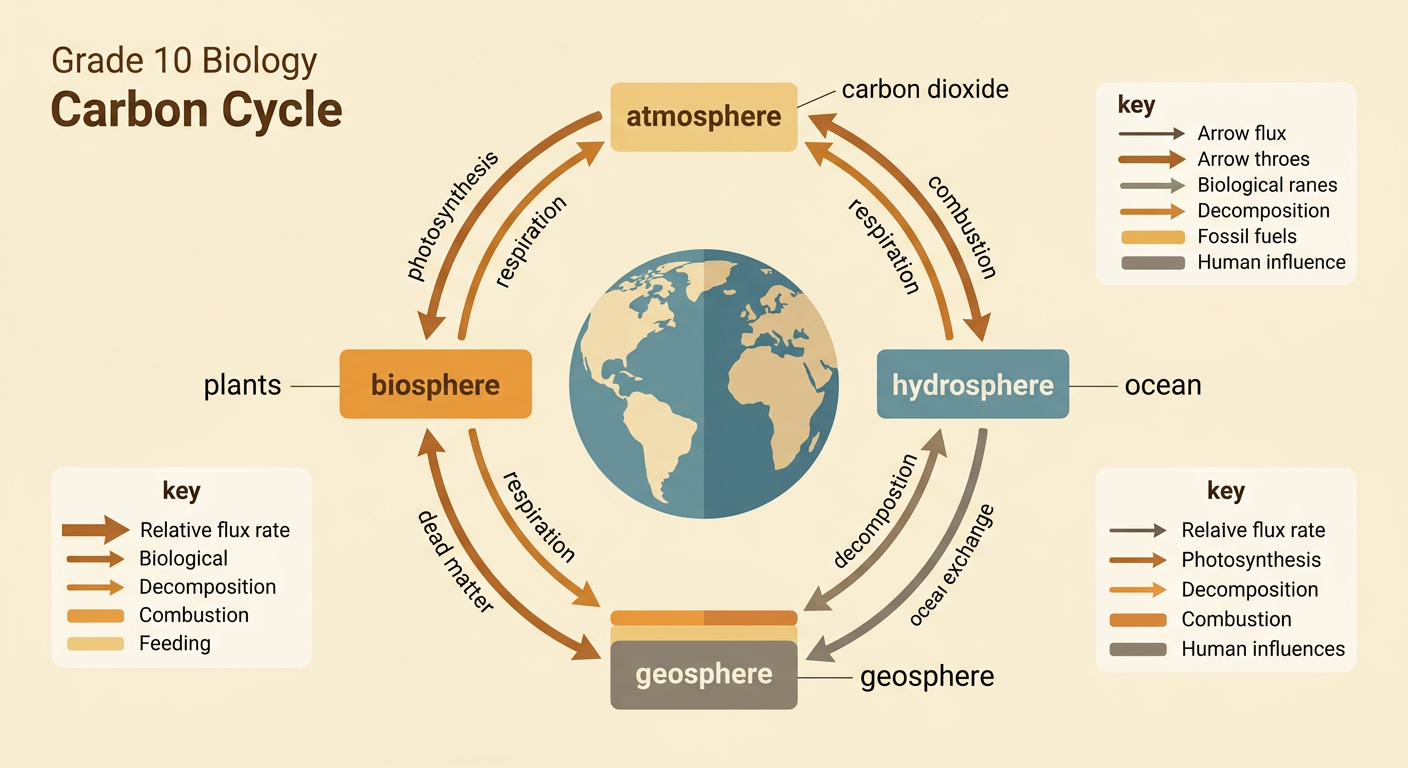
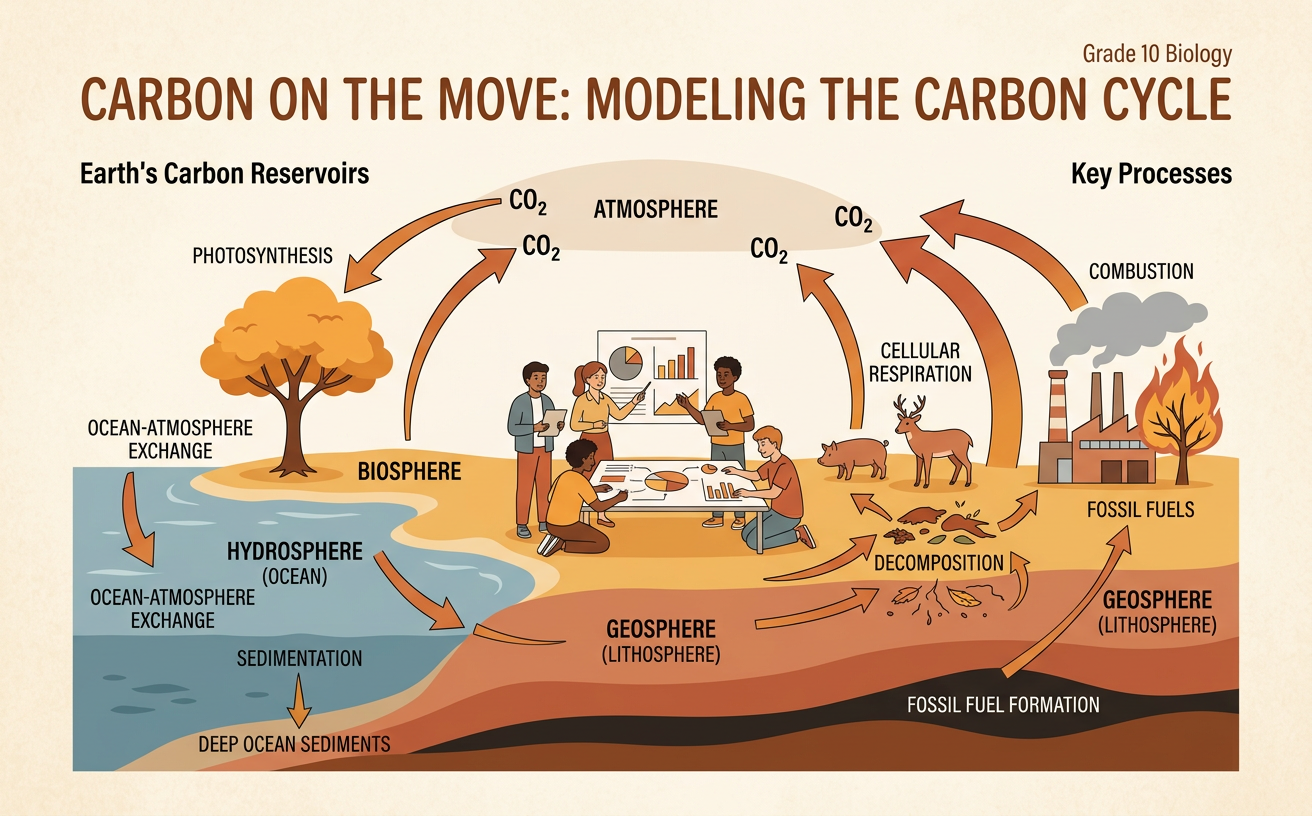
Carbon is stored in reservoirs within Earth’s four major systems. The atmosphere contains carbon mainly as carbon dioxide. The biosphere stores it in living organisms and dead organic matter. The hydrosphere contains dissolved carbon dioxide, bicarbonate, and carbonate, especially in the oceans. The geosphere stores carbon in soils, sediments, carbonate rocks, and fossil fuels. These reservoirs differ greatly in size. For example, rounded estimates place about 880 gigatons of carbon in the atmosphere and about 38,000 gigatons in the oceans. A bar graph of these values would show that the ocean reservoir is much larger. Carbon moves between reservoirs through fluxes, which are measured as amounts per unit of time. Reservoir size and flux rate are different quantities: a large reservoir does not necessarily exchange carbon quickly.

Photosynthesis and Carbon Storage
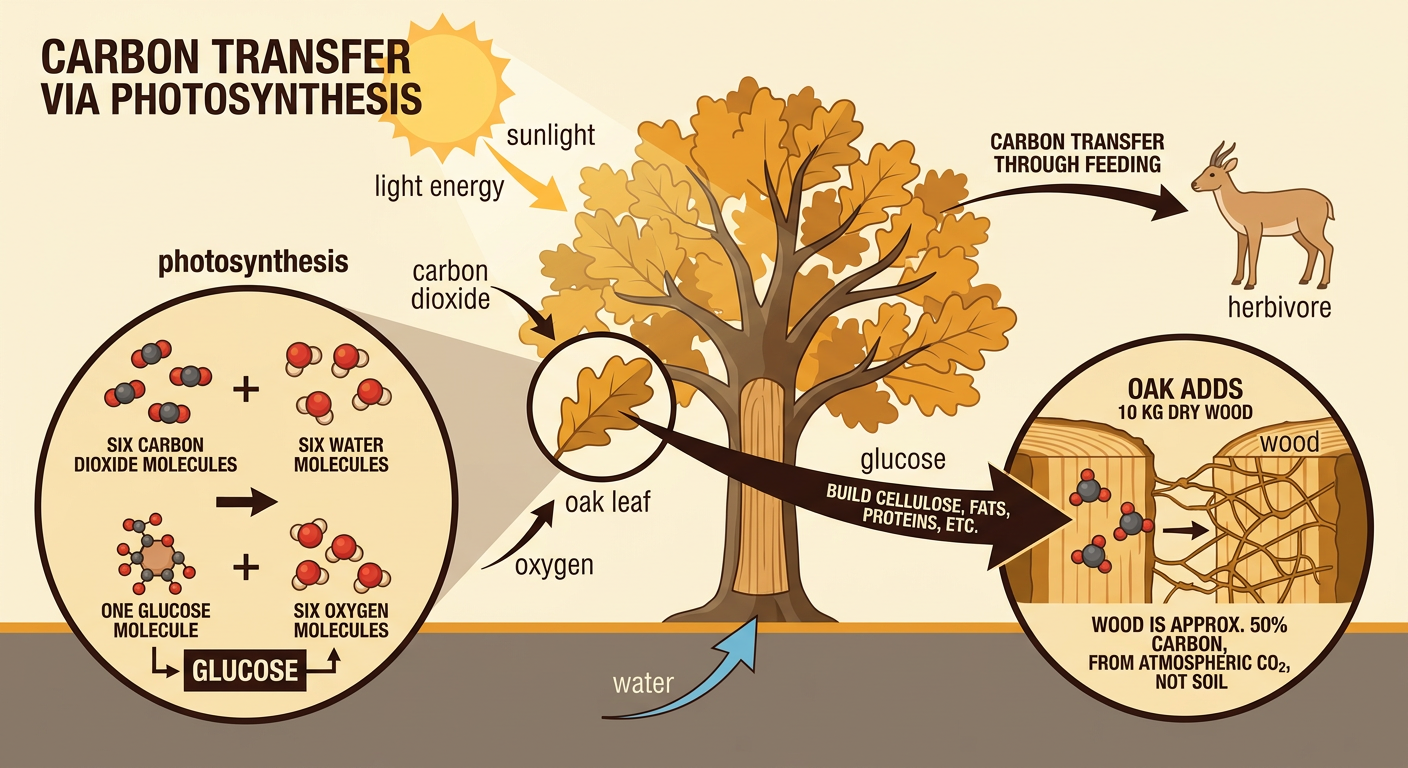
Photosynthesis moves carbon from the atmosphere or hydrosphere into the biosphere. Plants, algae, and some bacteria use light energy to combine carbon dioxide and water, producing glucose and oxygen. The simplified equation is 6CO₂ + 6H₂O → C₆H₁₂O₆ + 6O₂. The carbon atoms in glucose can become cellulose, fats, proteins, and other molecules in an organism. For example, a growing oak takes in atmospheric carbon dioxide and stores some of that carbon in new wood. Because about half of dry wood mass is carbon, 10 kilograms of added dry wood contains roughly 5 kilograms of carbon. Some stored carbon enters animals when they eat plants. Carbon may remain in biomass briefly, or it may stay in long-lived wood and soil for decades or longer.
Respiration and Decomposition
Cellular respiration returns carbon from organic molecules to the atmosphere or hydrosphere. Plants, animals, fungi, and many microorganisms break down glucose to release usable energy. The simplified equation is C₆H₁₂O₆ + 6O₂ → 6CO₂ + 6H₂O + energy. For example, a rabbit obtains carbon by eating grass and releases some of it as carbon dioxide when its cells respire. When organisms die or produce waste, decomposers such as fungi and bacteria break down the material. Their respiration releases carbon dioxide, while some carbon remains in soil organic matter. In low-oxygen environments, certain microorganisms can produce methane instead. A fallen leaf therefore has several possible pathways: its carbon may enter a decomposer, move into soil, or return to the atmosphere as carbon dioxide or methane.

Combustion and Human Impacts
Combustion rapidly transfers stored carbon to the atmosphere. When wood, coal, oil, or natural gas burns, carbon in the fuel combines with oxygen and forms carbon dioxide. Burning one gallon of gasoline releases about 8.9 kilograms of carbon dioxide; part of that mass comes from oxygen in the air. Wildfires are natural carbon-cycle events, but human activities have greatly increased combustion by using fossil fuels for electricity, transportation, heating, and industry. Fossil fuels contain carbon that was stored in the geosphere for millions of years. A graph of atmospheric carbon dioxide since industrialization shows a strong upward trend, especially after the mid-1900s. Oceans and plants absorb some added carbon, but not all of it. This interaction between human and physical systems changes atmospheric composition, climate, ocean chemistry, and carbon storage patterns.

Build and Explain a Carbon Cycle Model
A carbon cycle model should show reservoirs as labeled boxes and carbon fluxes as directional arrows. Include the atmosphere, biosphere, hydrosphere, and geosphere. Label arrows with processes such as photosynthesis, respiration, decomposition, combustion, feeding, and ocean exchange. Use arrow thickness or numbers to represent relative flux rates, but include a key so the symbols are understandable. For example, trace one carbon atom from atmospheric carbon dioxide into a maple leaf through photosynthesis, into soil after the leaf falls, and back to the atmosphere through decomposer respiration. Explain each arrow in words and identify any human influence. Check that carbon is transferred rather than created or destroyed. A strong model also states its limits: it may leave out seasonal changes, local differences, or exact reservoir sizes while still showing the major carbon pathways accurately.