Carbonate Equilibrium and Ocean Acidification
Students use chemical equations and particle-level reasoning to explain how dissolved carbon dioxide shifts carbonate equilibria and lowers ocean pH.
Illustrations are auto-generated and may be placeholders. They can be refreshed to match the narration.
Carbon Dioxide Dissolving in Seawater
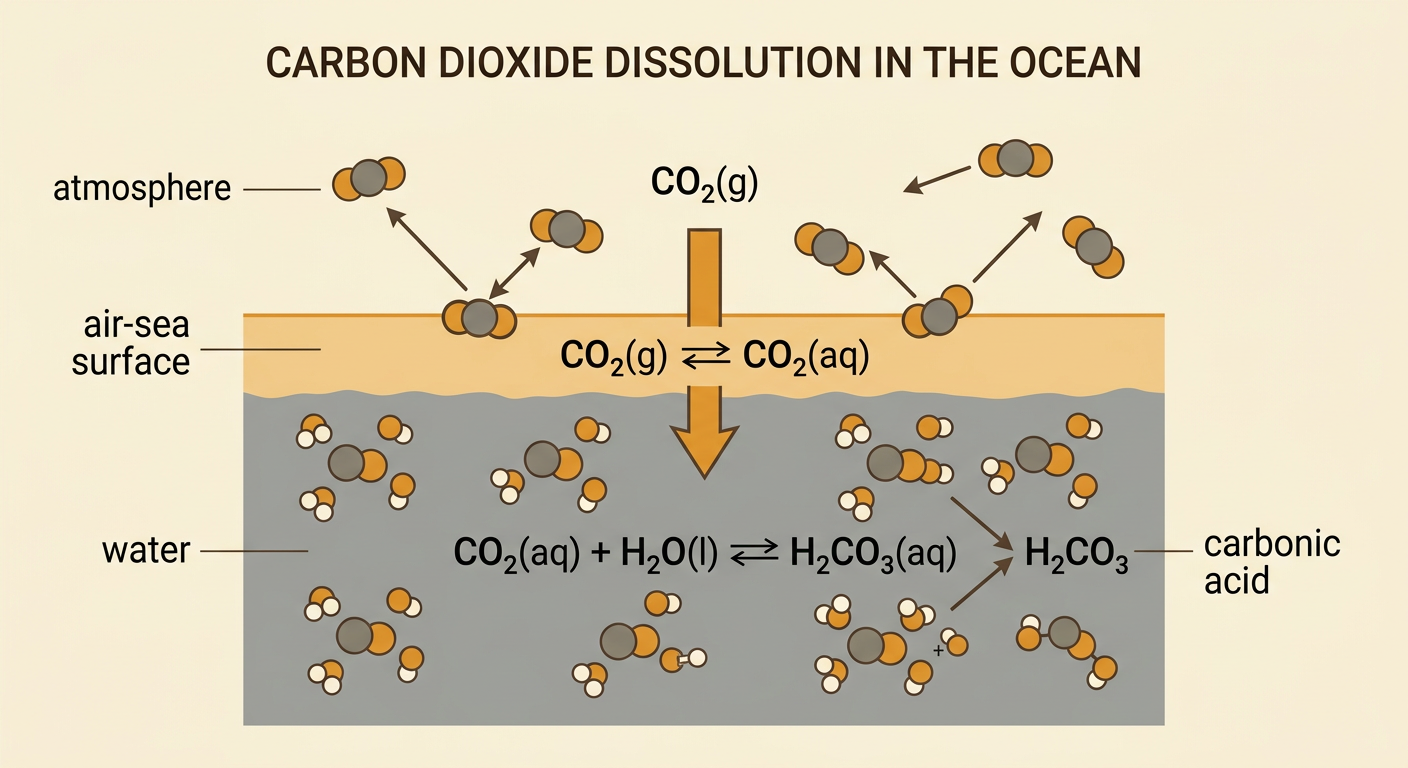
Carbon dioxide moves between the atmosphere and ocean at the air-sea surface. When atmospheric carbon dioxide increases, more molecules collide with the water and dissolve until the system approaches a new equilibrium. This process can be represented as CO₂(g) ⇌ CO₂(aq). Dissolved carbon dioxide is surrounded by water molecules, and a small fraction reacts with water: CO₂(aq) + H₂O(l) ⇌ H₂CO₃(aq). H₂CO₃ is carbonic acid. Temperature, pressure, wind, and mixing affect how much carbon dioxide enters seawater. For example, cold surface water generally dissolves more carbon dioxide than warm water. Winds can also mix carbon-rich surface water downward. Although the ocean absorbs some atmospheric carbon dioxide, that absorption changes seawater chemistry rather than permanently removing all effects of the gas.
The Carbonate Equilibrium System
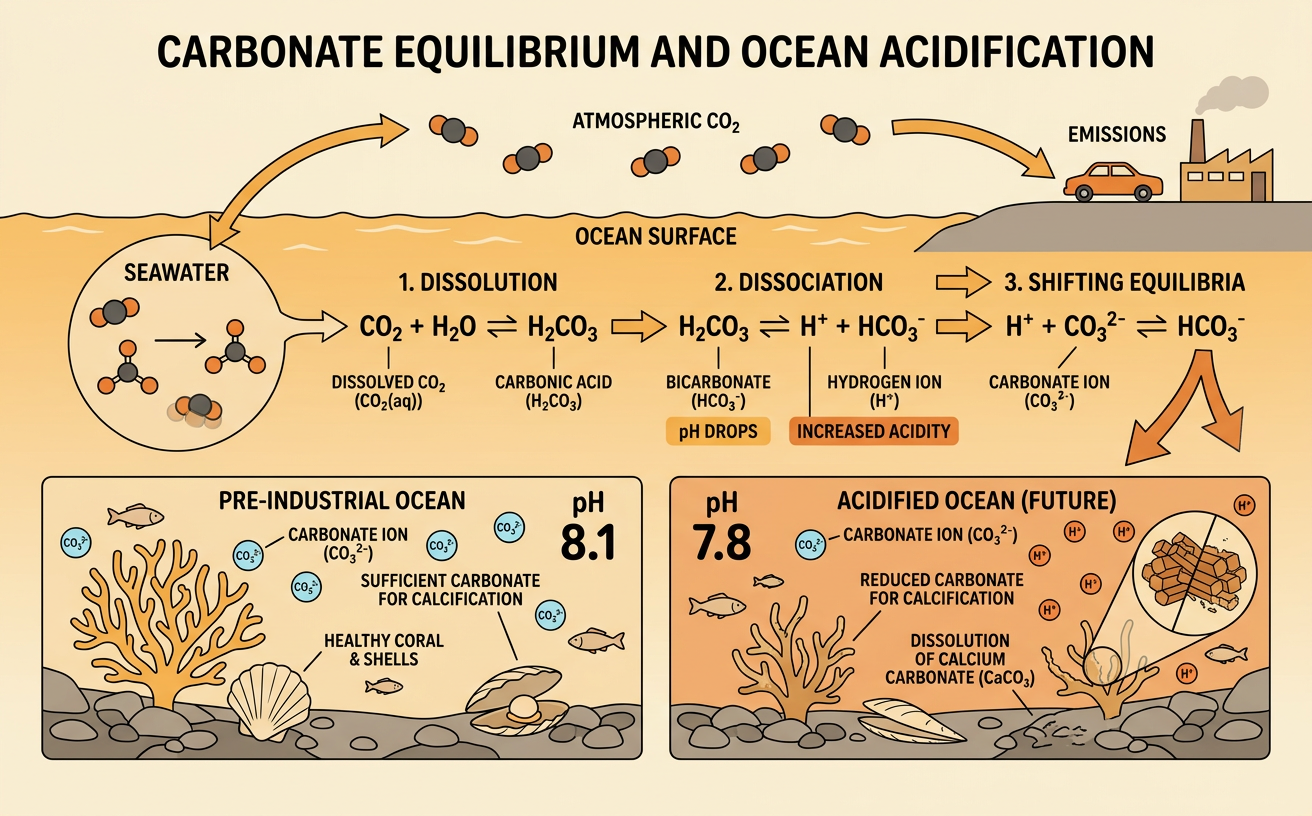
Dissolved carbon dioxide participates in several reversible reactions called the carbonate equilibrium system. First, CO₂(aq) + H₂O(l) ⇌ H₂CO₃(aq). Carbonic acid can then donate a hydrogen ion: H₂CO₃(aq) ⇌ H⁺(aq) + HCO₃⁻(aq). Bicarbonate can also donate a hydrogen ion: HCO₃⁻(aq) ⇌ H⁺(aq) + CO₃²⁻(aq). In typical seawater near pH 8, bicarbonate is the most abundant of these dissolved carbon forms. Carbonate ions and dissolved carbon dioxide are present in smaller amounts. Because every reaction is reversible, particles continually react in both directions even when concentrations remain nearly constant. For example, adding dissolved carbon dioxide increases carbonic acid formation and changes the rates of the forward and reverse reactions. The system then shifts toward a new equilibrium with more bicarbonate and hydrogen ions and less carbonate ion.

Explaining the Shift in pH
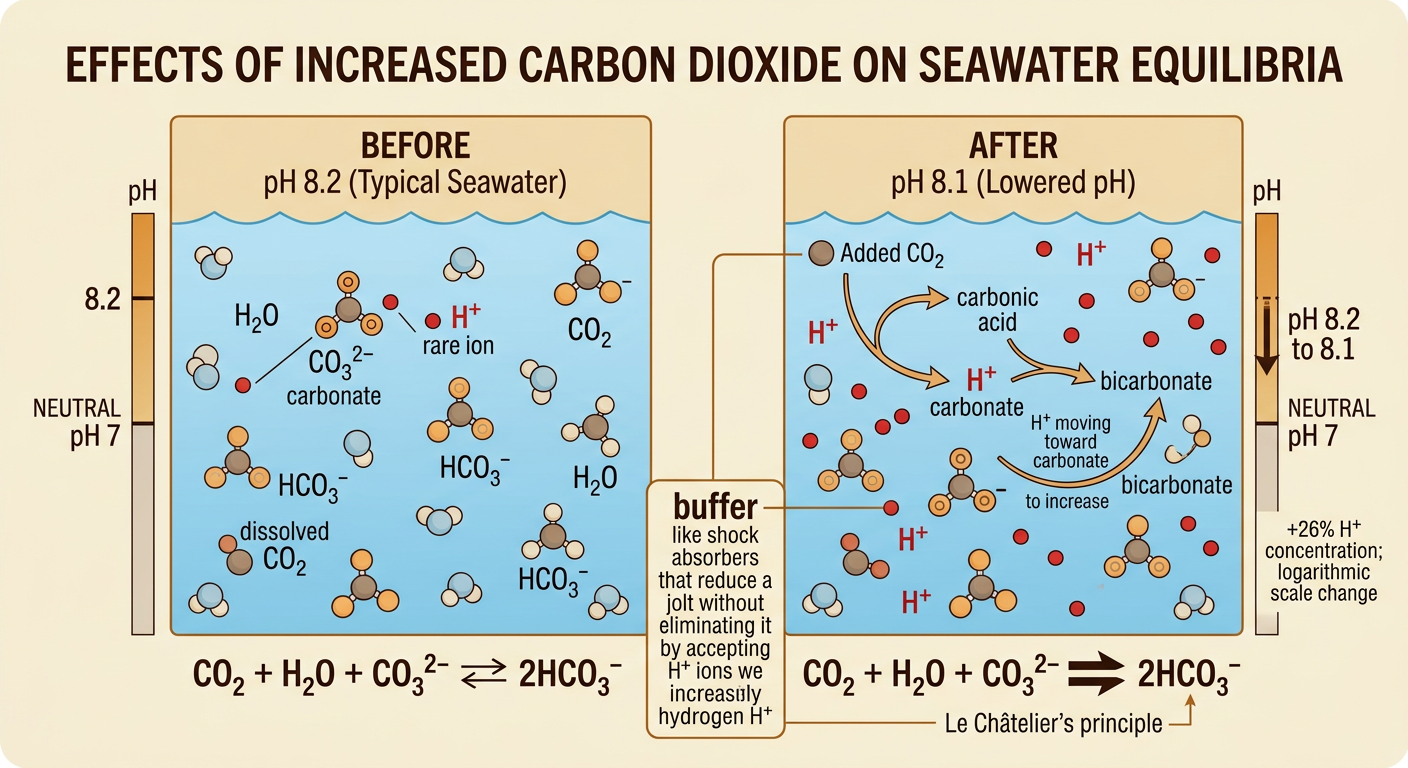
Adding carbon dioxide lowers seawater pH because it increases the concentration of hydrogen ions. According to Le Châtelier’s principle, adding CO₂(aq) drives carbonic acid formation and its dissociation toward products. Some additional H⁺ reacts with carbonate: H⁺(aq) + CO₃²⁻(aq) ⇌ HCO₃⁻(aq). A useful overall equation is CO₂(aq) + H₂O(l) + CO₃²⁻(aq) ⇌ 2HCO₃⁻(aq). Thus, added carbon dioxide produces more bicarbonate while reducing the carbonate ion concentration. Seawater buffers the change because carbonate and bicarbonate accept some added hydrogen ions, but the buffer does not prevent all pH decline. For example, seawater changing from pH 8.2 to 8.1 remains basic because its pH is above 7. However, its hydrogen ion concentration increases by about 26 percent because the pH scale is logarithmic.
Interpreting Ocean Chemistry Data
Scientists evaluate ocean acidification by combining time-series graphs, maps, and chemical measurements. Suppose a monitoring station records an average surface pH of 8.20 in 1990 and 8.10 in 2020 while atmospheric carbon dioxide and dissolved carbon dioxide both rise. The hydrogen ion concentration is modeled by [H⁺] = 10⁻ᵖᴴ. The ratio 10⁻⁸·¹⁰ ÷ 10⁻⁸·²⁰ equals about 1.26, indicating approximately 26 percent more hydrogen ions. This pattern supports, but does not alone prove, a carbon dioxide cause; temperature, salinity, runoff, respiration, and instrument calibration must also be examined. Maps may show especially low pH where deep, carbon-rich water rises near a coast. Such conditions can affect where shellfish farms operate, how seafood moves to markets, and which coastal communities face economic risk. Strong conclusions therefore integrate chemical data with geographic and human evidence.

Consequences for Calcium Carbonate
Many corals, oysters, clams, and plankton build structures from calcium carbonate. The relevant equilibrium is CaCO₃(s) ⇌ Ca²⁺(aq) + CO₃²⁻(aq). Ocean acidification reduces the carbonate ion concentration, making calcium carbonate formation more difficult and sometimes favoring dissolution. Scientists describe the tendency to form or dissolve a mineral with the saturation state, Ω = [Ca²⁺][CO₃²⁻]/Ksp. When Ω is greater than 1, precipitation is thermodynamically favored, although organisms still need energy and biological controls to build shells. When Ω is less than 1, unprotected calcium carbonate tends to dissolve. For example, pteropod shells can show surface damage in low-saturation water. Oyster hatcheries may experience poor larval shell growth during coastal upwelling events, so managers monitor carbonate chemistry and sometimes treat intake water. Responses vary by species, life stage, food supply, and local conditions.

Evidence-Based Exit Explanation
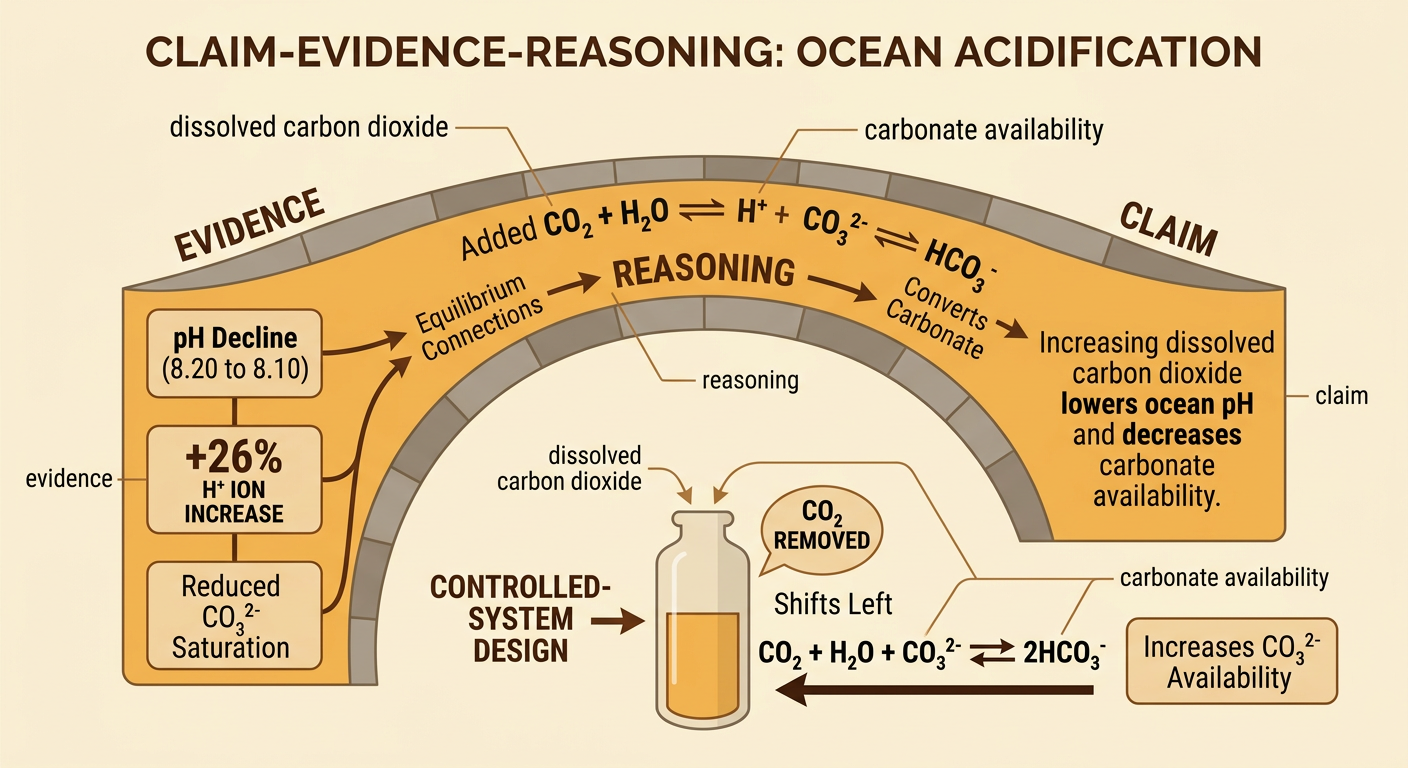
A strong exit explanation should make a claim, cite evidence, and connect the evidence with equilibrium reasoning. One example is: Increasing dissolved carbon dioxide lowers ocean pH and decreases carbonate ion availability. Evidence includes the measured decline from pH 8.20 to 8.10, the calculated 26 percent increase in hydrogen ion concentration, and observations of reduced carbonate saturation. The reasoning is that added CO₂ shifts the carbonate equilibria toward more H⁺ and HCO₃⁻, while H⁺ converts CO₃²⁻ into HCO₃⁻. Students can also refine the system by naming a condition that increases a desired equilibrium product. For example, removing dissolved carbon dioxide from a controlled seawater sample shifts CO₂(aq) + H₂O(l) + CO₃²⁻(aq) ⇌ 2HCO₃⁻(aq) toward the left, increasing carbonate ion availability. Any proposed intervention must be evaluated for scale, energy use, ecological effects, cost, and impacts on coastal communities.