Causes and Consequences of the French Revolution
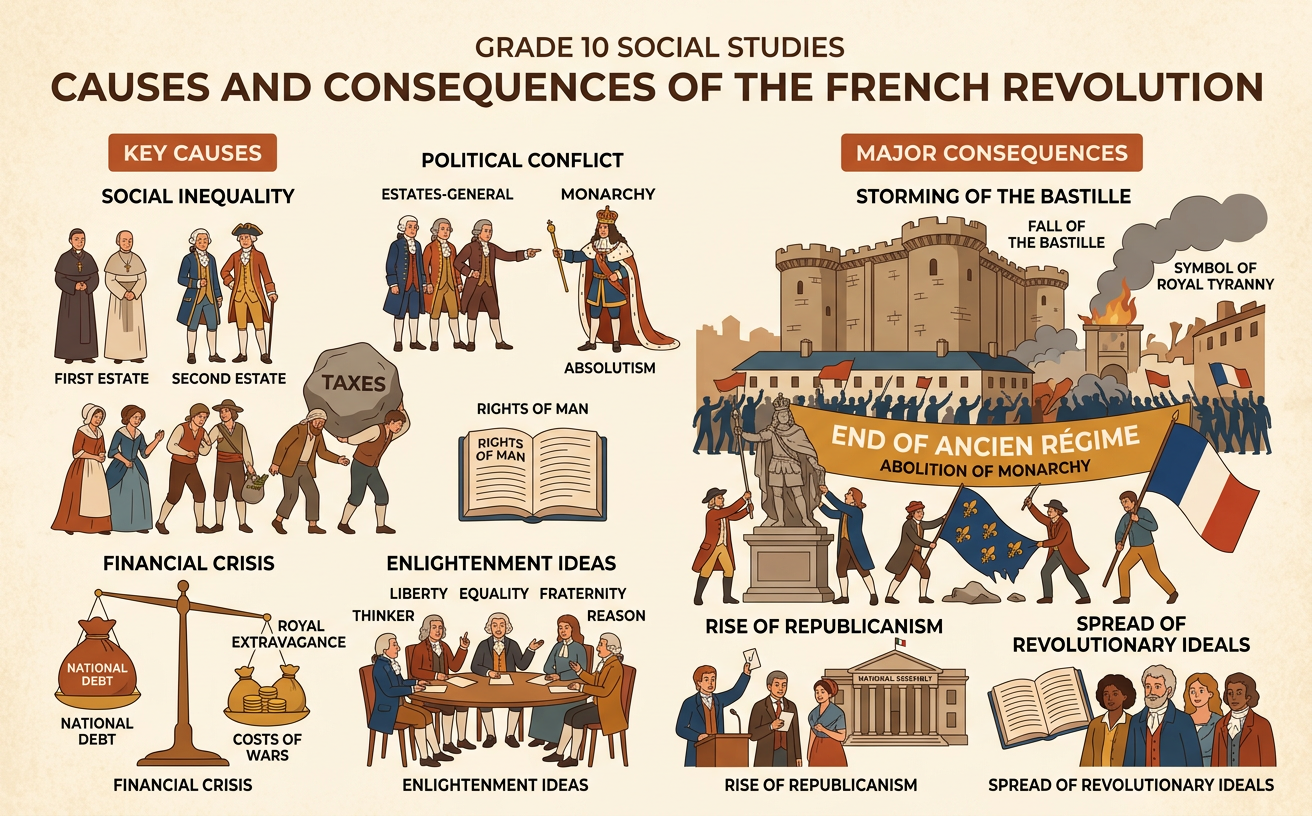
Students analyze how social inequality, financial crisis, Enlightenment ideas, and political conflict contributed to the French Revolution and the end of absolute monarchy.
Illustrations are auto-generated and may be placeholders. They can be refreshed to match the narration.
France’s Three Estates
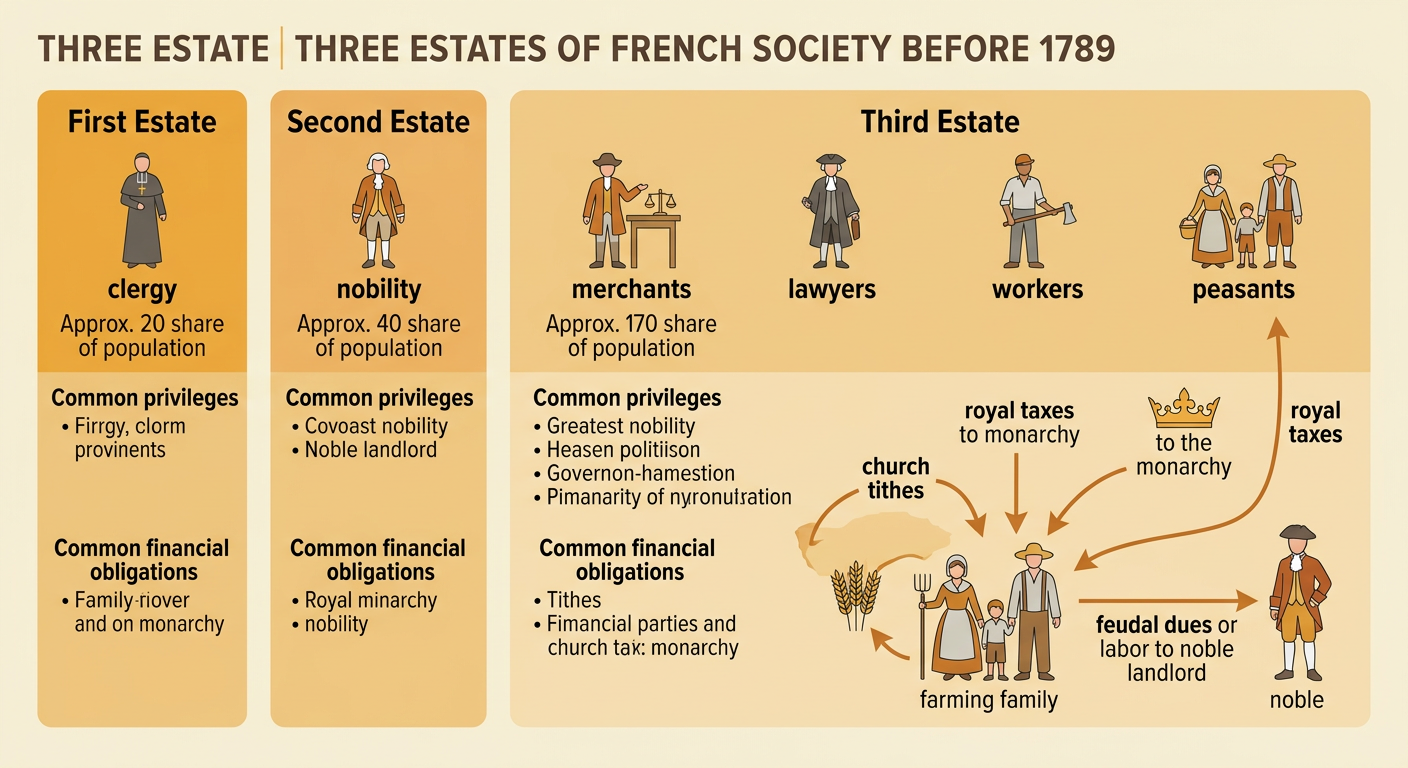
Before 1789, French society was legally divided into three orders, or Estates. The First Estate was the clergy, and the Second Estate was the nobility. Together, they formed a small part of the population but held major privileges, including access to powerful offices and exemptions from some taxes. The Third Estate included nearly everyone else, from wealthy merchants and lawyers to urban workers and peasants. It carried much of the tax burden despite having less political influence. Local customs made obligations different across France, but many peasants paid royal taxes, church tithes, and feudal dues. For example, a farming family might owe money or labor to a noble landlord while also paying taxes to the monarchy. This unequal system caused resentment because social rank, not simply wealth or ability, determined rights and responsibilities.
Debt and Economic Crisis
France’s financial crisis grew from decades of expensive warfare, including support for the American Revolution, as well as heavy borrowing and inefficient tax collection. The monarchy owed large interest payments, yet privileged groups resisted reforms that would make taxation broader and more equal. At the same time, poor harvests in 1788 reduced grain supplies and drove up bread prices. Because bread was a basic food, rising prices harmed ordinary families immediately. For example, an urban laborer might spend most of a day’s wages on bread, leaving little money for rent, fuel, or clothing. King Louis XVI’s ministers proposed new taxes, but political opposition blocked lasting reform. By 1789, the government could no longer solve the crisis through ordinary methods. Financial emergency therefore became a political crisis, forcing the king to call the Estates-General for the first time since 1614.

Enlightenment Challenges to Absolutism
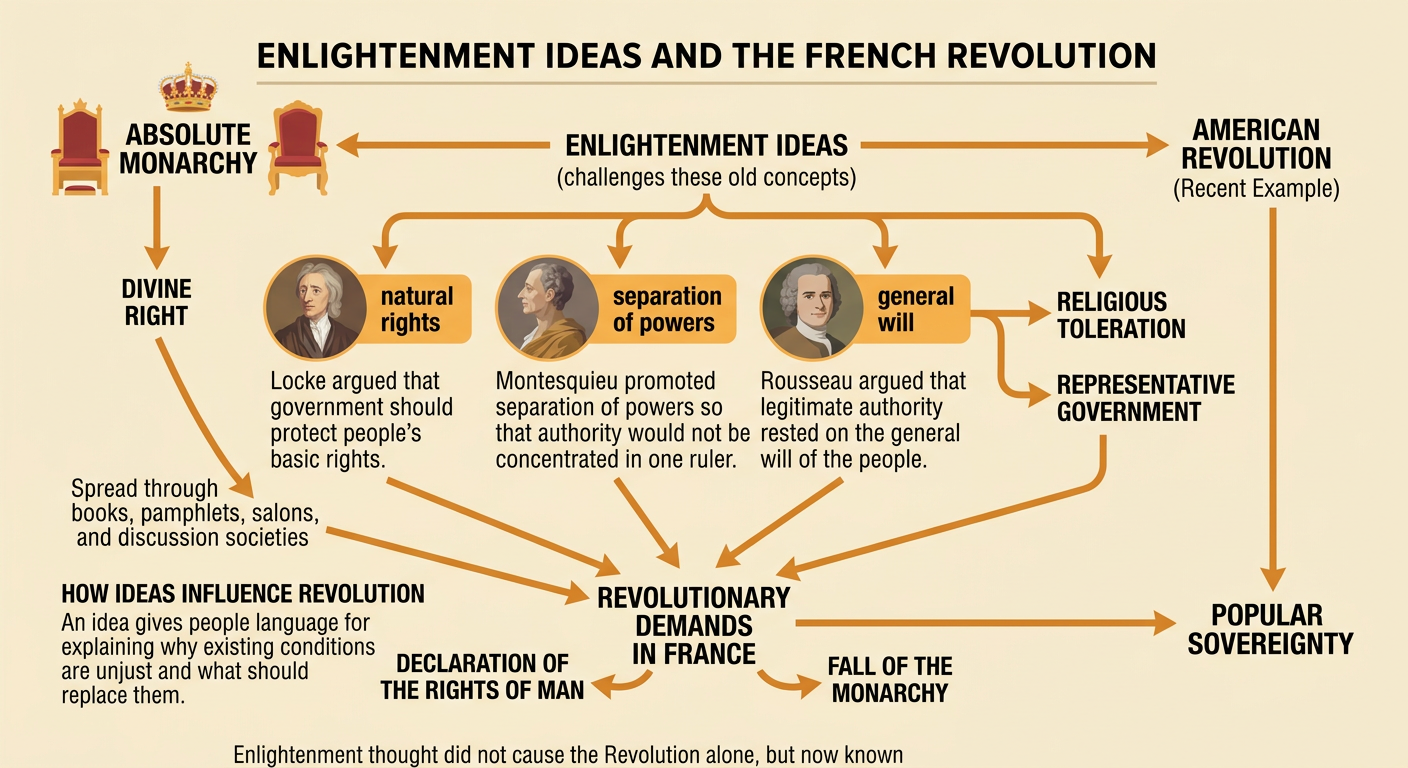
Enlightenment thinkers questioned the idea that kings possessed unlimited authority by divine right. John Locke argued that government should protect natural rights, while Montesquieu supported a separation of powers. Jean-Jacques Rousseau described legitimate political authority as resting on the general will of the people. French readers also encountered criticism of censorship, religious intolerance, and inherited privilege. These ideas circulated through books, salons, pamphlets, and discussion societies, although literacy and access were unequal. The American Revolution offered a recent example of colonists using ideas about rights and representation to challenge a monarch. For example, educated members of the Third Estate could use Enlightenment language in lists of grievances prepared for the Estates-General. Enlightenment thought did not cause the French Revolution by itself. Instead, it provided concepts and arguments that helped people interpret economic hardship and social inequality as problems requiring political change.
From the Estates-General to Revolution
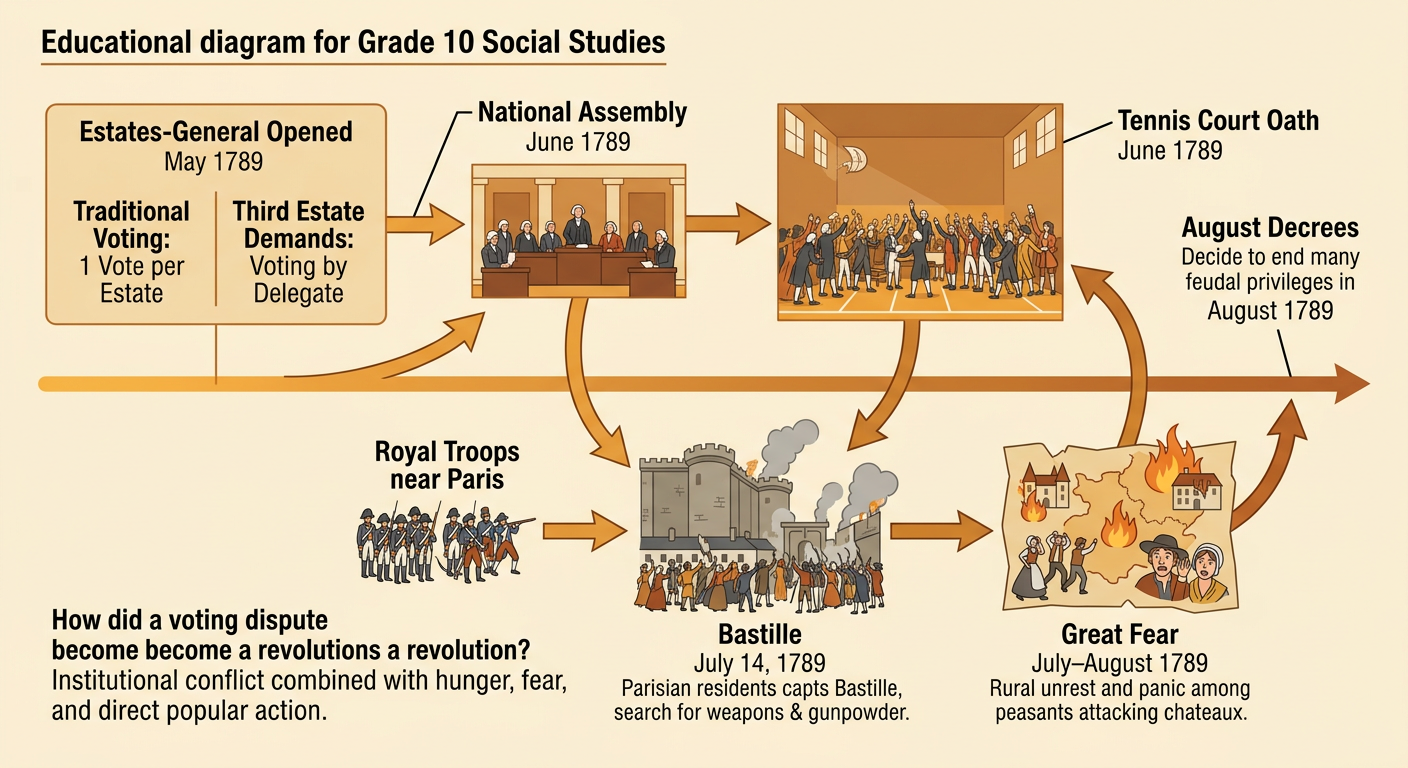
The Estates-General opened in May 1789, but conflict quickly developed over voting. Traditionally, each Estate received one collective vote, allowing the clergy and nobility to outvote the Third Estate. Representatives of the Third Estate demanded voting by individual delegate. In June, they declared themselves the National Assembly and promised in the Tennis Court Oath not to separate until France had a constitution. When royal troops gathered near Paris, many residents feared a crackdown. On July 14, a crowd captured the Bastille, a fortress and prison associated with royal authority, while searching for weapons and gunpowder. Rural uprisings known as the Great Fear soon spread. In August, the Assembly ended many feudal privileges. These events show how a dispute within a royal institution became a broader revolution when political conflict joined popular fear, hunger, and direct action.
The Declaration of the Rights of Man
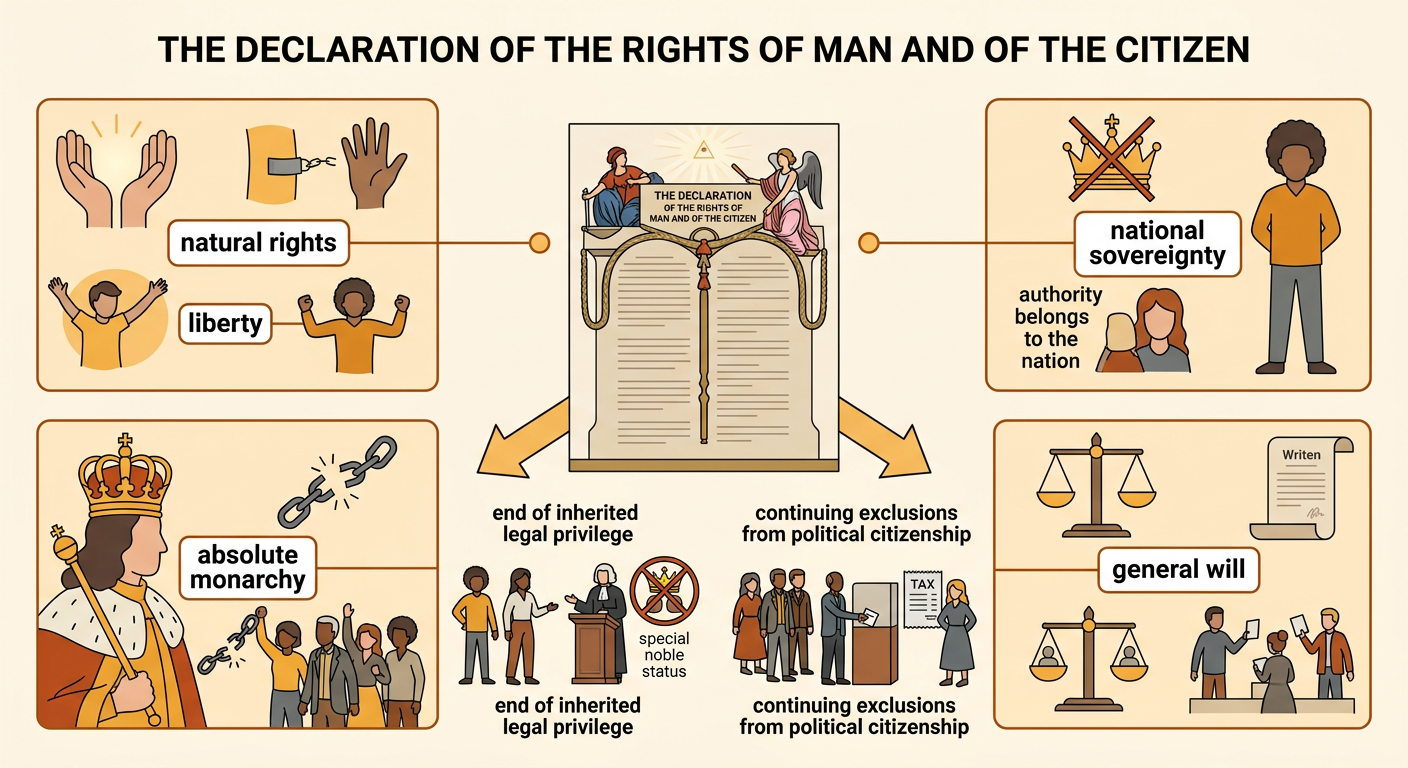
On August 26, 1789, the National Assembly adopted the Declaration of the Rights of Man and of the Citizen. It announced that men were born free and equal in rights and identified liberty, property, security, and resistance to oppression as natural rights. It also stated that sovereignty belonged to the nation, not personally to the king, and that laws should express the general will. These principles directly challenged absolute monarchy and legal privilege. For example, the declaration rejected the idea that nobles should receive special treatment simply because of birth. However, its broad language did not immediately produce equal political participation. Under later rules, voting was limited mainly to taxpaying men, while women had no national voting rights. The declaration became an influential statement of universal principles, but debates over who counted as a full citizen revealed the gap between revolutionary ideals and practice.
Revolutionary Change and Its Limits
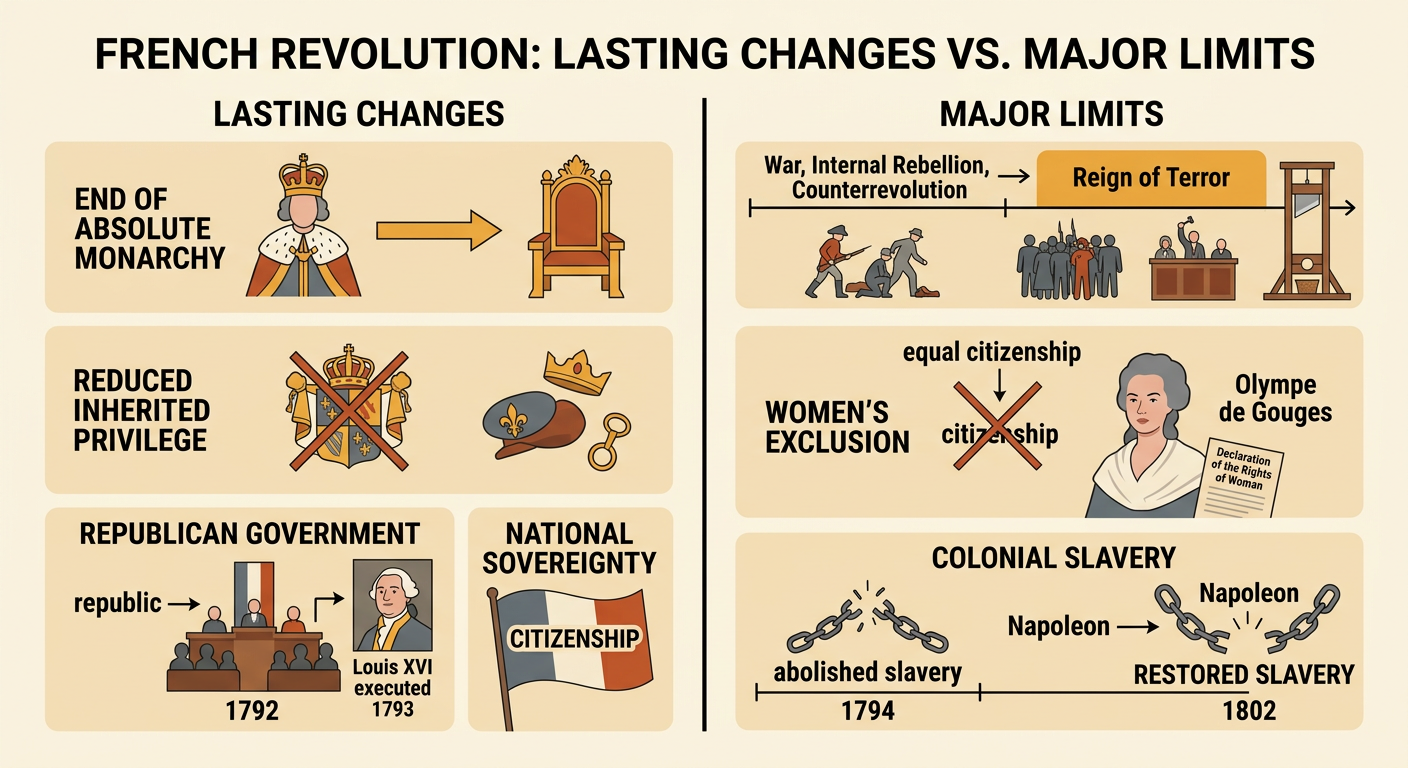
The Revolution transformed France by weakening inherited privilege, ending absolute monarchy, and making citizenship and national sovereignty central political ideas. France became a republic in 1792, and Louis XVI was executed in 1793. War, internal rebellion, and fear of counterrevolution then contributed to the Reign of Terror, during which revolutionary courts ordered thousands of executions. Change remained uneven. Women participated in marches, clubs, and political debate but did not gain equal citizenship, and authorities later closed women’s political clubs. Olympe de Gouges highlighted this contradiction in her Declaration of the Rights of Woman and of the Female Citizen. Colonial policy also shifted: revolutionary France abolished slavery in 1794, but Napoleon restored it in French colonies in 1802. Thus, the Revolution ended the old absolute monarchy and spread powerful ideals, yet violence, exclusion, and reversals showed the limits of revolutionary change.