
Cell Theory: Evidence That Living Things Are Made of Cells
Students analyze microscope observations and scientific evidence to explain how cells form the basic structural and functional units of living organisms.
Illustrations are auto-generated and may be placeholders. They can be refreshed to match the narration.
What Does Cell Theory State?
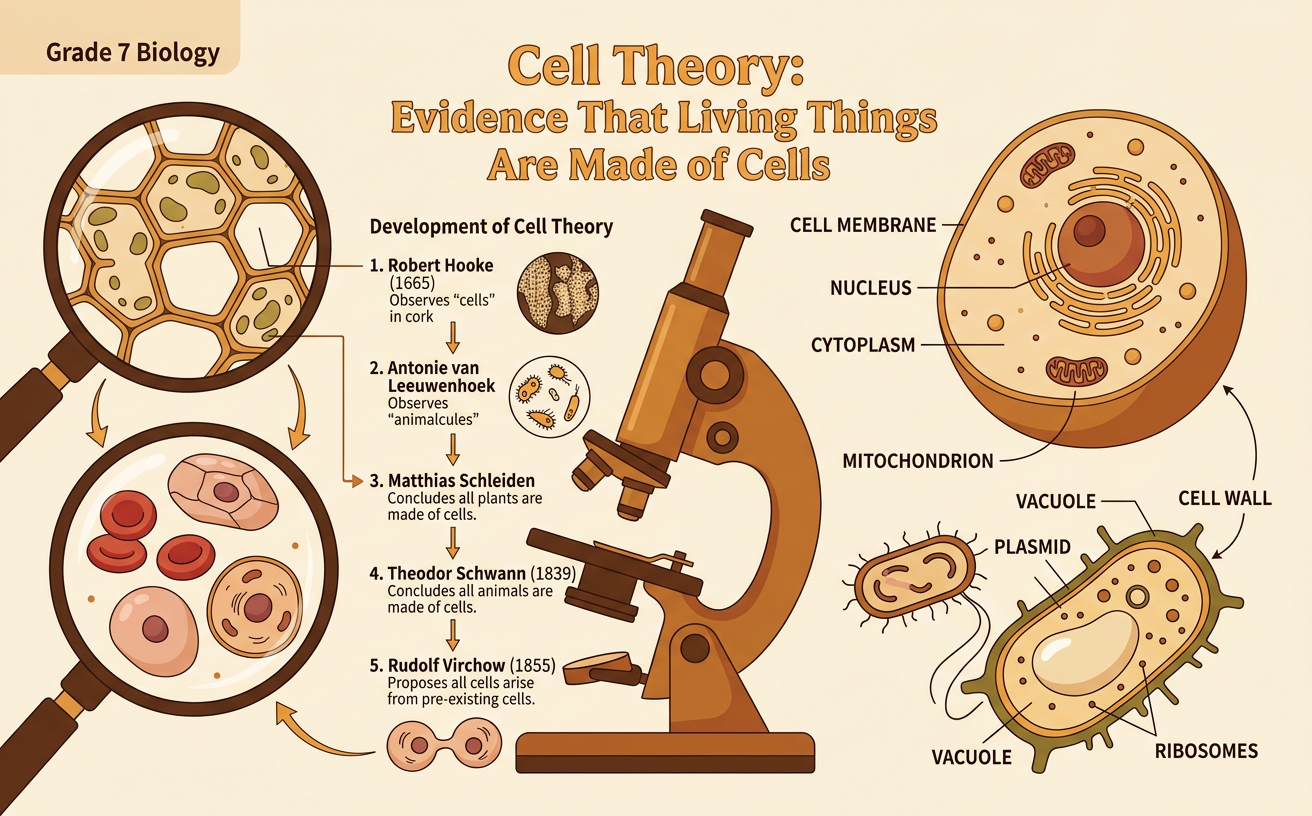
Cell theory summarizes evidence collected by many scientists. It states that all living things are made of one or more cells, the cell is the basic unit of structure and function in living things, and new cells come from existing cells. A cell is the smallest unit that can carry out all processes needed for life. For example, Robert Hooke observed thin slices of cork in 1665 and described tiny boxlike spaces that he called cells. Cork cells are dead, so Hooke mainly saw their remaining cell walls. Later observations of living tissue and microorganisms provided stronger evidence that cells are active units of life. Modern microscopes and studies of cell division continue to support cell theory, although one observation alone cannot prove every part of it.

Comparing Plant and Animal Cells
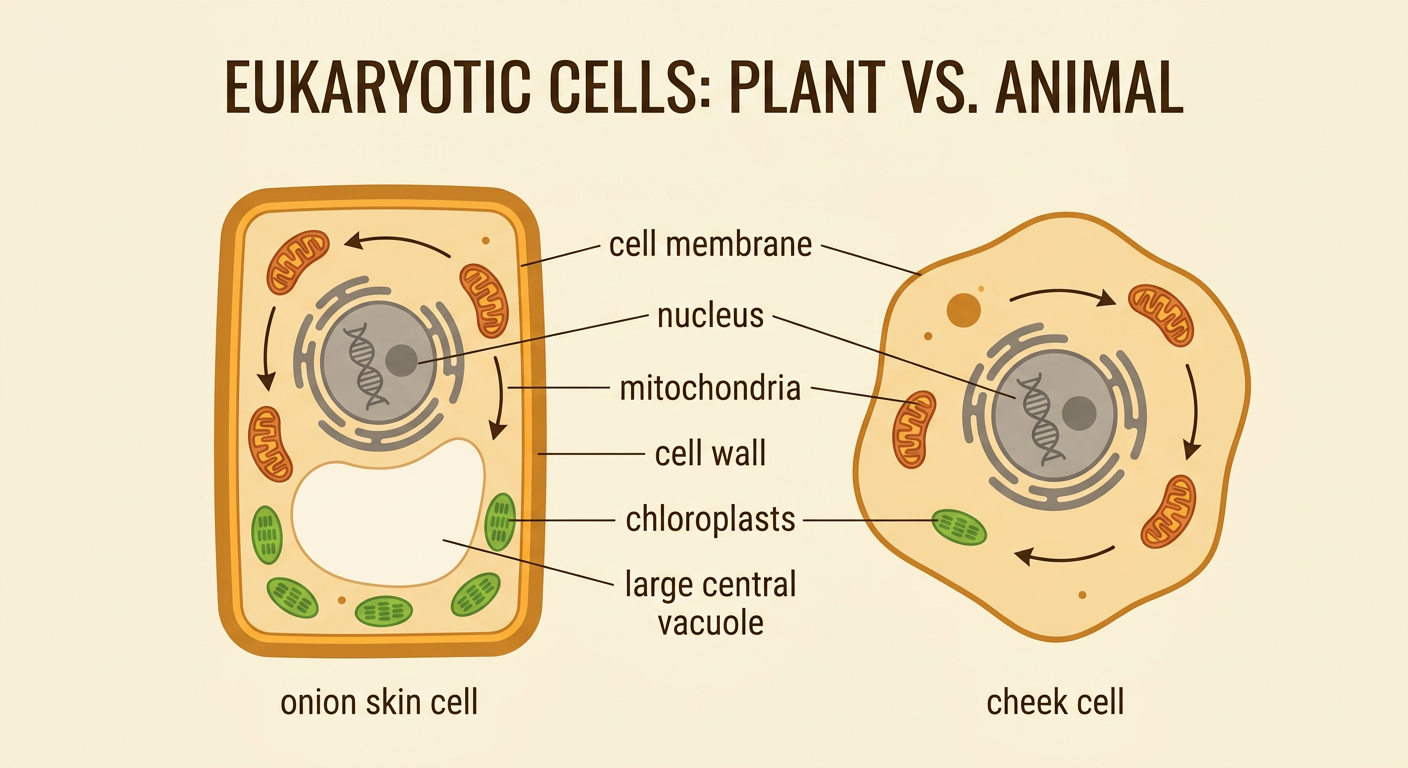
Plant and animal cells share important structures because both are eukaryotic cells. Each has a cell membrane that controls what enters and leaves, cytoplasm where many reactions occur, a nucleus containing DNA, and mitochondria that help release usable energy from food. Plant cells also have a rigid cell wall outside the membrane. Cells in green plant tissues often contain chloroplasts, which capture light energy for photosynthesis, and plant cells commonly have a large central vacuole. Animal cells lack cell walls and chloroplasts and usually have smaller vacuoles. For example, onion skin cells often appear like tightly packed rectangles because of their cell walls, while human cheek cells have flexible, irregular outlines. These differences help each cell perform functions needed by its organism.
Analyzing Microscope Evidence
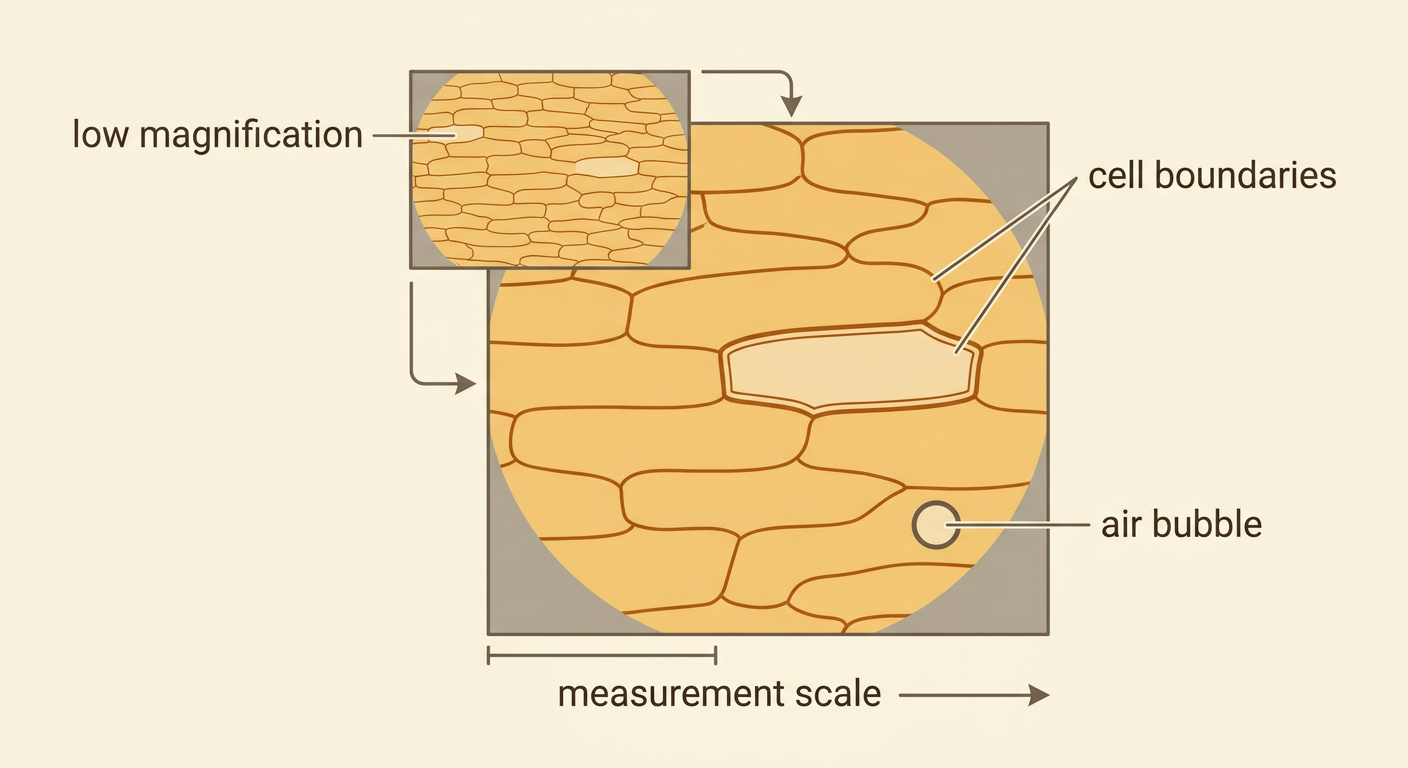
Microscope observations become useful evidence when they are recorded carefully and repeated. Begin with low magnification to locate the specimen, then increase magnification to see more detail. Draw or photograph what is visible, note the magnification, and examine several areas or samples. Suppose students view onion skin and observe many repeated compartments with clear boundaries. They may reasonably identify these compartments as cells and use the pattern as evidence that onion tissue is made of cells. A measurement scale can provide evidence about cell size. However, stains may change color, air bubbles may resemble structures, and a thin sample shows only part of a three-dimensional tissue. Comparing observations from several students and using a prepared reference image reduces error. Scientists distinguish what they directly observe from what they infer based on those observations.
Single-Celled and Multicellular Organisms
Some organisms consist of one cell, while others are made of many cells. A single-celled organism must complete all life functions within that one cell. For example, an amoeba takes in nutrients, responds to its surroundings, removes wastes, and reproduces as a single cell. Multicellular organisms contain many cells that often have specialized structures and jobs. In a human, muscle cells contract, nerve cells carry signals, and red blood cells transport oxygen. These cell types work together in tissues, organs, and organ systems. A multicellular organism is not simply a pile of identical cells; its organization allows different cells to cooperate. Microscope images of pond water may reveal individual single-celled organisms, while images of leaf, skin, or muscle tissue show many connected cells. Both kinds of evidence support the idea that cells are the basic units of living things.

Building a Claim from Evidence
A scientific argument connects a clear claim to relevant evidence and reasoning. A useful claim might be, “Onion tissue is made of many cells.” Evidence could include a microscope image showing hundreds of repeated, bounded compartments, observations from several onion samples, and a reliable scientific text explaining that plant tissues are cellular. The reasoning should explain that the repeated compartments match recognized features of plant cells, including cell walls and, when stained, visible nuclei. Strong arguments use multiple sources because each source has limitations. A microscope image provides direct visual evidence but shows only a small part of the onion. A textbook explains established knowledge but does not document the class sample. Student observations add repeated results but may include focusing or labeling errors. Acknowledging these limitations makes the argument more accurate rather than weaker.
