Cells: The Building Blocks of Life
Students examine cell images and observations to identify evidence that all living organisms are made of one or more cells.
Illustrations are auto-generated and may be placeholders. They can be refreshed to match the narration.
What Makes Something Alive?
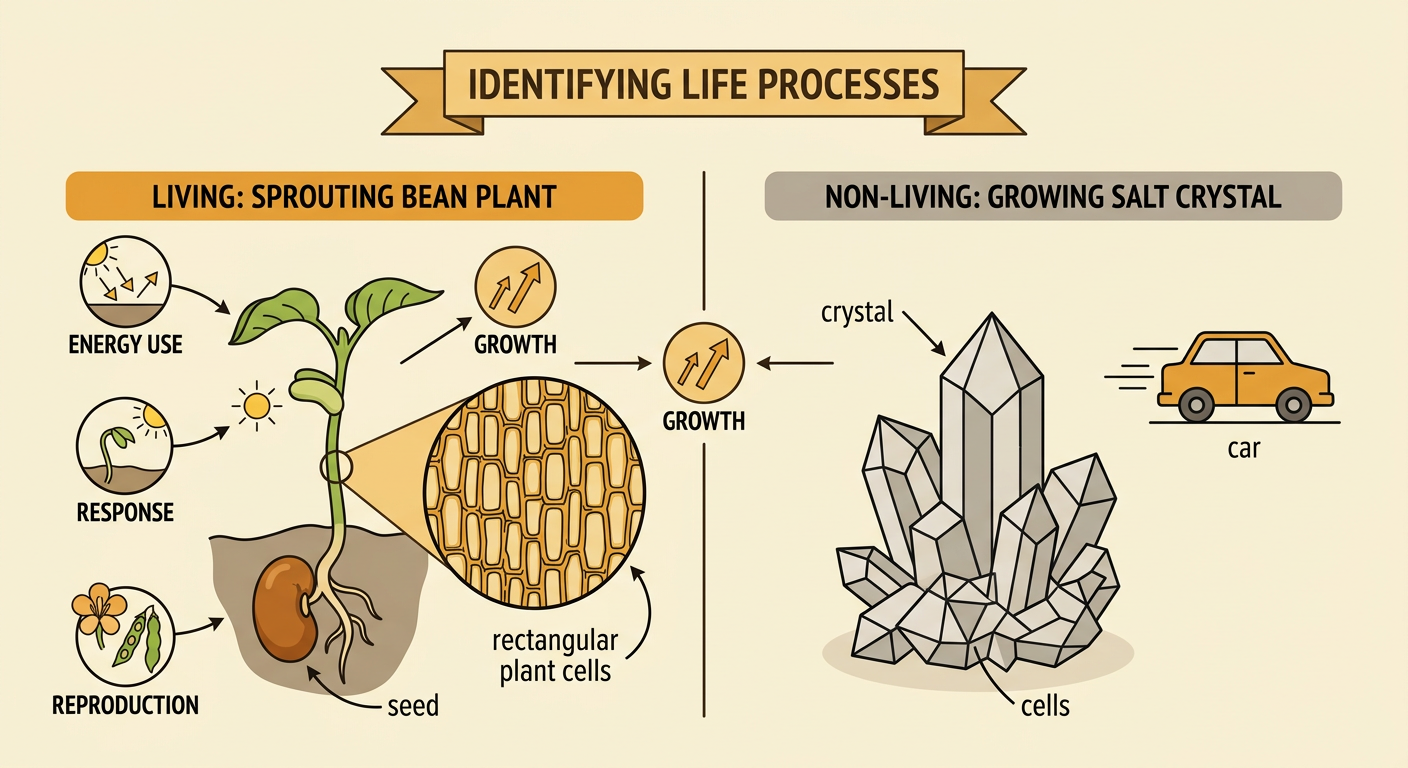
Living things share important characteristics. They use energy, grow, respond to their surroundings, maintain stable internal conditions, and reproduce. A seed may look inactive, but when it receives water and warmth, it uses stored energy, grows, and develops into a plant. Scientists also look for cellular organization because every organism is made of one or more cells. Size, movement, or color alone cannot determine whether something is alive. A crystal can grow, and a car can move, but neither is made of cells or carries out all life processes. During a cell investigation, scientists combine observations rather than relying on one feature. They examine samples with a microscope, record visible structures, and compare the results with evidence from known living and nonliving materials.
Introducing Cell Theory
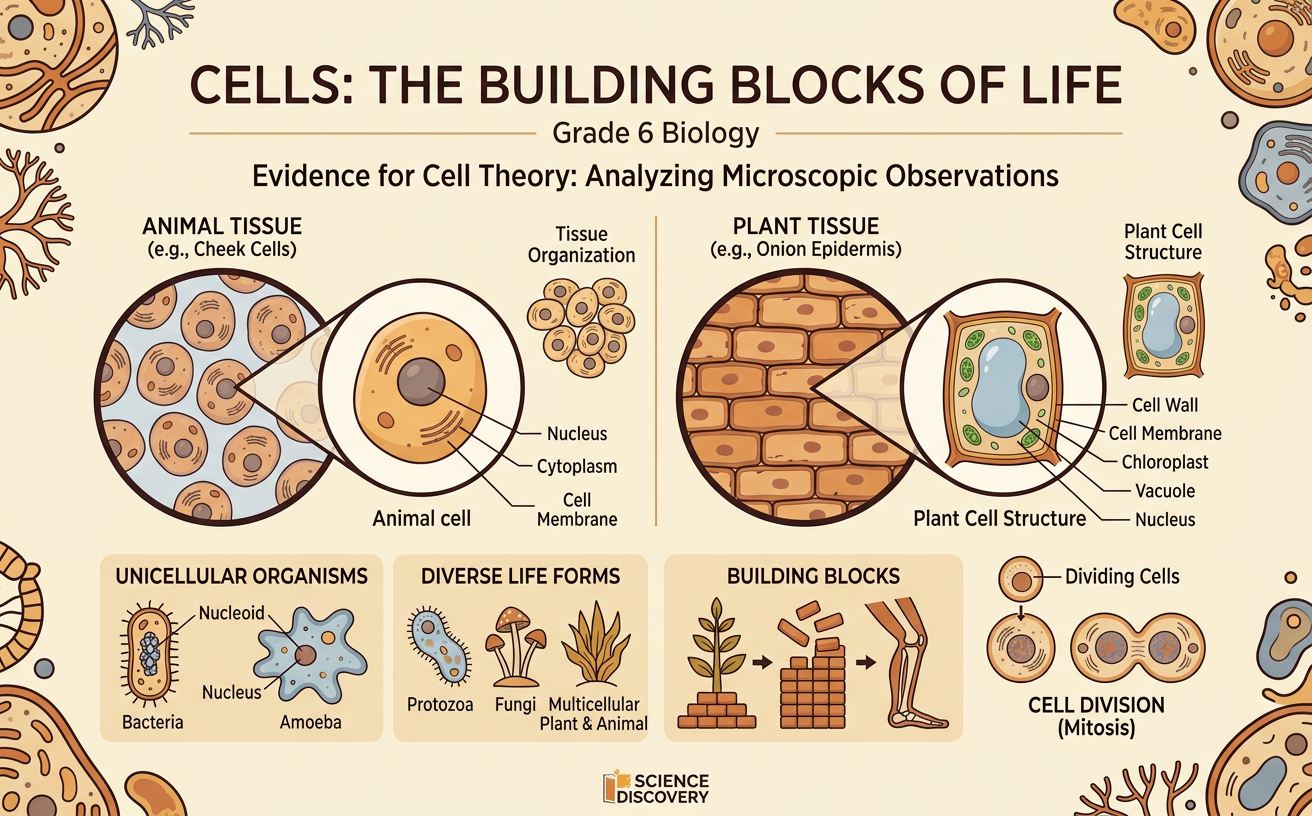
Cell theory is a scientific explanation supported by many observations. It has three main ideas: all living things are made of one or more cells, the cell is the basic unit of structure and function in living things, and new cells come from existing cells. Microscopes made this evidence possible because most cells are too small to see with unaided eyes. For example, a thin piece of onion tissue looks smooth, but under a microscope it appears as many boxlike units. Each unit is a cell surrounded by a cell membrane and a rigid cell wall. Scientists have examined samples from plants, animals, fungi, and microorganisms and consistently found cells. Repeated observations of different organisms strengthen cell theory, even though one classroom investigation cannot examine every living species on Earth.

Observing Unicellular and Multicellular Organisms
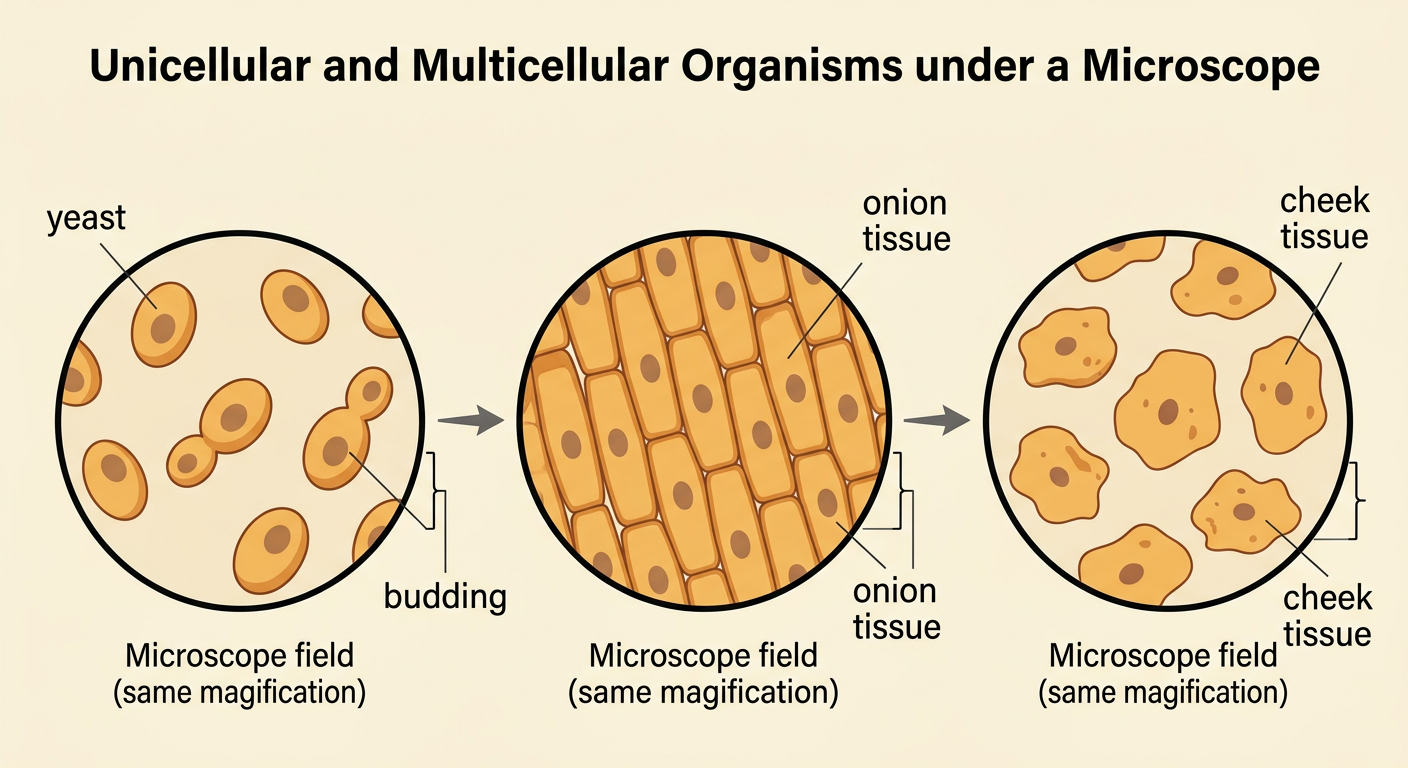
An investigation can compare prepared slides or images of yeast, pond protists, onion tissue, and human cheek tissue. A unicellular organism consists of one cell that performs all necessary life functions. For example, one yeast cell takes in nutrients, uses energy, and can reproduce by budding. A multicellular organism contains many cells that work together. Onion tissue shows many connected plant cells, while cheek tissue shows many separate-looking animal cells collected from a person. Students should view each sample at the same magnification when possible, sketch what they see, count visible cells in a defined area, and record repeated patterns. Finding one complete cell in each yeast organism but many cells in onion and cheek samples provides evidence that living things may be made of either one cell or many cells.
Comparing Cell Types
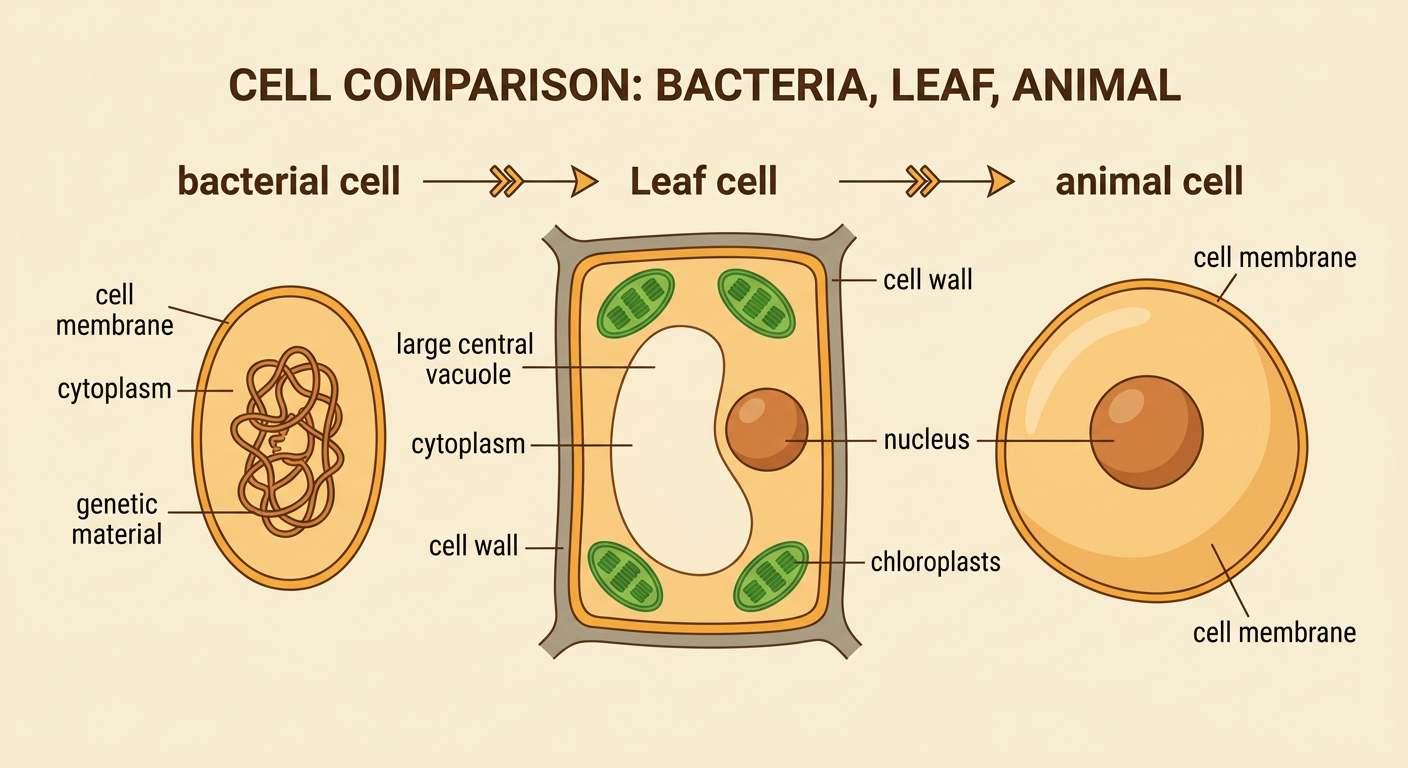
Cells do not all look alike, but they share basic features. Every cell has a cell membrane, cytoplasm, genetic material, and ribosomes. Bacterial cells are usually smaller and do not have a nucleus; their genetic material is located in the cytoplasm. Plant and animal cells have a nucleus that contains most of their genetic material. Plant cells also have a rigid cell wall, chloroplasts in photosynthetic tissues, and a large central vacuole. Animal cells do not have cell walls or chloroplasts and often have a more flexible shape. For example, a leaf cell contains chloroplasts that capture light energy, while a muscle cell has structures that help it use energy for contraction. These differences show that multicellular organisms can contain specialized cell types that perform different jobs.
Evidence-Based Exit Ticket
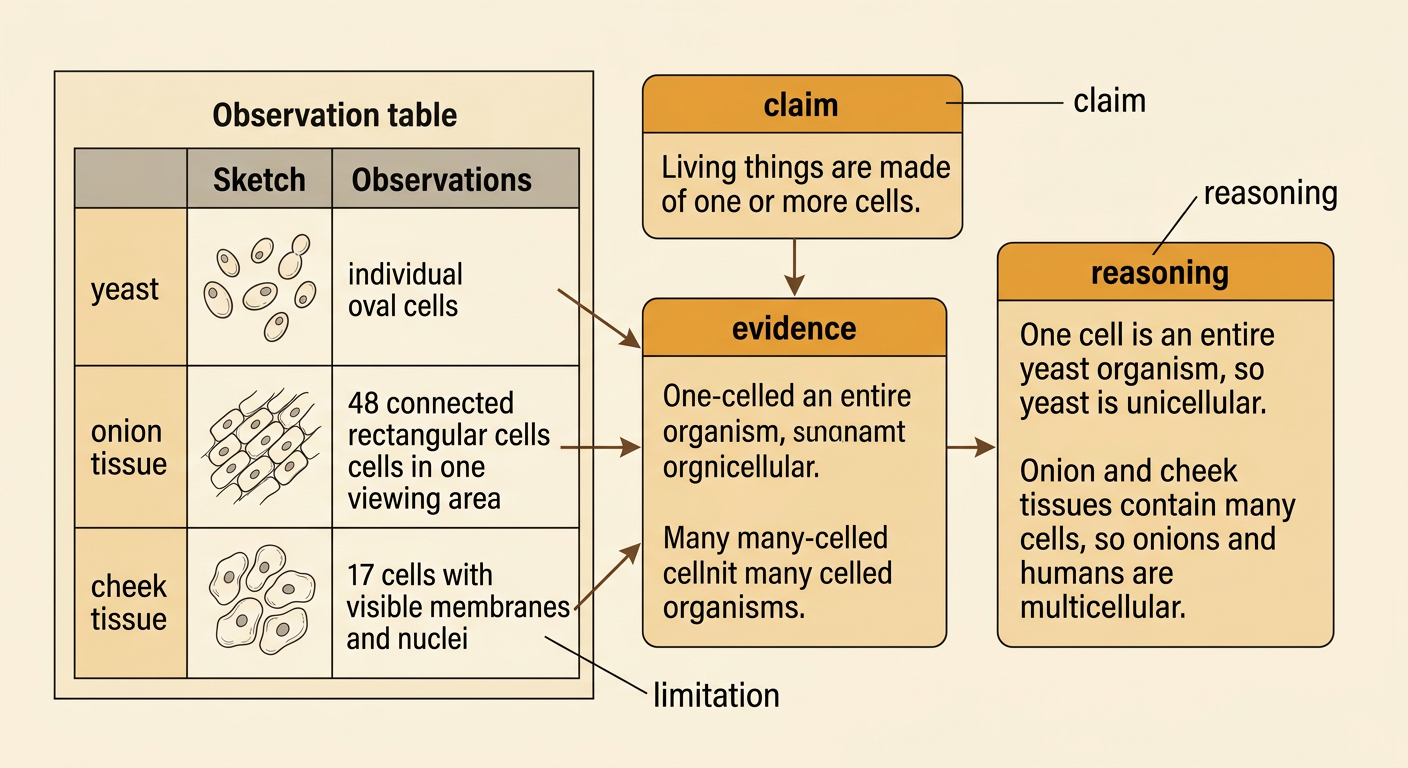
Use the claim-evidence-reasoning pattern to explain the investigation. Begin with a claim: living things are made of one or more cells. Next, cite specific observations as evidence. For example, the yeast image showed individual oval cells, the onion sample showed 48 connected rectangular cells in one viewing area, and the cheek sample showed 17 cells with visible membranes and nuclei. Then explain the reasoning: yeast is unicellular because one cell is an entire organism, while onions and humans are multicellular because their tissues contain many cells. Strong answers use measured or observed details instead of saying only, “I saw cells.” Also identify a limitation. A small set of samples cannot include every organism, but results that agree with many repeated scientific investigations support cell theory. Finish by naming one additional living sample you would examine.