
Cells, Tissues, Organs, and Body Systems
Students examine cells as the basic units of life and explain how specialized cells form tissues, organs, and interacting body systems.

Illustrations are auto-generated and may be placeholders. They can be refreshed to match the narration.
Cells as Units of Life
A cell is the smallest structure that can carry out the basic processes of life. All living organisms are made of one or more cells. Some organisms, such as many bacteria, consist of a single cell. Plants and animals are multicellular, meaning they contain many cells that work together. Cells take in materials, release wastes, use energy, grow, and respond to their environment. Most cells are too small to see without a microscope. For example, a small piece of onion skin appears solid to the unaided eye, but under a microscope it looks like rows of tiny compartments. Each compartment is a cell. Studying cells helps scientists understand how entire organisms survive, develop, heal, and reproduce.
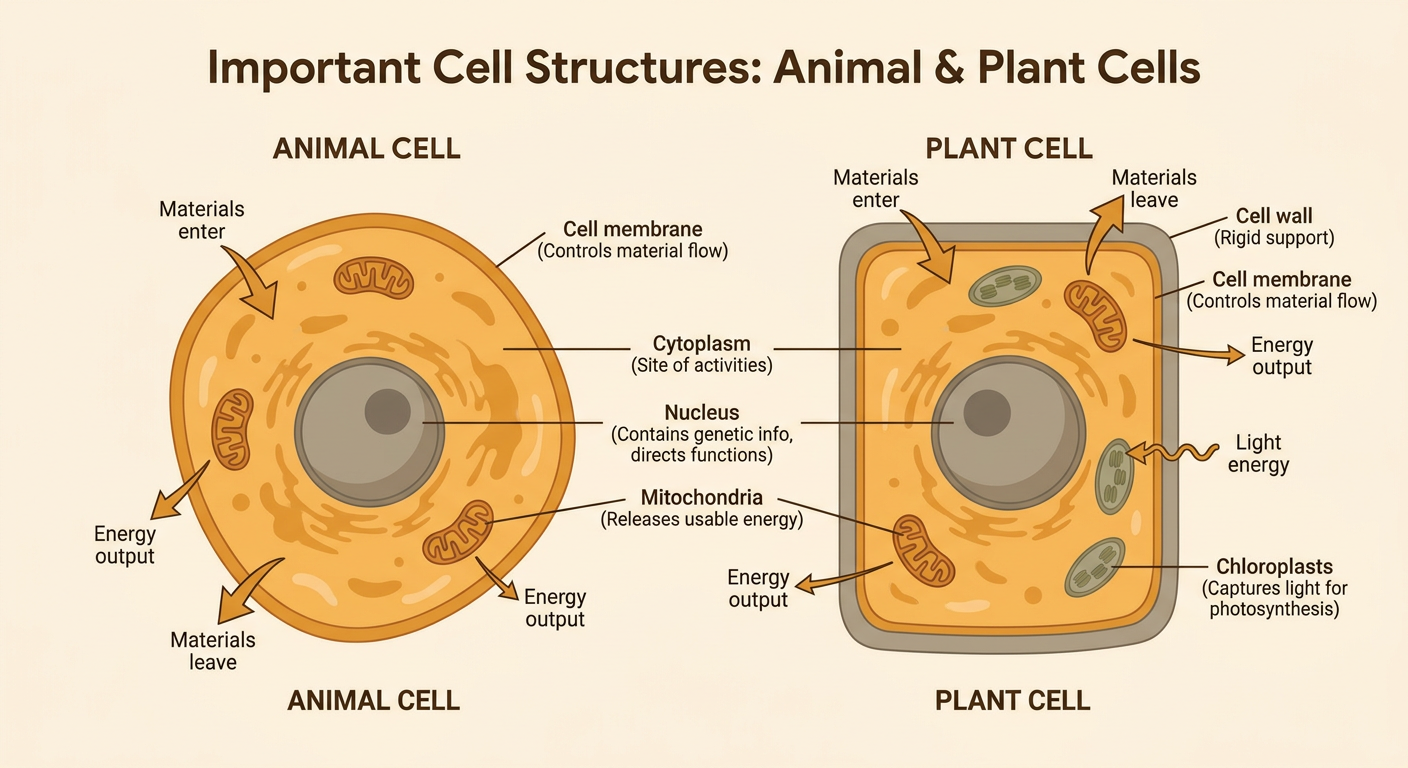
Important Cell Structures
Cell structures perform specific functions that keep a cell alive. The cell membrane controls which materials enter and leave the cell. Cytoplasm is the fluid-like region where many cell activities occur. The nucleus contains genetic information and helps direct cell functions. Mitochondria release usable energy from food. Plant cells also have a rigid cell wall for support, chloroplasts that capture light energy, and usually a large central vacuole that stores water and other materials. For example, the cell wall helps a plant stem remain firm, while the central vacuole helps maintain pressure inside its cells. Models of cells simplify their structures, but they help students connect each structure with the job it performs.
From Cells to Organs
In multicellular organisms, cells become specialized to perform particular jobs. Similar specialized cells working together form a tissue. Different tissues combine to form an organ, and organs cooperate in an organ system. Muscle cells, for example, can contract and produce movement. Groups of muscle cells form muscle tissue. The heart contains muscle tissue, nerve tissue, connective tissue, and other tissues, making it an organ. The heart belongs to the circulatory system, which transports blood throughout the body. This organization creates several levels: cells, tissues, organs, organ systems, and organism. Each level depends on the levels below it. Damage to one type of cell can therefore affect a tissue, an organ, and eventually the entire organism.

Body Systems Work Together
Body systems do not operate independently. They interact to obtain materials, transport substances, remove wastes, and maintain stable internal conditions. During a run, the respiratory system brings oxygen into the lungs. Oxygen moves into the blood, and the circulatory system carries it to muscle cells. The digestive system supplies nutrients such as glucose, which cells use to release energy. Muscles produce movement, while the nervous system coordinates breathing rate, heart rate, and muscle actions. The skin and circulatory system also help control body temperature by releasing heat. If one system cannot perform its job, other systems are affected. This cooperation allows the body to respond to changing conditions and maintain homeostasis, or a stable internal environment.
