
Cellular Respiration: Tracing Matter and Energy
Students use molecular models and data to explain how cellular respiration rearranges matter and transfers energy from food molecules to usable forms.

Illustrations are auto-generated and may be placeholders. They can be refreshed to match the narration.
Why Cells Need Energy
Cells require a continuous energy supply to maintain organization, grow, repair damage, transport substances, and perform specialized work. Most cellular work is powered by ATP, a small molecule that can transfer energy to other molecules. Cells make ATP by transferring energy from food molecules through cellular respiration. For example, an active muscle cell uses ATP when protein fibers slide past one another during contraction. It also uses ATP to pump calcium ions and restore ion concentrations after contraction. ATP is not a long-term energy store; cells continually recycle it from ADP and phosphate. Cellular respiration provides the energy needed for this recycling. Even resting cells need ATP for processes such as protein production and active transport across cell membranes.

Reactants and Products
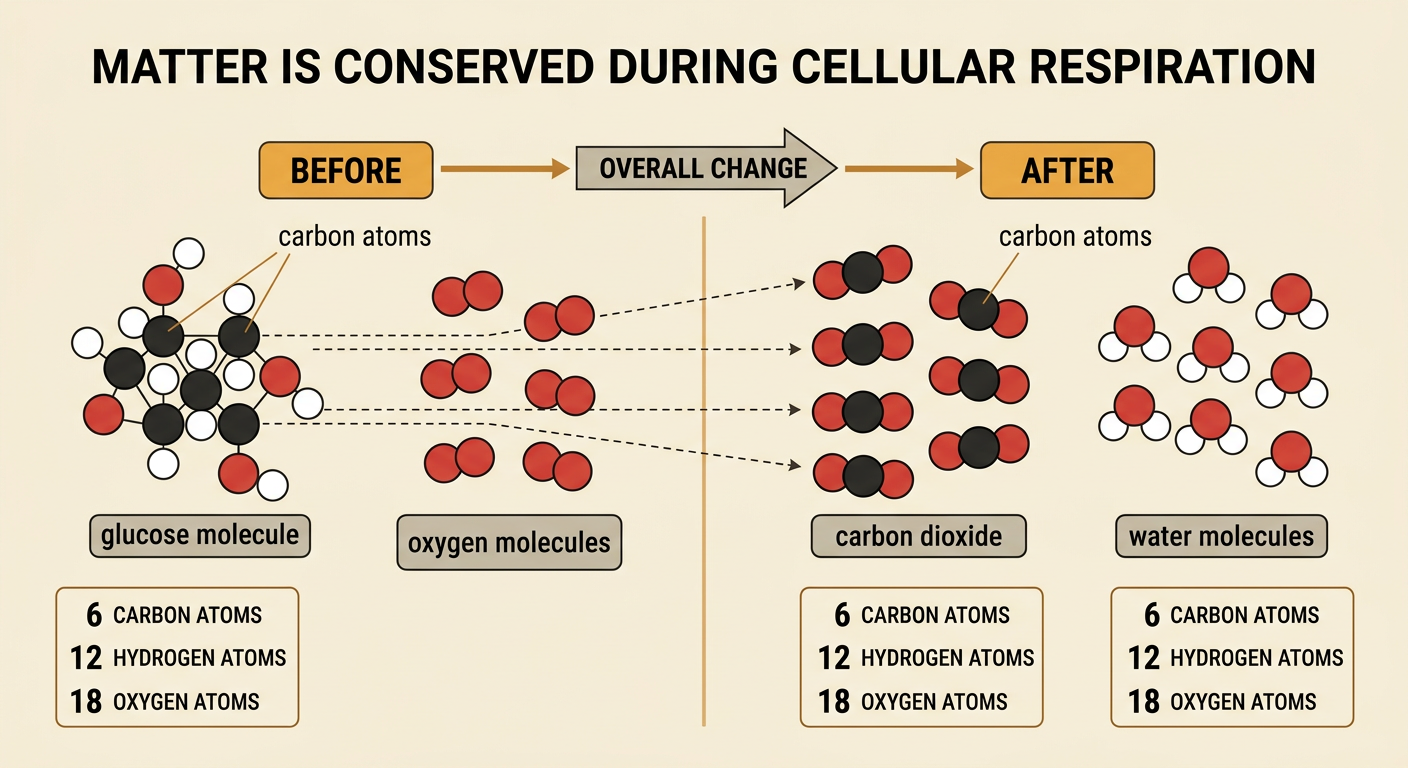
The overall cellular respiration equation is glucose plus oxygen producing carbon dioxide, water, and a net transfer of energy. It can be written as C6H12O6 + 6O2 → 6CO2 + 6H2O + energy transferred to ATP and heat. Glucose and oxygen are the reactants because they enter the process. Carbon dioxide and water are products because they form as atoms are rearranged. The equation is balanced: both sides contain 6 carbon atoms, 12 hydrogen atoms, and 18 oxygen atoms. For example, oxygen breathed into the lungs can enter the blood and reach a leg muscle. The muscle cell uses oxygen during respiration, while carbon dioxide produced by the cell returns through the blood to the lungs and is exhaled.

Modeling Molecular Rearrangement
A molecular model explains cellular respiration by tracking atoms rather than treating matter as if it disappears. Begin with one glucose model containing 6 carbon, 12 hydrogen, and 6 oxygen atoms. Add six oxygen molecules, each containing two oxygen atoms. During many enzyme-controlled reactions, bonds in these molecules break and new bonds form. The same atoms can be rearranged into six carbon dioxide molecules and six water molecules. For example, the six carbon atoms that entered in glucose can all be represented in the six carbon dioxide molecules that leave. No carbon atoms are converted into energy, and no atoms are created or destroyed. The balanced model represents the overall change, although actual respiration occurs through glycolysis, the citric acid cycle, and oxidative phosphorylation rather than in one step.
Tracking Energy Transfer
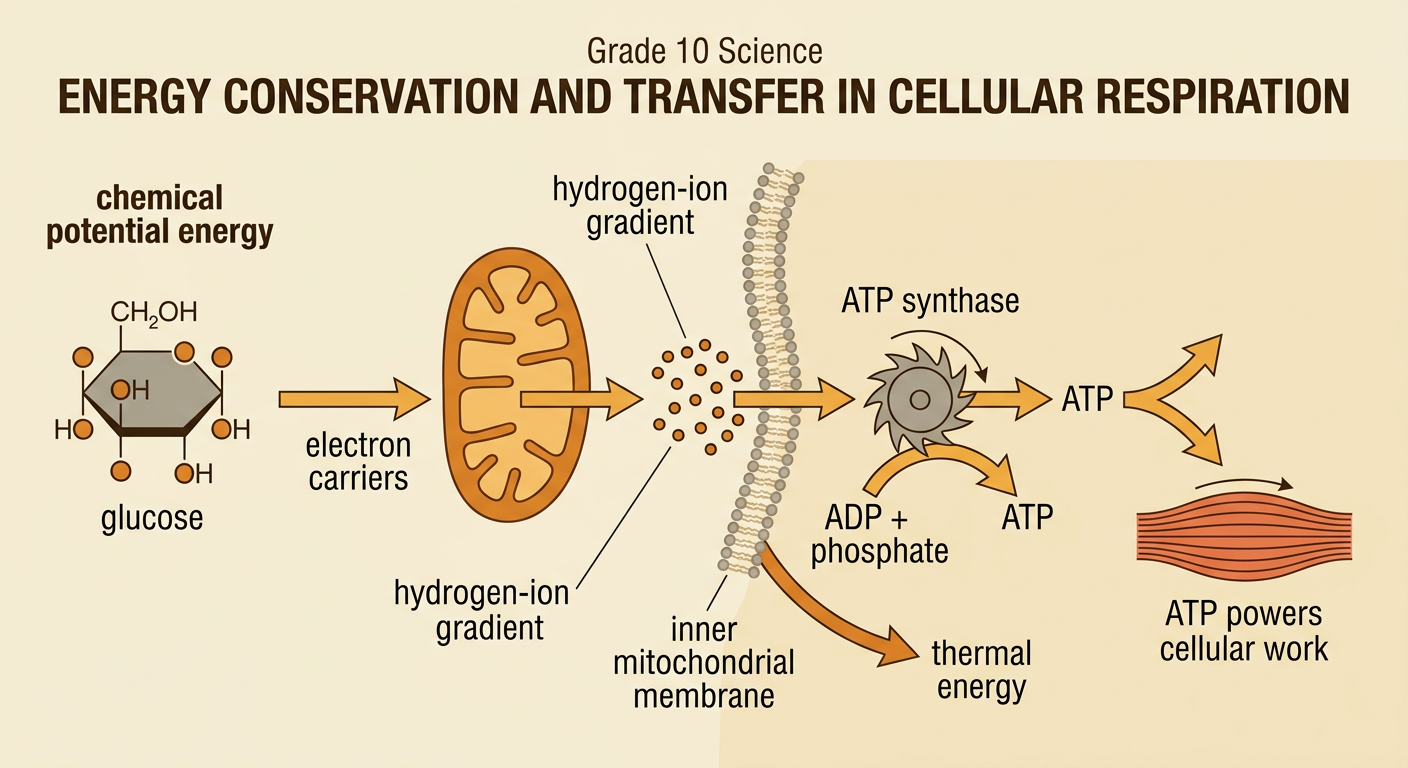
Matter is rearranged during respiration, but energy is transferred and transformed. Glucose contains chemical potential energy associated with its molecular structure. Through a series of reactions, cells transfer some of this energy to ATP. In aerobic respiration, high-energy electrons ultimately help create a hydrogen-ion gradient across the inner mitochondrial membrane. ATP synthase uses this gradient to produce ATP from ADP and phosphate. When ATP is later broken down, its transfer of phosphate can drive cellular work. Not all energy from glucose becomes available in ATP; a substantial portion is transferred to the surroundings as thermal energy. For example, contracting muscle cells use ATP for movement and release heat, which helps explain why body temperature rises during exercise. Energy is conserved overall, but it becomes more dispersed and less available for cellular work.
Interpreting Respiration Data
Respiration can be investigated by measuring oxygen consumption, carbon dioxide production, or temperature change over time. Suppose germinating seeds in a sealed respirometer consume 4.0 milliliters of oxygen in 20 minutes. A mathematical model gives an average rate of 4.0 ÷ 20, or 0.20 milliliter of oxygen per minute. If an equal mass of dormant seeds consumes only 1.0 milliliter in 20 minutes, its rate is 0.05 milliliter per minute. The steeper line for germinating seeds indicates a higher respiration rate because growing cells require more ATP. A control chamber without living seeds can reveal volume changes caused by temperature or air pressure rather than respiration. When interpreting a graph, students should identify the variables, compare slopes, include units, and connect the numerical pattern to the molecular process.

Connecting Food Systems to Cellular Energy
Human cellular energy depends on food systems that connect biological processes with land, water, climate, technology, and labor. Crop plants capture solar energy through photosynthesis and store part of it as chemical energy in sugars and other food molecules. When a person eats corn, digestion breaks large molecules into smaller molecules, including glucose, that cells can use in respiration. Producing that corn may require soil, rainfall or irrigation, fertilizer, machinery, transportation, and workers. Drought can reduce yields and limit food availability, while irrigation can support production but place pressure on freshwater supplies. Transporting food also uses energy and creates emissions. A food-system model can therefore trace both matter and energy from sunlight to crops, through human cells, and into carbon dioxide, water, and heat while showing how environmental conditions and human decisions affect access to food.
