Changing Fractions into Decimals Using Division
Students interpret a fraction as division, divide the numerator by the denominator, and use equivalent decimal forms to represent and locate rational numbers.
Illustrations are auto-generated and may be placeholders. They can be refreshed to match the narration.
Fractions as Division
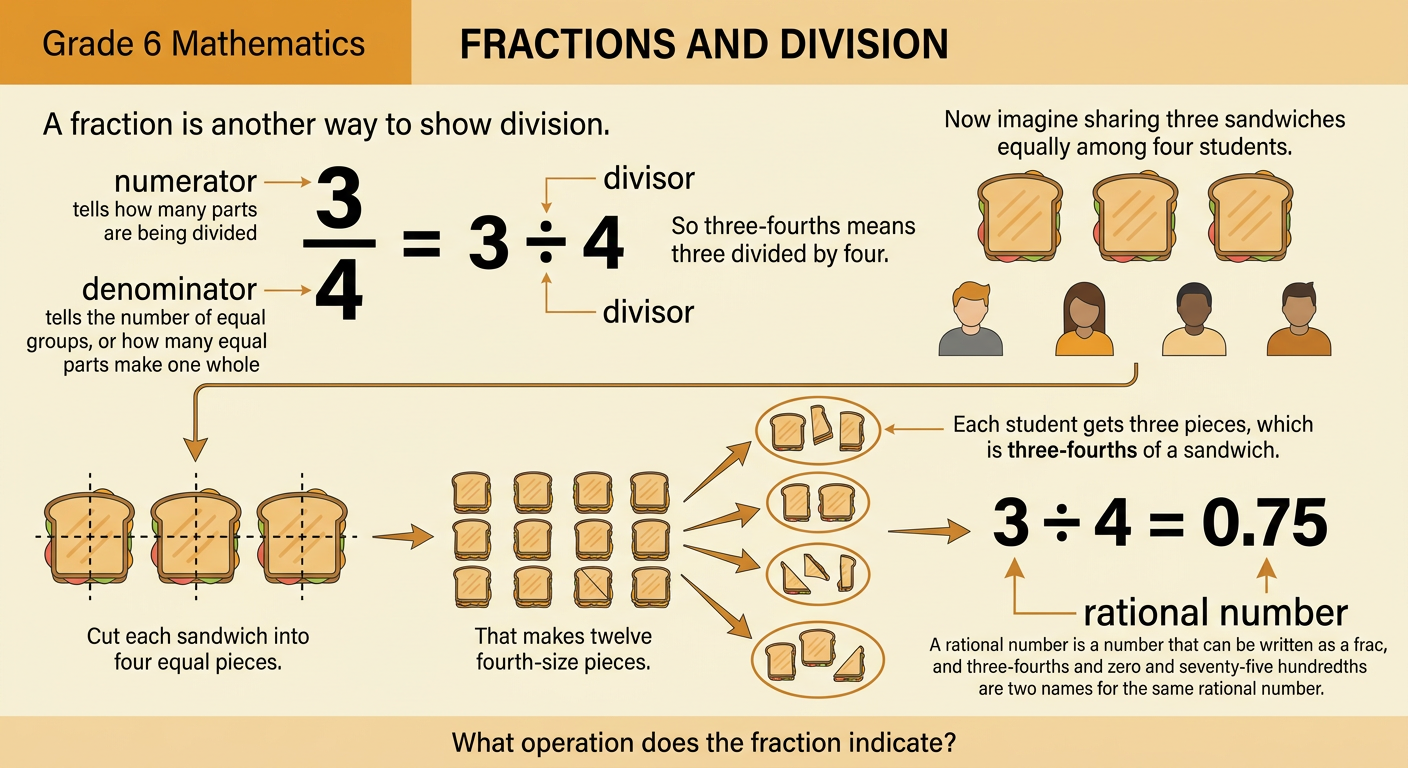
A fraction represents division. The numerator tells how many parts are being divided, and the denominator tells how many equal groups or parts make one whole. Therefore, a/b means a divided by b. For example, 3/4 means 3 divided by 4. Imagine sharing 3 whole sandwiches equally among 4 students. Each sandwich can be cut into 4 equal pieces. There are 12 fourth-size pieces, so each student receives 3 pieces, or 3/4 of a sandwich. Written as division, 3 ÷ 4 = 0.75. This shows that the fraction 3/4 and the decimal 0.75 are two names for the same rational number. When changing any fraction to a decimal, treat the numerator as the dividend and the denominator as the divisor.
Dividing the Numerator by the Denominator
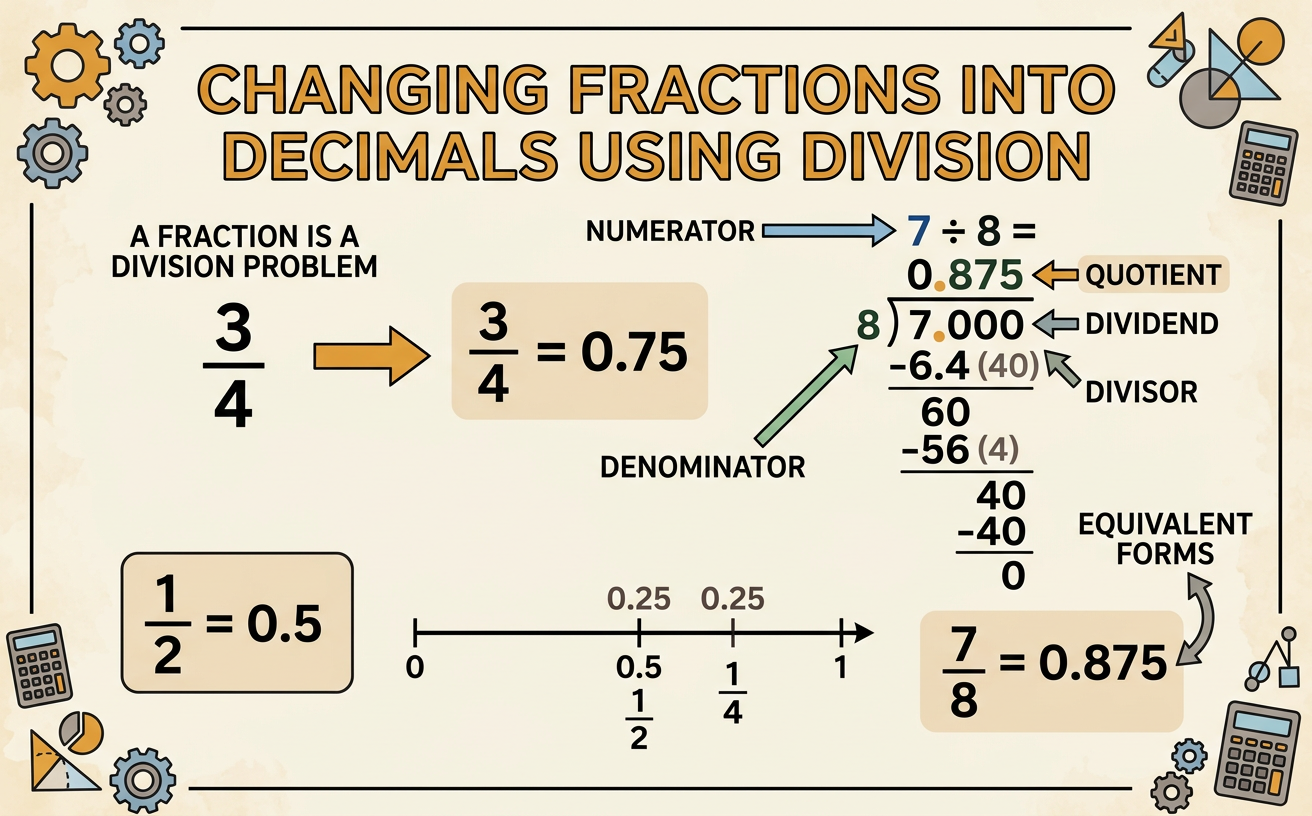
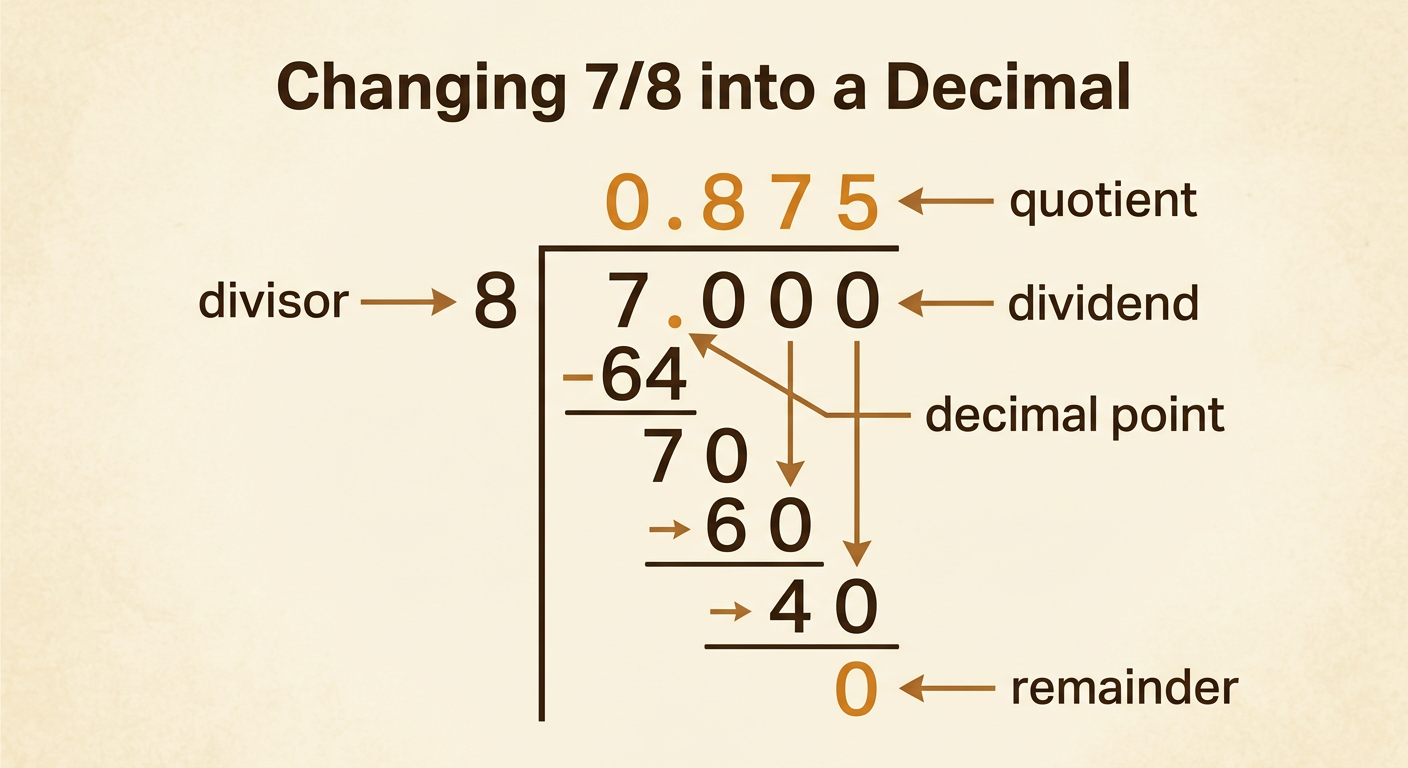
To change a fraction into a decimal, divide the numerator by the denominator. In 7/8, the numerator 7 is the dividend, and the denominator 8 is the divisor. Write 7 inside the long-division symbol and 8 outside. Because 8 cannot go into 7 as a whole number, write 0 and a decimal point in the quotient. Write the decimal point directly above the decimal point in 7.000. Then divide step by step: 8 goes into 70 eight times, leaving a remainder of 6. Bring down the next zero. Eight goes into 60 seven times, leaving 4. Bring down another zero. Eight goes into 40 five times with no remainder. Thus, 7 ÷ 8 = 0.875, so 7/8 = 0.875.
Adding Zeros to Continue Division
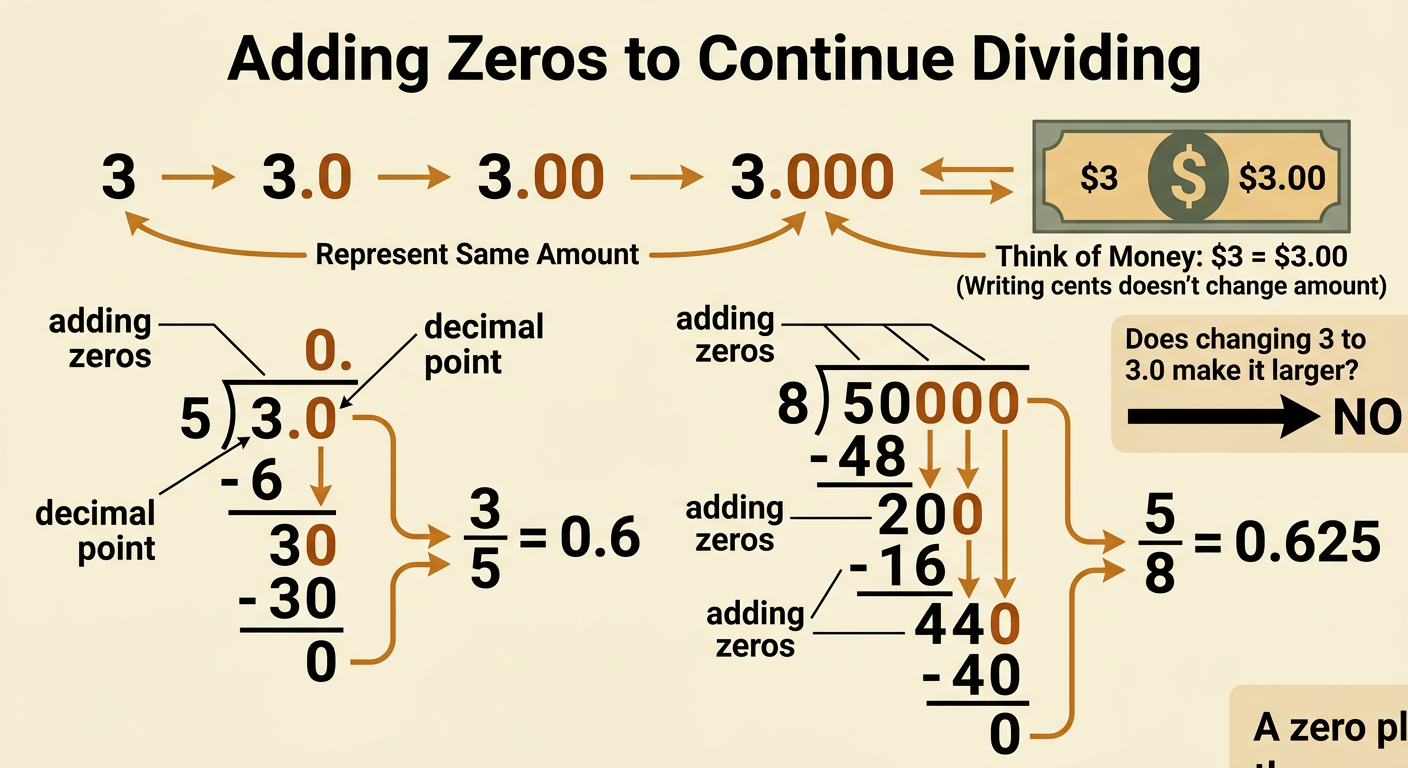
Sometimes a division problem does not end after the original digits have been used. You may place a decimal point after a whole-number numerator and add zeros without changing its value. For example, 3 can be written as 3.0, 3.00, or 3.000. To find the decimal form of 3/5, calculate 3 ÷ 5. Since 5 does not go into 3 as a whole number, write 0 and a decimal point in the quotient. Rewrite 3 as 3.0 and bring down the zero to make 30. Five goes into 30 six times, so 3/5 = 0.6. For 5/8, zeros allow the division to continue through 50, 20, and 40, producing 0.625. Adding zeros changes the written form of the dividend but not its value.
Checking with Equivalent Fractions
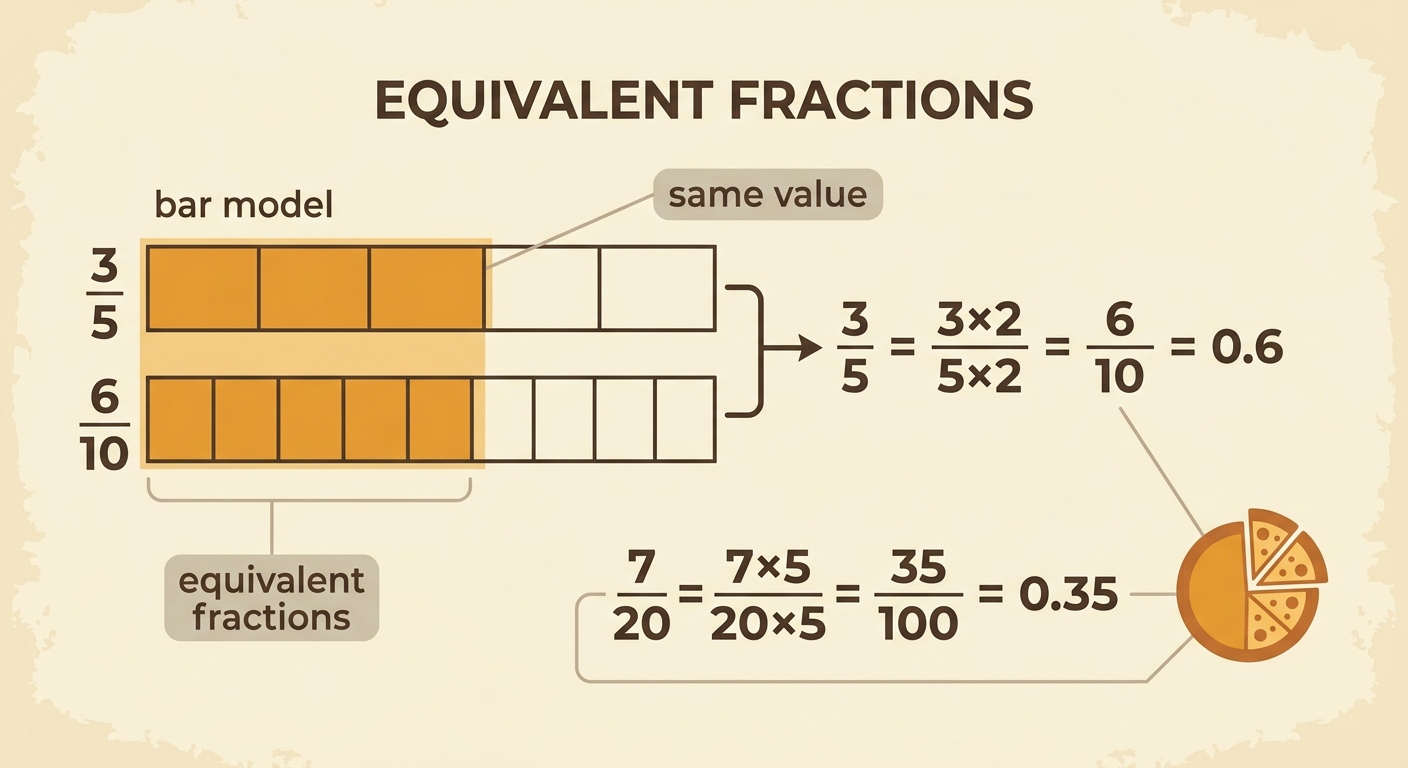
Equivalent fractions can help you check a decimal answer. A fraction is especially easy to write as a decimal when its denominator is 10, 100, or 1,000. For example, to check 3/5, multiply both the numerator and denominator by 2. This gives 3/5 = 6/10. Six tenths is written as 0.6, confirming that 3 ÷ 5 = 0.6. To check 7/20, multiply both parts by 5: 7/20 = 35/100 = 0.35. Multiplying the numerator and denominator by the same nonzero number does not change the fraction's value. Not every denominator can be changed into 10, 100, or 1,000 using a whole-number multiplier, so long division is the method that always works for converting a fraction to a terminating or repeating decimal.
Representing Decimals on a Number Line
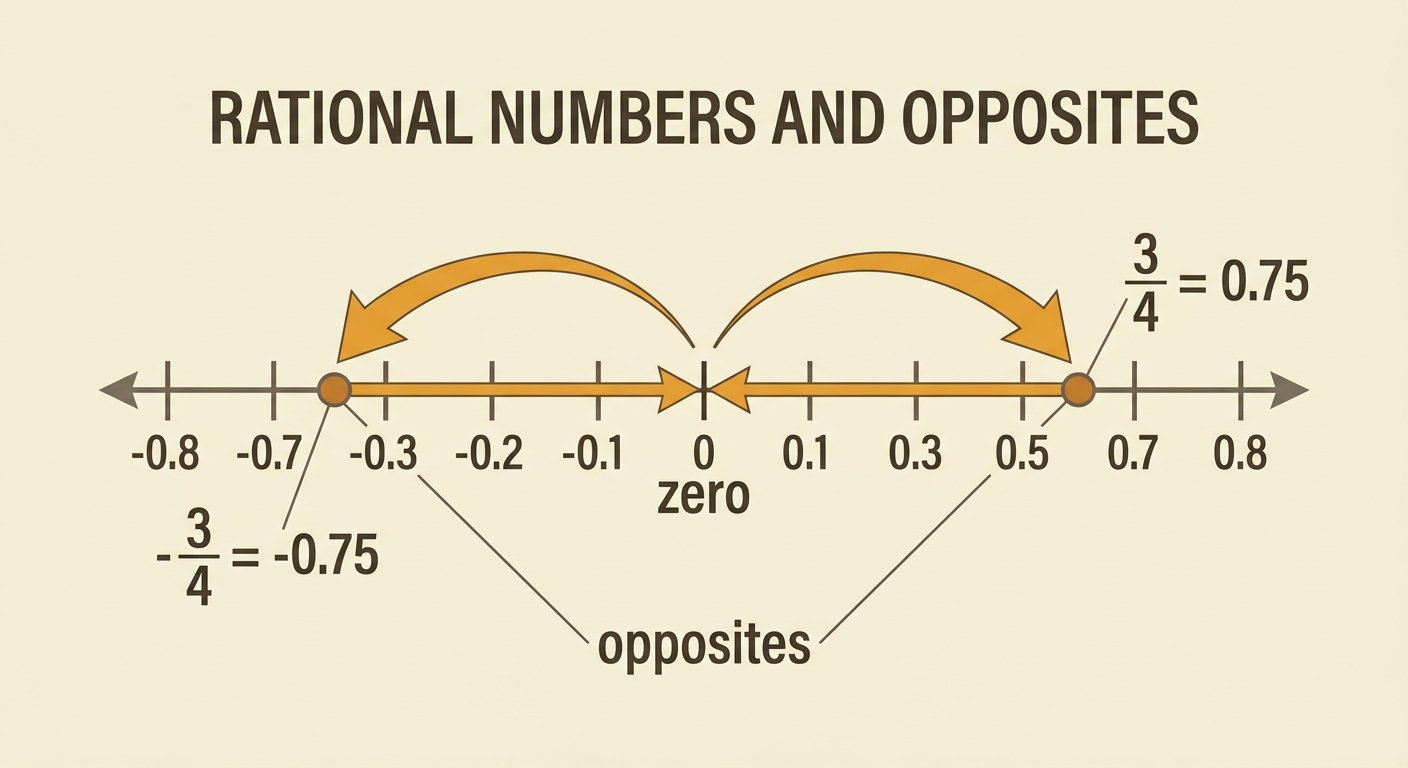
A fraction and its equivalent decimal name the same point on a number line. To locate 3/4, first change it to a decimal: 3 ÷ 4 = 0.75. On a number line from 0 to 1, divide the distance into hundredths or recognize that 0.75 is halfway between 0.7 and 0.8. Place a point at 0.75 and label it 3/4 = 0.75. Rational numbers can also be negative. The number -3/4 equals -0.75, so its point is the same distance from 0 but on the opposite side. On a number line from -1 to 1, -0.75 lies between -0.8 and -0.7, while 0.75 lies between 0.7 and 0.8. Equivalent fraction and decimal forms always share one location.