Changing Habitats: Choosing a Solution
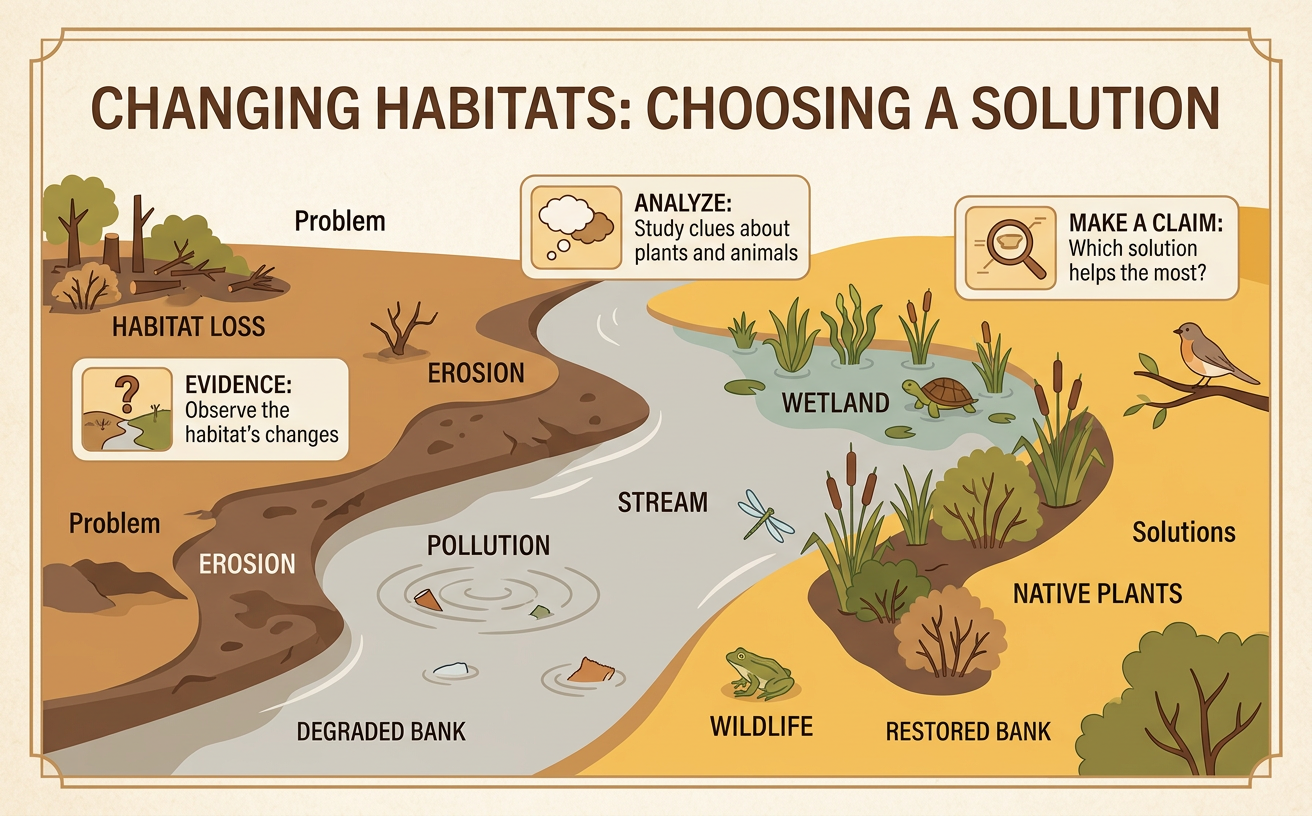
Students analyze evidence about a changing local habitat and make a supported claim about which solution would best help its plants and animals.
Illustrations are auto-generated and may be placeholders. They can be refreshed to match the narration.
What Happens When a Habitat Changes?
A habitat provides living things with food, water, shelter, and space. When one part of a habitat changes, plants and animals may have trouble meeting their needs. Imagine Meadow Creek Pond beside a bare, sloping bank. During heavy rain, water carries loose soil down the bank and into the pond. The extra soil makes the water cloudy and can cover underwater plants. Insects may lose places to lay eggs, and frogs may find less food and shelter. Some organisms may move away, while others may not survive. People can help by studying what changed and choosing a solution that matches the problem. A useful solution should improve important habitat needs without causing a new problem.

Read the Habitat Evidence
Good decisions begin with evidence, not guesses. A class studying Meadow Creek Pond reads a report from three spring visits. The report says that rainwater flowed from a bare bank into the pond. Students observed brown, cloudy water after storms and a layer of soil on underwater leaves. They also counted fewer frogs and dragonflies than in earlier visits. A park worker reported that trash was removed each week, but the water still became cloudy after rain. These details point to soil runoff as the main problem. When reading, ask questions such as, “What changed?” and “Which details show a cause or effect?” For example, the soil on leaves supports the idea that runoff is harming pond plants. Evidence should be quoted or described accurately.

Interpret the Population Graph
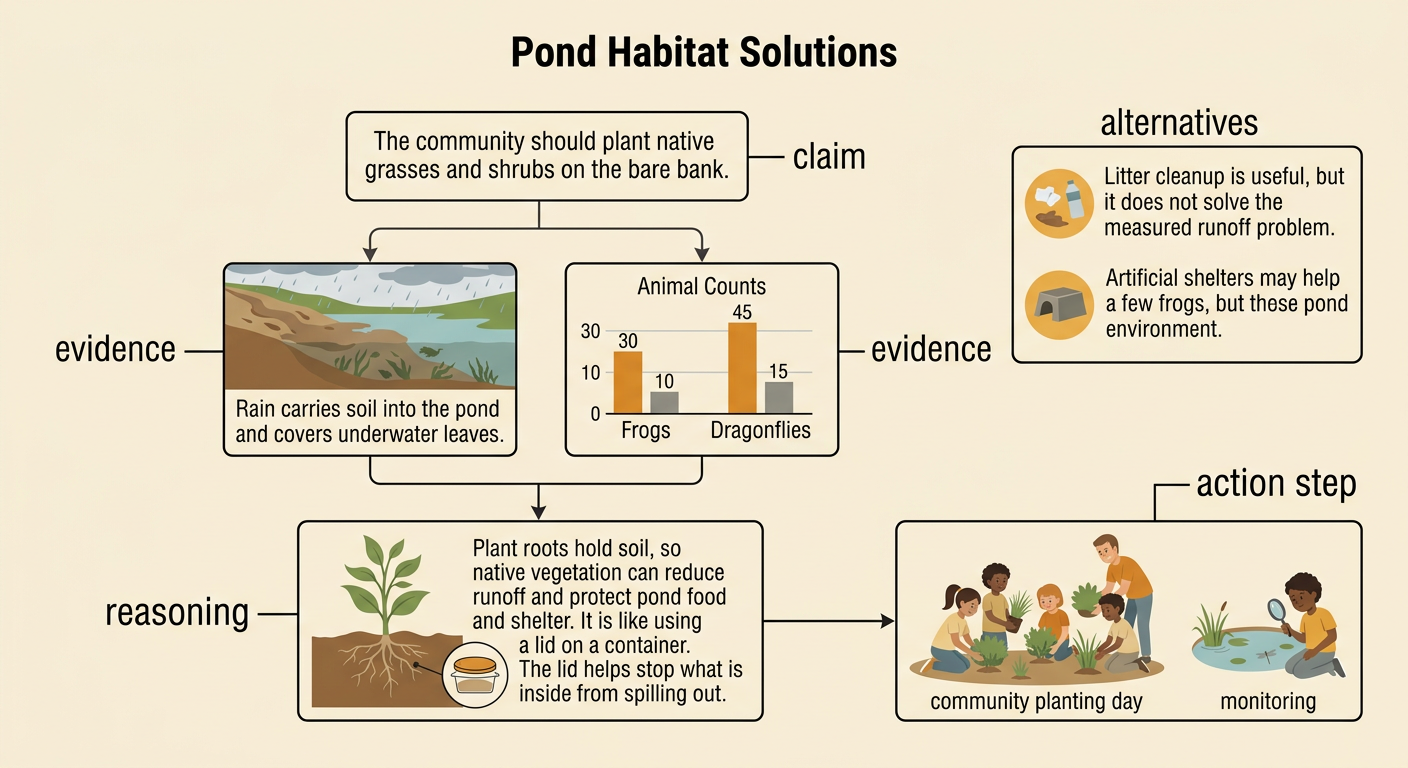
A scaled bar graph can show how organism populations change. The Meadow Creek Pond graph compares counts made in the same survey area each spring. The vertical axis is marked from 0 to 50 in intervals of 5. Frog counts decreased from 30 in Year 1 to 20 in Year 2 and 10 in Year 3. Dragonfly counts decreased from 45 to 30 and then 15. To interpret the graph, read the title, labels, scale, and key. Then compare bar heights. Frogs decreased by 20 because 30 minus 10 equals 20. Dragonflies decreased by 30 because 45 minus 15 equals 30. The graph shows a pattern of decline, but it does not prove the cause by itself. Combine the graph with observations from the habitat report.

Compare Possible Solutions
A strong solution addresses the cause of a habitat change and can be carried out safely. The community considers three ideas. First, volunteers could plant native grasses and shrubs on the bare bank. Their roots would hold soil, and their stems and leaves would slow rainwater before it reached the pond. Second, volunteers could collect litter around the pond. This would protect animals from harmful trash, but the evidence says litter removal has not stopped cloudy runoff. Third, workers could place artificial shelters near the water. Shelters might help some frogs, but they would not prevent soil from covering pond plants. Planting native vegetation best matches the runoff evidence, although it requires time, supplies, and care. The community could combine planting with signs, volunteer workdays, and regular checks of water clarity and animal counts.

Make and Support a Claim
A claim states which solution you think is best. Support it with evidence and explain your reasoning. One possible claim is, “The community should plant native grasses and shrubs on the bare bank.” Evidence from the report shows that rain carries soil into the pond and covers underwater leaves. The graph also shows that frog counts fell from 30 to 10 and dragonfly counts fell from 45 to 15. The reasoning connects the evidence to the claim: plant roots hold soil, so native vegetation can reduce runoff and protect pond food and shelter. A complete opinion paragraph also compares alternatives. Litter cleanup is helpful, but it does not solve the measured runoff problem. End with an action step, such as asking park leaders to organize a planting day and having students track water clarity and animal counts afterward.