Changing the Volume of Sound
Students investigate how gentle and strong vibrations produce softer and louder sounds, then develop classroom rules for safe sound levels.

Illustrations are auto-generated and may be placeholders. They can be refreshed to match the narration.
Loud and Soft Sound Sort
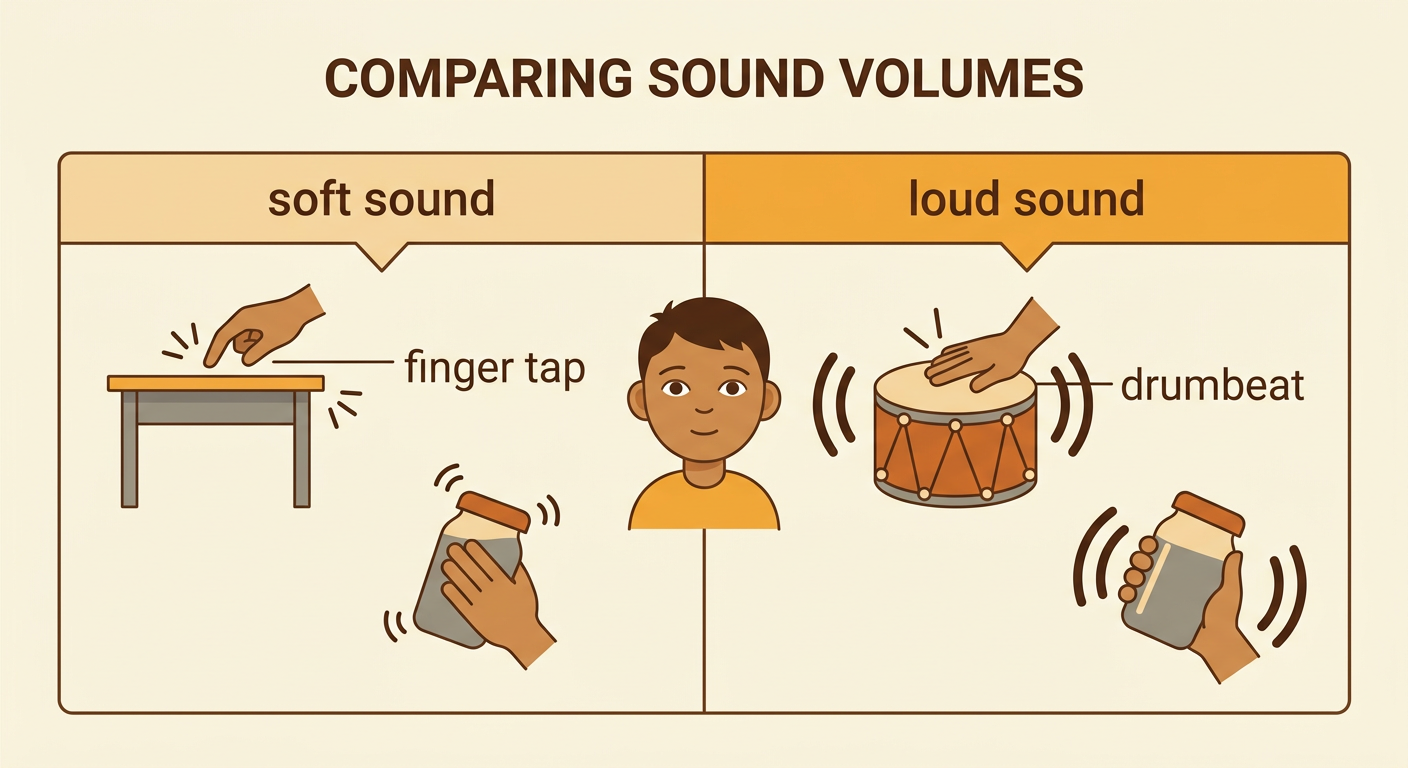
Sound volume tells how loud or soft a sound seems. Listen as your teacher makes or plays one sound at a time. For each sound, decide whether it belongs in the loud group or the soft group. A quiet finger tap on a desk may sound soft. A firm drumbeat may sound loud. Show your choice without calling out, and then take turns explaining what you noticed. Different listeners may not always agree, so listen respectfully to each idea. Remember that the same object can make sounds at different volumes. A drum is not always loud, and a desk tap is not always soft. The way an object vibrates can change its sound volume.
Make Gentle Vibrations
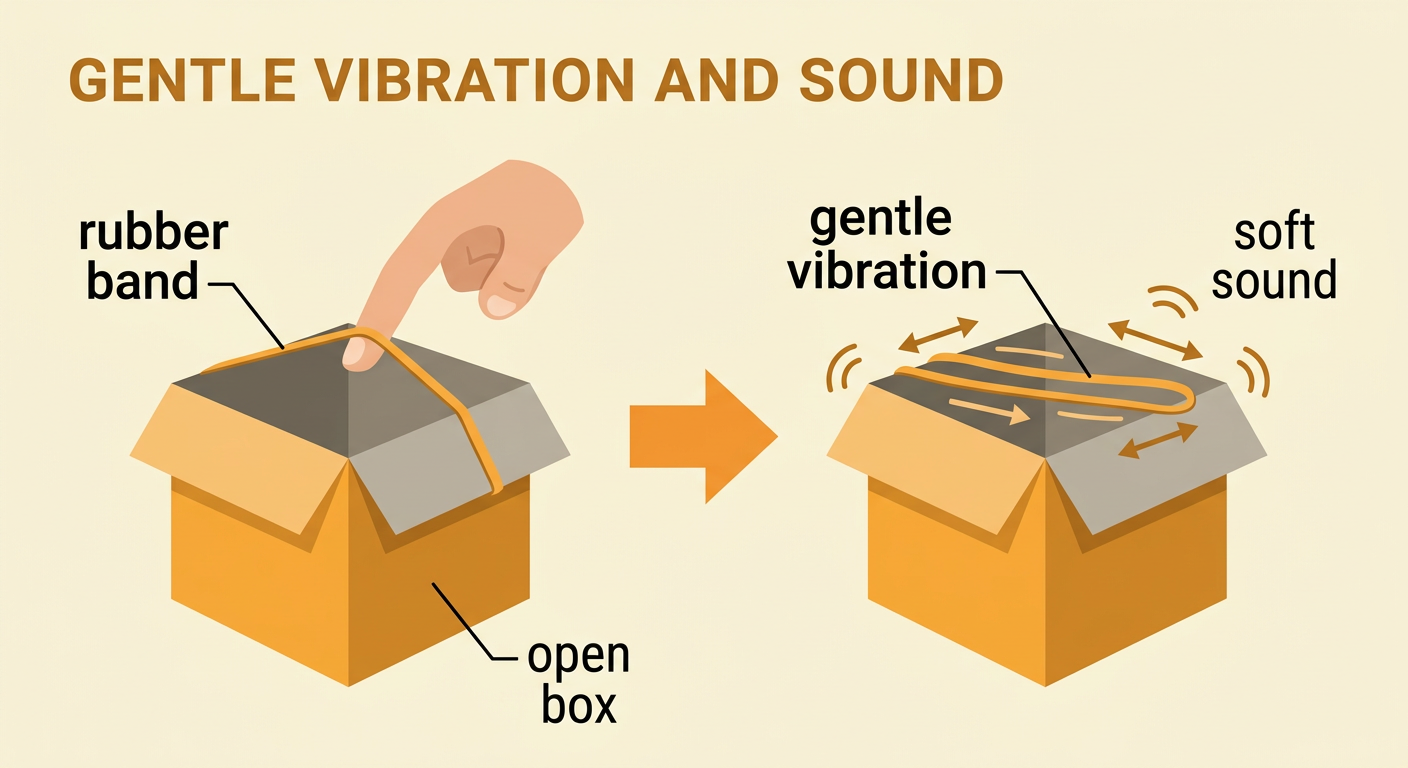
A vibration is a quick back-and-forth motion. Vibrating materials can make sound. Stretch a rubber band around an open box and gently pull it a short distance. Let it go while keeping your face and eyes away from the band. Watch closely and listen. The rubber band moves back and forth and makes a soft sound. Try it again in the same way to check what happens. You can also gently tap a ruler that extends a little past the edge of a desk while your teacher holds it safely in place. The ruler vibrates and makes sound. Gentle actions usually create smaller vibrations and softer sounds. Work calmly, use only the materials your teacher provides, and wait for your turn.
Make Stronger Vibrations
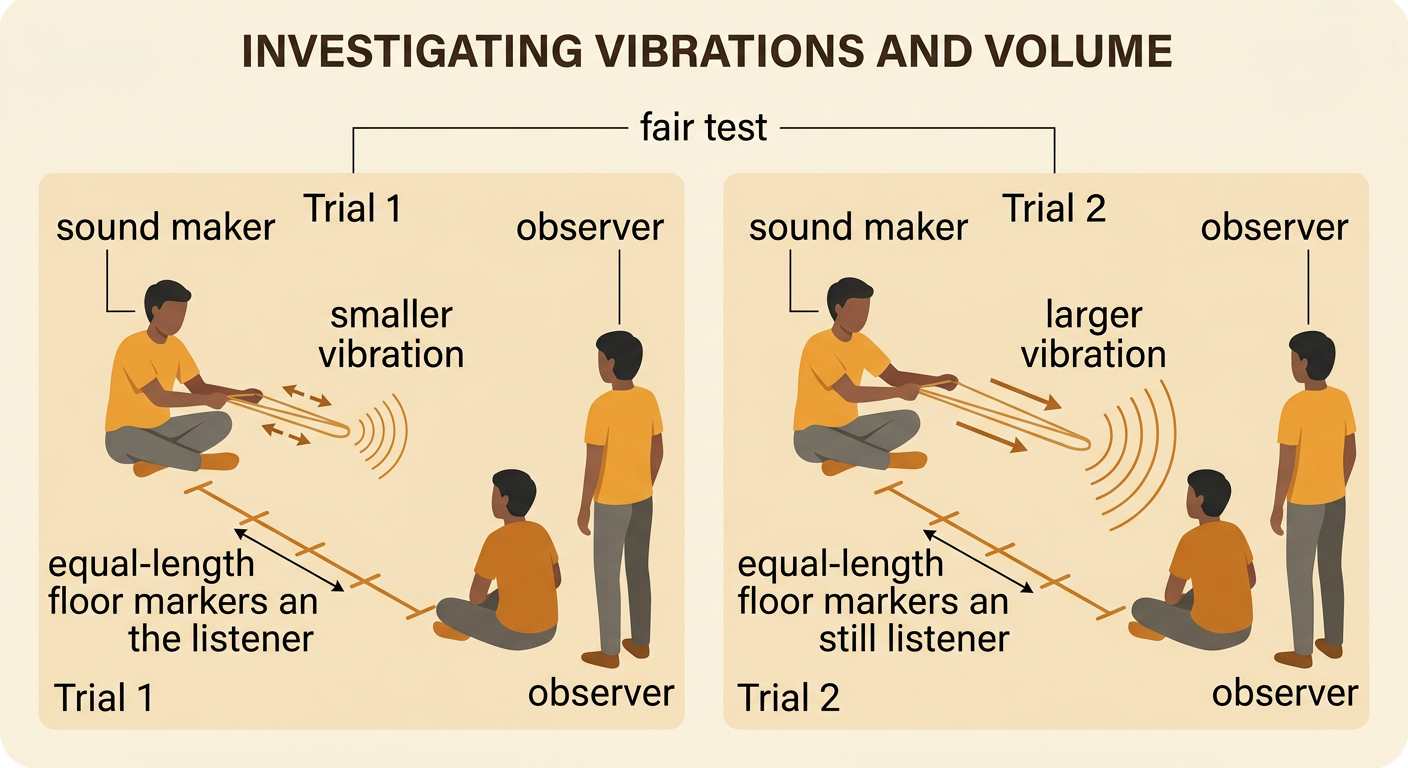
Now compare a stronger vibration using the same rubber band and box. Pull the band a little farther than before, but only as far as your teacher says is safe. Let it go, keeping your face and eyes away. Watch and listen. The band moves farther back and forth and usually makes a louder sound than it did after the gentle pull. This is a stronger vibration. Do not pull so far that the band could break or fly off the box. Change only how far you pull the band. Keep the same rubber band, box, listener distance, and room. For example, if you listen from one arm’s length away both times, you can make a fair comparison between the gentle and stronger vibrations.

Compare Sound Volumes
A fair test helps us learn what changed the sound volume. Use the same object in the same place, and listen from the same distance. First, make a gentle vibration. Next, make a stronger vibration. Ask: Which sound was softer? Which sound was louder? With the rubber band, the gentle pull creates a smaller vibration and usually a softer sound. The farther safe pull creates a larger vibration and usually a louder sound. Repeat each test to see whether the result happens again. Take turns as the sound maker, listener, and observer. Speak one at a time and respond kindly. You might say, “I agree because I heard the second sound more clearly,” or “Can we repeat the test?” Repeating helps the group use evidence instead of guessing.
Record Our Observations
Scientists record what they do, see, and hear. Make a class chart with one row for a gentle pull and one row for a farther safe pull. Draw the rubber band in each row. Use short arrows to show a small vibration and longer arrows to show a larger vibration. Then record the sound as softer or louder. For example, the class might write, “When we pulled the band gently, it made a softer sound.” Work together to create one shared report. Each student can add a picture, word, or sentence. Use observations from the investigation, not guesses. Afterward, read the report aloud and check it as a group. The evidence should show that the vibrating band made sound and that the stronger vibration usually produced greater volume.

Choose Safe Sound Rules
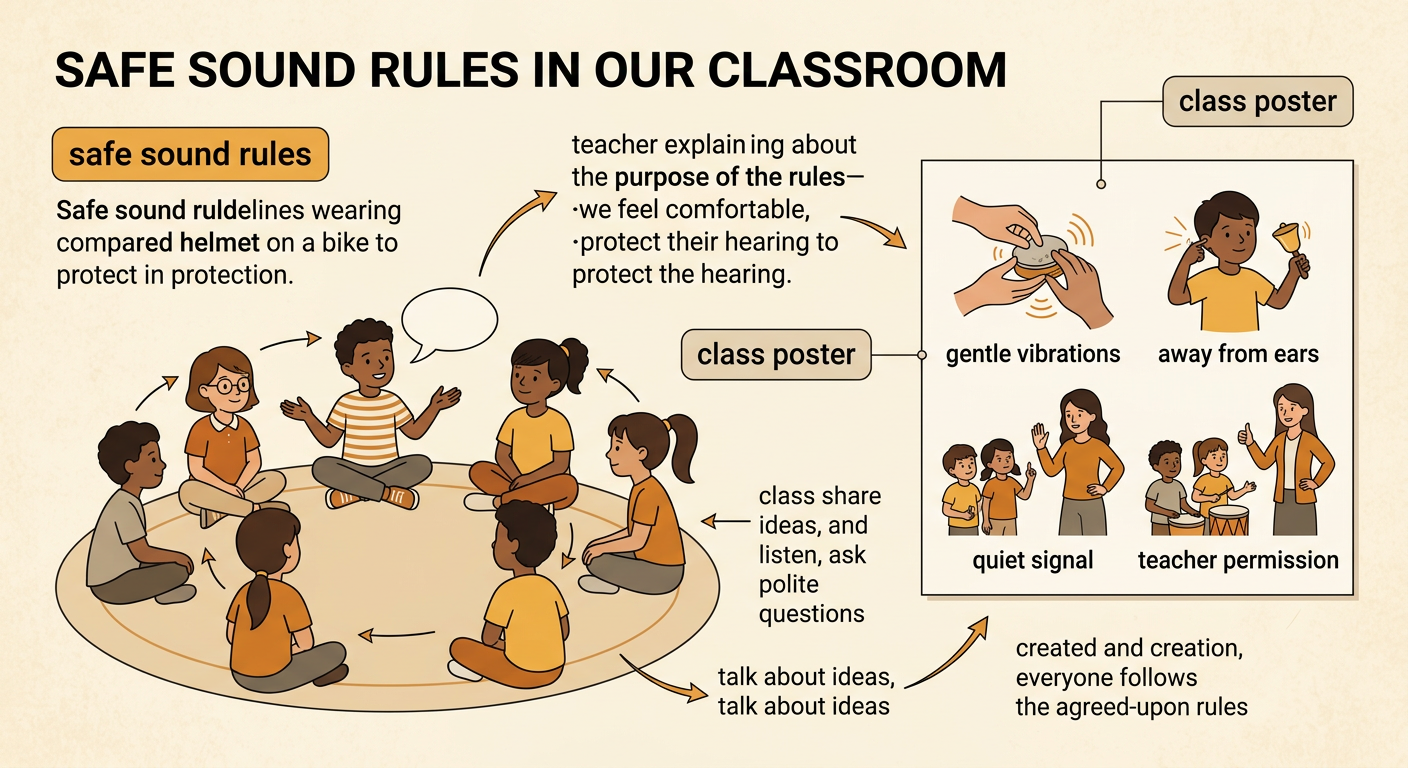
Very loud sounds can be uncomfortable and may harm hearing. Our class can choose rules that help everyone learn safely. First, share ideas one at a time. Listen without interrupting, ask polite questions, and respond to the idea instead of the person. Possible rules include using gentle vibrations indoors, keeping sound makers away from ears, stopping when someone says a sound hurts, and following the teacher’s signal for quiet. Discuss each idea, then decide together which rules to use. For example, the class might agree, “We will test loud sounds only with teacher permission and for a short time.” Write the chosen rules on a class poster. Everyone should follow the agreement. Safe sound rules let us investigate vibrations while caring for our own hearing and the comfort of others.