
Chemical Equilibrium, Acids, and Bases
Students use Le Châtelier's principle to predict equilibrium shifts and apply equilibrium ideas to acid-base systems and pH.
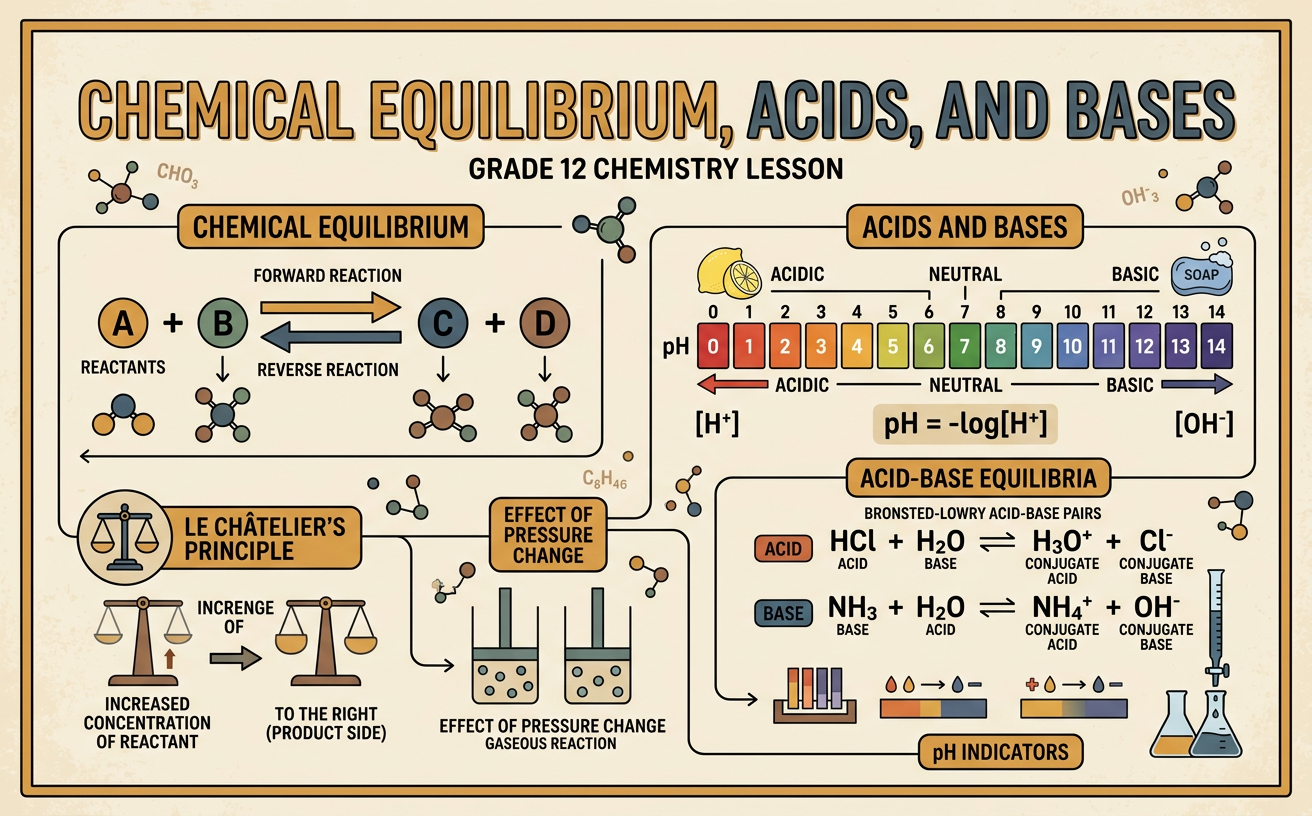
Illustrations are auto-generated and may be placeholders. They can be refreshed to match the narration.
Dynamic Equilibrium
Dynamic equilibrium occurs when a reversible reaction proceeds in both directions at equal rates. Reactant and product particles continue to collide and react, but their concentrations remain constant because products form as quickly as they are consumed. Constant concentrations do not mean that reactant and product amounts are equal. For example, colorless dinitrogen tetroxide gas and brown nitrogen dioxide gas establish the equilibrium N₂O₄(g) ⇌ 2NO₂(g) in a sealed container. At first, N₂O₄ breaks apart faster than NO₂ recombines. As NO₂ accumulates, the reverse reaction speeds up. Eventually, the forward and reverse rates become equal, and the brown color remains steady. Opening the container or changing its temperature disturbs this equilibrium because matter or energy is exchanged with the surroundings.
Equilibrium Expressions
An equilibrium constant describes the relative concentrations of products and reactants at equilibrium at a particular temperature. For a reaction aA + bB ⇌ cC + dD, the concentration expression is Kc = [C]ᶜ[D]ᵈ divided by [A]ᵃ[B]ᵇ. Each coefficient becomes an exponent. Pure solids and pure liquids are omitted because their effective concentrations remain constant. Consider H₂(g) + I₂(g) ⇌ 2HI(g). Its expression is Kc = [HI]² divided by [H₂][I₂]. If the equilibrium concentrations are [HI] = 0.80 M, [H₂] = 0.20 M, and [I₂] = 0.20 M, then Kc = 16. A large Kc indicates that products are favored at equilibrium, although reactants are still present. Changing concentrations can shift the system, but only changing temperature changes the value of Kc.
Le Châtelier's Principle
Le Châtelier's principle predicts how an equilibrium system responds to a change in conditions. The system shifts in the direction that partially opposes the disturbance. For the exothermic Haber process, N₂(g) + 3H₂(g) ⇌ 2NH₃(g) + heat, adding nitrogen or hydrogen shifts equilibrium toward ammonia. Removing ammonia also shifts the reaction toward products. Increasing pressure by decreasing container volume favors the product side because it has two moles of gas rather than four. Lowering temperature favors the exothermic forward reaction because heat is a product, although excessive cooling can make the reaction too slow. A refined industrial design therefore uses elevated pressure, continuously removes ammonia, and selects a balanced operating temperature. A catalyst speeds both directions equally, helping equilibrium be reached sooner without changing the equilibrium amounts or the value of K.
Acids, Bases, and pH
A Brønsted–Lowry acid donates a proton, H⁺, while a Brønsted–Lowry base accepts a proton. In water, donated protons form hydronium ions, H₃O⁺. The pH scale measures hydronium concentration using pH = −log[H₃O⁺]. At 25°C, acidic solutions have pH below 7, neutral water has pH 7, and basic solutions have pH above 7. For example, 0.0010 M hydrochloric acid is a strong acid that dissociates nearly completely, so [H₃O⁺] is approximately 1.0 × 10⁻³ M and the pH is 3.00. Weak acids ionize only partially and establish an equilibrium with their conjugate bases. Acid strength is described by Ka: a larger Ka generally indicates greater ionization and a stronger acid. At 25°C, pH + pOH = 14.00.
Shifting Acid-Base Systems
Weak acid solutions are equilibrium systems that respond to added substances. Acetic acid establishes CH₃COOH(aq) + H₂O(l) ⇌ H₃O⁺(aq) + CH₃COO⁻(aq). Adding sodium acetate increases the concentration of CH₃COO⁻, a product, so equilibrium shifts left and more undissociated acetic acid forms. This common-ion effect reduces the acid’s percent ionization. A mixture containing substantial amounts of acetic acid and acetate is a buffer. When a small amount of strong acid is added, acetate accepts hydronium and forms acetic acid, limiting the pH decrease. When a small amount of strong base is added, acetic acid donates protons and forms additional acetate, limiting the pH increase. Thus, adjusting the ratio of weak acid to conjugate base refines the system for a desired pH, while exceeding the buffer capacity causes a much larger pH change.