
Chemical Reactions and Conservation of Mass
Students identify evidence of chemical reactions, interpret and balance equations, and apply conservation of mass to closed-system investigations.
Illustrations are auto-generated and may be placeholders. They can be refreshed to match the narration.
Recognizing Chemical Reactions
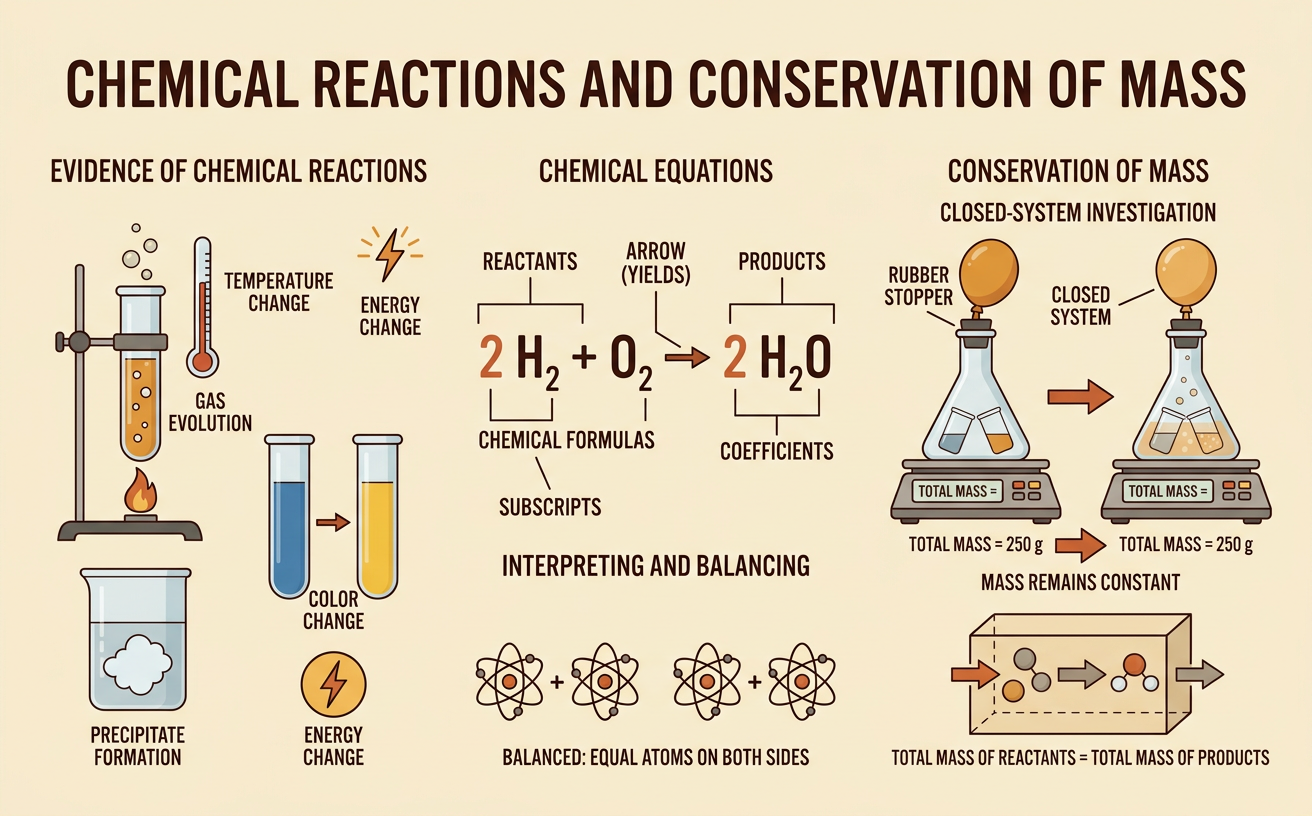
A chemical reaction rearranges atoms to produce one or more new substances. The starting substances are reactants, and the substances formed are products. Possible evidence includes an unexpected color change, gas production, formation of a solid precipitate, light emission, or a temperature change not caused by outside heating or cooling. No single sign always proves a reaction, so observations should be considered together. For example, when vinegar and baking soda are mixed, rapid bubbling shows that a gas is produced, and the mixture becomes cooler. These observations support the conclusion that a chemical reaction occurred. By contrast, bubbles in boiling water result from a physical change because the water remains the same substance.
Energy in Chemical Reactions
Chemical reactions involve energy because breaking existing bonds requires energy and forming new bonds releases energy. If a reaction transfers more energy to the surroundings than it absorbs, it is exothermic. The surroundings may become warmer, as in many combustion reactions. If a reaction absorbs more energy than it releases, it is endothermic, and the surroundings may become cooler. A disposable hand warmer provides a concrete exothermic example: iron reacts with oxygen and releases thermal energy. An instant cold pack provides an endothermic example when its contents dissolve and absorb energy. Temperature measurements taken before and after a process can provide quantitative evidence about energy transfer, but they must be collected carefully under controlled conditions.
Chemical Equations and Atom Counting
A chemical equation uses formulas to summarize a reaction. Reactants appear on the left of an arrow, and products appear on the right. The arrow means yields or produces. In the equation 2H2 + O2 → 2H2O, hydrogen and oxygen react to produce water. Count atoms to interpret the equation: both sides contain four hydrogen atoms and two oxygen atoms. Coefficients may be changed to balance an equation, but subscripts must not be changed because doing so would change the identities of the substances. A useful balancing procedure is to count each type of atom, adjust one coefficient at a time, recount, and continue until every element has equal totals on both sides.
Conservation of Mass
The law of conservation of mass states that matter is not created or destroyed in an ordinary chemical reaction. Atoms are rearranged into new combinations, so the total mass remains constant in a closed system. Suppose baking soda and vinegar react inside a sealed plastic bag. If the bag and contents have a mass of 105 grams before the reaction, they should have about 105 grams afterward, even though the bag inflates with gas. If the same reaction occurs in an open cup, the measured mass may decrease because gas escapes into the room. This does not violate conservation of mass; the escaped gas is still matter. Balanced equations represent the same principle by showing equal numbers of each kind of atom before and after a reaction.