
Choosing Materials by Their Physical Properties
Students observe and measure properties such as hardness, flexibility, magnetism, and conductivity to identify materials and choose the best material for a specific use.
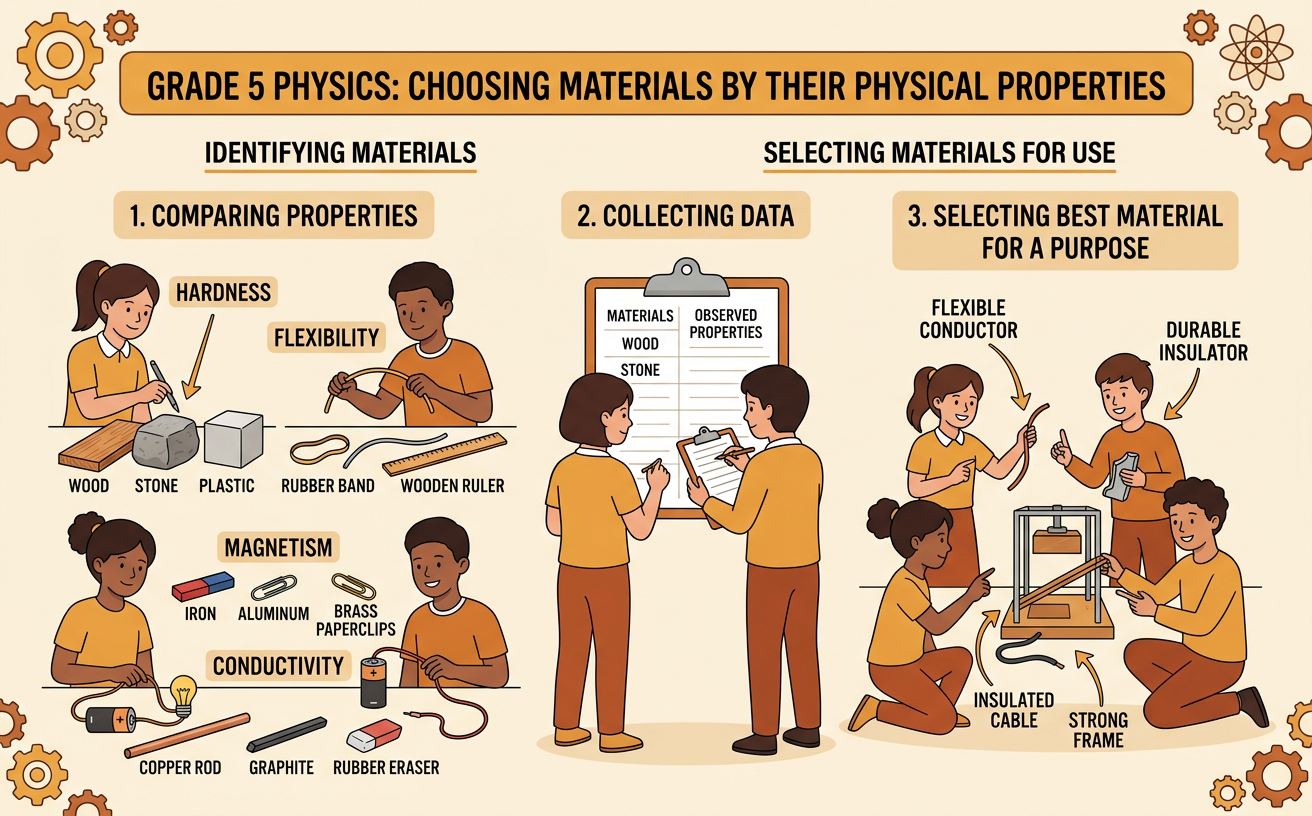
Illustrations are auto-generated and may be placeholders. They can be refreshed to match the narration.
What Are Physical Properties?
Physical properties are features of a material that can be observed or measured without changing the material into a new substance. Hardness describes how well a material resists scratching or denting. Flexibility describes how easily it bends without breaking. Magnetism tells whether a material is attracted to a magnet. Conductivity describes how well heat or electric current moves through a material. For example, a steel paper clip is hard, not very flexible, attracted to a magnet, and able to conduct electricity. A rubber band is flexible, not attracted to a magnet, and a poor electrical conductor. Scientists use several properties together because one property may not be enough to identify a material. Color alone, for instance, cannot prove that a shiny gray object is steel because several materials can have that appearance.

Observe and Test Materials
Begin by observing each sample carefully and then use the same test on every material. To test hardness, gently try to scratch each sample with the same wooden craft stick and record whether a mark appears. To test flexibility, bend equal-sized strips over the same rounded support and measure how far each strip bends without cracking. Test magnetism by holding the same magnet at the same distance from every sample. Electrical conductivity can be tested with a teacher-approved, low-voltage battery circuit; never use a wall outlet. If a sample closes the circuit and lights the bulb, it conducts electricity. For example, a metal strip may light the bulb and move toward the magnet, while a plastic strip does neither. Keeping sample size, tools, and test steps the same makes the comparison fair.

Record Measurement Data
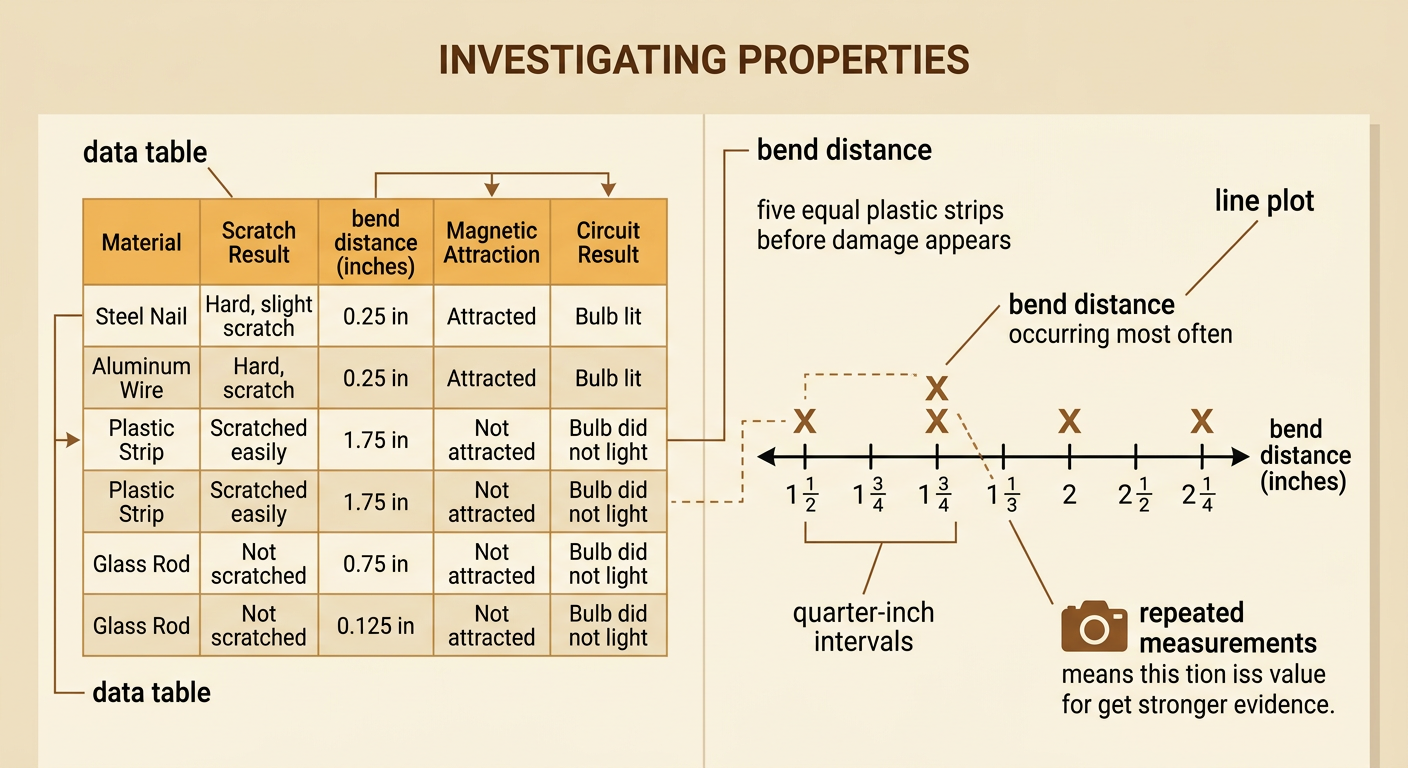
A data table helps organize observations and measurements so patterns are easier to see. Write the material names in rows and the tested properties in columns. Use numbers with units whenever possible, such as bend distance in inches. Use clear words such as attracted, not attracted, bulb lit, or bulb did not light for results that are not measured with a number. Suppose five equal plastic strips bend 1 1/2, 1 3/4, 1 3/4, 2, and 2 1/4 inches before showing damage. Plot these values on a line plot marked in quarter-inch intervals. The plot shows that 1 3/4 inches occurred most often and that the measurements ranged from 1 1/2 to 2 1/4 inches. Repeated measurements provide stronger evidence than one trial and can reveal an unusual result that should be checked.
Identify Mystery Materials
To identify a mystery material, compare its tested properties with reliable data from known materials. Do not rely on only one clue. A sample that conducts electricity might be copper, aluminum, steel, or another conductor. More tests can narrow the possibilities. Imagine that Mystery Sample A conducts electricity, is not attracted to a magnet, bends without cracking, and has the same reddish-brown surface as a known copper sample. These combined observations support identifying it as copper. Mystery Sample B may conduct electricity and be attracted to a magnet, matching the tested steel sample instead. Measurements should agree closely, but small differences can occur because of sample thickness, surface coatings, or measurement error. If the evidence does not clearly match one known material, report the possible choices and perform another safe test rather than guessing.

Choose the Best Material
The best material depends on what an object must do. First list the required properties, and then compare the benefits and costs of each choice. For a cooking-pot handle, the material should transfer heat slowly, stay firm, and be durable. Metal is strong, but it conducts heat well and could become dangerously hot. Wood transfers heat more slowly and is fairly rigid, but it may crack or wear after repeated washing. Heat-resistant silicone is a poor heat conductor, provides a comfortable grip, and resists water, but it may cost more than basic wood. A designer might choose silicone when safety, comfort, and long use are most important. Another designer might choose wood to reduce cost. Cost can include the purchase price, how long the material lasts, repair or replacement, and environmental effects. A good choice balances performance, safety, and available resources.

Explain the Choice with Evidence
An informative explanation should name the chosen material, describe the object’s needs, and use test data as evidence. Organize the explanation with an introduction, connected facts, and a conclusion. For example: “Heat-resistant silicone is the best choice for our cooking-pot handle. In our heat test, the end of the silicone sample increased by only 4°F, while the metal sample increased by 18°F during the same amount of time. The silicone also bent without cracking and did not absorb water. Although silicone costs more than wood, its low heat conductivity, comfortable grip, and water resistance provide important safety and durability benefits. Therefore, the added cost is reasonable for this use.” This explanation is convincing because it includes measurements, compares alternatives, and connects each property to the handle’s purpose. Check that every claim is supported by recorded observations or measurements.
