Choosing Materials for a Purpose
Students test common materials for strength and water resistance, record their observations, and choose the best material for making a simple rain cover.
Illustrations are auto-generated and may be placeholders. They can be refreshed to match the narration.
Notice Material Properties
A material is what an object is made from. Paper, aluminum foil, cotton cloth, and plastic are materials. Each material has properties, or features we can observe. A material may be stiff, soft, smooth, rough, bendable, strong, absorbent, or water resistant. Water-resistant materials keep water from passing through easily. Absorbent materials soak up water. Think about a paper towel and a plastic bag. A paper towel absorbs spilled water, so it is useful for cleaning. A plastic bag does not soak up water, so it can help keep an object dry. For a rain cover, we need a material that can hold together and resist water. Looking closely at properties helps us decide which material may work best.

Predict the Best Material
A prediction is a careful idea about what may happen. Before testing, examine each material and predict which one will make the best rain cover. A good rain cover should be strong enough to stay in one piece and water resistant enough to keep an object dry. You might predict that plastic wrap will work best because water usually stays on its surface. Another student might choose aluminum foil because it does not soak up water and seems strong. Record your prediction and your reason. You can write, “I predict aluminum foil will be best because it will block water and hold together.” A prediction does not have to be correct. Testing gives us evidence that we can use to check and improve our ideas.

Test Strength and Water Resistance
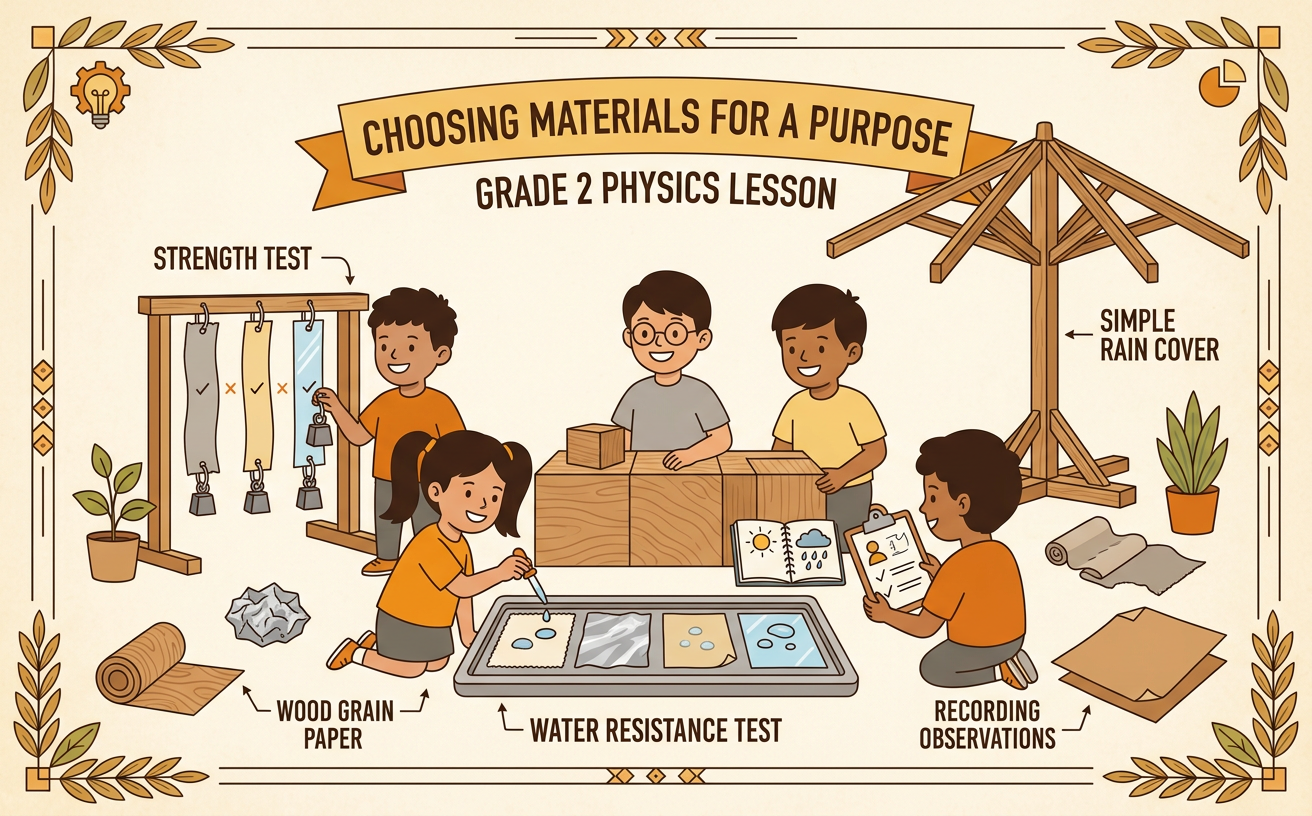
Test every material in the same way so the comparison is fair. For the strength test, place an equal-sized sample across two cups. Add pennies one at a time to the center. Count how many pennies the material holds before it tears, slips, or changes too much. Stop at the class limit. For the water-resistance test, place a new sample over a dry cup. Use a dropper to add the same number of water drops to each sample. Look inside the cup after one minute. Record whether the inside stayed dry or became wet. For example, cloth may hold several pennies but let water soak through. Use small amounts of water, keep it away from electrical objects, and wipe spills promptly. Equal sample sizes, equal drops, and equal waiting times make the test fair.

Record and Compare Results
Record observations in a table so the results are easy to compare. Write the number of pennies each material held. Then write “dry” if no water reached the cup or “wet” if water passed through. A sample class might find that paper held 3 pennies and became wet, cloth held 6 pennies and became wet, foil held 8 pennies and stayed dry, and plastic wrap held 7 pennies and stayed dry. These numbers describe only that class’s test. Your results may be different. Compare the materials by asking two questions: Which held more pennies? Which kept the cup dry? You can also make a bar graph of the penny counts. The table and graph are mathematical models that help show which materials meet the needs of a rain cover.

Choose and Explain
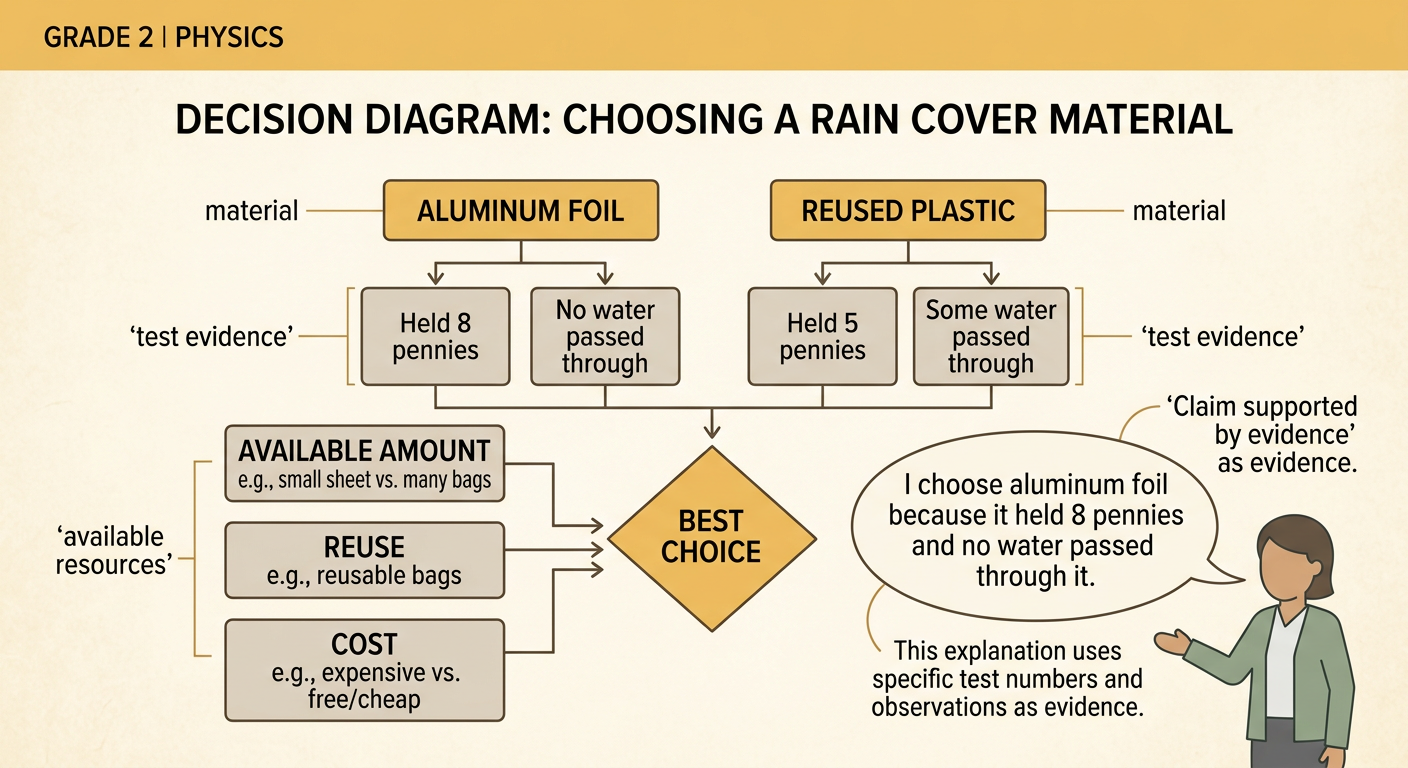
Choose the material that best matches the purpose, using evidence from your tests. Suppose aluminum foil held the most pennies and kept the cup dry. You could say, “I choose aluminum foil because it held 8 pennies and no water passed through it.” This explanation uses observations and numbers, not just an opinion. Also think about limited resources. A class may have only one small sheet of foil but many reusable plastic bags. People often consider how much material is available, its cost, whether it can be reused, and how much is needed. Plastic might be the practical choice if it also stayed dry and was strong enough. No material is best for every job. The best choice meets the important needs of the purpose while using available resources carefully.