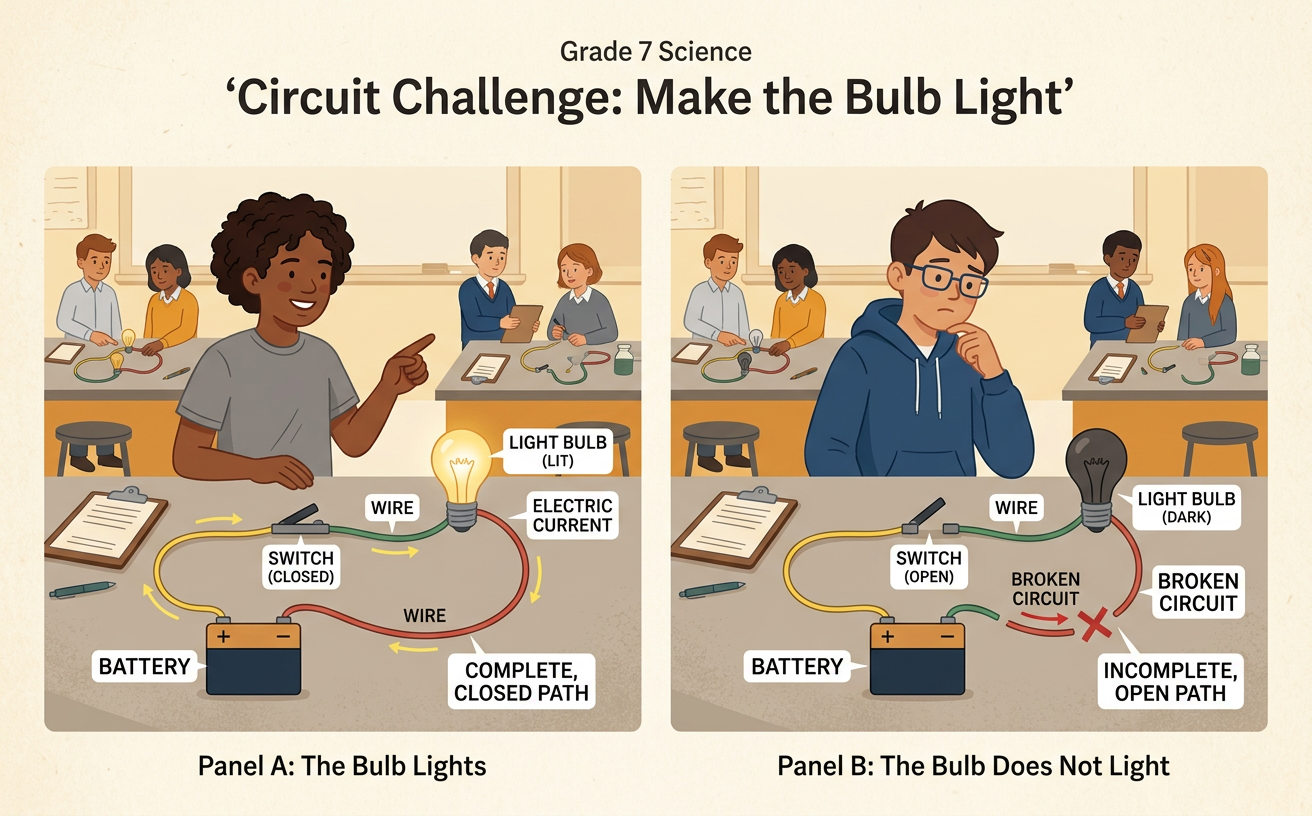
Circuit Challenge: Make the Bulb Light
Students assemble and compare simple electrical circuits to discover that a complete, closed path is required for electric current to transfer energy from a battery to a bulb.
Illustrations are auto-generated and may be placeholders. They can be refreshed to match the narration.
Can You Light the Bulb?
Your challenge is to make a small bulb light using one battery, one bulb, and two wires. Before connecting anything, examine each object and predict how the parts must touch. A bulb will not light simply because it is near a battery. Its two electrical contacts must connect to opposite battery terminals, creating one uninterrupted path. Test different arrangements and record whether the bulb lights. For example, touching only one wire from the positive battery terminal to the bulb does not complete the path, so the bulb stays dark. Avoid connecting a wire directly from one battery terminal to the other because the wire and battery may become hot. Use your observations as evidence, and change only one connection at a time so you can identify what makes a successful circuit.
Identify the Circuit Components
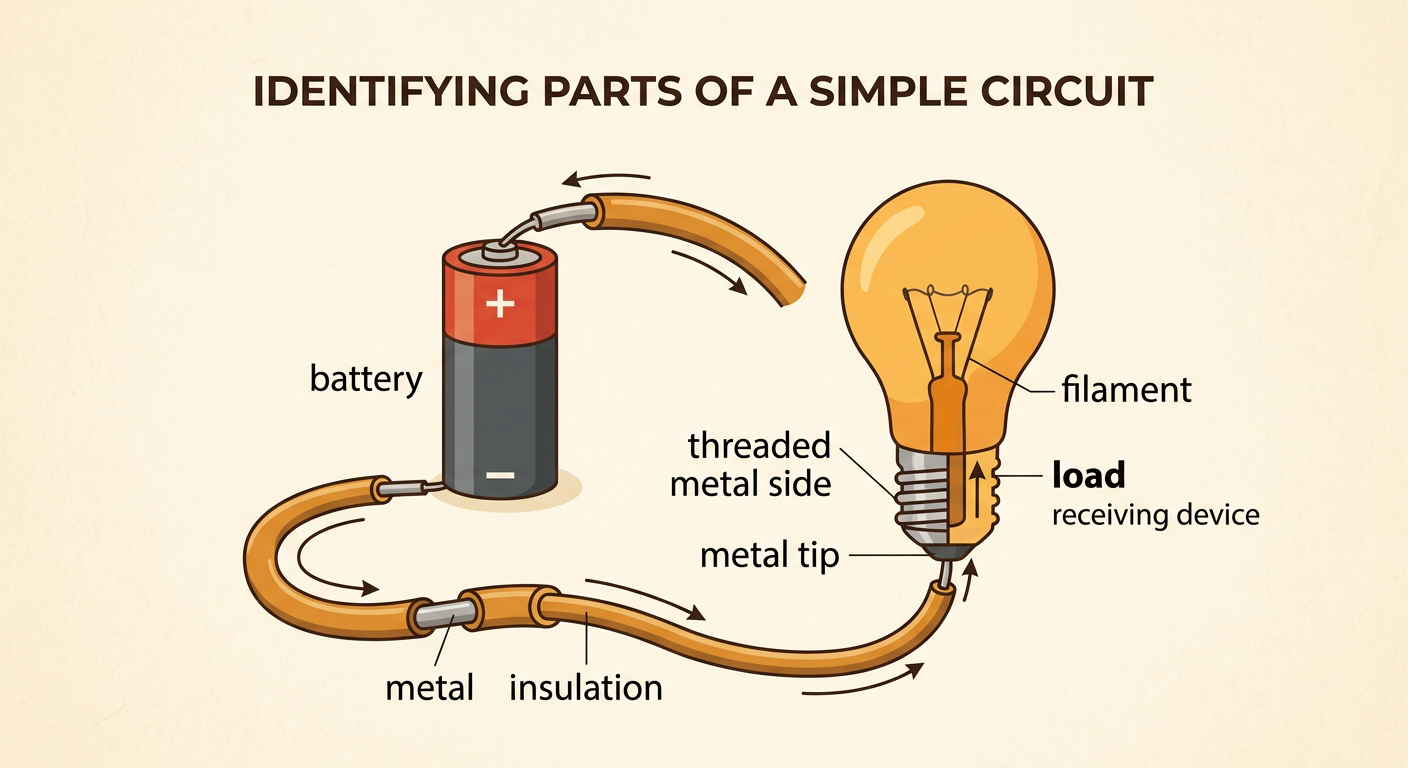
A simple circuit has an energy source, a device that receives energy, and conducting materials that connect the parts. The battery is the source. Its positive and negative terminals provide the two different connection points needed for current. The wires contain metal conductors covered by insulation. The bulb is the receiving device, or load. A typical miniature bulb has two separate contacts: a metal tip on the bottom and a threaded metal side. Inside the bulb, a thin filament connects these contacts. For example, if one wire touches the bulb’s metal tip but the second wire touches the glass, the bulb remains dark because glass does not provide a conducting connection. Correctly identifying each terminal and contact makes it easier to assemble a complete circuit.
Build a Closed Circuit
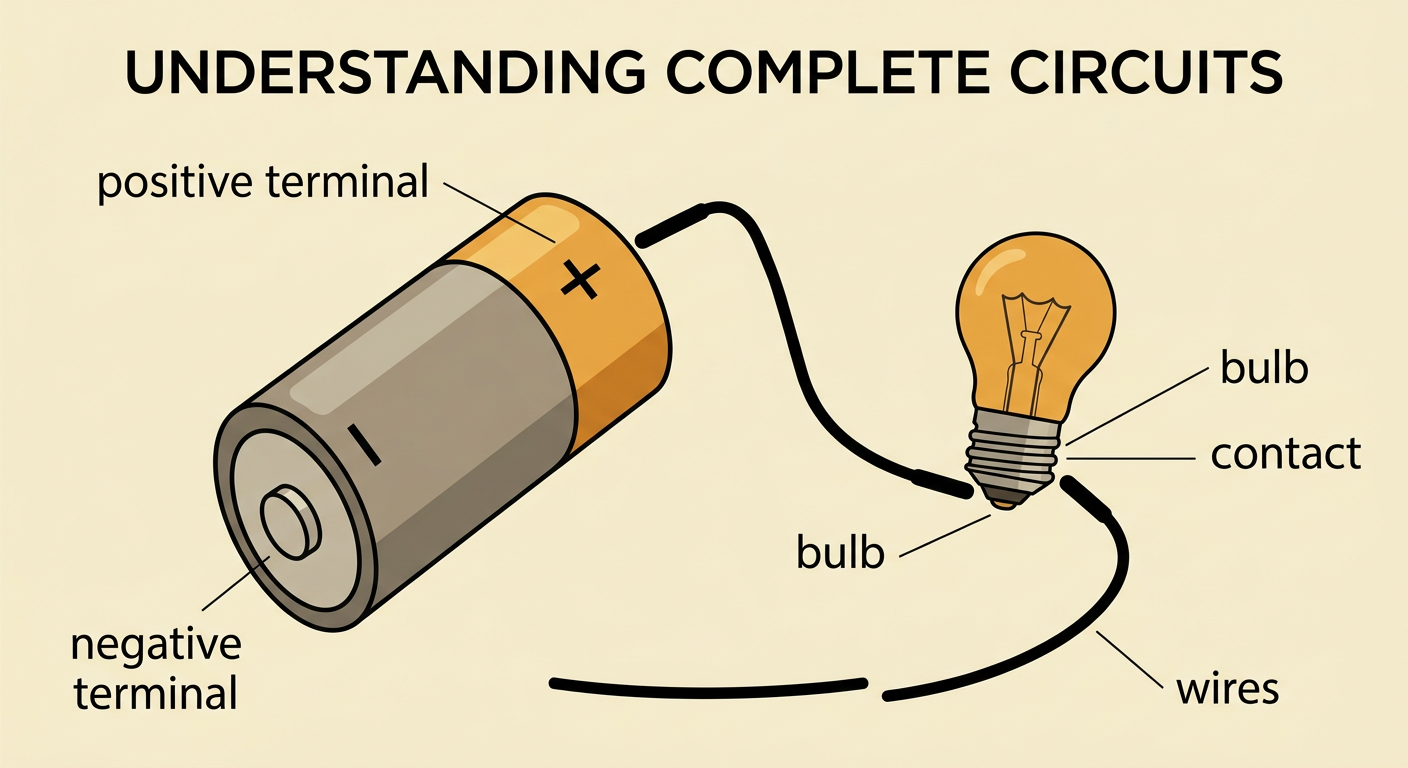
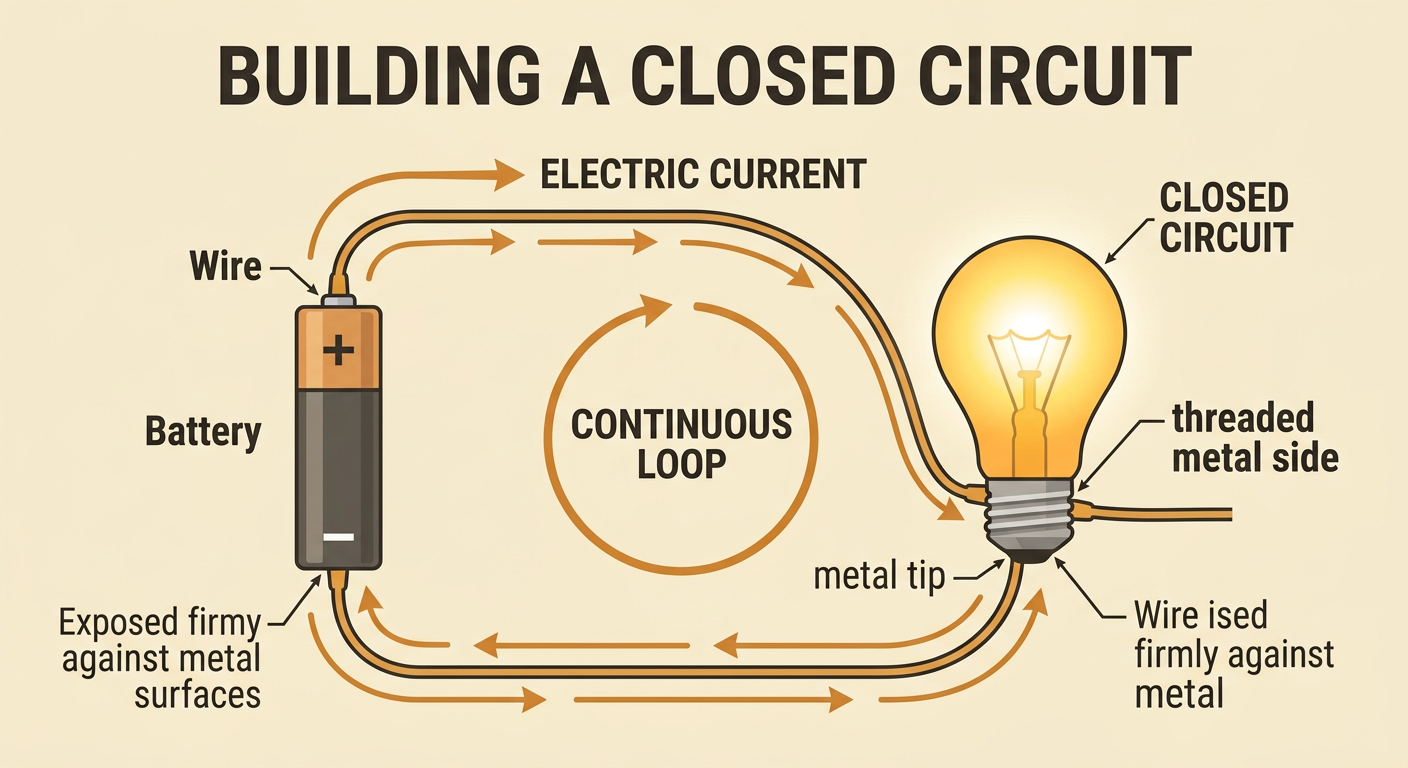
To build a closed circuit, connect one wire from the battery’s positive terminal to one bulb contact. Connect the second wire from the bulb’s other contact to the battery’s negative terminal. Press each exposed wire end firmly against metal, not glass or plastic. The connections should form one continuous loop with no gaps. When the loop is complete, electric current moves through the circuit and the bulb lights. For example, one wire can touch the bulb’s bottom metal tip while the other touches its threaded metal side. If the bulb does not light, check the battery orientation, tighten each connection, and make sure the wires touch different bulb contacts. Disconnect the circuit after the test so the battery does not continue transferring energy or become unnecessarily warm.
Compare Open and Closed Circuits
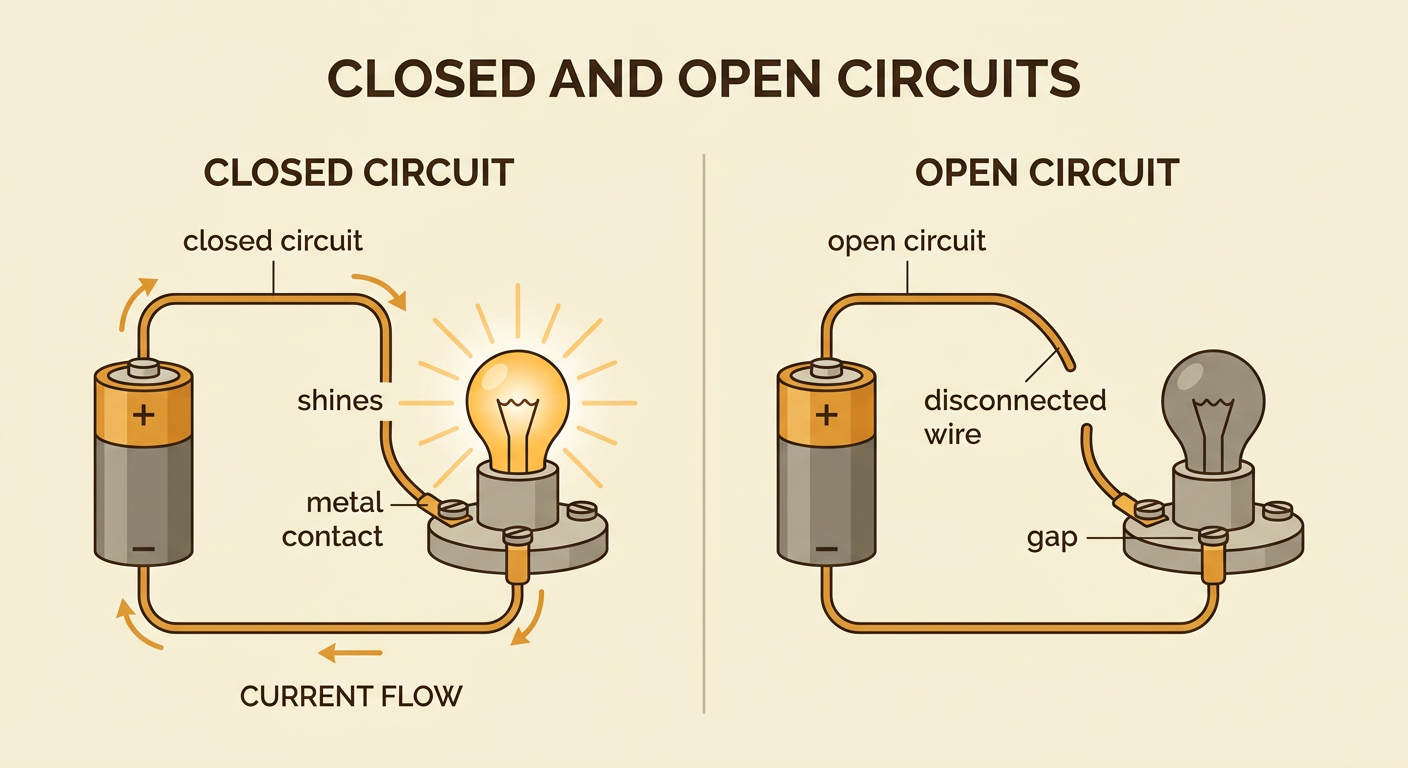
A closed circuit has a continuous conducting path, so current can flow and transfer energy to the bulb. An open circuit has a gap somewhere in the path, so current cannot continue around the loop. The gap may be obvious, such as a disconnected wire, or less obvious, such as a wire touching the bulb’s glass instead of a metal contact. Compare two arrangements using the same battery, bulb, and wires. In the closed arrangement, both battery terminals connect to different bulb contacts, and the bulb lights. In the open arrangement, lift one wire away from the metal tip; the bulb immediately goes dark. This comparison provides evidence that a battery alone is not enough. The condition that changes the result is whether the conducting path is complete or broken.
Trace the Path of Energy
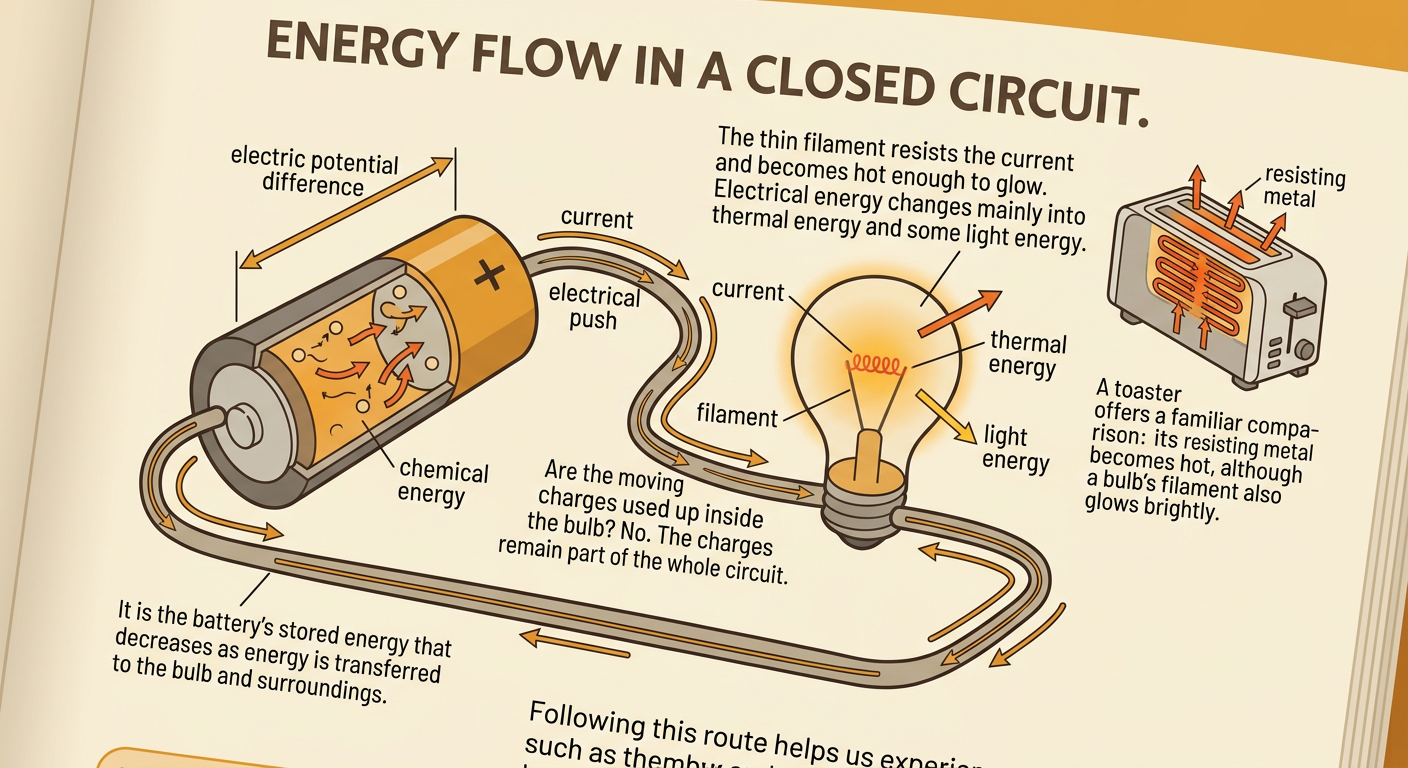
The battery stores chemical energy. When the circuit is closed, chemical reactions in the battery create an electric potential difference that drives current through the circuit. The electric current transfers energy from the battery to the bulb. In an incandescent bulb, the thin filament resists the current and becomes hot enough to glow. Electrical energy is transformed mainly into thermal energy and some light energy. For example, begin at the battery’s positive terminal and trace the external circuit through a wire, the bulb filament, and the second wire to the negative terminal. This tracing shows a complete route for current. The moving charges are part of the entire circuit; they are not used up by the bulb. Instead, the battery’s stored energy decreases as energy is transferred to the bulb and the surroundings.
Explain Why the Bulb Lights
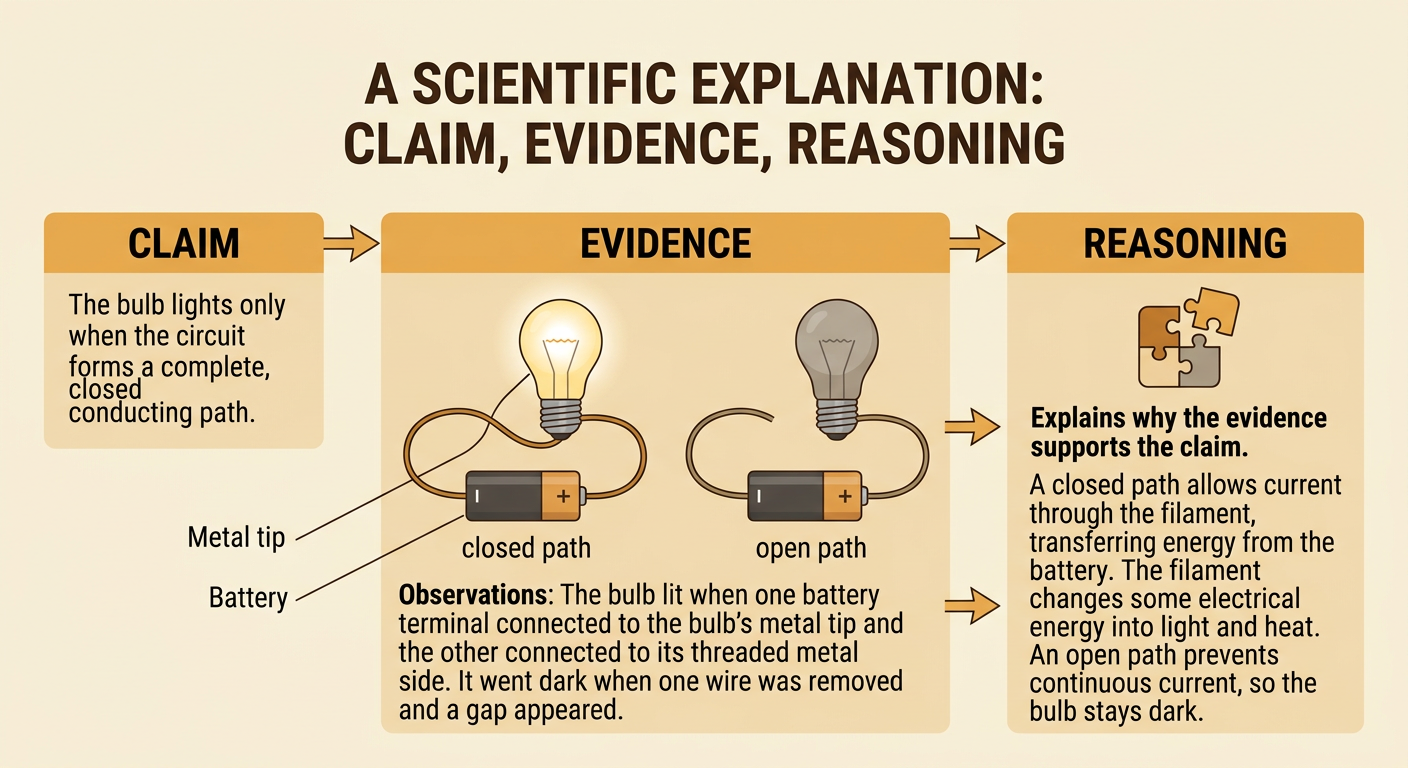
A strong scientific explanation includes a claim, evidence, and reasoning. Claim that the bulb lights only when the circuit forms a complete, closed conducting path. Support the claim with observations from your tests. For example, the bulb lit when one battery terminal was connected to the bulb’s metal tip and the other terminal was connected to the threaded metal side. It went dark when one wire was removed, creating a gap. Then connect the evidence to scientific ideas: a closed path allows electric current to pass through the filament, transferring energy from the battery. The filament transforms some electrical energy into light and thermal energy. An open path prevents continuous current, so energy is not transferred to the bulb in the same way. This reasoning explains both the successful arrangement and the failed arrangements using relevant experimental evidence.