
Circular Motion and Gravitation
Students connect centripetal acceleration and force to Newton’s law of universal gravitation to explain circular motion, satellites, and planetary orbits.
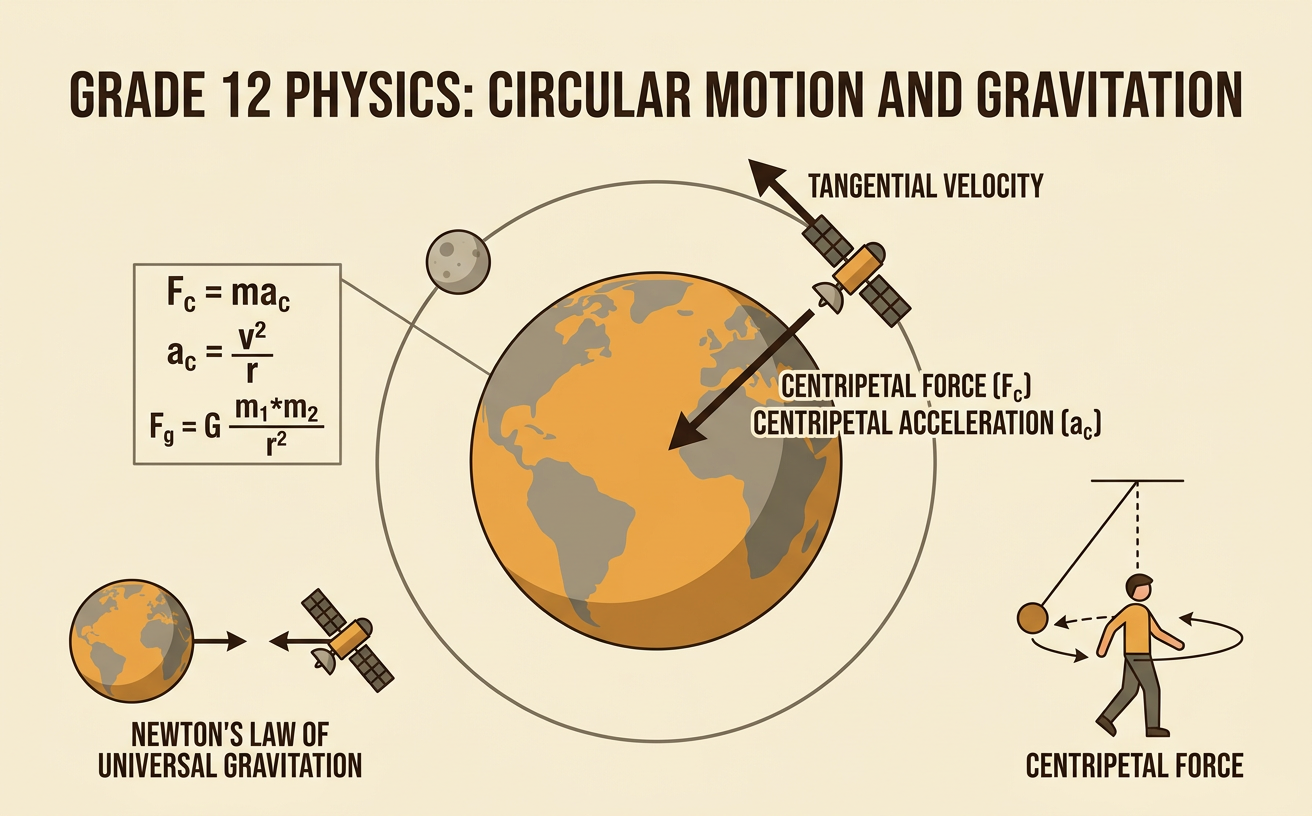
Illustrations are auto-generated and may be placeholders. They can be refreshed to match the narration.
Circular Motion Variables
Uniform circular motion occurs when an object travels around a circle at constant speed. The radius, r, is the distance from the center to the object. The period, T, is the time required for one complete revolution, while the frequency, f, is the number of revolutions per second. They are related by f = 1/T. During one revolution, the object travels the circumference 2πr, so its tangential speed is v = 2πr/T, or v = 2πrf. Although the speed remains constant, the velocity changes because its direction continuously changes. For example, a rider moving in a circle of radius 10 m with a period of 20 s has a speed of 2π(10)/20, or about 3.14 m/s. At every point, the rider’s velocity is tangent to the circle.

Centripetal Acceleration
An object in uniform circular motion accelerates even when its speed is constant because its velocity changes direction. This inward acceleration is called centripetal acceleration. It always points toward the center of the circle and is perpendicular to the object’s instantaneous tangential velocity. Its magnitude is a_c = v²/r. Using v = 2πr/T gives the equivalent model a_c = 4π²r/T². At a fixed radius, a greater speed produces much greater acceleration because speed is squared. At a fixed speed, a smaller radius requires greater acceleration. For example, a car traveling at 20 m/s around a level curve of radius 50 m has a centripetal acceleration of 20²/50 = 8.0 m/s² directed toward the curve’s center. The acceleration changes the direction of motion rather than increasing the car’s speed.

Sources of Centripetal Force
Centripetal force is not a separate type of force. It is the name for the net force directed toward the center of a circular path. Newton’s second law gives F_net,inward = ma_c = mv²/r. Different interactions can supply this inward force. Tension pulls a ball attached to a string, static friction turns a car on a level road, gravity keeps a satellite in orbit, and a normal force can help guide a roller-coaster car through a loop. To identify the source, draw all real forces and add their components in the radial direction. For example, a 0.50 kg ball moving at 4.0 m/s in a horizontal circle of radius 2.0 m requires an inward net force of 0.50(4.0²)/2.0 = 4.0 N. If tension is the only horizontal force, the string tension is 4.0 N.
Universal Gravitation
Newton’s law of universal gravitation states that every pair of masses attracts each other. The force magnitude is F_g = Gm₁m₂/r², where G = 6.67 × 10⁻¹¹ N·m²/kg² and r is the center-to-center separation. Each mass experiences a force of equal magnitude directed toward the other mass, consistent with Newton’s third law. Because distance is squared in the denominator, doubling the separation reduces the gravitational force to one-fourth of its original value. Near the surface of a spherical planet, an object’s weight can be found from F_g = GMm/r², and the gravitational field strength is g = GM/r². For example, a 60 kg student near Earth’s surface, where g is about 9.8 N/kg, experiences a gravitational force of approximately 588 N toward Earth’s center. The student pulls Earth upward with the same force magnitude.
Satellites and Orbits
A satellite remains in orbit because gravity continually accelerates it toward the central body while its tangential velocity carries it forward. It is therefore in continuous free fall, repeatedly falling around rather than into the planet. For a circular orbit, gravity supplies the centripetal force: GMm/r² = mv²/r. Canceling the satellite mass gives v = √(GM/r), showing that circular orbital speed depends on the central mass and orbital radius, not on satellite mass. The radius r is measured from the planet’s center, so it equals the planet’s radius plus the satellite’s altitude. The period is T = 2πr/v. For example, a satellite about 400 km above Earth has an orbital radius near 6.77 × 10⁶ m, a speed of about 7.7 km/s, and a period near 92 minutes. Real planetary orbits are generally elliptical, although circular models are useful approximations.