
Circumference and Area of Circles
Students develop an understanding of pi and use circle formulas to solve mathematical and real-world problems involving circumference and area.

Illustrations are auto-generated and may be placeholders. They can be refreshed to match the narration.
Radius, Diameter, and Pi
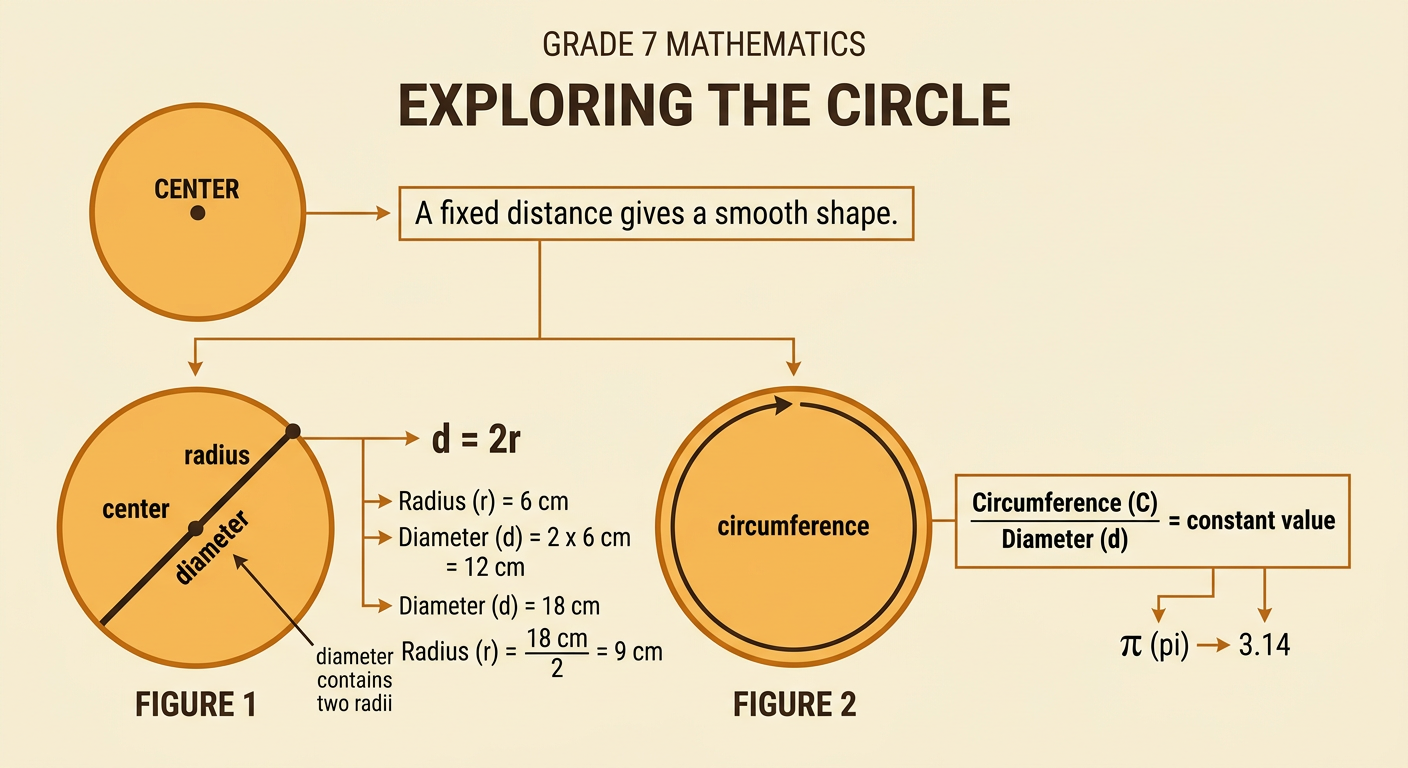
A circle is the set of all points in a plane that are the same distance from a center point. The radius is the distance from the center to the circle, and the diameter passes through the center from one side of the circle to the other. Therefore, the diameter is twice the radius: d = 2r. A circle with a radius of 6 centimeters has a diameter of 12 centimeters. For every circle, the ratio of circumference to diameter is the constant pi, written π. This means C ÷ d = π. Pi is approximately 3.14, although calculators often provide a more precise value. If a circle’s circumference is about 31.4 centimeters and its diameter is 10 centimeters, then 31.4 ÷ 10 = 3.14, demonstrating this constant ratio.
Finding Circumference
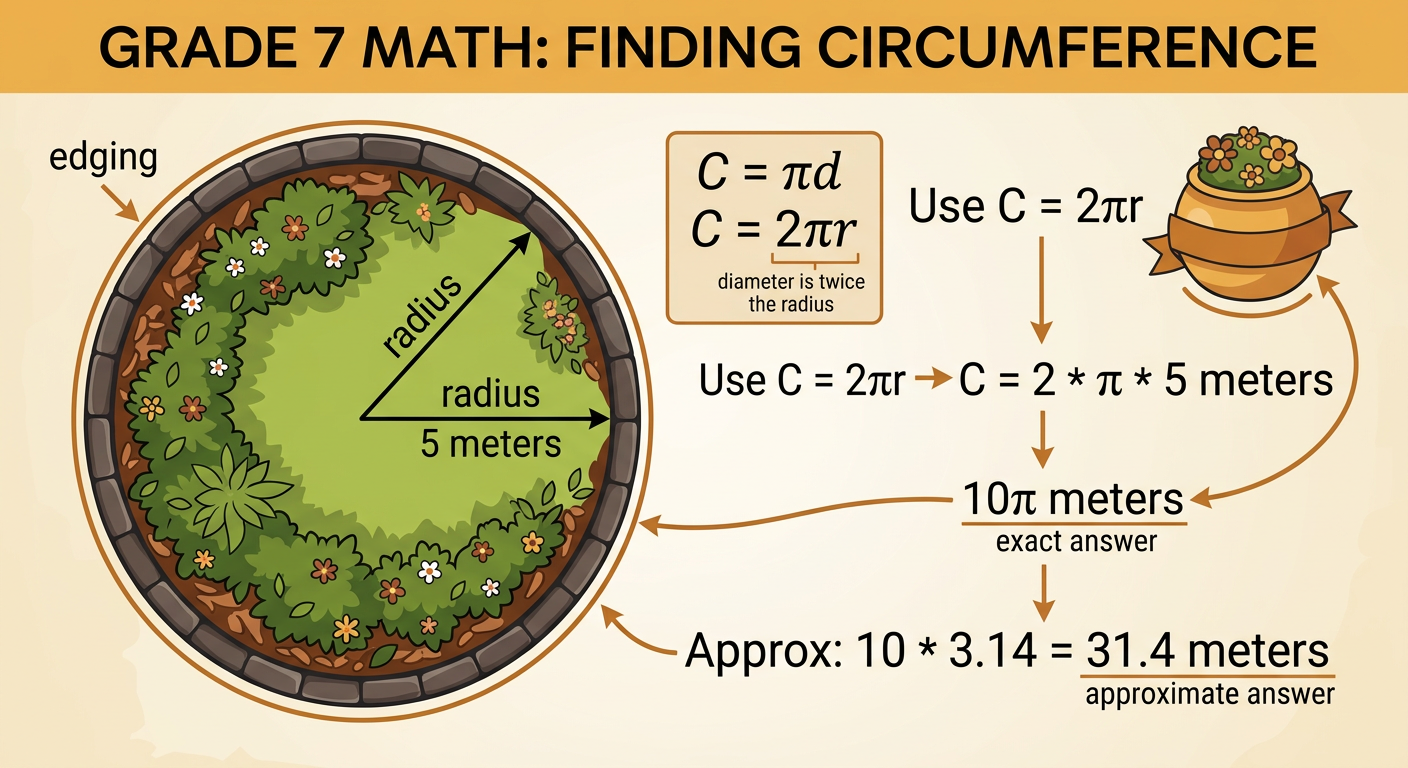
Circumference is the distance around a circle. The formula C = πd uses the diameter, while C = 2πr uses the radius. Both formulas are equivalent because d = 2r. Suppose a circular garden has a radius of 5 meters. Its circumference is C = 2π(5), or 10π meters. Using 3.14 for pi gives approximately 31.4 meters. If an exact answer is requested, leave the result as 10π meters. If an approximate answer is requested, use 31.4 meters. In a practical problem, this could represent the amount of edging needed to surround the garden. Students should not confuse circumference with area: circumference measures a one-dimensional distance, so its unit is meters rather than square meters.
Finding Area
Area measures the amount of surface inside a circle. The formula is A = πr², where r is the radius. Squaring the radius means multiplying it by itself before multiplying by pi. For a circle with a radius of 7 inches, A = π(7²) = 49π square inches. Using 3.14 gives approximately 153.86 square inches. If the diameter is given, divide it by 2 before using the formula. For example, a circular table with a diameter of 10 feet has a radius of 5 feet. Its area is π(5²) = 25π, or approximately 78.5 square feet. Area is written in square units because it describes how many unit squares would cover the circular region.

Solving Multistep Circle Problems
Circle problems may require finding a missing measure or comparing more than one circle. Suppose a circular track has a circumference of 62.8 meters. Using C = πd and π ≈ 3.14, substitute to get 62.8 = 3.14d. Dividing by 3.14 gives d = 20 meters, so the radius is 10 meters. The enclosed area is then A = π(10²), which is approximately 314 square meters. In another situation, doubling a circle’s radius doubles its circumference but multiplies its area by four. For example, increasing a radius from 3 centimeters to 6 centimeters changes the area from 9π to 36π square centimeters. Drawing and labeling the circle before calculating helps identify whether the given measurement is a radius, diameter, circumference, or area.
