Citing Textual Evidence to Support Inferences
Students will make logical inferences about a literary text and support their ideas with relevant, accurately cited evidence.

Illustrations are auto-generated and may be placeholders. They can be refreshed to match the narration.
Explicit Meaning and Inference
Explicit meaning is information the author states directly. An inference is a logical conclusion you reach by combining textual evidence with your own reasoning or background knowledge. For example, a story might say, “Maya pulled her sleeves over her hands and hurried toward the glowing fireplace.” The explicit details are that Maya covers her hands and moves toward the fire. Readers can infer that Maya feels cold. The author never directly says, “Maya was cold,” but her actions provide evidence. A strong inference must fit the text and cannot be based only on a guess. When explaining an inference, identify specific details that led to it. One detail may suggest an idea, while several related details can make the inference more convincing. Always ask, “What does the text show, and what reasonable conclusion does that evidence support?”

Reading a Short Passage
Read this passage closely: “Eli paused outside the auditorium doors. He checked the note cards in his pocket for the third time. When his name was announced, he took a slow breath, straightened his shoulders, and walked onto the stage” (paragraph 1). The passage explicitly states that Eli checks his cards, breathes slowly, and walks onstage. Readers can infer that Eli feels nervous but is trying to remain calm. Checking the cards repeatedly suggests worry about remembering what to say. Taking a slow breath suggests an effort to control his feelings. Straightening his shoulders shows that he is preparing himself to face the situation. Notice that the inference depends on several details rather than a single word. During close reading, underline important actions, notice repeated behavior, and consider what the character’s choices reveal about thoughts, feelings, or motivations.

Selecting Relevant Evidence
Relevant evidence directly supports the inference you are making. Return to the passage about Eli and consider the inference that he is nervous. The quotation “He checked the note cards in his pocket for the third time” (paragraph 1) is relevant because repeated checking suggests anxiety or uncertainty. The detail “he took a slow breath” (paragraph 1) also supports the inference because people often control their breathing when they feel tense. However, “he walked onto the stage” is less useful by itself. It tells where Eli went, but it does not strongly show nervousness. Choose the strongest details, not simply the first lines you notice. Cite quotations accurately by copying the author’s exact words and identifying the paragraph or page. Several pieces of evidence are especially helpful when they point toward the same reasonable conclusion.

Explaining the Evidence
A quotation does not explain itself. After citing evidence, tell how it supports your inference. Use a three-part structure: make an inference, cite evidence, and explain the connection. For example: Eli seems nervous before speaking. The text states that “he checked the note cards in his pocket for the third time” (paragraph 1). Rechecking the cards suggests that he worries about forgetting his speech, which supports the inference that he feels anxious. A second piece of evidence strengthens the analysis: Eli “took a slow breath” (paragraph 1). This controlled breath shows that he is trying to calm himself before going onstage. The explanation is the reasoning bridge between the quotation and the inference. Avoid ending a response immediately after a quotation. Helpful explanation phrases include “This suggests,” “This shows,” and “This detail supports the inference because.”

Independent Inference Practice
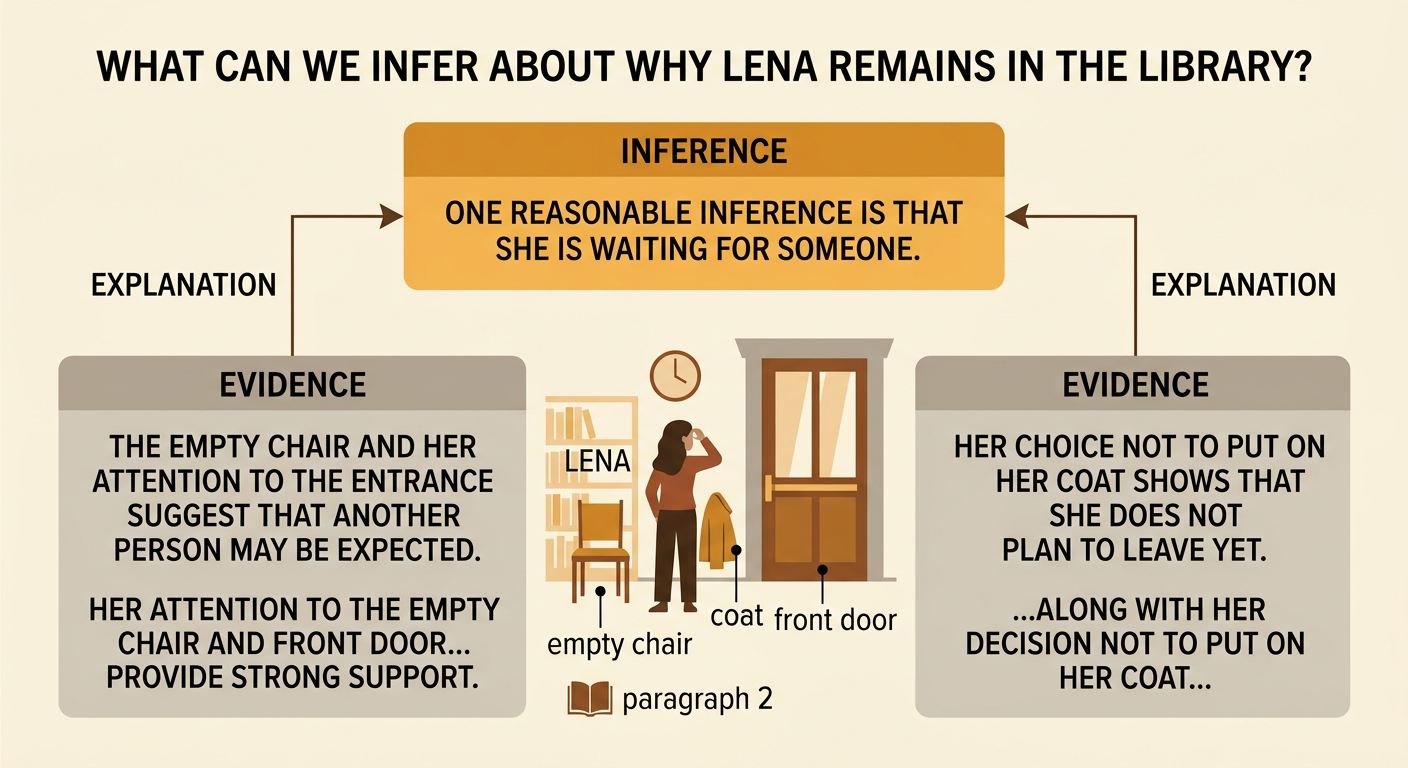
Read this new passage: “Rain tapped against the library windows as Lena stacked the last returned book. She glanced at the clock, then at the empty chair beside the entrance. Instead of putting on her coat, she opened her novel and sat where she could see the front door” (paragraph 2). What can you infer about why Lena remains in the library? One reasonable inference is that she is waiting for someone. The empty chair and her repeated attention to the entrance suggest that another person may be expected. Her decision not to put on her coat shows that she does not plan to leave yet. Write your own response with an inference, at least two accurately quoted details, and an explanation for each detail. Check that your evidence is relevant and that your reasoning stays grounded in the passage. Another inference may be valid if several details clearly support it.