
Civil Liberties and Public Health Emergencies
Students examine constitutional principles, court precedents, and public health evidence to evaluate how governments should balance individual rights with community safety during emergencies.
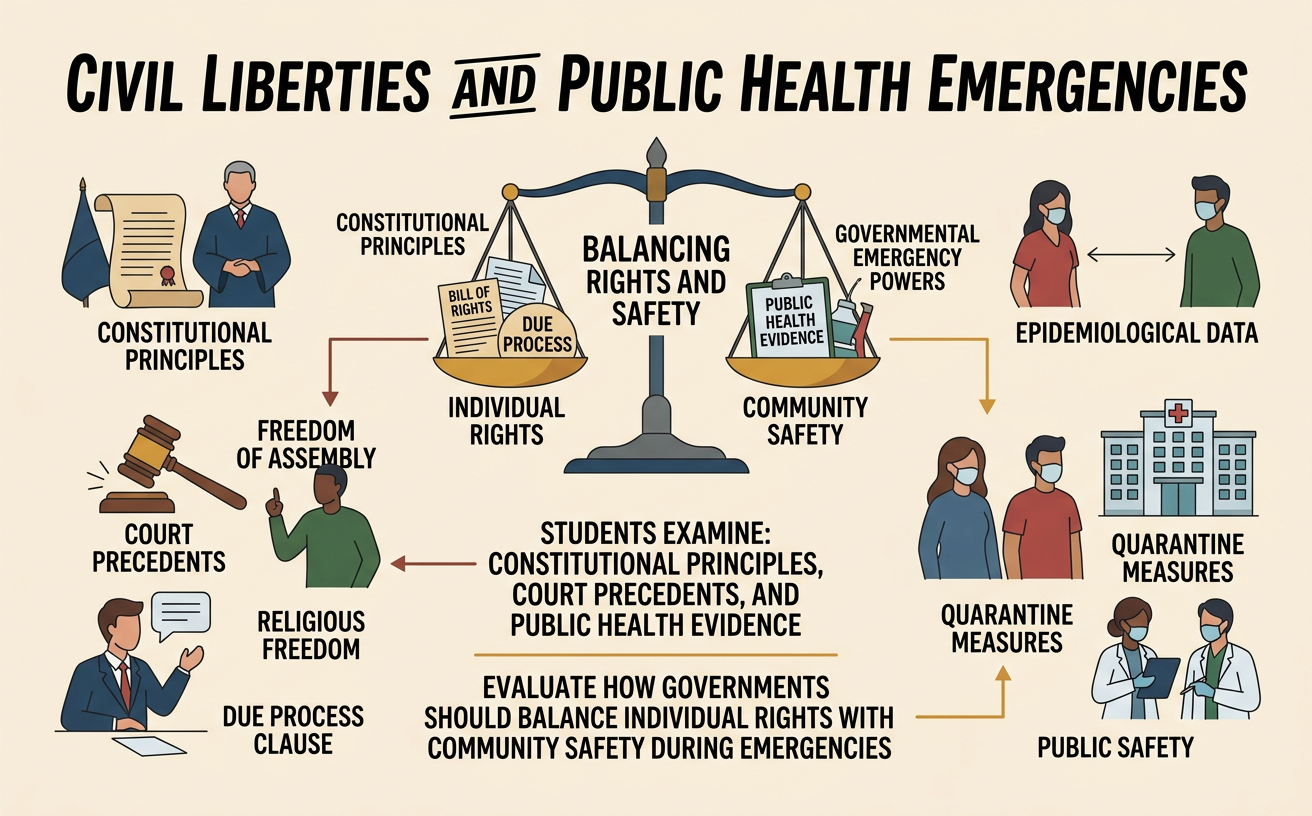
Illustrations are auto-generated and may be placeholders. They can be refreshed to match the narration.
Emergency Powers and Constitutional Rights
Public health emergencies may require rapid government action, but an emergency does not suspend the Constitution. States generally use their police powers to protect health and safety, while the federal government acts through powers granted by the Constitution and federal law. Restrictions on liberty must have legal authority, serve a legitimate public purpose, and comply with protections such as due process, equal protection, free exercise of religion, speech, and assembly. Courts may also consider whether a policy is narrowly tailored and whether less restrictive options are available. For example, a health department might order a person with confirmed exposure to a highly contagious disease to quarantine. Providing notice, scientific reasons, a limited duration, and an opportunity to challenge the order helps protect due process while addressing community risk.

Evidence from Laws and Court Decisions
Students should examine the exact language of constitutions, statutes, emergency orders, and judicial opinions rather than relying only on summaries. In Jacobson v. Massachusetts (1905), the Supreme Court upheld a smallpox vaccination law against a particular constitutional challenge, recognizing state authority to protect public health. The decision did not establish unlimited emergency power; it warned against regulations that are arbitrary or oppressive. More recent cases show that emergency rules can still violate constitutional protections. In Roman Catholic Diocese of Brooklyn v. Cuomo (2020), the Court blocked attendance limits that treated houses of worship more harshly than some comparable secular activities. When using a case, identify the facts, legal question, holding, and reasoning. Then quote or cite specific passages and explain how factual differences may limit the precedent’s application.

Public Health Data and Government Action
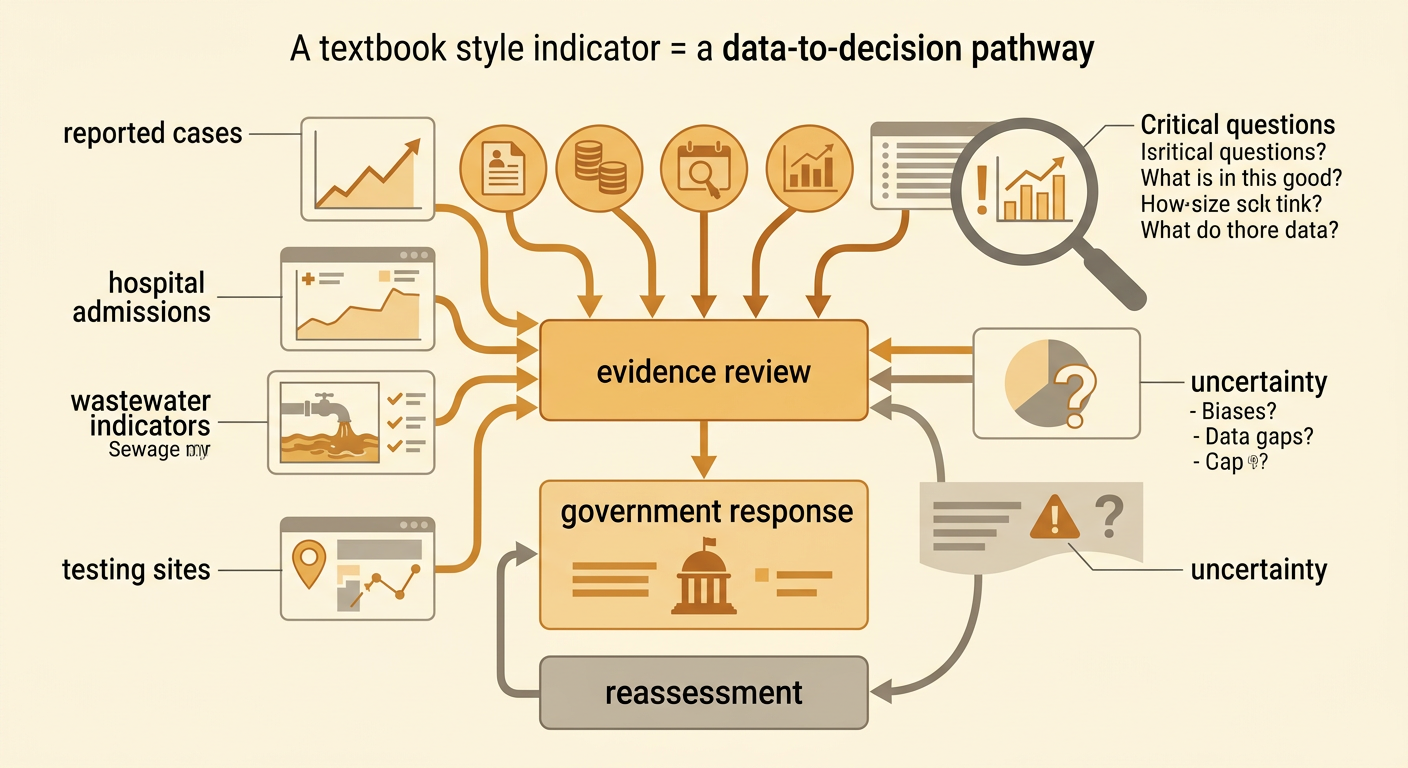
Public officials use evidence such as infection rates, hospitalization levels, deaths, laboratory results, vaccination coverage, and health care capacity to judge the severity of a threat. Reliable analysis asks who collected the data, how measurements were defined, whether reporting changed, and which groups may be missing. A rising number of reported cases may reflect greater transmission, increased testing, or both, so several indicators should be compared. Data should also be disaggregated when possible to reveal unequal effects by age, location, disability, occupation, or access to care. For example, a city detecting a sustained rise in wastewater indicators and hospital admissions might increase testing sites and issue targeted guidance before considering broader restrictions. Officials should publish the evidence, explain uncertainty, and regularly reassess whether the response remains necessary and effective.
Individual Liberty Versus Community Safety
Civil liberties protect personal choice, movement, privacy, religion, speech, and association, but exercising one person’s liberty can sometimes create risks for others. Democratic government must therefore distinguish personal preferences from actions that cause substantial public harm. Perspective matters: a business owner may emphasize economic survival, a medically vulnerable resident may emphasize protection, and a public official may emphasize hospital capacity and equal enforcement. Civic judgment requires taking each concern seriously without assuming that one interest automatically decides the issue. For example, temporarily isolating a person known to be infectious is more targeted than restricting an entire population regardless of exposure. A fair policy should connect the burden to documented risk, avoid discrimination, provide reasonable exceptions when possible, and use the least restrictive effective approach. Public participation can also reveal burdens that officials initially overlooked.

Evaluating Policy Trade-Offs
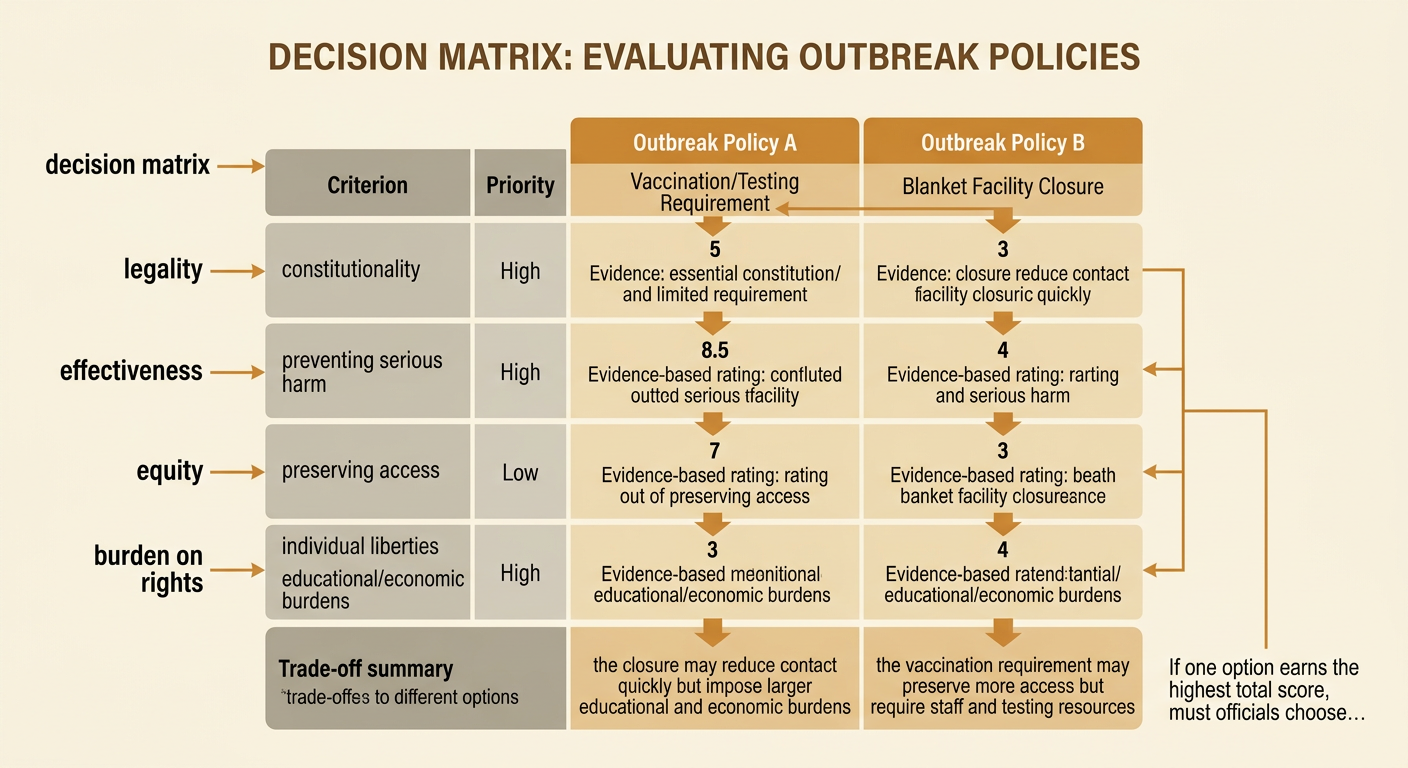
A public health policy is a proposed solution to a complex problem, so it should be evaluated using clear, prioritized criteria. Useful criteria include legality, likely effectiveness, equity, feasibility, cost, transparency, duration, and the burden placed on rights. Because no option performs best on every measure, decision makers must explain trade-offs. Students can create a decision matrix, assign greater weight to essential criteria such as constitutionality and prevention of serious harm, and score each option using cited evidence. For example, during an outbreak, a vaccination requirement with a testing alternative may be compared with a blanket facility closure. The first option could preserve more access but require administrative resources; the second might reduce contact quickly but create larger educational or economic burdens. Scores do not make the decision automatically. They organize reasoning and expose assumptions for public review.
Evidence-Based Civic Judgment
Evidence-based civic judgment combines constitutional analysis, public health evidence, and awareness of competing perspectives. Begin with a focused question, such as whether a temporary school exclusion during a measles outbreak is justified. Gather primary sources, including the policy text, relevant law, agency data, and court opinions, along with credible secondary analysis. Then make a claim, cite specific evidence, explain the connection between the evidence and the claim, and address a serious counterargument. A strong recommendation might support a temporary exclusion for students who lack documented immunity after verified exposure while requiring notice, educational access, medical exceptions, an appeal process, and frequent review. The judgment should also state what new evidence would justify changing or ending the policy. Democratic accountability improves when officials publish reasons, invite public comment, apply rules consistently, and allow independent legal review.
