Classify Two-Dimensional Figures
Students classify triangles and quadrilaterals by identifying parallel or perpendicular lines and types of angles.

Illustrations are auto-generated and may be placeholders. They can be refreshed to match the narration.
Review Lines and Angles
Lines and angles help us describe shapes precisely. A line segment is a straight part of a line with two endpoints. Parallel lines stay the same distance apart and never meet, even if they continue forever. Perpendicular lines cross to make four right angles. A right angle measures 90 degrees. An acute angle is smaller than a right angle, while an obtuse angle is larger than a right angle but smaller than a straight angle. For example, on a street map, two straight east-west roads may be parallel. A north-south road crossing one of them can be perpendicular, making a right angle at the intersection. Look for arrow marks that show parallel lines and small square marks that show right angles.

Identify Shape Attributes
A shape can be classified by attributes, which are features that stay true when the shape is turned, moved, or resized. First count its straight sides and vertices. Then examine each angle and decide whether it is acute, right, or obtuse. Finally, check whether any sides are parallel or perpendicular. Marks on a drawing provide reliable evidence: matching arrow marks indicate parallel sides, and a small corner square indicates a right angle. For example, a rectangle that is 8 units long and 3 units wide has four sides, four vertices, two pairs of parallel sides, and four right angles. Each pair of neighboring sides is perpendicular. These attributes remain true even if the rectangle is tilted.

Classify Triangles
Triangles have three sides, three vertices, and three angles. They can be classified by the sizes of their angles. An acute triangle has three acute angles. A right triangle has exactly one right angle, so right triangles form a special category of triangles. An obtuse triangle has exactly one obtuse angle. Because the three angle measures total 180 degrees, a triangle cannot have more than one right or obtuse angle. Also, a triangle has no parallel sides because every pair of its sides meets at a vertex. For example, a triangle with side lengths of 3, 4, and 5 units is a right triangle. Its 3-unit and 4-unit sides are perpendicular and form its 90-degree angle.

Classify Quadrilaterals
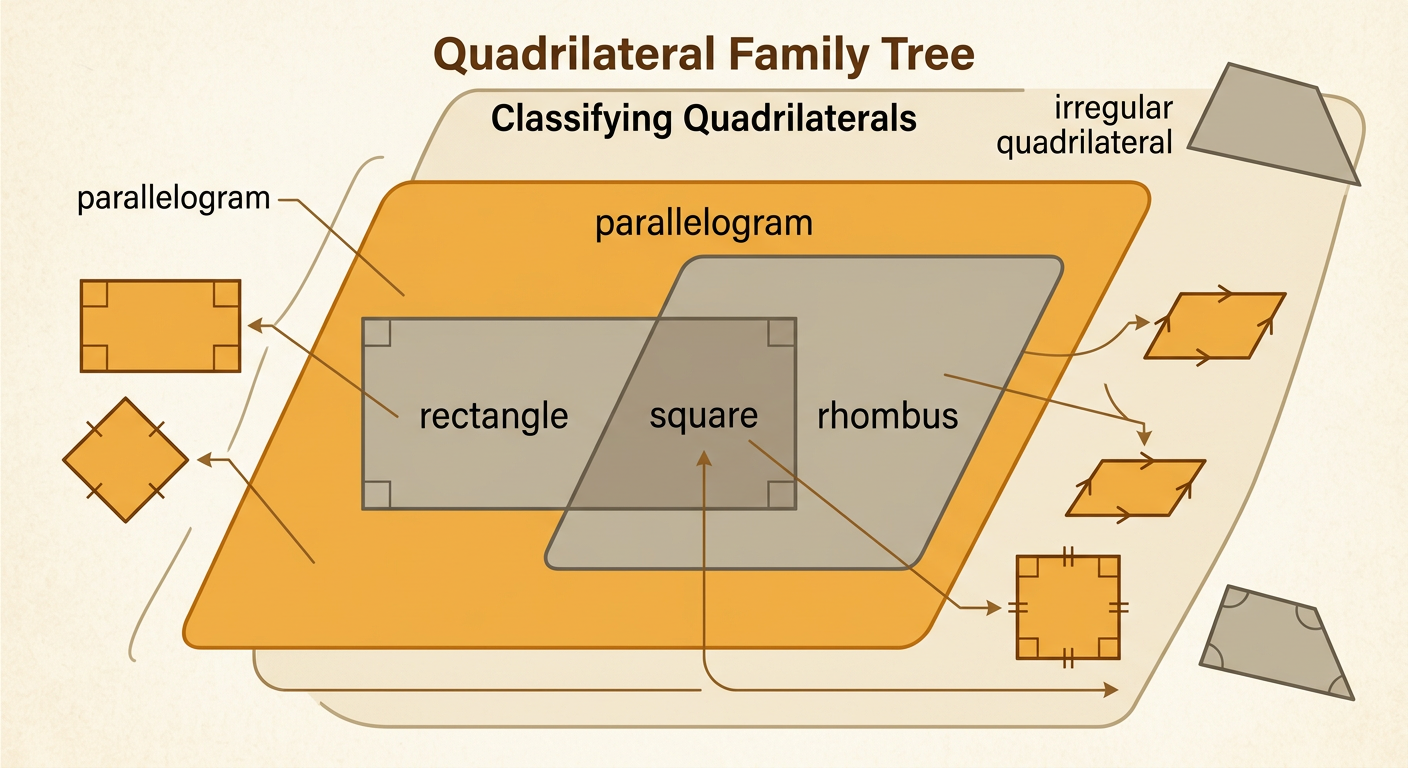
A quadrilateral is any polygon with four sides and four angles. Its line and angle attributes can place it in more than one category. A parallelogram has two pairs of parallel opposite sides. A rectangle is a parallelogram with four right angles, so neighboring sides are perpendicular. A rhombus is a parallelogram with four equal sides, but its angles do not have to be right angles. A square has four equal sides and four right angles. Therefore, every square is also a rectangle, a rhombus, and a parallelogram. For example, a square with 4-unit sides has two pairs of parallel sides and four pairs of perpendicular neighboring sides. An irregular quadrilateral, however, may have no parallel sides and no right angles.
Explain Each Classification
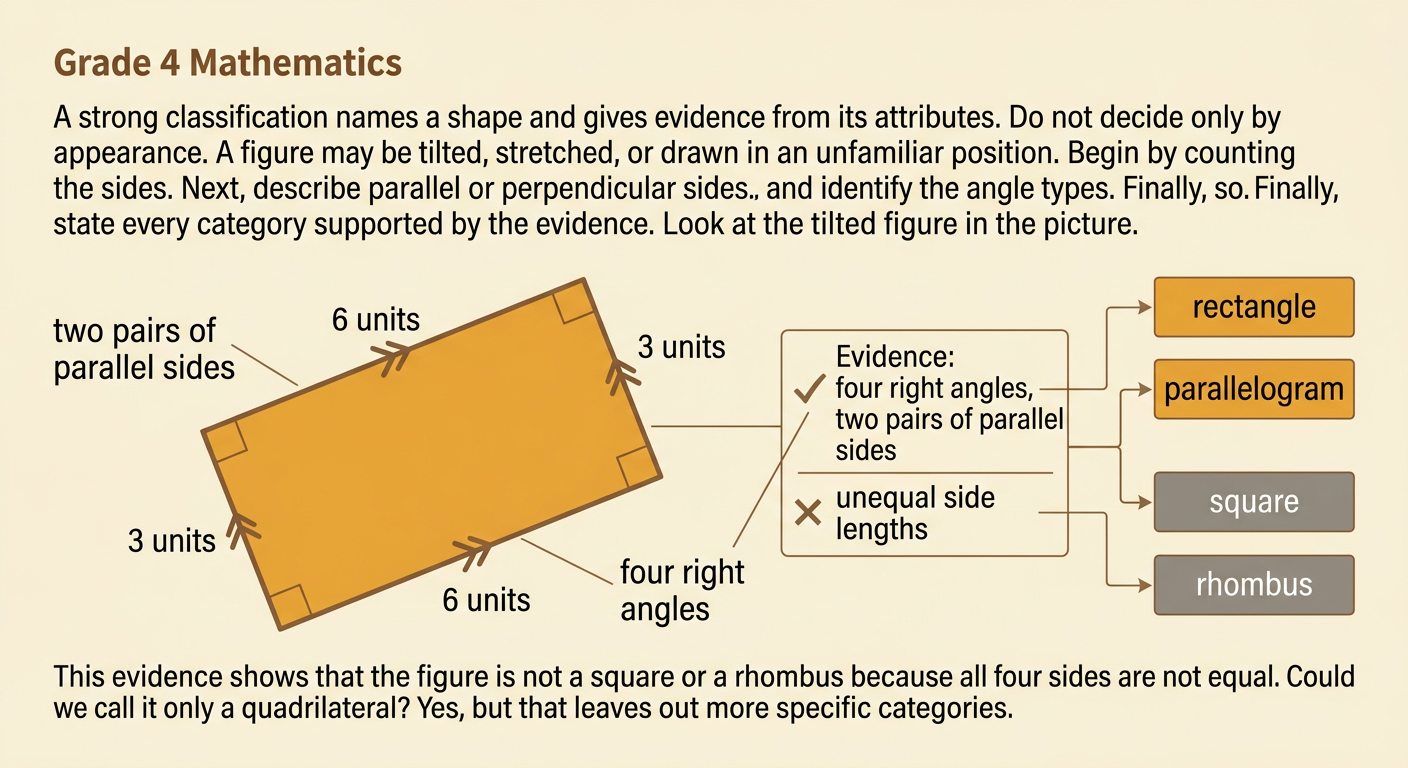
A strong classification names the shape and gives evidence from its attributes. Do not decide only by how a figure looks, because a shape may be turned or drawn in an unfamiliar way. Begin with the number of sides. Next, describe parallel or perpendicular sides and the types of angles. Then state every category that the evidence supports. Suppose a quadrilateral has opposite sides measuring 6 units and 3 units, two pairs of parallel sides, and four right angles. It is a rectangle because it has four right angles. It is also a parallelogram because both pairs of opposite sides are parallel. It is not a square or rhombus because its four sides are not equal. Each statement connects a classification to a specific attribute.