
Classifying Chemical Reactions and Predicting Products
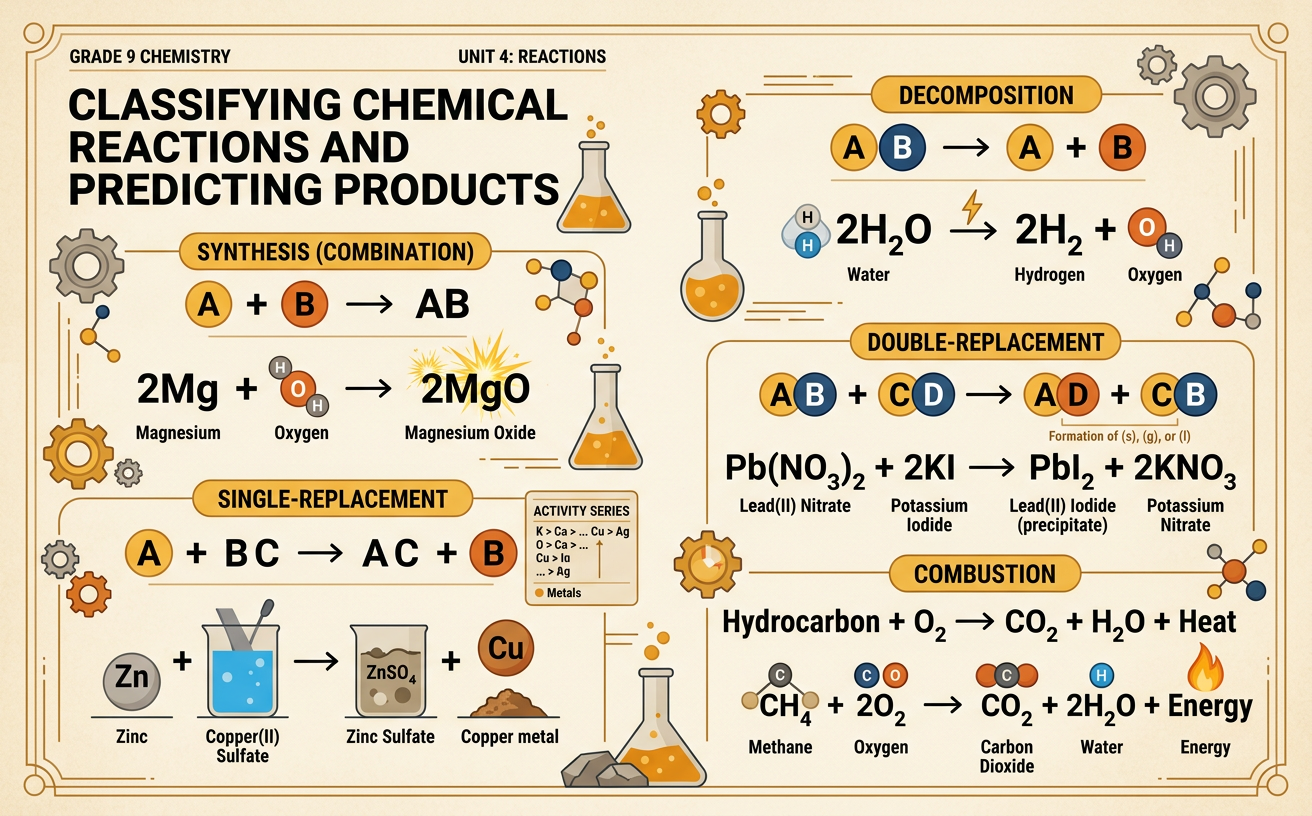
Students identify synthesis, decomposition, single-replacement, double-replacement, and combustion reactions and use their patterns to predict likely products.
Illustrations are auto-generated and may be placeholders. They can be refreshed to match the narration.
Reactants, Products, and Reaction Patterns
A chemical equation describes how reactants change into products. Reactants appear to the left of the arrow, and products appear to the right. In 2H₂ + O₂ → 2H₂O, hydrogen and oxygen are reactants, while water is the product. The arrow means “yields” or “produces.” Subscripts show the number of atoms in one particle, while coefficients show the number of particles or moles. Because atoms are rearranged rather than created or destroyed, a balanced equation has the same number of each type of atom on both sides. Chemists classify reactions by looking for structural patterns in how substances separate, combine, or exchange parts. Recognizing these patterns helps identify a reaction type and predict likely products, although experimental evidence is needed to confirm that a reaction occurs.

Synthesis and Decomposition
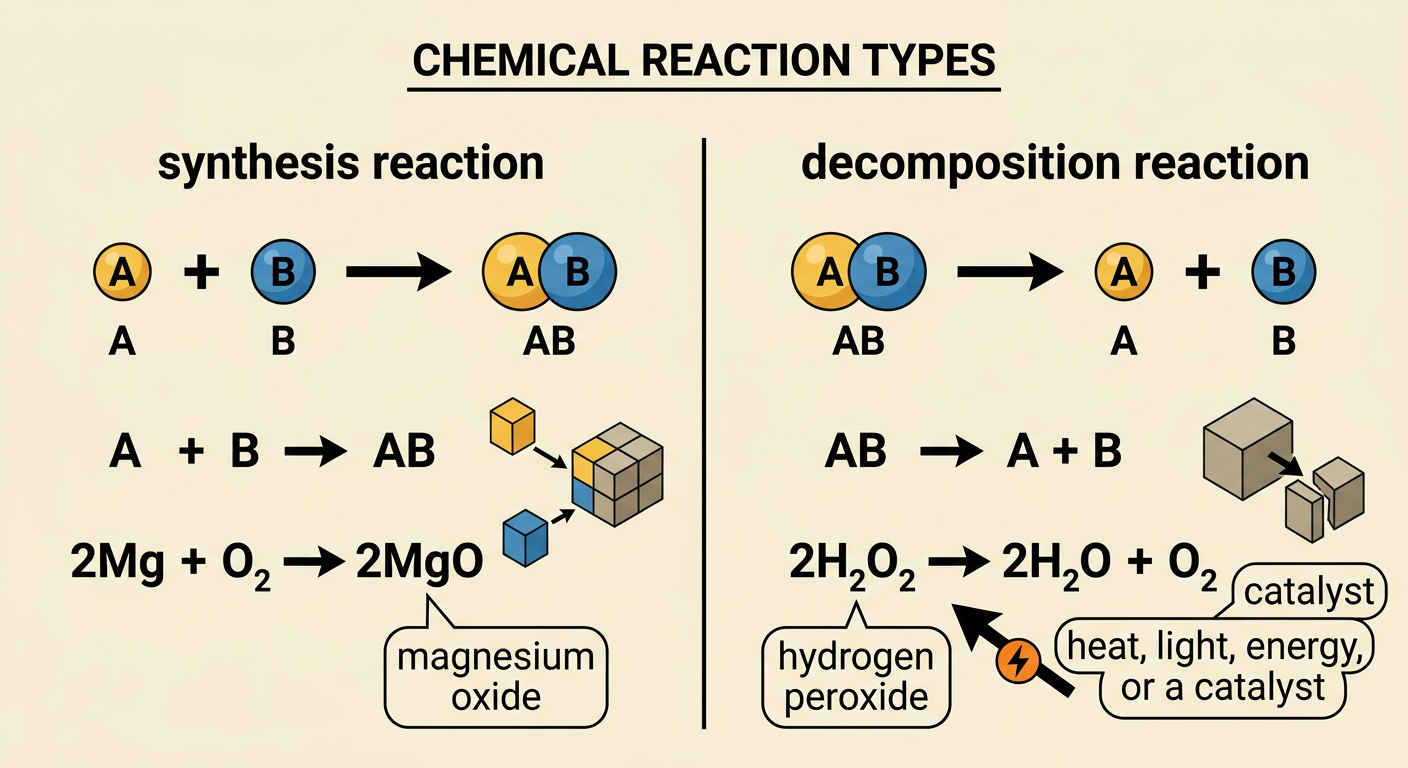
In a synthesis reaction, two or more reactants combine to form one product. Its general pattern is A + B → AB. For example, 2Mg + O₂ → 2MgO shows magnesium and oxygen combining to make magnesium oxide. In a decomposition reaction, one compound breaks into two or more simpler products. Its general pattern is AB → A + B. For example, 2H₂O₂ → 2H₂O + O₂ shows hydrogen peroxide decomposing into water and oxygen gas. Energy, heat, light, or a catalyst may be needed for some decomposition reactions. The number of substances provides an important clue: synthesis usually has multiple reactants and one product, while decomposition has one reactant and multiple products. Always balance the equation after identifying the likely products.
Single- and Double-Replacement Reactions
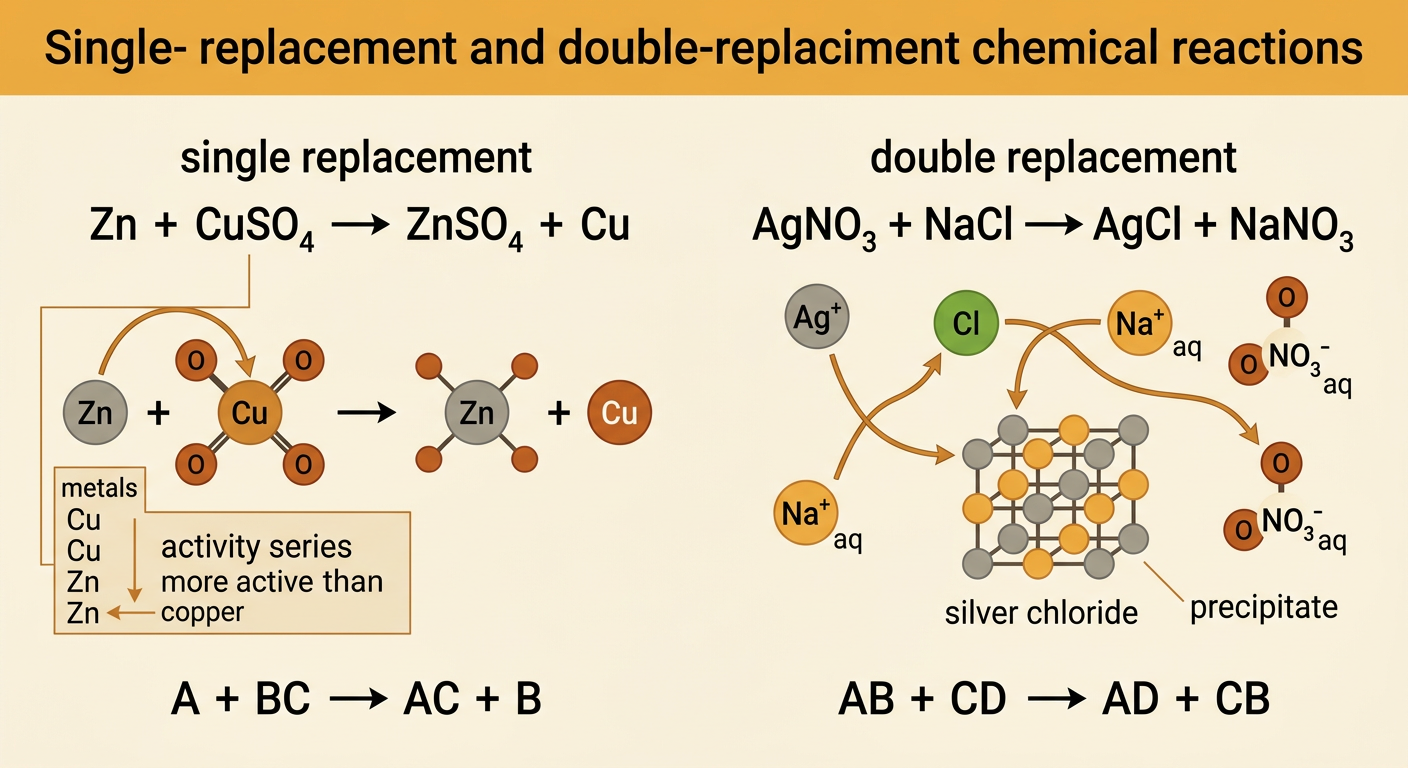
A single-replacement reaction occurs when one element replaces a similar element in a compound. Its pattern is A + BC → AC + B. For example, Zn + CuSO₄ → ZnSO₄ + Cu occurs because zinc is more active than copper and can replace it. An activity series helps determine whether a metal replacement will happen. A double-replacement reaction occurs when ions in two compounds exchange partners, following AB + CD → AD + CB. For example, AgNO₃ + NaCl → AgCl + NaNO₃ produces solid silver chloride. Double replacement usually occurs in water and is driven by the formation of a precipitate, gas, or molecular substance such as water. Ionic charges must be used to write correct product formulas; subscripts are not simply carried across unchanged.
Combustion Reactions
Combustion is a reaction in which a substance reacts rapidly with oxygen and releases energy, often as heat and light. When a hydrocarbon burns completely, the pattern is hydrocarbon + O₂ → CO₂ + H₂O. For example, propane undergoes complete combustion according to C₃H₈ + 5O₂ → 3CO₂ + 4H₂O. Carbon atoms become part of carbon dioxide, and hydrogen atoms become part of water. The coefficients are chosen so the numbers of carbon, hydrogen, and oxygen atoms are equal on both sides. If oxygen is limited, incomplete combustion may produce carbon monoxide or solid carbon instead of only carbon dioxide. Therefore, predicting CO₂ and H₂O assumes complete combustion with sufficient oxygen. Combustion is identified by oxygen as a reactant and characteristic oxygen-containing products.

Predicting Products from Patterns
To predict products, first identify the reactant types and match them to a reaction pattern. Next, rearrange the elements or ions according to that pattern. Use ion charges to write neutral compound formulas, remember that some elements occur as diatomic molecules, and then balance the equation with coefficients. Finally, check whether the proposed reaction is chemically likely by using an activity series, solubility rules, or combustion conditions. For example, CaCl₂ + Na₂CO₃ fits a double-replacement pattern. Exchanging ions gives CaCO₃ and NaCl. Calcium ions have a 2+ charge and carbonate ions have a 2− charge, so the formula is CaCO₃. Because calcium carbonate is insoluble, it forms a precipitate. The balanced prediction is CaCl₂ + Na₂CO₃ → CaCO₃ + 2NaCl.

Classifying Practice Reactions
Classify each equation by comparing its structure with the five reaction patterns. In 2Na + Cl₂ → 2NaCl, two reactants form one product, so the reaction is synthesis. In CaCO₃ → CaO + CO₂, one compound forms two products, so it is decomposition. Zn + 2HCl → ZnCl₂ + H₂ is single replacement because zinc replaces hydrogen. BaCl₂ + Na₂SO₄ → BaSO₄ + 2NaCl is double replacement because the ions exchange partners and a precipitate forms. CH₄ + 2O₂ → CO₂ + 2H₂O is combustion because a hydrocarbon reacts with oxygen. A strong classification claim names the type, cites the arrangement of reactants and products as evidence, and explains how that arrangement matches the general pattern. Physical appearance alone is not enough to classify a reaction.
