
Classifying Rational and Irrational Numbers
Students distinguish rational numbers from irrational numbers by examining fractions, square roots, and decimal expansions.

Illustrations are auto-generated and may be placeholders. They can be refreshed to match the narration.
Reviewing Rational Numbers
A rational number is any number that can be written as a fraction a/b, where a and b are integers and b is not zero. Fractions such as 3/5 and -7/4 are rational by definition. Integers are also rational because each integer can be placed over 1. For example, -2 equals -2/1, and 0 equals 0/1. A terminating decimal is rational because it can be converted to a fraction with a power of 10 as the denominator. For example, 0.75 equals 75/100, which simplifies to 3/4. Different forms can therefore represent the same rational number. When classifying a number, ask whether it can be expressed as a ratio of two integers.

Recognizing Decimal Expansion Patterns
Every rational number has a decimal expansion that either terminates or repeats. A terminating decimal ends after a finite number of digits. For example, dividing 5 by 8 gives 0.625, so 5/8 is rational. A repeating decimal has a digit or block of digits that continues in the same pattern forever. For example, 2/11 equals 0.181818..., in which the block 18 repeats. This happens because long division has only a limited number of possible remainders. Eventually, the remainder becomes zero, producing a terminating decimal, or a previous remainder returns, causing the digits to repeat. Thus, both terminating decimals and repeating decimals can be written as fractions and are rational.

Identifying Irrational Numbers
An irrational number cannot be written as a ratio of two integers. Its decimal expansion continues forever without terminating and without repeating a fixed block of digits. One important example is the square root of 2. Its decimal begins 1.414213562..., but no final digit or repeating block occurs. The digits shown are only an approximation because the full decimal never ends. The number pi is another irrational number, beginning 3.141592653.... A long decimal is not automatically irrational; it might eventually repeat. To identify an irrational decimal, the expansion must be known to continue without becoming periodic. Irrational numbers still have exact values, even when their decimal forms must be rounded for calculations.

Classifying Square Roots
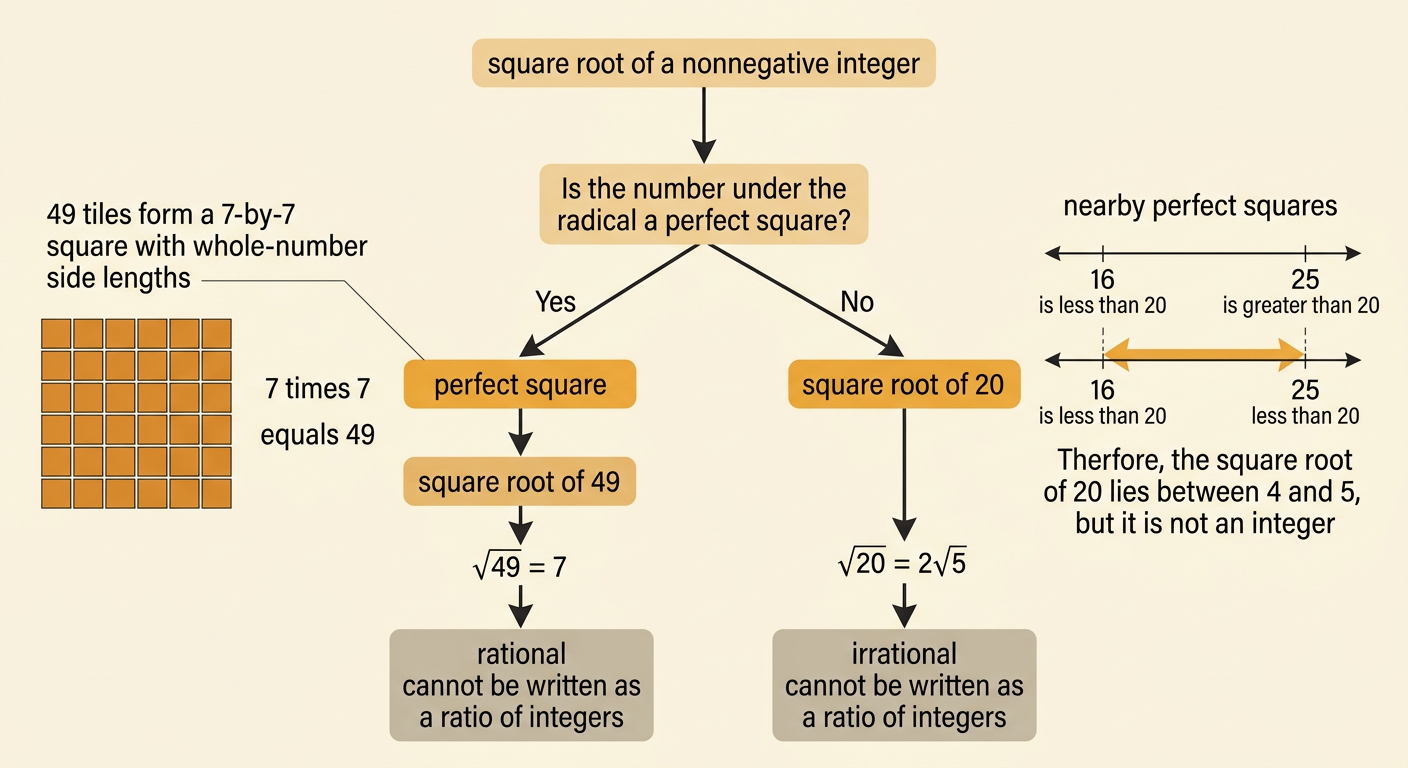
To classify the square root of a nonnegative integer, first determine whether the integer is a perfect square. A perfect square is the product of an integer multiplied by itself. For example, 49 is a perfect square because 7 times 7 equals 49. Therefore, the square root of 49 is 7, which is rational. In contrast, 20 is not a perfect square. Its square root can be simplified to 2 times the square root of 5, but it cannot be written as a ratio of integers, so it is irrational. For nonnegative integers, the square root is rational exactly when the number under the radical is a perfect square. Estimating between nearby perfect squares can help check the classification.
Explaining Classification Decisions
A strong classification includes both an answer and evidence. For -3.2, explain that the decimal terminates and equals -32/10, or -16/5, so it is rational. For 0.272727..., identify the repeating block 27; the number equals 27/99, or 3/11, so it is rational. The square root of 81 is rational because it equals the integer 9. The square root of 7 is irrational because 7 is not a perfect square. A decimal such as 0.101001000100001... is irrational when the stated pattern continues with increasing groups of zeros. It neither terminates nor eventually repeats one fixed block. Always name the relevant feature: a fraction form, a terminating decimal, a repeating pattern, or a nonrepeating, nonterminating expansion.
