
Coal, Industry, and Social Change in the Industrial Revolution
Students analyze historical and scientific evidence to explain how coal resources and geographic conditions shaped industrialization, urban growth, labor, and environmental change.
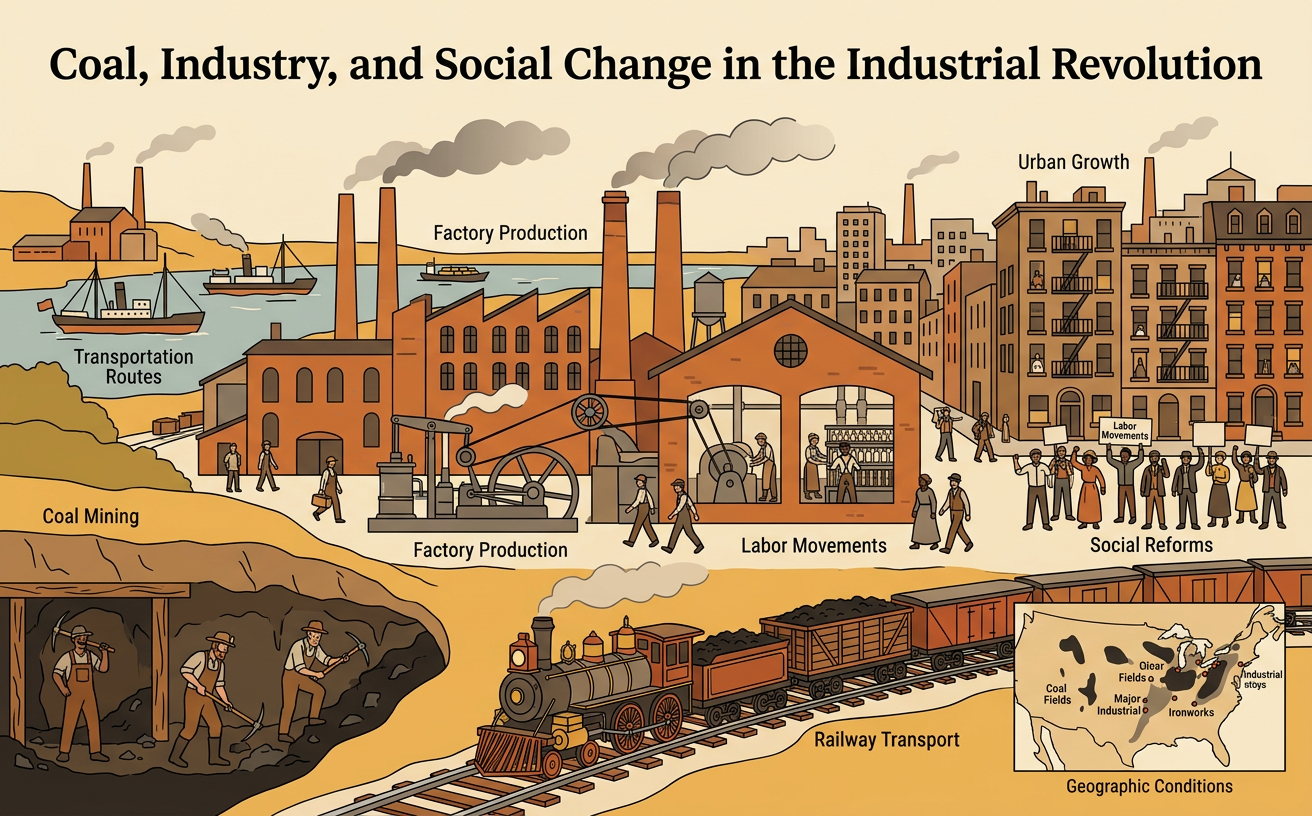
Illustrations are auto-generated and may be placeholders. They can be refreshed to match the narration.
Industrialization in Context
The Industrial Revolution was a long transformation from hand production toward machine-powered manufacturing. It began in Britain in the late 1700s and spread unevenly to parts of Europe, the United States, and elsewhere during the 1800s. Earlier developments created favorable conditions: agricultural improvements increased food supplies, population growth expanded markets and labor forces, and trade provided raw materials and investment capital. Political institutions, transportation networks, technical knowledge, and Britain’s access to coal also mattered. No single cause explains industrialization. Instead, resources and human decisions interacted within a particular time and place. For example, British textile manufacturers used inventions such as the spinning jenny and water frame to produce cotton thread faster. Steam power later allowed larger factories to operate beyond fast-flowing rivers, strengthening the factory system and changing where and how people worked.

Why Coal and Geography Mattered
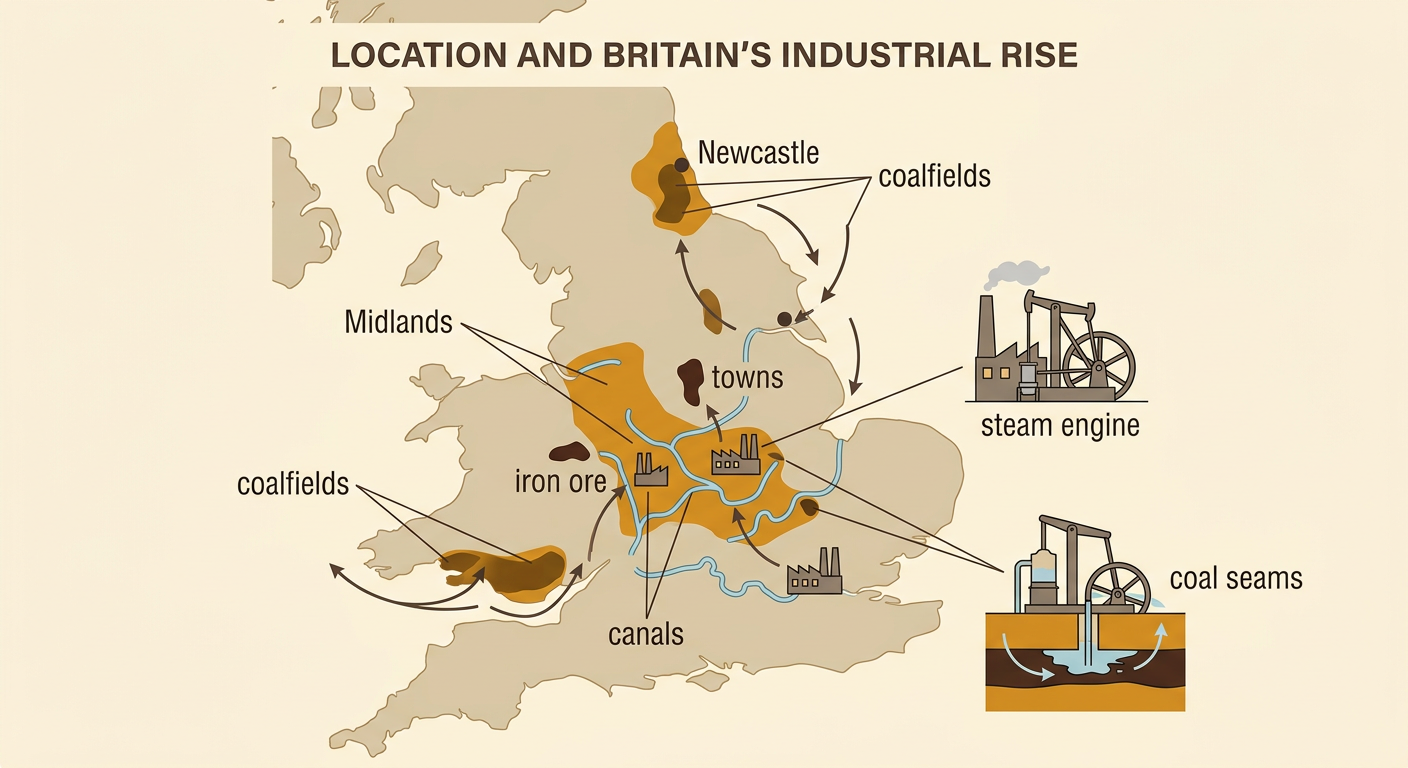
Coal supplied concentrated energy for steam engines, iron production, and factory machinery. Britain had large coalfields, including deposits near Newcastle, South Wales, and the Midlands. Many mines were reasonably close to rivers, canals, ports, growing cities, and manufacturing centers, which reduced transportation costs. Coal did not create industry by itself; engineers, investors, workers, laws, and markets helped determine how the resource was used. Geography also affected which places industrialized first. In the English Midlands, coal and iron ore were available near towns connected by canals. Manufacturers could bring fuel and raw materials to ironworks and ship heavy products to buyers. James Watt’s improved steam engine, developed in the eighteenth century, used coal-derived steam energy more efficiently than many earlier engines. Steam pumps also removed water from mines, helping miners reach deeper coal seams.
Analyzing Historical Evidence
Historians build explanations by comparing primary sources from the period with later secondary interpretations. A factory report, worker testimony, newspaper, map, or census can provide specific evidence, but every source has limits. Students should identify the creator, date, audience, purpose, and historical context before drawing conclusions. They should also quote or describe exact details rather than making unsupported claims. For example, testimony from a child worker to a British parliamentary commission might describe long hours and dangerous machinery. That account offers direct evidence about one worker’s experience, while factory records could reveal schedules or wages. A modern historian may connect these details to wider labor patterns. Agreement among different sources strengthens a conclusion, while disagreement invites further investigation. A source may be useful even if it is biased, because its language can reveal the interests and assumptions of its creator.

Urban and Labor Changes
Industrialization encouraged rapid urban growth because factories, mines, railways, and workshops concentrated jobs in particular places. Many people moved from rural communities to industrial towns, while natural population growth also increased city size. Manchester, England, expanded as a cotton-manufacturing center during the nineteenth century. Its mills attracted workers and stimulated construction, trade, and transportation. Growth often moved faster than housing, sanitation, and public services. Working-class families commonly lived in crowded neighborhoods, although experiences varied by city, occupation, age, gender, and decade. Factory labor also changed daily life. Employers organized work by the clock, divided production into specialized tasks, and enforced workplace rules. Women and children formed important parts of some industrial workforces and were often paid less than adult men. Workers responded through mutual-aid groups, unions, petitions, strikes, and campaigns for laws that gradually limited some abuses.

Environmental Consequences
Coal-powered industrialization changed air, water, land, and human health. Burning coal released soot, sulfur compounds, carbon dioxide, and other pollutants. In industrial cities, smoke darkened buildings and contributed to respiratory illness, although pollution levels and medical understanding varied over time. Mines altered landscapes through shafts, waste piles, and land disturbance. Mine drainage and factory waste could contaminate rivers used for drinking or industry. Coal combustion also transferred carbon stored underground into the atmosphere as carbon dioxide, a greenhouse gas. Over many decades, increasing fossil-fuel use contributed to modern climate change. For example, nineteenth-century Manchester became known for smoky air produced by numerous coal-burning mills and homes. An evidence-based environmental explanation should connect a resource to an activity and a measurable effect: abundant coal supported combustion, combustion emitted pollutants, and concentrated emissions degraded urban air quality. Benefits such as greater production came with environmental costs.

Evidence-Based Exit Response
Write a short claim-evidence-reasoning response to this question: How did coal resources and geographic conditions shape industrialization and social change in Britain? Begin with a defensible claim that recognizes multiple causes. Then cite at least two specific pieces of evidence from lesson sources, such as the location of coalfields near canals and cities, the use of coal in steam engines, Manchester’s factory growth, worker testimony, or records of urban pollution. Explain how each detail supports the claim instead of merely listing facts. Include historical context by noting relevant conditions such as expanding markets, available labor, investment, or new technology. A strong response might argue that accessible coal accelerated industrial growth where transportation networks connected mines to factories, which then encouraged urban migration and increased pollution. Finish by acknowledging a limit or qualification: coal was highly influential, but resources alone did not guarantee industrialization without technology, capital, workers, and markets.
