
Collision Engineering: Applying Newton’s Third Law
Students analyze force pairs in collisions and use evidence to propose a design that reduces damage during an impact.
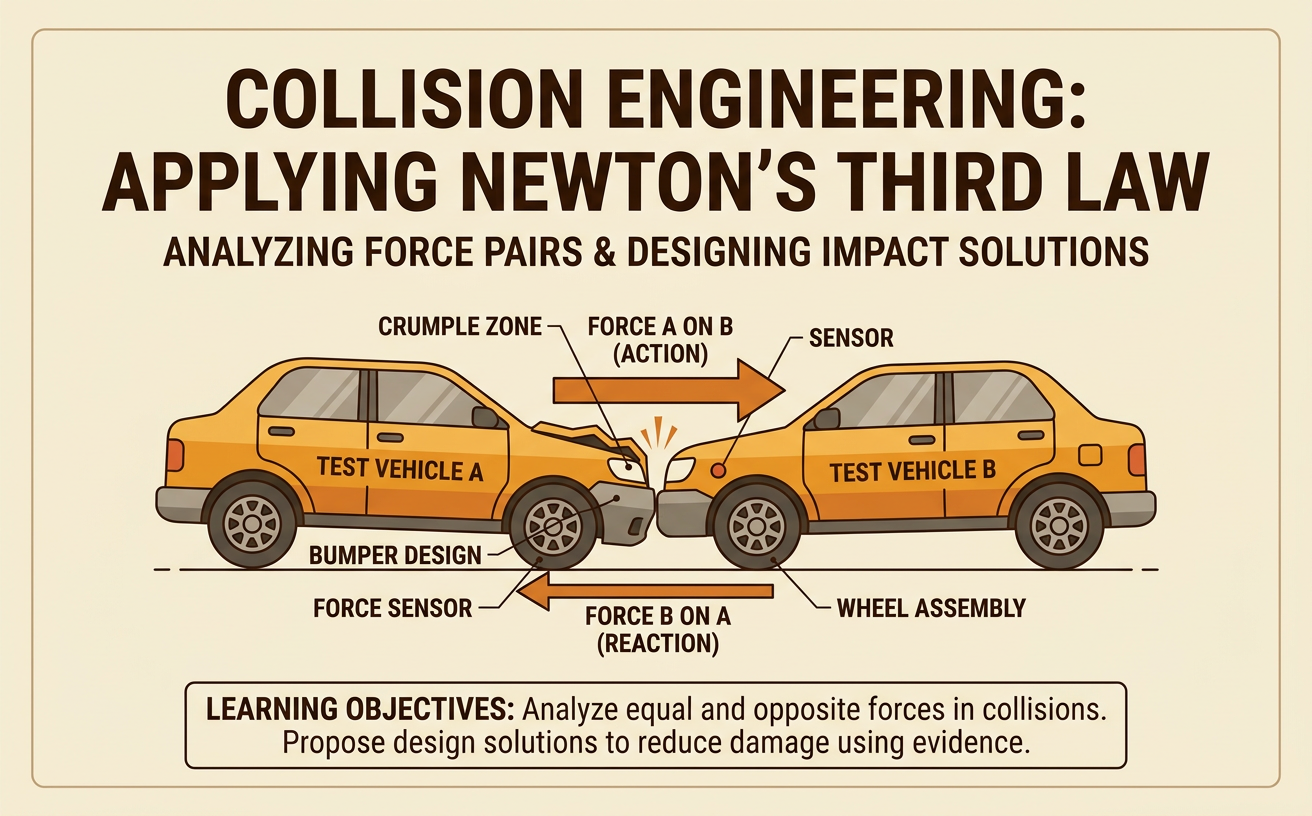
Illustrations are auto-generated and may be placeholders. They can be refreshed to match the narration.
What Happens During a Collision?
A collision occurs when two objects touch and exert forces on each other for a short time. During contact, the objects may bend, compress, slow down, speed up, or change direction. According to Newton’s Third Law, each object pushes on the other with a force that is equal in size and opposite in direction. For example, when a moving cart strikes a stationary cart, the moving cart pushes the stationary cart forward. At the same time, the stationary cart pushes the moving cart backward with an equal force. These forces do not cancel because they act on different objects. The motion of each cart may change differently depending on its mass, starting velocity, and the length of the collision. Careful observations of these changes help engineers understand and reduce collision damage.

Identifying Action-Reaction Force Pairs
To identify a Newton’s Third Law force pair, name both interacting objects and state what each object does to the other. The force of object A on object B is paired with the force of object B on object A. For example, when a baseball bat hits a ball, the bat pushes the ball forward while the ball pushes the bat backward. The forces are equal in magnitude, opposite in direction, and present during the same interaction. They act on different objects, so they should not be added as if they act on one object. The ball’s weight and the bat’s force on the ball are not a Third Law pair because both forces act on the ball and come from different interactions. Naming the objects clearly prevents this common mistake.

Comparing Force and Motion Data
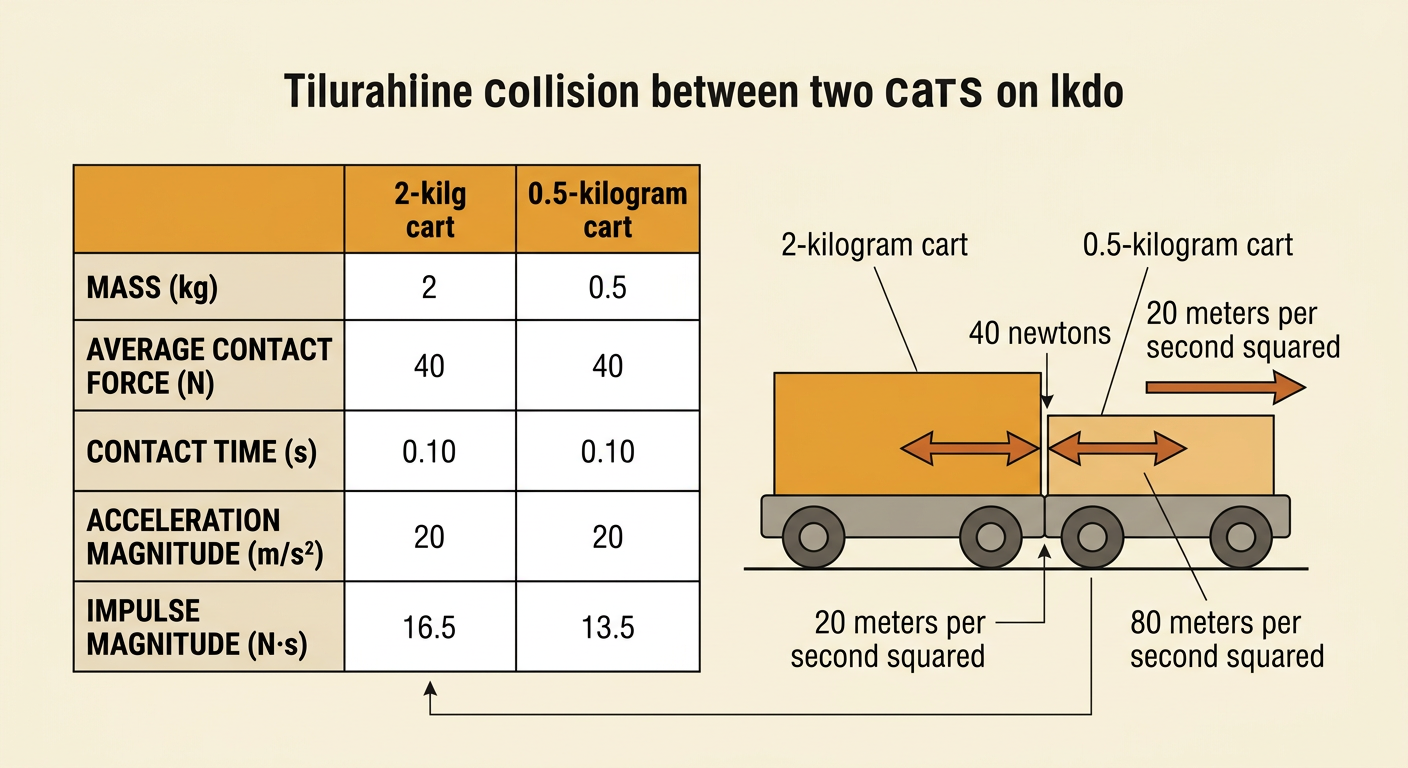
Force measurements can be compared with mass and motion data to explain why colliding objects respond differently. Suppose a 2-kilogram cart and a 0.5-kilogram cart exert average contact forces of 40 newtons on each other. Their forces are equal and opposite, but their accelerations are not equal. Using acceleration equals force divided by mass, the 2-kilogram cart has an acceleration magnitude of 20 meters per second squared. The 0.5-kilogram cart has an acceleration magnitude of 80 meters per second squared. If the contact lasts 0.10 second, each cart receives an impulse magnitude of 4 newton-seconds in opposite directions. However, the lighter cart undergoes a greater change in velocity because it has less mass. Engineers use graphs, tables, and repeated trials to connect force data with observed changes in motion.
Designing an Impact-Reducing Solution
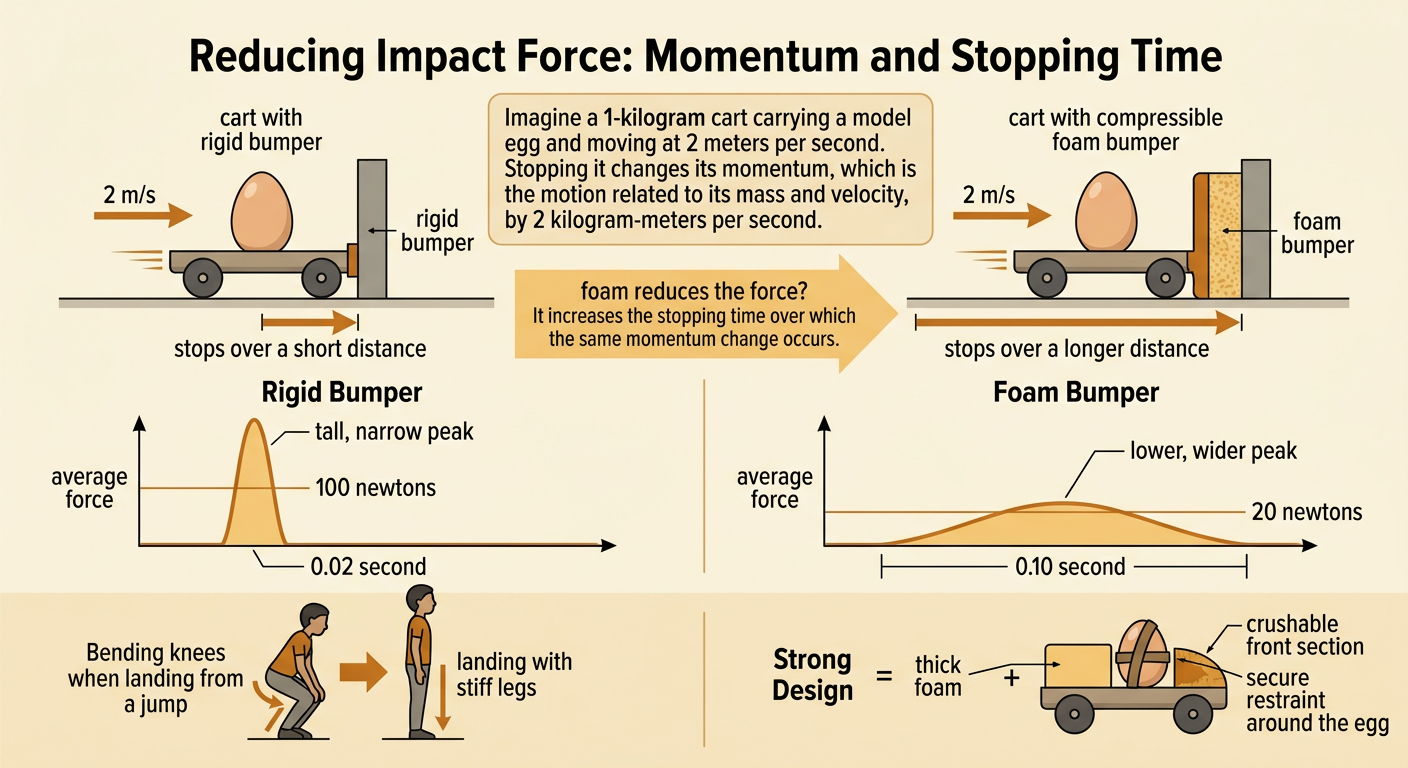
Engineers can reduce collision damage by increasing the time over which an object stops. Consider a 1-kilogram cart carrying a model egg and moving at 2 meters per second. Stopping the cart changes its momentum by 2 kilogram-meters per second. If a rigid bumper stops it in 0.02 second, the average force is about 100 newtons. If a foam bumper compresses and increases the stopping time to 0.10 second, the average force falls to about 20 newtons. A proposed design could combine a thick foam bumper, a crushable front section, and a secure restraint for the egg. The bumper must be attached firmly and cannot block the wheels. Engineers should test several materials while keeping the cart mass and starting speed consistent. They must also consider cost, size, durability, and whether the design can be reused.
Defending the Design with Evidence
A strong design argument includes a claim, specific evidence, scientific reasoning, and an honest discussion of limitations. A team might claim that a layered foam bumper best protects a model egg. As evidence, the team could report that three baseline trials produced an average peak force of 120 newtons, while three foam-bumper trials averaged 45 newtons at the same starting speed. The reasoning should explain that the foam increased stopping time, reducing peak force while the cart and barrier still exerted equal and opposite forces on each other. The team should also recognize strengths and limitations. The design is lightweight and inexpensive, but the foam may wear out, measurements may contain error, and results from model carts may not apply directly to full-sized vehicles. A fair recommendation compares alternatives and identifies additional testing needed before a final decision.
