Collision Theory: Explaining and Controlling Reaction Rates
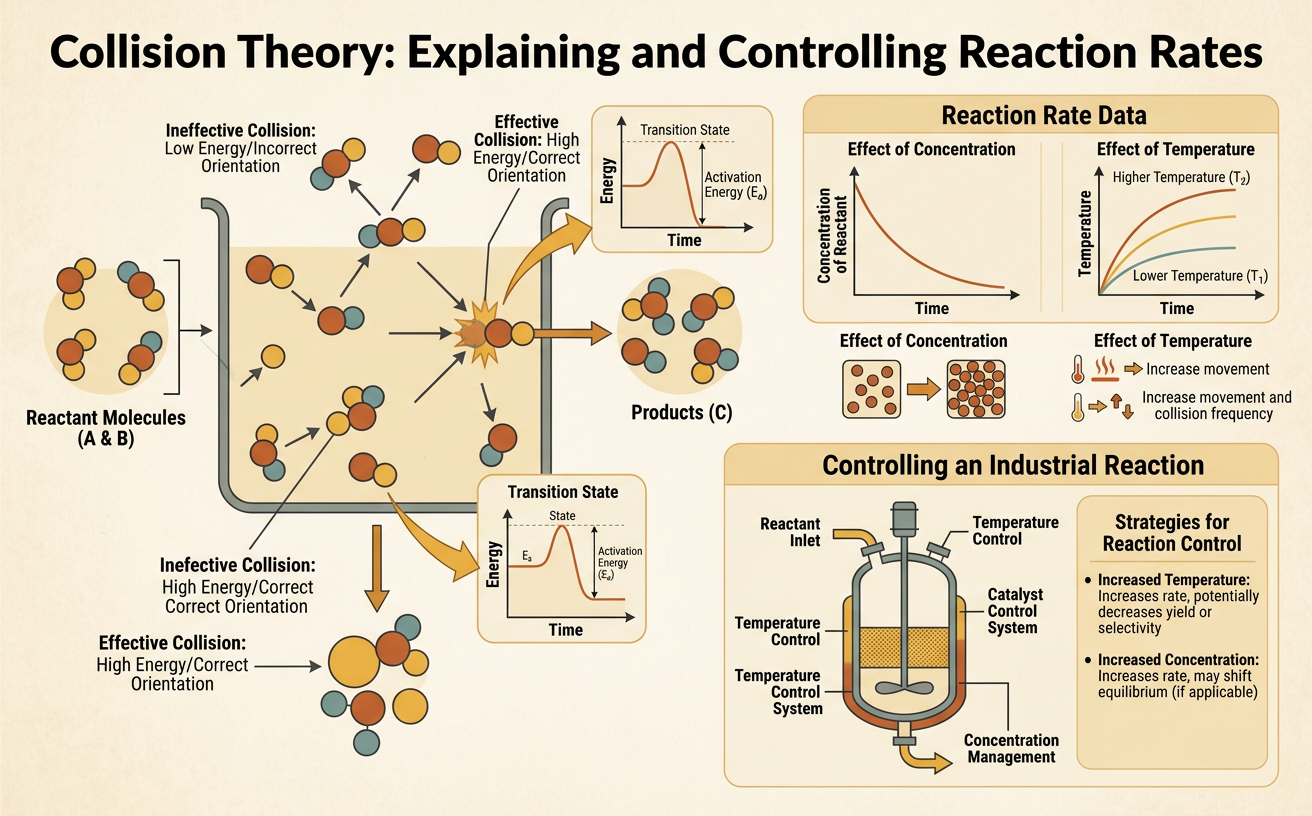
Students use particle-level models and reaction-rate data to explain how temperature and concentration affect chemical reactions and evaluate a practical strategy for controlling an industrial reaction.
Illustrations are auto-generated and may be placeholders. They can be refreshed to match the narration.
Reaction Rates in Everyday and Industrial Processes
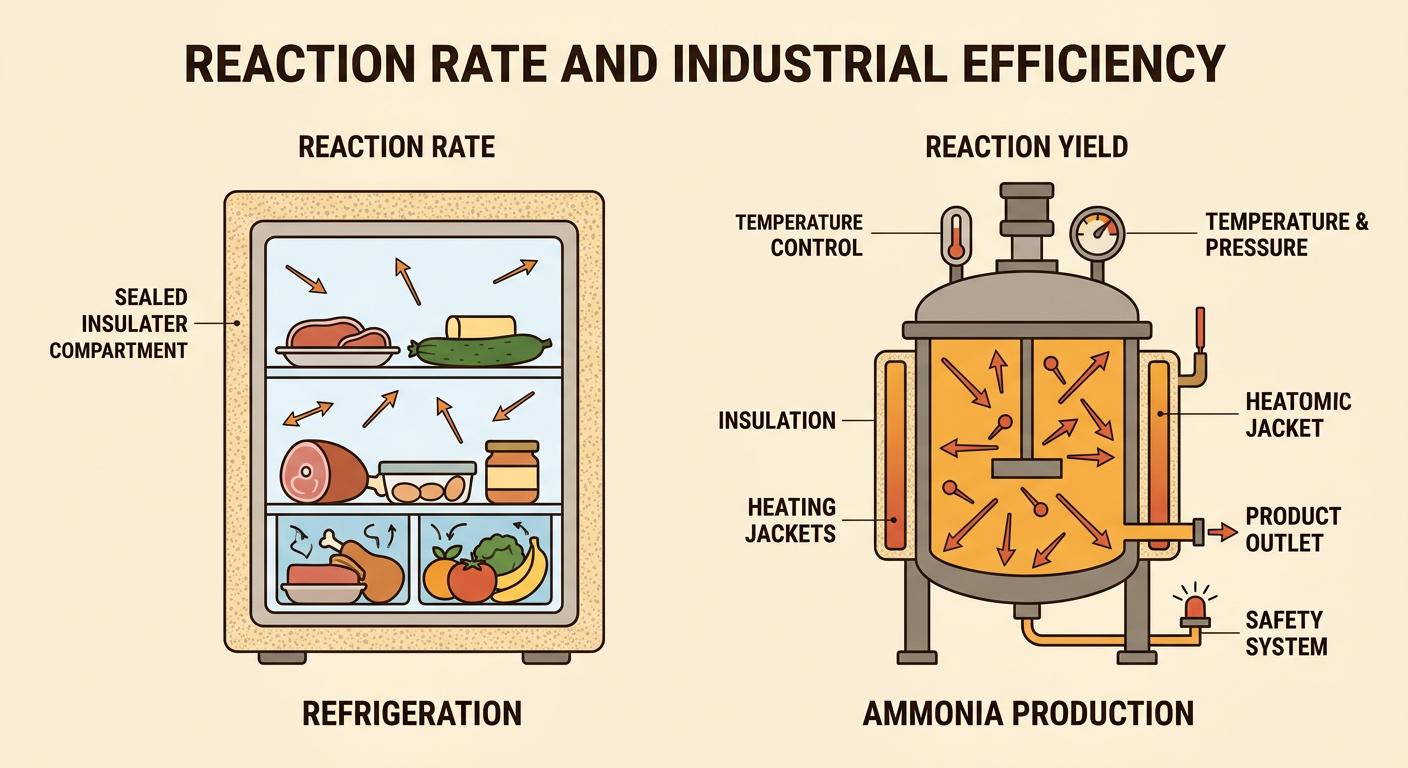
A reaction rate describes how quickly reactants are consumed or products are formed. It can be measured as a change in concentration, mass, gas volume, or another observable quantity per unit time. Reaction rates matter because some reactions need to be accelerated, while others must be slowed for safety or product quality. Refrigeration slows food-spoilage reactions by lowering temperature. In industry, carefully controlled conditions help manufacturers produce useful chemicals efficiently without overheating equipment. For example, during ammonia production, nitrogen and hydrogen must react fast enough for economical operation, but high pressures and temperatures increase energy costs and safety risks. Engineers therefore compare reaction-rate evidence with practical constraints before selecting operating conditions. Reaction rate is not the same as reaction yield: rate describes how fast change occurs, while yield describes how much product is ultimately obtained.
Collision Theory at the Particle Level
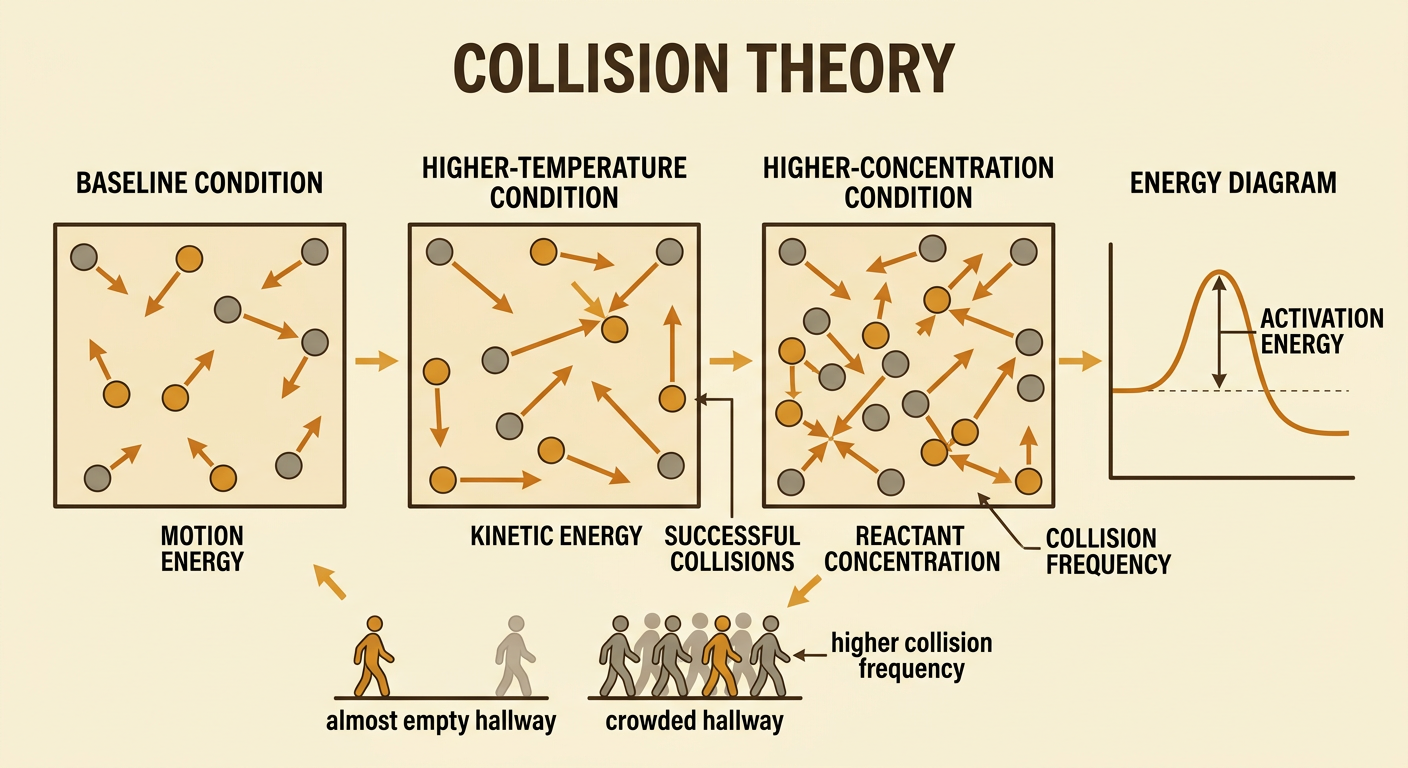
Collision theory explains reaction rate by focusing on interactions among particles. Reactant particles must collide before their atoms can rearrange, but not every collision produces a reaction. A collision is successful only if the particles have enough kinetic energy to overcome the activation-energy barrier and approach with a suitable orientation. Increasing temperature raises the particles’ average kinetic energy. Collisions then occur more frequently, and a larger fraction of them have enough energy to react. Increasing reactant concentration places more particles in the same volume, producing more collisions per second. For example, magnesium ribbon reacts faster in concentrated hydrochloric acid than in dilute hydrochloric acid because more acid particles are available near the magnesium surface. Concentration mainly changes collision frequency, whereas temperature changes both collision frequency and the fraction of collisions exceeding activation energy.
Interpreting Temperature and Concentration Data
Reaction-rate claims should be supported with quantitative evidence collected while other variables are controlled. Suppose a reaction has an initial rate of 1.2 millimoles per liter per second at 20°C and 3.0 millimoles per liter per second at 40°C, with concentration held constant. The higher rate supports the claim that increasing temperature speeds the reaction. In a second trial at 20°C, increasing a reactant concentration from 0.10 molar to 0.20 molar raises the rate from 1.2 to 2.4 millimoles per liter per second. This proportional change suggests first-order behavior for that reactant over the tested range, but it does not prove that the pattern applies at every concentration. Students should connect the numerical trends to particle models: faster particles explain the temperature result, while more particles per volume explain the concentration result.
Modeling Successful Molecular Collisions
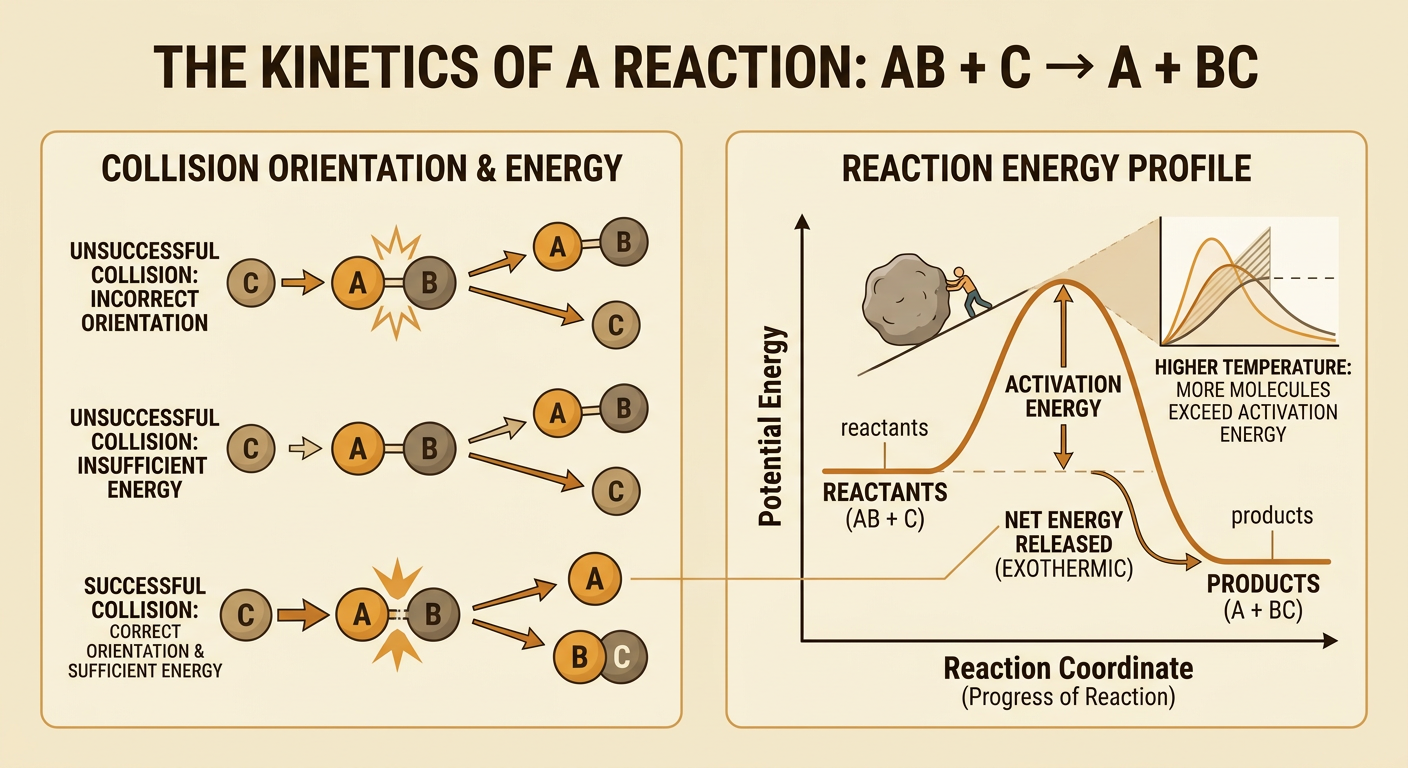
A particle model can distinguish unsuccessful collisions from successful ones. Imagine a reaction between molecules AB and C that forms A and BC. If C strikes the A end of AB, the orientation may not place C near the atom with which it must bond, so the particles separate unchanged. If C strikes the B end with enough kinetic energy, the AB bond can weaken while a BC bond forms. Even a correctly oriented collision fails when its energy is below the activation energy. An energy profile represents this requirement as a barrier between reactants and products. At higher temperature, the barrier itself does not become lower; instead, a larger fraction of molecules has energy equal to or greater than the barrier. This model explains why a warmer sample usually contains more successful collisions per second.
Evaluating a Reaction-Control Strategy
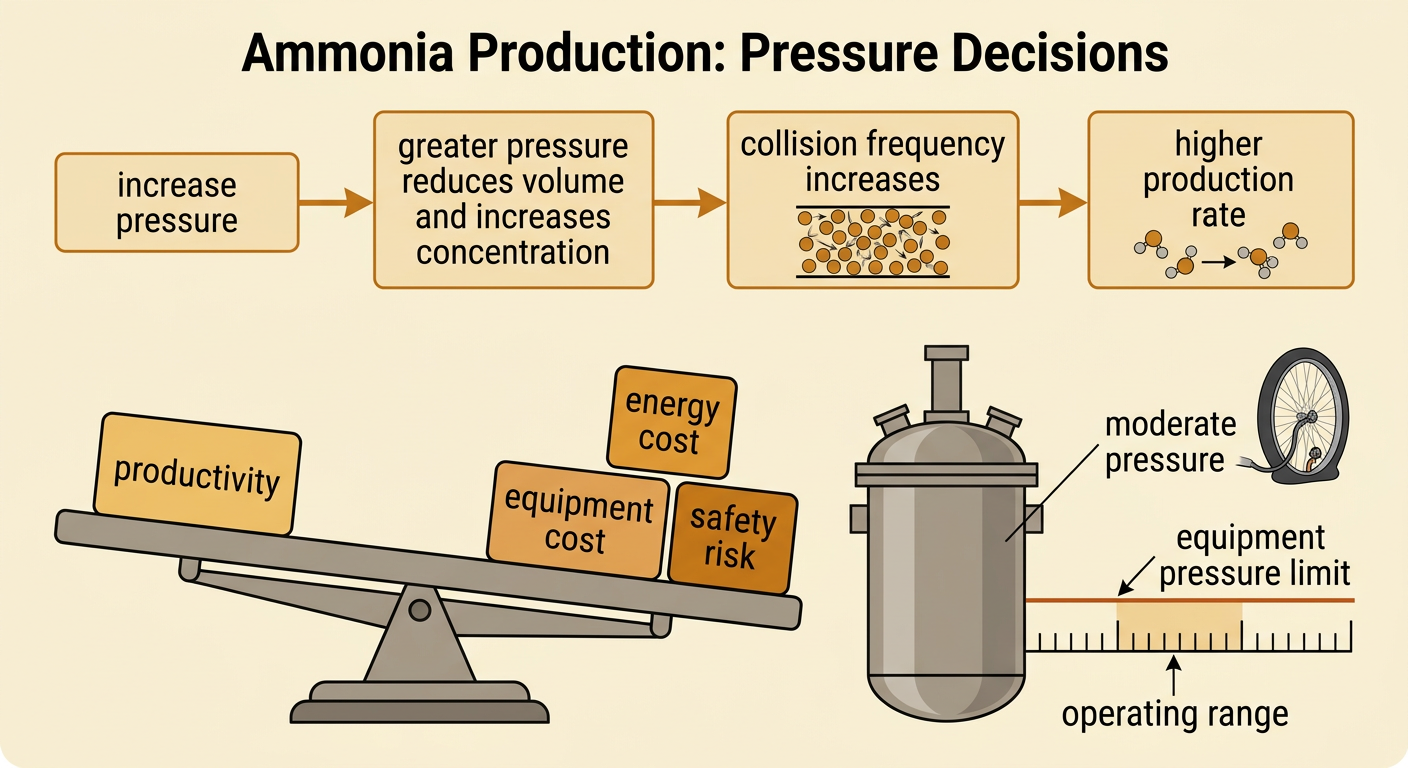
Consider a proposal to increase pressure in an ammonia plant so nitrogen and hydrogen react faster. For gases, greater pressure at constant temperature reduces volume and increases reactant concentration. Collision theory therefore predicts more collisions per second, and plant data showing a higher ammonia production rate would support the proposal. A reasonable claim is that a moderate pressure increase can improve productivity if equipment limits are respected. However, the argument must also consider counterclaims and limitations. Compressing gases requires energy, high-pressure equipment is expensive, and leaks or equipment failure create safety hazards. Reaction-rate data alone also do not establish total yield, long-term catalyst performance, or economic benefit. Engineers should integrate particle models, measured production rates, energy-use records, maintenance evidence, and safety assessments. The best strategy is not necessarily the condition with the fastest rate, but the condition that balances productivity, cost, and risk.